
- Governor Newsom’s 2019–20 budget anticipates continued revenue growth.
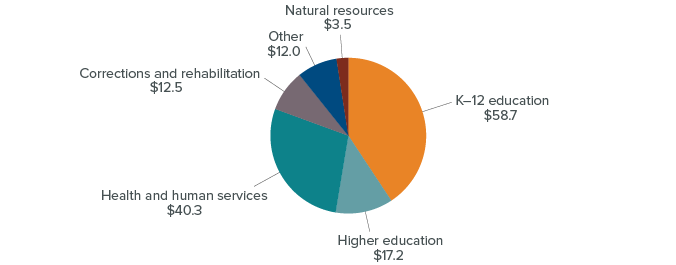
On January 10, Governor Newsom submitted his proposed 2019–20 budget to the legislature. The $209.1 billion spending plan includes $144.2 billion from the state’s General Fund, $59.5 billion from special funds, and $5.4 billion in bond funds. Looking forward, the budget assumes economic growth will slow, projecting revenue increases of about 3% per year for the next three years.
Education makes up the majority of General Fund expenditures
SOURCE: Governor’s Proposed Budget, California Department of Finance, January 10, 2019.
NOTES: Dollar amounts presented in billions. The “other” category includes transportation, environmental protection, labor and workforce development, and other agencies.
- Maintaining budget reserves and managing debt remain priorities.
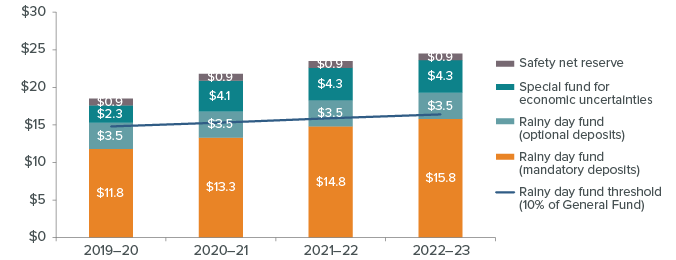
The governor’s budget makes the constitutionally required transfer of $1.8 billion into the state’s rainy day fund, for a total fund balance of $15.3 billion in 2019–20. For discretionary reserves, the budget allocates $2.3 billion to the special fund for economic uncertainties and adds $700 million to the safety net reserve to protect Medi-Cal and CalWORKs during an economic downturn. The plan proposes $3 billion in additional one-time funds to CalPERS and CalSTRS, the state’s largest public pension funds, to pay down unfunded liabilities—while allocating $4.1 billion to pay off budgetary debts and prior deferral payments.
Total reserves are projected to rise well above the rainy day fund threshold
SOURCE: Governor’s Proposed Budget, California Department of Finance, January 10, 2019.
NOTES: Dollar amounts presented in billions. According to Proposition 2, once the rainy day fund reaches 10% of General Fund taxes, any additional funds are required to be spent on infrastructure. In addition to the constitutionally required amounts, the legislature has made two optional deposits into the rainy day fund (2016–17 and 2018–19). Recently, the Office of the Legislative Counsel has concluded that any optional deposits made into the rainy day fund do not count toward the 10% threshold.
- The budget includes new spending to address the state’s housing crisis.
The governor proposes linking transportation funding to local housing targets, while also allocating $1.3 billion in one-time funds to spur low- and moderate-income housing production via local government grants and developer loans. The plan includes $500 million for local governments to build emergency shelters, navigation centers, and supportive housing for the state’s homeless population. The budget proposes streamlining the California Environmental Quality Act (CEQA) to expedite such construction. - All education levels receive significant funding increases.
The budget includes a large investment in early childhood education and child care, with $1.25 billion in one-time funds for facilities and workforce training, and $422 million to expand access to preschool. The Local Control Funding Formula would receive $2 billion in additional funding for 2019–20, with a larger share designated for special education than in previous years. Community colleges are slated to receive an increase of $367 million, with $40 million to support a second year of free tuition for first-time students. The University of California would receive a $240 million increase, plus $138 million in one-time funds for deferred maintenance, while California State University would see a $300 million increase, with $247 million in one-time funds for deferred maintenance. Finally, student aid funding would rise by $289 million. - The proposal would expand health and human services programs.
The spending plan proposes $260 million to expand Medi-Cal coverage to eligible young adults ages 19–25 regardless of immigration status. By establishing a state tax penalty for not having health insurance coverage, the proposal would increase subsidies in the state-run health insurance marketplace for currently eligible Californians and introduce new subsidies for moderate-income residents. The plan also proposes increasing CalWORKs grant amounts for the lowest-income residents and growing the size of the state’s Earned Income Tax Credit (CalEITC) from $400 million to $1 billion. The plan proposes conformity with the most recent federal tax law changes to generate funds for the tax credit expansion. - Additional funding would target wildfires and support clean drinking water.
The governor’s plan includes $415 million to address forest health and to prevent and fight wildfires, as well as $172 million to improve the state’s emergency response communications. The governor also proposes a new fund to increase access to safe drinking water through fees imposed on water customers, fertilizer purchasers, and dairy producers.
Related Content
2018
California’s State Budget: The Enacted 2018-19 Budget, 2018
California’s State Budget: The Governor’s Proposal, 2018
2017
California’s State Budget: The Enacted 2017-18 Budget, 2017
California’s State Budget: The Governor’s Proposal, 2017
2016
California’s State Budget: The Enacted 2016-17 Budget, 2016
California’s State Budget: The Governor’s Proposal, 2016
2015
California’s State Budget: The Enacted 2015-16 Budget, 2015
California’s State Budget: The Governor’s Proposal, 2015
2014
California’s State Budget: The Enacted 2014-15 Budget, 2014
California’s State Budget: The Governor’s Proposal, 2014
2013
California’s State Budget: The Enacted 2013-14 Budget, 2013
California’s State Budget: The Governor’s Proposal, 2013
2012
California’s State Budget: The Governor’s Proposal, 2012
California’s State Budget: The May Revision, 2012
California’s State Budget: The Enacted 2012-13 Budget
California’s State Budget: Impact of the November Election, 2012
2011
California’s State Budget: The Governor’s Proposal, 2011
California’s State Budget: The Governor’s May Revision, 2011
California’s State Budget: The Enacted Budget, 2011
Topics
Political Landscape