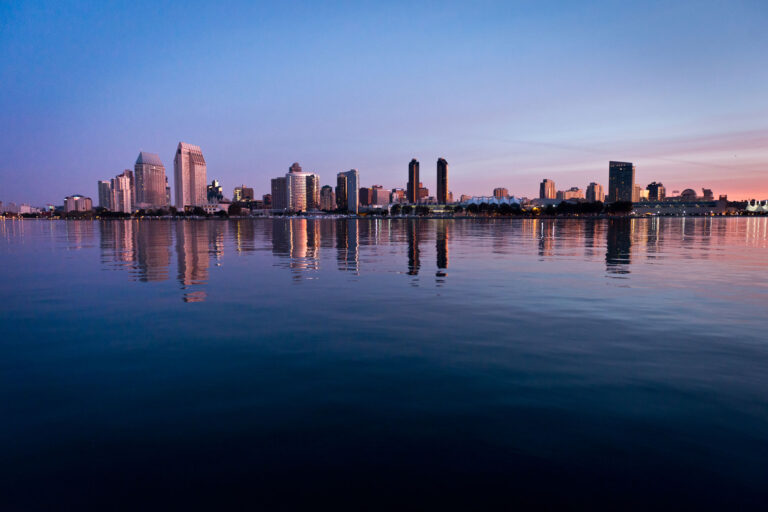

Water agencies all over California are experiencing water affordability and cost increase challenges. We spoke with Dan Denham, general manager of San Diego County Water Authority, to learn how his agency is working to keep prices affordable for its customers.
How much of a concern is water affordability for the San Diego County Water Authority?

It is a topline issue. It’s not new: water affordability is something we’ve always had to deal with. But there’s an enhanced focus on affordability now, because rates have been outpacing income growth for most residents in San Diego County and elsewhere.
It’s coming to the forefront because a couple of things have happened. First, demand is hardening, which means our customers can’t reduce water use too much more. And the customer base is flattening, if not declining, over time, so we’re selling less water with the same—or higher—fixed costs. Since water sales are the primary revenue source to cover our costs, these two trends are making it increasingly difficult to cover our costs.
When the Metropolitan Water District allocated us 30% less water in the early 1990s, the public felt that we must do whatever was necessary to protect our economy, businesses, and way of life. We spent $3 billion dollars on projects to improve reliability. We now have an arguably 100% reliable supply that other water districts covet.
But reliability comes with a price tag: we have a big mortgage payment that doesn’t go away, and that’s driving up prices. We’re looking outside the county to see if agencies in Orange County, Riverside, Los Angeles, and the Colorado basin would be willing to lease, buy, or exchange water with us.
When two of our retail agencies detached from the water authority, water deliveries dropped by roughly 25,000 acre-feet, which lowered revenues. We have to look elsewhere to make up that lost revenue.
We pay a company called Channelside $3,500 an acre-foot for desalinated water, which is a drought-proof supply. Yet that reliability also comes at a price: it’s roughly three times what we pay Metropolitan for water, but Metropolitan could curtail our water at any time in the event of a drought. All cheap water is gone in Southern California; folks are realizing that the next increment of water is expensive.
What opportunities do you see for water affordability in San Diego County? Are water markets part of the solution?
Water markets are absolutely part of the solution. They should have been 20 years in the making. While a lot of drought spot transfers have happened, the market has never really matured, however.
There are several reasons for that. The biggest is that we were in an era of relative water abundance, and we didn’t have to think creatively about moving water around Southern California. Then there are barriers, including compacts and court decrees between different parties, that make it difficult to set up a water arrangement.
But we can get around that with cooperative agreements. There’s no pipeline to the Imperial Valley, for instance. We pay for water conservation in Imperial Valley, and the water that they don’t use is left in Lake Mead. It makes it to Lake Havasu and then into Metropolitan’s system to be delivered to San Diego.
There was an institutional barrier around doing deals like this since I came into the industry. It just changed three or four months ago. Now I can negotiate an agreement with a third party and Met will make its infrastructure available for the transfer. This is a good way to right-size and cut down on capital-heavy investments.
What barriers, if any, are preventing the increased use of water markets?
In the case of San Diego, we’re at the end of the pipe both literally and figuratively. Getting cooperation going has been invaluable; it’s going to open up more with northern-to-southern California water transfers.
I would stress the importance of developing relationships. Engineers, economists, and lawyers can come up with just about anything and make it pencil out, but having willing partners who will take risks to enter into long-term contracts is the glue that will make this water market mature. For past 20 years, we put relationships to the side, and that was the barrier that kept us from doing deals with neighbors to the north and east of us. Now that’s all changing for the better.
Topics
infrastructure Paying for Water Poverty & Inequality Safe Drinking Water safety net water affordability water markets Water Supply Water, Land & AirLearn More

Commentary: Why Does Water Cost More in Some Parts of California Than Others?

Water Affordability in California

Is California Experiencing a Water Affordability Crisis?