The White House recently issued a summary of an immigration plan that would shift the nation’s largely family-based immigration system toward a skills-based approach that would probably prioritize immigrants with higher levels of formal education. Given that the education levels of new immigrants are already on the rise, what impact might a skills-based system have on in California, the state with the largest immigrant population?
The proposed new system would increase the percentage of skills-based legal immigrants from 12% to 57%, leaving the total number of immigrants at 1.1 million per year.
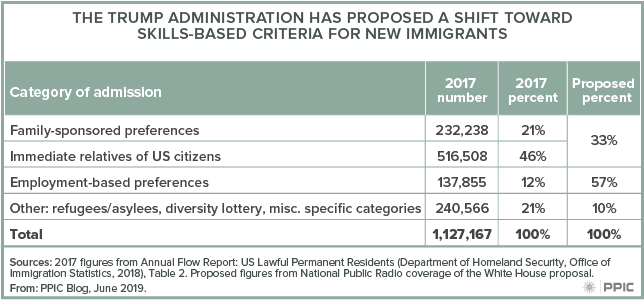
In recent years, about two-thirds of immigrants with lawful permanent residence status (or “Green Cards”) have been admitted to the US through family-based preferences. The proposed new system would reduce this by half, to 33%. The White House statement emphasizes that priority would still be given to immediate family members of both US citizens and lawful permanent residents.
Past PPIC research suggests that family-preference immigrants have historically been high- and low-skilled. And California’s economy relies on immigrants at both ends of the educational spectrum. Nearly a third of the state’s working-age immigrants lack a high school diploma, and they make up a large portion of the workforce in industries requiring less formal education. However, the foreign-born now constitute 31% of California workers who have at least a BA, and they are overrepresented in high-skill industries like technology and health care.
Recent PPIC research finds that new immigrants in California are increasingly well-educated. In 2017, a slight majority (52%) of the state’s working-age immigrants with fewer than five years in the US had a bachelor’s or graduate degree, compared to only 22% in 1990. Only 17% had not graduated from high school, down from 47% in 1990. Indeed, recently arrived immigrants are more likely than US-born Californians to have college or graduate degrees.
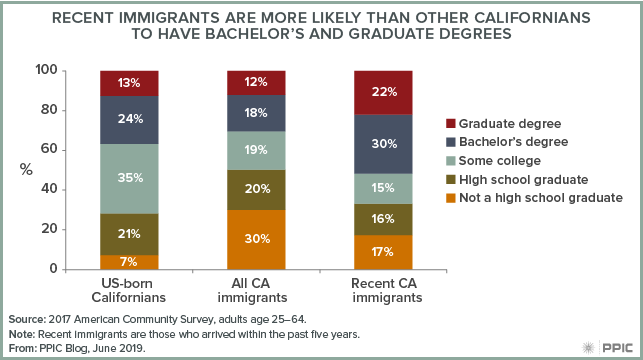
It is impossible to know exactly how a skills-based immigration system would affect California. But given the trend toward higher education levels among new immigrants and state economy’s reliance on both high- and low-skilled workers, a shift toward such a system might not be necessary to meet California’s workforce needs.
Topics
Donald Trump Economy Higher Education Immigrants in California immigration Population Workforce and Training Workforce Needs workforce skills gapLearn More

Immigrants in California

Policy Brief: California’s Immigration Landscape and Current Public Opinion

How Has California’s Immigrant Population Changed over Time?

California’s Highly Educated Immigrants