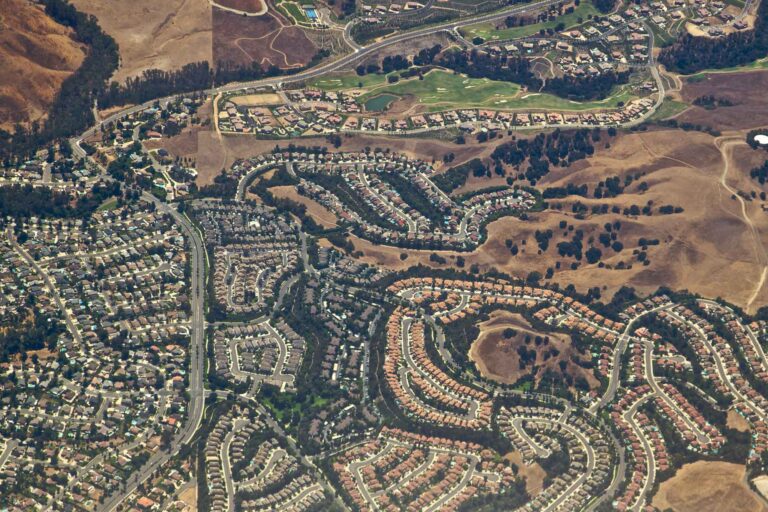

The arcane subject of congressional redistricting has become a major story in recent days. Republicans in Texas have begun redrawing their congressional lines to get a map more favorable to their party, which has prompted Democrats in California and other states to consider doing the same. How might the state go about redrawing its congressional map—and what is the broader context of redistricting in California?
Redistricting is the process of redrawing the lines of representational districts—in this case for the US House of Representatives. It is usually conducted only at the beginning of each decade, as new decennial census numbers require changes to reflect shifts in population. But the US Supreme Court has explicitly allowed mid-decade redistricting (in a case involving Texas), and the Texas governor and legislature are considering a mid-decade plan that would likely net Republicans five more seats than the current districting plan. California governor Gavin Newsom has responded with a threat to counter whatever Texas produces with a redraw in California.
Newsom’s threat runs head-on into the state’s method for drawing districts: the Citizens Redistricting Commission (CRC). CRC members are selected through a complex process designed to field a group of average Californians who are independent from the political establishment. The CRC must comprise a mix of Democrats (5 members), Republicans (5 members), and other party registrants (4 members). The districts it draws must meet federal standards for equal district populations and representation for voters of color under the Voting Rights Act. Where possible, the districts must also be compact (looking more like squares or circles than strange shapes with squiggly boundaries) and keep cities, counties, and communities with common interests bound together. And the CRC has always interpreted a prohibition on favoring incumbents or parties to mean that it cannot know where incumbents live or review any partisan data.
A mid-decade redraw would replace the CRC’s lines with ones drawn by the legislature. The most commonly discussed approach would be to put a new map before voters in a special election this fall. The new map would still be subject to legal challenges based on equal population and Voting Rights Act requirements. And if the map were to be enacted through a statutory and not a constitutional change, it could face challenges under multiple provisions that were added to the constitution at the creation of the CRC (since the constitution trumps statutes).
The CRC emerged from decades of redistricting conflict. In the 1970s and 1990s, stalemates between the Democratic legislature and Republican governor threw matters to the courts. In the 1980s, a Democratic legislature and governor drew an aggressive partisan gerrymander (with districts so contorted that legendary Democratic politician Phil Burton described the map as his “contribution to modern art”). This plan was struck down by voters in a referendum and used in only one election. Democrats also controlled the process in 2001, but fear of another referendum led them to strike a deal with Republicans that protected all sitting incumbents instead of maximizing Democratic seats. The result was a congressional plan so uncompetitive that only one seat was flipped over the next decade. This led to the adoption of the CRC, first in a 2008 constitutional amendment that covered state legislative districts, and then in a 2010 constitutional amendment that added US House seats to the process. Voters passed the first measure narrowly (50.8%); the second measure passed comfortably (61.2%). The CRC has been used for both sets of districts ever since.
The creation of the CRC was not the first effort to adopt a redistricting commission in California. A largely Republican coalition had tried four times before at the ballot box—most recently in 2005—losing by clear margins each time. By contrast, the coalition behind the CRC was much broader and more bipartisan, reflecting widespread anger over the incumbent-protection gerrymander. This pattern is not limited to California: redistricting reforms across the country have been much more successful when crafted with bipartisan coalitions, rather than with one-sided partisan support.
The first plan drawn by the CRC was better on virtually every dimension than the one that had been drawn to protect incumbents: it was more compact, split fewer cities and counties, facilitated greater representation for voters of color, and spurred more competitive outcomes. It did lean Democratic, but not to a significant extent. Instead, increased competitiveness allowed Democrats to pick up seats that the previous plan had prevented them from claiming as voters had shifted Democratic over the previous decade.
The second CRC map, adopted in 2022, continued this theme, with reasonably compact districts, intact cities and counties, and competitive outcomes, and still more representation for voters of color. But it did lean more strongly Democratic, a point that has become contentious in the context of the current debate. This extra advantage emerged in the final maps, as a result of adjustments aimed at improving representation for voters of color. Because these adjustments were made without consulting partisan data, the commission did not anticipate the partisan consequences.
Nothing is certain yet. Newsom has pledged not to push for redistricting except in response to Texas, and Texas has not yet passed a new plan. If both states move forward, others may as well, leading to a much wider cascade of changes. PPIC will continue to monitor the situation and produce analysis to inform the process.
Topics
California State Legislature elections Gavin Newsom Political Landscape political representation redistricting US House of RepresentativesLearn More

What’s at Stake in Proposition 50?

How Would the Prop 50 Redistricting Plan Affect Racial and Geographic Representation?
How Many Seats Would Democrats Gain under California’s Mid-Decade Redistricting Plan?

California’s Voters and the Upcoming Redistricting Decision

Do California and Texas Have Gerrymandered Districts?
Redistricting and the Changing Demographics of the California Legislature

Understanding the Geography of California’s Final Redistricting Maps
Racial Representation and Partisan Leanings in California’s Final Redistricting Maps