California’s economy may be altered should the current Trump administration adopt proposed tariffs on Mexican and Canadian goods, as it already did with Chinese goods; it has also renewed steel and aluminum tariffs for all countries. California ranks as the nation’s largest importer and second-largest exporter. With Mexico, China, and Canada among the state’s biggest trading partners, concerns around proposed tariffs are heightened. Given the potential consequences of federal trade policy, what are key aspects of California trade, especially with these three countries?
In 2024, California’s total merchandise trade reached $675 billion—close to 16% of state GDP. California imports 2.7 times more goods than it exports, reflecting the purchasing power of the state’s market. However, imports also include intermediate goods used in the manufacturing of California products that could eventually be exported. In this way, tariffs on imported goods may have direct effects on consumers, producers, and exporters in the state.
Manufactured goods dominate California exports at 87% ($159 billion)—computer equipment, semiconductors, instruments, and aerospace products and parts are at the top of manufacturing exports. The state also leads the nation in agricultural exports ($15 billion), with products like nuts, processed and fresh fruits, and processed vegetables generating an important revenue stream for California farmers.
Manufactured goods also dominate the state’s imports (89% or $436 billion), with motor vehicles, computer equipment, semiconductors and other electronic components, and communication equipment representing one third of all manufacturing imports. Oil and gas, the fifth largest item imported by the state ($26 billion), represents 5.3% of total imports.
Together, Mexico, Canada, and China account for 37% of California's exports and 41% of its imports. In 2024, California exported $65 billion in manufactured and agricultural goods to these nations, while importing $187 billion in manufactured goods from them—China provided nearly 30% of all manufacturing imports. The Golden State also imported $9 billion in agricultural goods from the three countries (52% of all agricultural imports), primarily from Mexico.
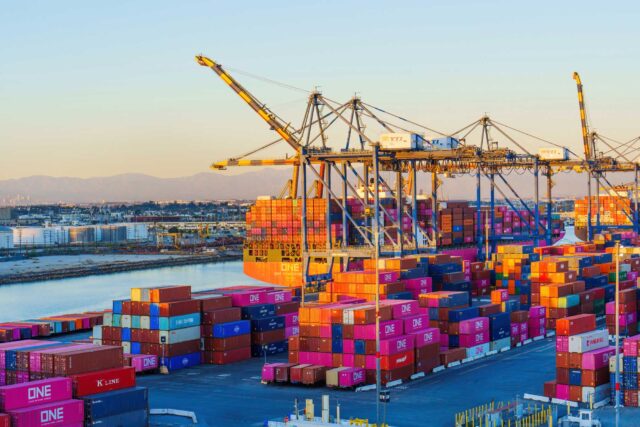
Export activity from California supported an estimated 584,000 jobs in 2021, with small and medium businesses playing a crucial role. Some of these jobs are in California’s ports, which handle 40% of US container imports and nearly 30% of exports. Businesses employing fewer than 500 workers generated 43% of the state's exported goods in 2022.
The trade wars with China and other countries during the first Trump administration provide valuable insights into how additional tariffs can impact California’s economy. Initially, retaliatory tariffs contributed to falling prices and reduced exports for certain agricultural commodities. For example, revenues dropped for walnut, wine, orange, and table grape exporters as China adjusted its trade patterns. California’s almond producers faced disruptions, with lower export volumes and downward price pressures.
Today, if the US imposed a 10% tariff on all goods from all countries and those countries responded similarly, estimated annual export losses would be between $3.1 billion and $4.8 billion for California agribusiness, according to one recent study.
Tariffs imposed in 2018 and 2019 led to higher prices across the country for consumer goods—like washing machines and solar panels, and for intermediate goods—like aluminum and steel. Higher costs were largely paid by American consumers and firms. At the time, these higher prices didn’t necessarily impact overall prices—that is, inflation—in a major way. In manufacturing sectors, such as aluminum production and household appliances, lower employment and output in the short-term were due to rising costs of imported materials necessary for production and retaliatory tariffs.
The ultimate effect of US tariffs and retaliatory measures on California’s economy is hard to predict; it will depend on how sizeable they are and whether they are broad-based or target certain products. Efforts to diversify trade markets and supply chains will be key to helping California’s future economy thrive.
Furthermore, supporting a vibrant business environment that addresses the cost of doing business in the state, promotes innovation, and helps the workforce to increase its productivity may help California offset the potential impacts of a trade conflict in the years to come.