



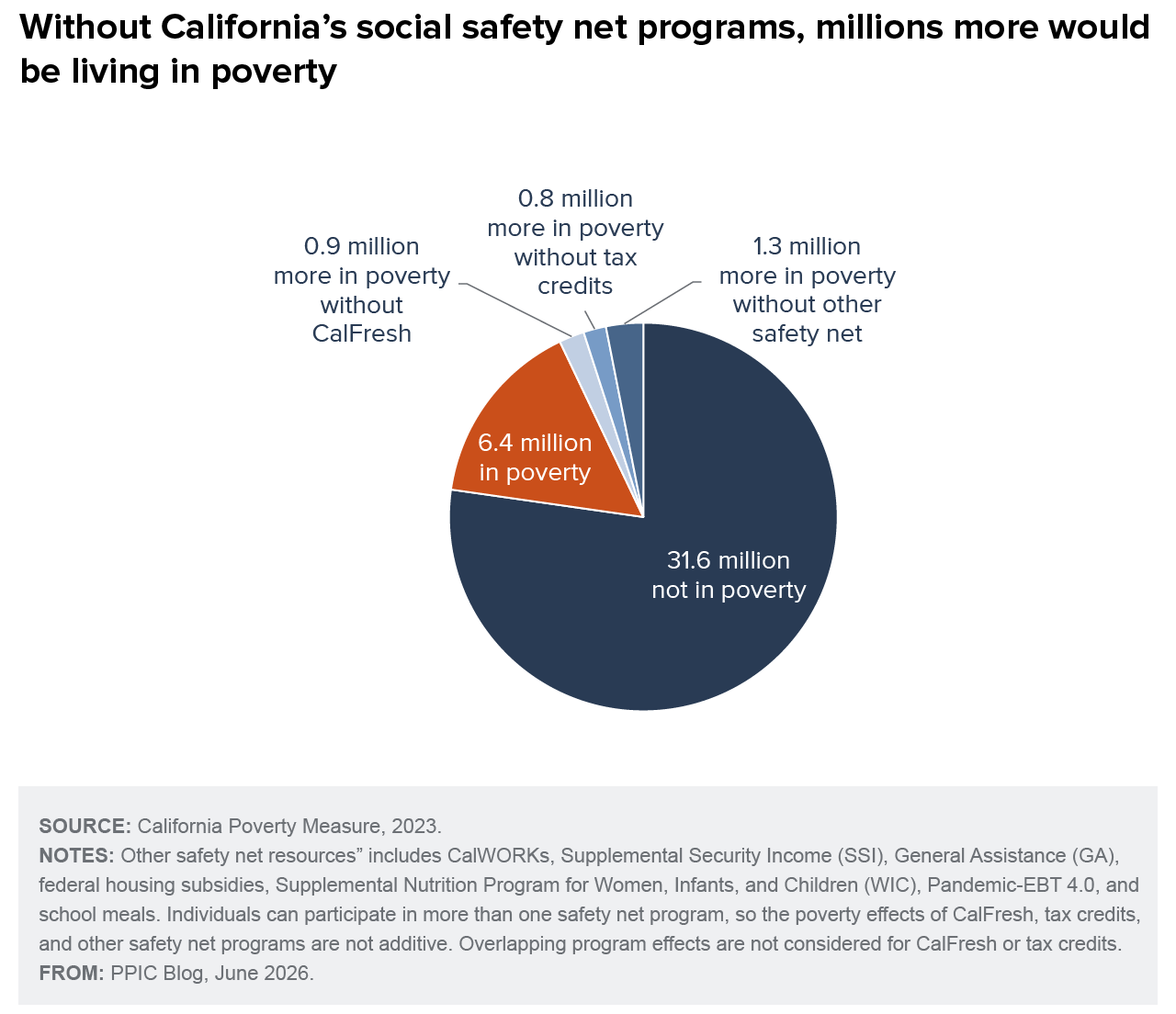
California’s next governor will face the challenge of delivering a safety net impacted by federal policy . In particular, new federal policy is reducing the scope of CalFresh—the state’s largest nutrition assistance program, which keeps close to a million Californians out of poverty—and changes have major implications for low-income Californians and for state and county budgets. The scope of other large-scale safety net programs—such as low-income tax credits—remains largely the same, although many are also subject to federal changes.
Fundamentals
California’s safety net is a complicated network of programs that help low- and moderate-income families cover basic needs; individual programs often have additional aims, including supporting work and training, improving nutrition, and helping children thrive. CalFresh, low-income tax credits, and Supplemental Security Income/State Supplementary Payment (SSI/SSP) represent the largest expenditures. CalWORKs, school meals, child care subsidies, and other programs have smaller budgets but still meaningfully reduce poverty among participating families and individuals.
Nearly all programs are designed and funded primarily by the federal government. Cash aid, including tax credits, totaled $22.6 billion from the federal government and $5 billion from state and local governments in 2024–25. Federal spending for the state’s major nutrition assistance programs totaled $18.6 billion in 2025–26, while the state spent $3.4 billion. As a result, federal changes have significant implications for California’s safety net.
Key Issues
The safety net helps to reduce poverty—but rates are rising. In a typical year, safety net programs keep 2.6 million Californians (or 7%) out of poverty and boost resources for millions of low-income individuals. During the pandemic, temporary expansions reduced poverty rates to historic lows, with CalFresh benefits increasing by 69% and the expanded federal Child Tax Credit alone reducing child poverty by a third.
However, poverty rates began rising after these expansions expired, and recent federal legislation—HR1 (2025)—is likely to spur further increases. In addition to rescinding CalFresh eligibility for about 72,000 immigrants with legal status, HR1 reduces benefits and expands time limits on assistance for adults not working, volunteering, or in education or training programs. Even with some participants exempt, time limits could curtail assistance for more than 550,000 current participants.
Expanding work and community engagement requirements in CalFresh will shrink safety net access for childless adults. CalFresh is a key support for Californians regardless of employment status— especially for nondisabled, childless adults under 65, who are the primary focus of the expanded requirements under HR1, and who are already eligible for few safety net resources. Notably, while most low-income families have some employment, people often seek assistance when work becomes unstable. Implementing the new policy while ensuring individuals can still meet basic needs will at a minimum require counties to accurately identify exemptions, document ways participants meet requirements, and help connect participants to work, education, and other engagement opportunities.
State policymakers often adjust or supplement federal programs to alleviate poverty. California policymakers have long sought to increase the impact of key safety net programs and found ways to expand benefits or ease access while adhering to federal rules. State initiatives range from piloting simplified CalFresh applications for elderly and disabled adults (which eases access to federal benefits) to creating a suite of tax credits for low-income Californians (which cost the state $1.4 billion in 2025).
California faces substantial new costs to deliver CalFresh. Starting in fall 2027, the federal government will cover a lower share of administrative costs for CalFresh, and states with high payment error rates will need to cover a share of benefit costs; the benefit share alone could cost California up to $2 billion a year. Additionally, some policymakers are currently exploring unprecedented state funding models to respond to HR 1’s cuts to CalFresh eligibility, which could cost up to $1 billion annually.
Takeaways
The next governor will grapple with a complex safety net amid federal changes that reduce access and raise state costs, making it more critical than ever to improve coordination across programs that reduce poverty, support employment, and improve outcomes. Policymakers can continue exploring measures—including automated income verification, targeted outreach, and benefit integration—that hold promise for increasing the efficiency of program administration, cost effectiveness, and reducing administrative burdens for applicants and participants.