The jail population remains significantly lower than it was a decade ago.
- As of June 2025 (the most recent month of data), California’s jail population stood at roughly 60,300, up from 56,800 in June 2024 but well below pre-pandemic levels, which ranged from 70,000 to 75,000 between 2015 and 2020.
- In the first months of the pandemic, shifts in criminal justice policies prompted a significant population decrease from about 75,000 in January 2020 to under 51,000 by May 2020. The population then climbed and has fluctuated between 58,000 and 62,000 since September 2020.
- The passage of Proposition 47 in 2014 reclassified several property and drug felonies as misdemeanors, reducing the jail population sharply. Since the implementation in December 2024 of Proposition 36, which reversed some of Prop 47’s changes, the jail population is up about 2,700 (roughly 5%).
County jail populations dropped sharply after Proposition 47 passed in 2014 and plunged at the beginning of the pandemic
Number of jail inmates
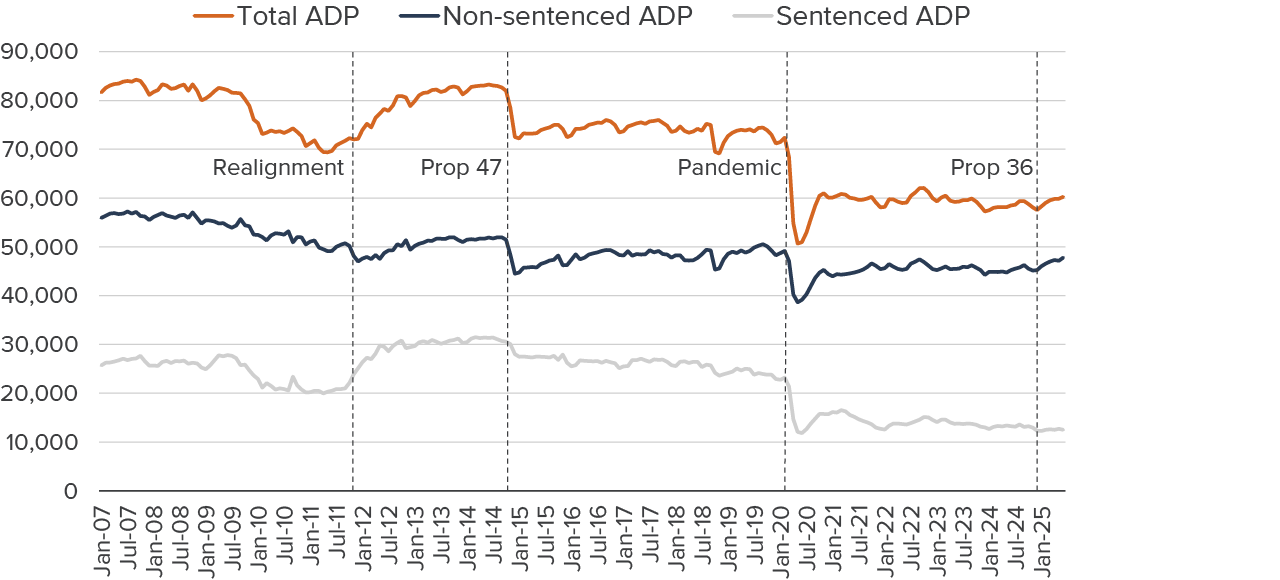
SOURCE: Jail Profile Survey, January 2007–June 2025, Board of State and Community Corrections.
NOTE: ADP = average daily population. Del Norte County Sheriff and Merced County Sheriff did not report jail profile survey numbers for June 2025, so we impute May 2025 numbers for these two counties to show a full picture of the statewide jail population.
Fewer people are booked into jail than before the pandemic—and fewer are released early.
- Bookings into jail dropped sharply early in the pandemic, from around 72,000 in the months leading up to February 2020 to only 31,000 in May 2020. Bookings have partly recovered since but remain roughly 20% below pre-pandemic levels. Monthly bookings were about 6% higher in the first half of 2025, compared to the same months a year earlier.
- With reductions in the jail population, early releases declined as well. In the first half of 2025, the state averaged 5,300 monthly early releases, compared to over 8,000 in the months before Prop 47 was passed.
- The number and share of people in jail with mental health needs have grown over the past 15 years. The number rose from around 11,000 (roughly 20% of the jail population among agencies that report mental health case data) in 2010 to 25,000 (37%) in 2019. As of June 2025, the number was around 29,400 (55%); in the most recent data, these agencies accounted for 88% of the total jail population.
Early releases due to overcrowding have fallen since the passage of Proposition 47
Total capacity-constrained releases

SOURCE: Jail Profile Survey, January 2007–June 2025, Board of State and Community Corrections.
NOTES: Release figures include both non-sentenced and sentenced people. Del Norte County Sheriff and Merced County Sheriff did not report jail profile survey numbers for June 2025, so we impute May 2025 numbers for these two counties to show a full picture of the statewide jail population.
The jail population is largely male, not sentenced, and being held for felonies.
- As of June 2025, men make up the vast majority (88%) of the jail population and have comprised 85% to 91% of the population historically.
- More than 79% of people in jail are awaiting either arraignment, trial, or sentencing (“non-sentenced”).
- People held for felony charges or convictions account for 88% of the jail population, with the rest being held for less serious misdemeanor charges.
- Historically, non-sentenced felony inmates have made up between 55% and 62% of the total jail population. This group now accounts for about 71% of a smaller overall population.
California has about 120 county jail facilities; many are several decades old.
- California counties operate short-term holding facilities for processing arrests, bookings, and active court proceedings, as well as long-term facilities that hold people who are either awaiting the outcomes of their cases or serving sentences.
- Nearly all counties (56 of 58) have at least one long-term facility; there are nearly 120 such facilities statewide, with over 82,000 beds (up from 75,000 in 2007).
- Many counties are operating facilities that are decades old (about 40% were built before 1980) and lack proper rehabilitation spaces; the state has made funding available for renovation and new construction.
Many jail construction projects have been completed; long-term planning should try to anticipate future needs.
- Since 2007, the state has allocated $2.14 billion for 53 jail projects; 38 have been completed. These projects are adding over 12,500 new beds, with a net gain over 8,400, as some of these beds will replace those in aging facilities. Counties also invest their own dollars to create additional bed space.
- More recent state funding initiatives incentivized counties to expand and add new space for medical, educational, and other services with the aim of preparing people for successful reentry into the community.
- Building and renovating facilities take considerable time and money, and it can be difficult to plan for future needs. The drop in jail populations under Prop 47 and during the pandemic indicated that fewer jail beds would be needed; in June 2024, only 9 facilities were over capacity, and another 21 were over 90% of capacity. In June 2025, those numbers total 12 and 25, respectively, which could be a sign that jail populations are on the rise, possibly because of the implementation of Prop 36.
Topics
Criminal Justice