California spends 10% of the state budget on higher education.
- California spent $23 billion on higher education in the 2025–26 budget—about 10% of the General Fund. At that share, higher education ranks third for state spending, behind Health and Human Services (38%) and K–12 education (35%).
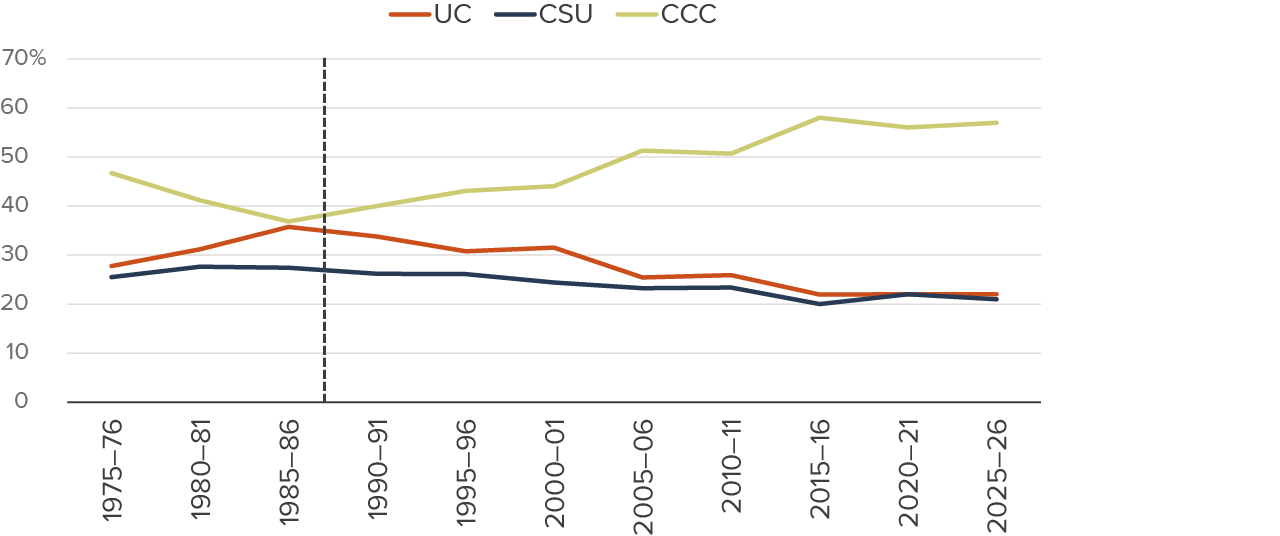
- As a share of the budget, higher education spending has dropped over the last four decades, from 16% of the General Fund to 10%.
- Per full-time student, California has spent about $12,100 on public higher education. This amount is just above the recent US average ($11,700) but slightly less than Texas ($12,800) and much less than New York ($15,300).
The majority of state higher education spending goes to community colleges.
- Over half of state higher education funding goes to the California Community Colleges (CCC), while about 20% goes to each of the University of California (UC) and California State University (CSU).
- The CCC is funded under the Proposition 98 guarantee, which requires the state to spend about 40% of the General Fund on K–14 education (the CCC receives about 11% of Prop 98 funds).
- After adjusting for inflation, per-student state funding has grown 148% at the community colleges over the last 30 years; funding has grown only 3% at CSU while declining 35% at UC.
State funding for UC and CSU has dropped since Proposition 98 but climbed for community colleges
SOURCE: California Department of Finance, State Budget Analysis (2026).
NOTES: Figure shows the share of total General Fund allocations to higher education in constant dollars. The vertical line represents passage of Proposition 98, in 1988.
Rising tuition has offset lower state appropriations.
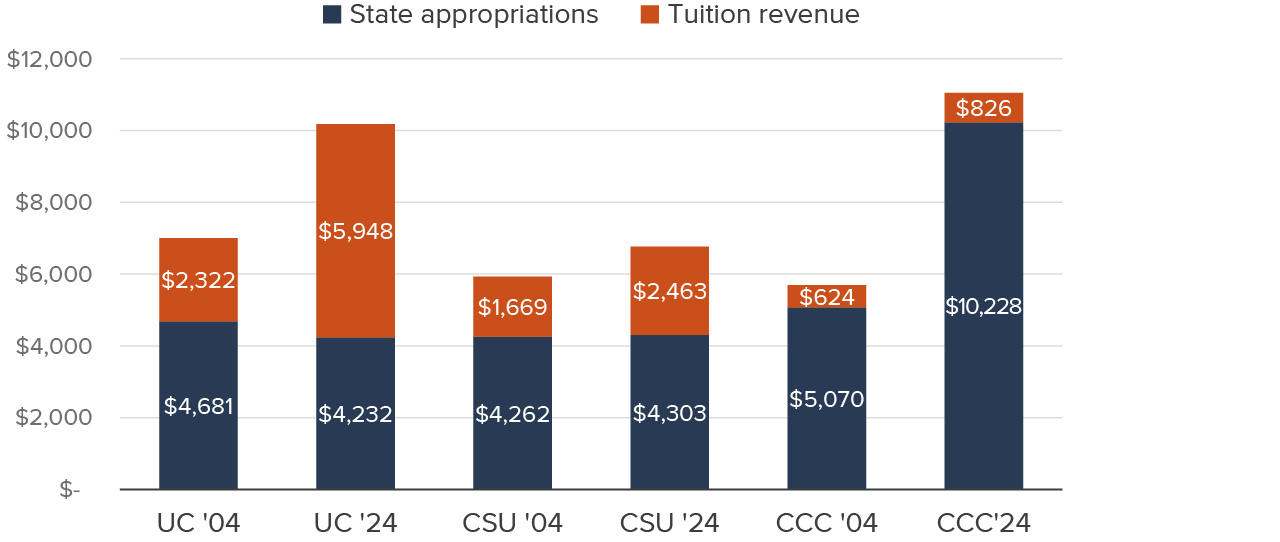
- California’s public higher education systems are funded primarily from two sources—state appropriations and tuition. Tuition revenue accounts for roughly two-thirds of UC funding, about half of CSU funding, and just under a tenth of CCC funding.
- Tuition increased significantly at UC and CSU between 1995 and 2013, then remained flat for almost a decade. As of 2023, both systems have long-term tuition plans that grow annually with inflation.
- In-state tuition in the CCC system is the lowest in the nation ($46/unit). Tuition for state residents at UC and CSU is slightly below the national average ($11,950); for nonresidents, it is the third highest in the nation at over $40,000 per year.
Today, state universities rely more on tuition than in the past, especially at UC
SOURCE: Integrated Postsecondary Education Data System (IPEDS).
NOTES: Numbers are in millions. Inflation adjusted to 2026 dollars. State appropriations for community colleges include state and local appropriations.
As university tuition increases, so does the cost to fund state financial aid programs.
- In 2025–26 state financial aid accounted for 11% ($2.5 billion) of higher education funding, an increase from about 8% ($2.3 billion) in 2018, when California enacted large funding reforms.
- High school graduates and community college transfer students are guaranteed a Cal Grant—free tuition at UC and CSU—if they meet certain financial and eligibility requirements. Over 450,000 students received a Cal Grant in 2024, up from 371,000 in 2017. As more students become eligible, the cost of funding the program increases.
- Other efforts to expand eligibility for aid and cover student cost of living expenses—like the Middle Class Scholarship–have further increased the cost of California’s financial aid programs while maintaining affordability for students and families.
Several strategies can help California universities align future funding.
- By 2040, the state’s high school population is expected to decline by 100,000. This trend could put fiscal pressure on California’s higher education systems if the decreases in K–12 enrollment carry over into colleges.
- California could address these challenges and increase enrollment by improving college readiness and community college transfer: nearly half of public high school graduates do not meet university admissions requirements and less than a fifth of community college students successfully transfer after four years.
- Aligning funding with higher education goals could also alleviate financial pressure. One example of this is the CCCs’ Student-Centered Funding Formula, which allocates 10% of state support toward schools where students reach successful outcomes, such as earning associate degrees or transferring to a four-year college.
Topics
Finance Higher Education