Table of Contents
- Key Takeaways
- Introduction
- How Are Latino and Black Men Faring under AB 705?
- AB 705’s Impact on Transfer and Completion Is Not Yet Clear
- How Can Community Colleges Address the Needs of Black and Latino Men?
- Conclusion
- Notes and References
- Authors and Acknowledgments
- PPIC Board of Directors
- Copyright
Key Takeaways
California community colleges are the primary gateway to higher education for historically underrepresented students—and for Black and Latino men in particular. Recent reforms in developmental education, mandated by Assembly Bill (AB) 705, have the potential to improve educational outcomes among Latino and Black men, whose attainment levels continue to lag behind those of white and Asian Californians as well as women of the same race and ethnicity. We assess the impact of these reforms on Latino and Black men by examining the completion of introductory transfer-level math courses, an important milestone on the path to transfer to four-year colleges. Several key findings emerge:
- AB 705 has allowed more Latino and Black men to enroll directly in and successfully complete transfer-level courses. Latino and Black men are enrolling directly in transfer-level math at the same rate as their peers (100%), and the share of male Latino and Black first-time math students completing transfer-level math in one term tripled, when comparing the fall 2018 and fall 2023 cohorts. →
- However, Black and Latino men who start in transfer-level math are less likely than white and Asian men (and their female counterparts) to complete these courses. On average, 44 percent of Latino men successfully completed these courses between fall 2019 and fall 2023, compared to 48 percent of Latina women, 60 percent of white men, and 68 percent of Asian men. Black men are only slightly less likely to complete than their female counterparts (2 percentage points) but significantly less likely than white (20 percentage points) and Asian men (28 percentage points). →
- AB 705’s impact on transfers to four-year colleges is not yet clear. Given the higher shares of Latino and Black men who successfully completed transfer-level math, we may see more transfer-eligible students. However, completion of transfer-level math is only one milestone in a student’s path to transfer. →
- Persistence may be the biggest challenge for Latino and Black men. We find that 59 percent of Latino and 66 percent of Black male students from the fall 2019 entering cohort left the system within three years without earning a degree or transferring. Gender gaps in college persistence are larger than the gender gaps we see in math course completion. →
- More empirical research is needed, but the foundational work of researchers and practitioners should inform next steps. Growth-minded instructors, well-designed corequisite models, and learning communities have shown promise in supporting Black and Latino students in transfer-level courses. Men-of-color-specific programs seem to help address low persistence by cultivating sense of belonging and key relationships on campus. More work is needed to evaluate and perhaps expand these models. →
Introduction
Latino and Black young men have the lowest educational attainment in the state. According to the 2022 American Community Survey, only 13 percent of Latino and 16 percent of Black men ages 22 to 27 in California have at least a bachelor’s degree (Figure 1). In this area, Latino and Black men lag behind women of the same race (24% and 27%, respectively) and significantly behind their white and Asian counterparts (41% and 60%, respectively). The implications of the growing racial gap in bachelor’s degree attainment are significant, considering that a growing share of California’s future labor force will come from these groups. For example, more than half of boys under 18 years old (52%) are Latino, compared to 42 percent of prime-working-age males (see Technical Appendix Table B1).
Latino and Black young men have the lowest levels of educational attainment in the state
Share of adults ages 22 to 27 with at least a bachelor's degree
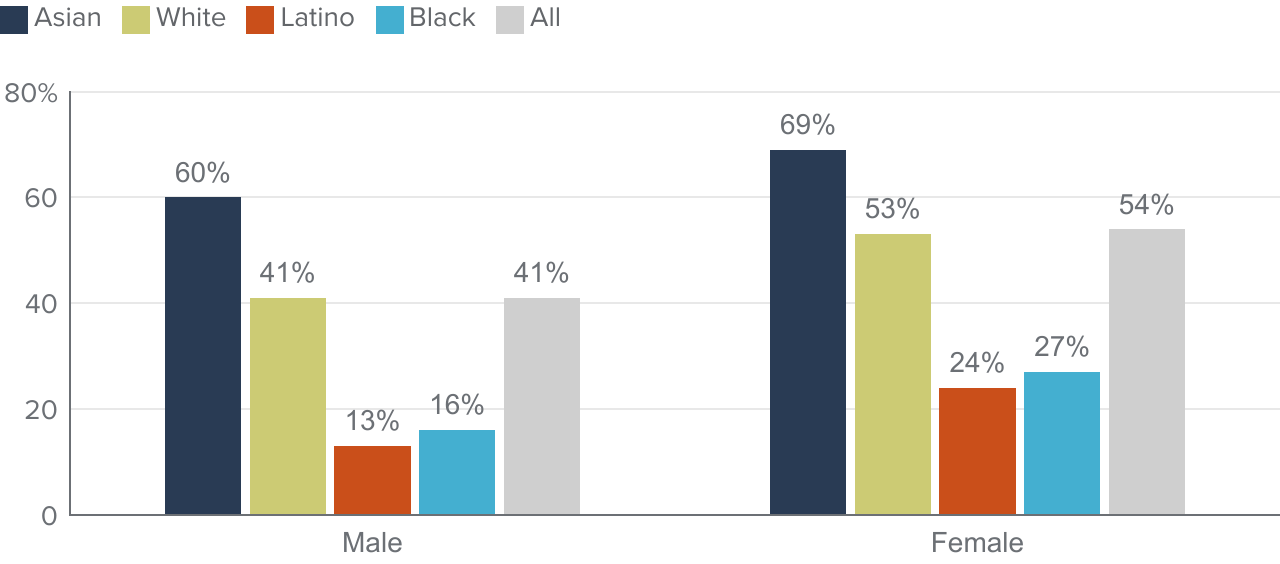
SOURCE: 2022 American Community Survey 1-Year Estimates.
NOTES: Adults 22-27 not enrolled in school.
Bachelor’s degree attainment is crucial not only for the state’s economic success, but also for expanding economic opportunity among Californians. Annual earnings among workers with a bachelor’s degree are, on average, 62 percent higher than among those whose highest level of education is a high school diploma. The earnings premium jumps up to 90 percent when comparing those with graduate degrees to only-high-school completers. The benefits of a college degree extend beyond wage gains, as college-educated workers are more likely to participate in the labor force, less likely to be unemployed, more likely to work full time, and more likely to have jobs that provide benefits such as paid vacation, employer-provided health insurance, remote work opportunities, and retirement plans (Cuellar Mejia et al. 2023; Levine and Pardue 2024). Of course, a college degree does not guarantee financial security, but for most students it represents their best chance at economic prosperity.
Lower bachelor’s degree attainment among Latino and Black young adults stems at least partially from lower high school graduation rates, A–G course completion rates, and college-going rates compared to their female counterparts and their white and Asian peers (see Technical Appendix Tables B2 and B3). But there are also important gaps even among those who do enroll in a higher education institution.
In California, community colleges are the primary access point to higher education for Latino and Black students. Most Latino and Black men rely on the transfer path to achieve their bachelor’s degree dreams. Indeed, 60 percent of entering Latino and Black male students state that their goal is transferring to a four-year institution. However, few succeed in this endeavor. Transfer rates remain low across the board and rates are particularly low among Latino and Black male students (Johnson and Cuellar Mejia 2020; Velasco et al. 2024). Community college students face multiple barriers on the path to transfer (Bustillos 2017; Cooper et al. 2020; Fink 2021). Until recently, one of these challenges was the completion of transfer-level math and English courses during the first year of community college enrollment (Jenkins and Bailey 2017; Cooper et al. 2017; Hayward and Booth 2010). Research has shown that passing both transfer-level English and math in the first year is a strong predictor of transferring to a four-year institution (Cooper et al. 2022). Until a few years ago, it was impossible for most students to reach this early milestone because they were initially placed in long remedial sequences that most students never exit (Cuellar Mejia, Rodriguez, and Johnson 2016).
In fall 2019, the implementation of Assembly Bill 705 (AB 705) led to a dramatic transformation of the community college system’s English and math assessments as well as its course placement policies and practices. AB 705 required community colleges to maximize students’ likelihood of starting and completing transfer-level (or degree-appropriate) coursework in English and math/quantitative reasoning within one year of taking the first course in the discipline. It also required colleges to use high school information (e.g., GPA, coursework, and/or grades in specific math/English courses) as the primary placement criteria.
As a result of this landmark legislation, the number of students starting directly in transfer-level courses—instead of remedial classes—increased significantly across all racial/ethnic groups, as did the number of students successfully completing these courses (Cuellar Mejia, Rodriguez, and Johnson 2020; Cuellar Mejia et al. 2021; Cuellar Mejia et al. 2022; Cuellar Mejia et al. 2023).
Our focus on how Latino and Black men are faring in the AB 705 era is motivated by (1) the growing need to increase educational attainment among Latino and Black men; and (2) the potential of significant downstream effects on transfer rates of comprehensive remedial education reform. With this in mind, this research has three main goals. First, we assess whether Latino and Black men have benefited equitably from the implementation of AB 705. Second, we explore what AB 705 implementation could mean in terms of improvements in completion and transfer among Latino and Black men. Third, we highlight ways in which community colleges can better support persistence and completion among Latino and Black men. Each one of these goals is addressed in a separate section of the report. Finally, we offer some thoughts about the path forward.
In the first two sections, we rely on longitudinal student-level data provided by the California Community Colleges Chancellor’s Office (this data covers the universe of students enrolled across all the colleges in the system). We construct cohorts of students based on the first time a student takes a math/English course. We have data spanning from fall 2015 to fall 2023. For definitions and more details about our data and methods, please refer to Technical Appendix A.
How Are Latino and Black Men Faring under AB 705?
AB 705 has led to unprecedented changes in the community college system. In the first panel of Figure 2, we show the share of first-time math and English students enrolling directly in transfer-level courses. The shares of first-time math and first-time English students enrolled in transfer-level courses increased from 24 percent and 38 percent in fall 2015 to 100 percent in fall 2023. Increases in direct access have translated into substantial increases in the number and share of students successfully completing transfer-level math and English courses in one term. From fall 2015 to fall 2023, the one-term throughput rate increased from 15 percent to 53 percent among first-time math students, and from 27 percent to 61 percent among first-time English students.
AB 705 has dramatically transformed direct access to transfer-level math and English courses
Direct enrollment in TL
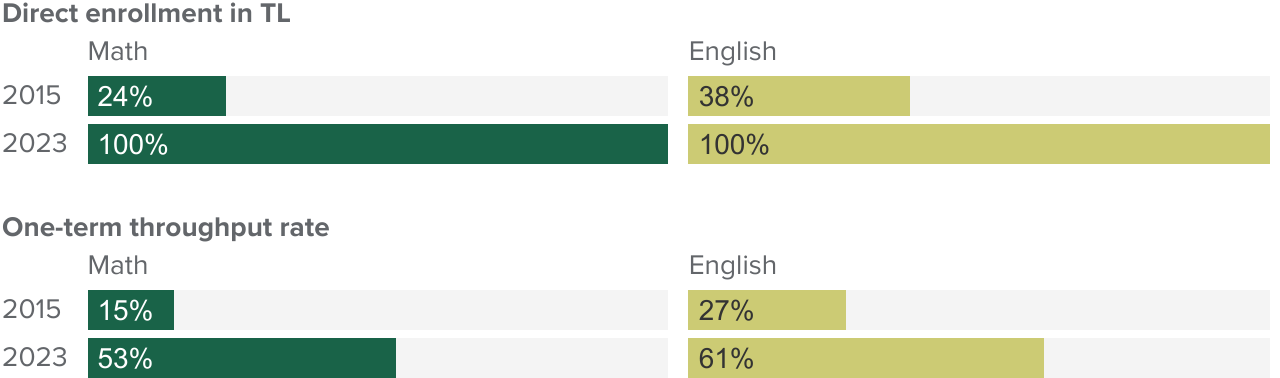
SOURCE: Authors’ calculations using MIS data.
NOTE: Based on first-time students in the discipline in the fall of each year.
Throughout the rest of this section, we focus on math access and completion because it is a stronger determinant of transfer (Cooper et al. 2017). See Figures B1–B7 in the technical appendix for results from our analysis of college composition, the introductory transfer-level English course. To contextualize the trends that we observe among Latino and Black men, we use two comparison groups: Latina and Black women and white and Asian men.
In fall 2023, 100 percent of Latino and Black men enrolled directly in a transfer-level math course. One of the main concerns about pre-reform assessment and course placement was that Latino and Black students (men and women) were disproportionately placed in remedial courses. For example, in fall 2018 (just before AB 705 was implemented statewide), male Latino and Black first-time math students were 16 and 20 percentage points less likely to start directly in a transfer-level math course than their white counterparts. However, compared to their female counterparts, Latino and Black men were slightly more likely to start directly in transfer-level math. In only five years, access rates among Latino and Black male students increased by 67 and 72 percentage points, and racial/ethnic and gender gaps completely disappeared (Figure 3).
Under AB 705, Latino and Black men are starting in transfer-level math courses at the same rate as their peers
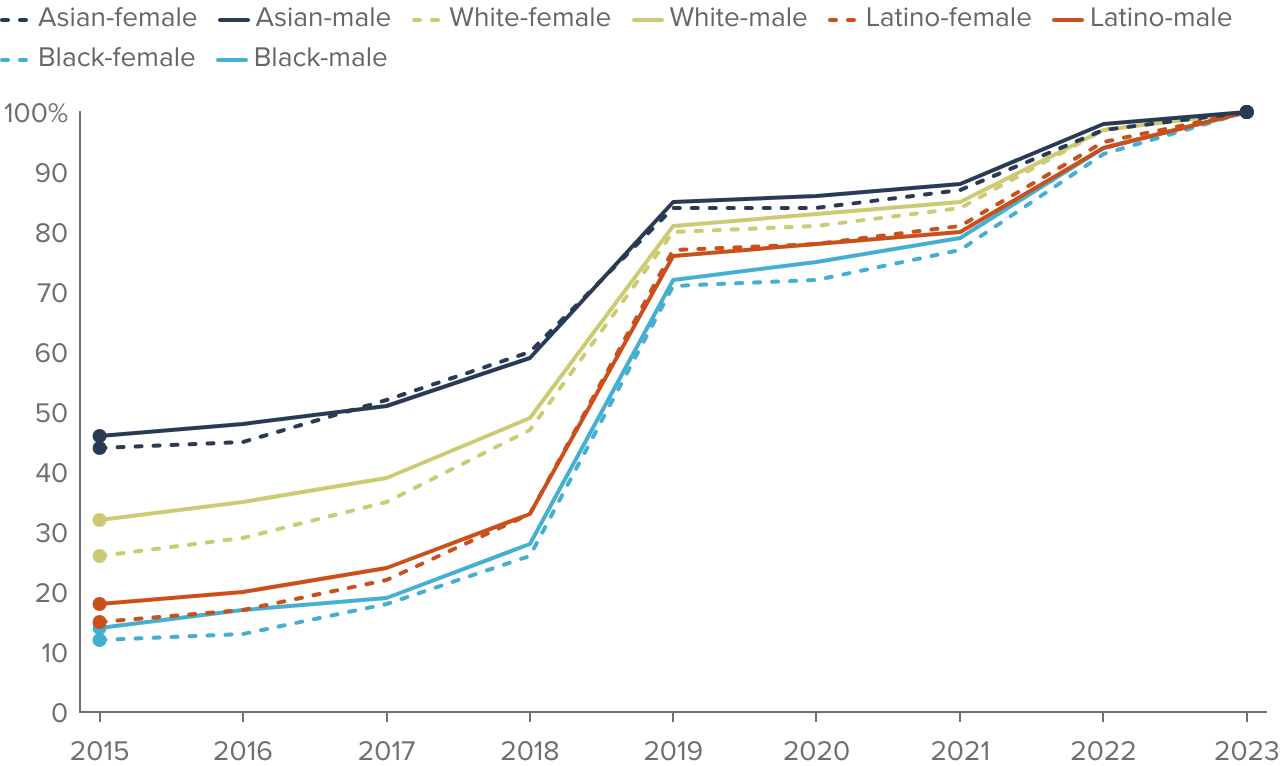
SOURCE: Authors’ calculations using MIS data.
NOTES: Share of first-time math students starting directly in a transfer-level course. Fall of each year.
Due to increases in access, a higher share of male Latino and Black first-time math students are successfully completing transfer-level math and English courses. As of fall 2023, 44 percent of Latino men and 41 percent of Black men successfully completed a transfer-level math course in one term. These completion rates are about three times the rates observed five years earlier, when only 16 percent of Latino and 13 percent of Black men completed a transfer-level math course in one term (Figure 4).
Shares of first-time math Latino and Black men completing transfer-level math in one term have tripled under AB 705
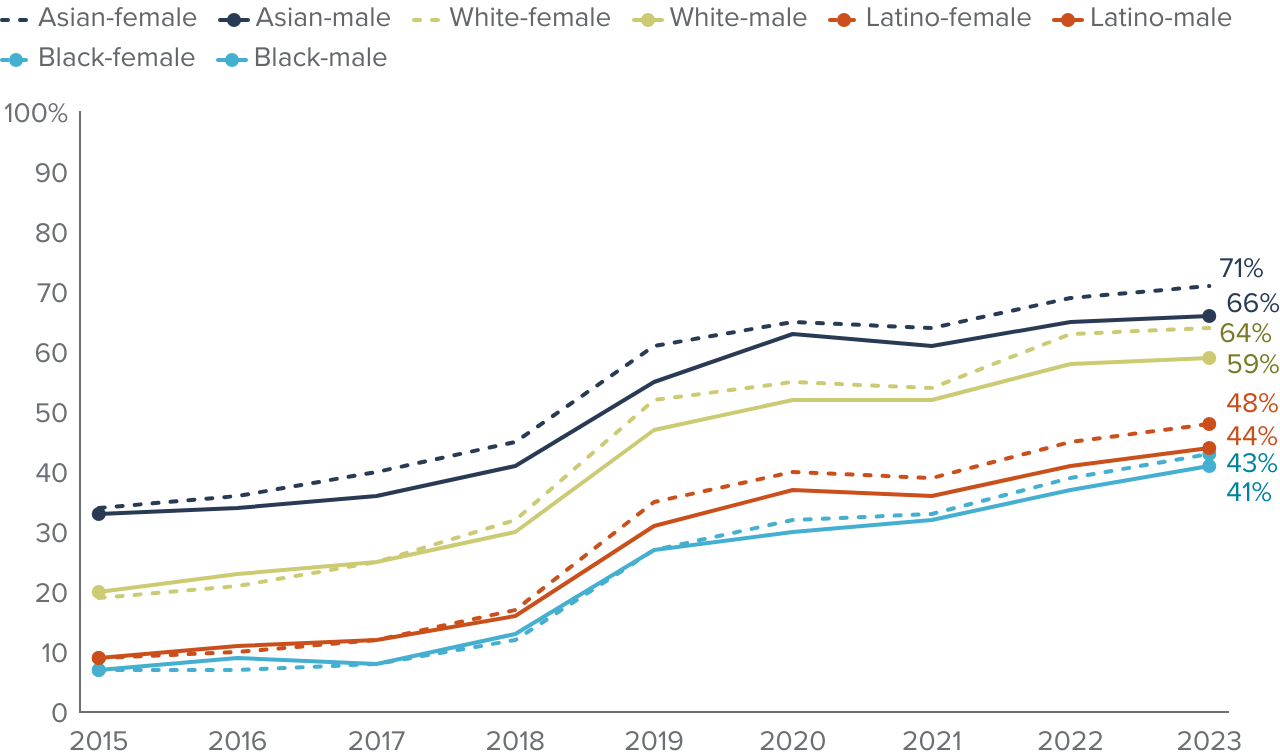
SOURCE: Authors’ calculations using MIS data.
NOTES: Share of first-time math students successfully completing a transfer-level course in one term (also known as one-term throughput rates). Fall of each year.
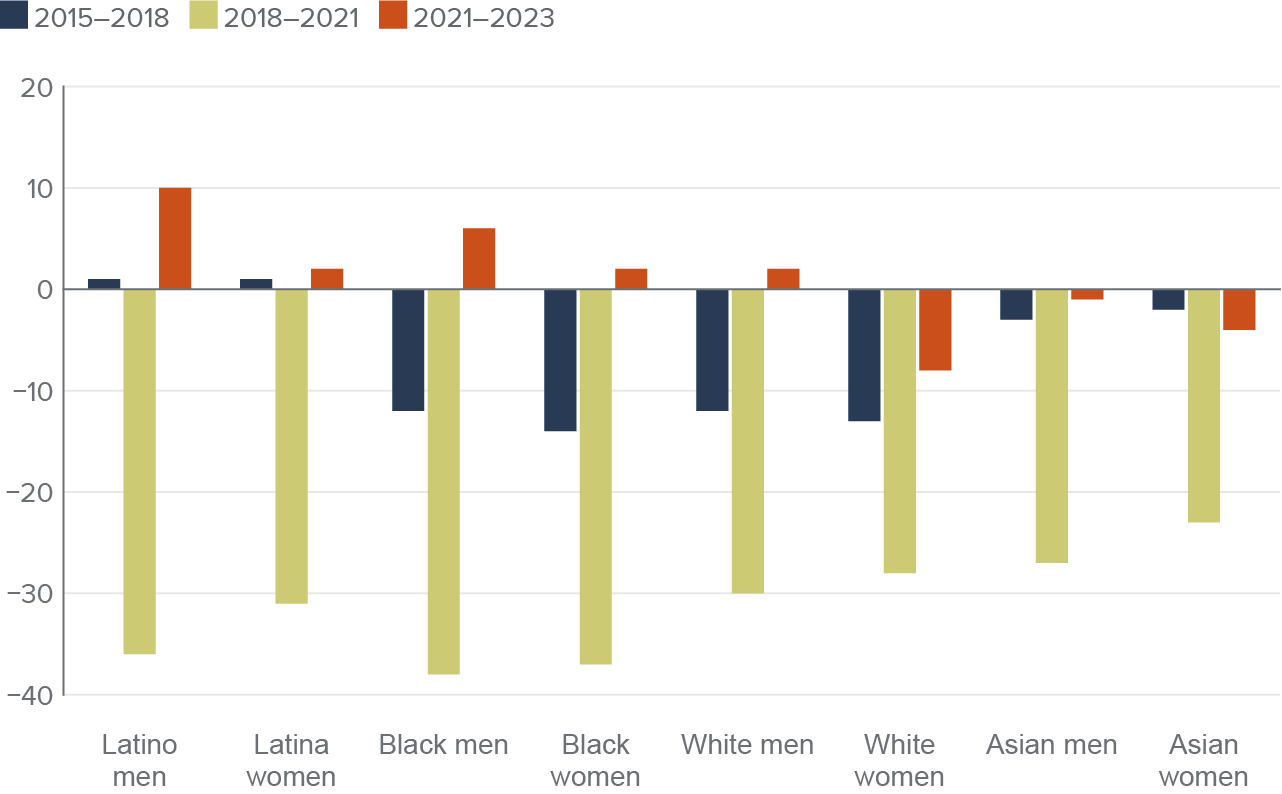
After declining for several years, first-time math enrollment among Latino and Black men drove overall increases starting in 2022. Declines in first-time math enrollment among Latino and Black men started around 2018 and intensified in fall 2019, which coincided with the first term of systemwide implementation of AB 705. Students delaying math enrollment amid changing placement policies and efforts to align math course-taking with programs of study likely drove this decline. The onset of the pandemic led to dramatic drops in overall community college enrollment, particularly among Latino and Black men, which led to additional declines in first-time math enrollment. But when first-time math enrollment finally showed some positive signs in fall 2022 and fall 2023, the increases were driven by Black and Latino men (Figure 5). Still, first-time math enrollment among Latino and Black men is down 30 percent and 34 percent compared to fall 2018.
After declining for several years, recent increases in first-time math enrollment were driven by increases among Latino and Black men
SOURCE: Authors’ calculations using MIS data.
NOTE: Changes in first-time math enrollment. Fall of each year.
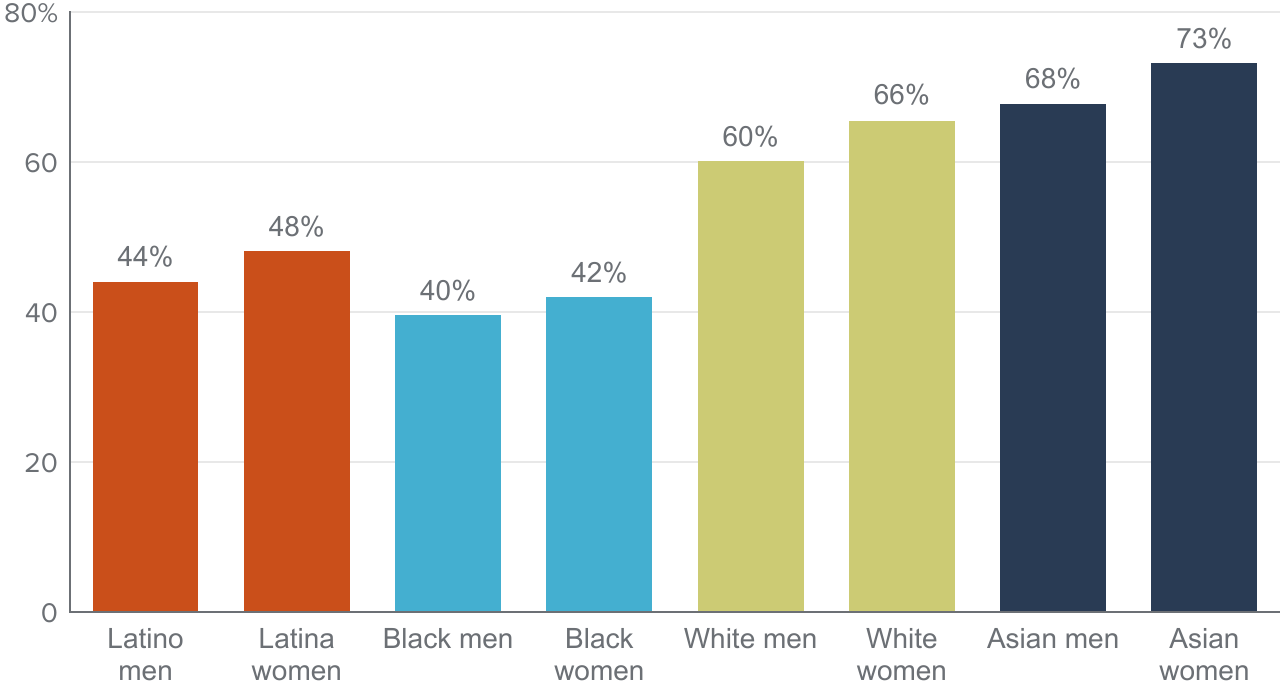
Despite the improvements brought about by the implementation of AB 705, Latino and Black men who start in transfer-level math remain less likely to successfully complete these courses than their female counterparts and their white and Asian peers. On average, 44 percent of Latino men who started in a transfer-level math course between fall 2019 and fall 2023 successfully completed the course on their first attempt; this rate is 4 percentage points lower than the rate for Latina women, and 16 and 24 percentage points lower than the rate for white and Asian men (Figure 6). Black men are only slightly (2 percentage points) less likely to complete than their female counterparts but significantly less likely than white (20 percentage points) and Asian men (28 percentage points).
Completion rates for Latino and Black men are below those of their peers
Share of students starting in a transfer-level math course who completed it in their first attempt
SOURCE: Authors’ calculations using MIS data.
NOTE: Average completion rates of fall 2019 through fall 2023 cohorts.
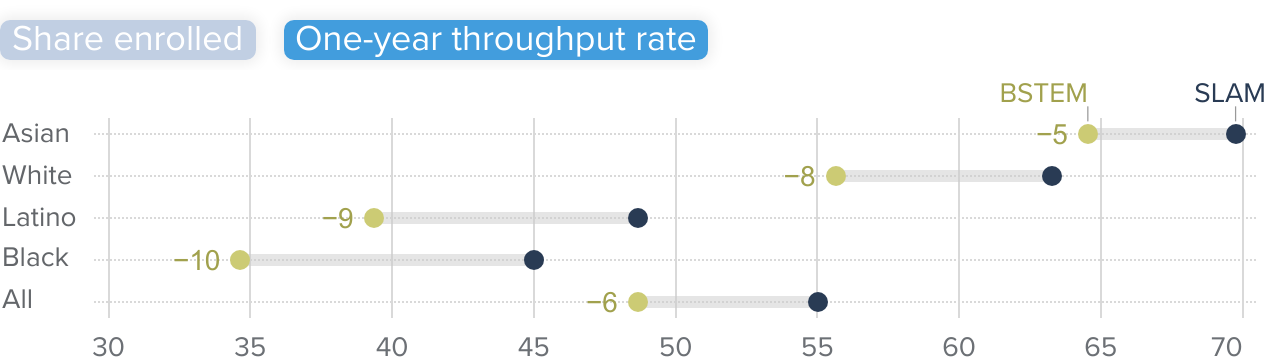
The gender gap in one-term math throughput is partially due to the tendency of Latino and Black men to start on the BSTEM path. In the context of AB 705, California community colleges offer math pathways that align with student majors or programs of study: Business, Science, Technology, Engineering, and Math (BSTEM); and Statistics and Liberal Arts Math (SLAM). Almost half (47%) of male Latino first-time math students started in a BSTEM course, compared to only 27 percent of Latina students (Figure 7, first tab). The share of Black first-time math students starting in a BSTEM course is lower, as is the gender gap (38% versus 26%).
On average, completion rates are lower in BSTEM courses than in SLAM courses. For example, 39 percent of first-time Latino men who started in a BSTEM course successfully complete it in one term, this is 9 percentage points lower than the completion rate among male Latino first-time students who started in a SLAM course. Among Black men, completion rates are lower overall, but the difference between BSTEM (35%) and SLAM (45%) is about the same (Figure 7, second tab).
Across all races, male students are more likely to start in a BSTEM course than their female counterparts

SOURCE: Authors’ calculations using MIS data.
NOTES: Tab 1: Share of first-time math students starting in a BSTEM course among those who started directly in a transfer-level course. Tab 2: Share of first-time math students in successfully completing transfer-level within a year (i.e. one-year throughput). The horizontal axis is showing percent values. The number in the figure is the difference in one-year throughput rate in percentage points. Both tabs: fall 2019–fall 2023 cohorts.
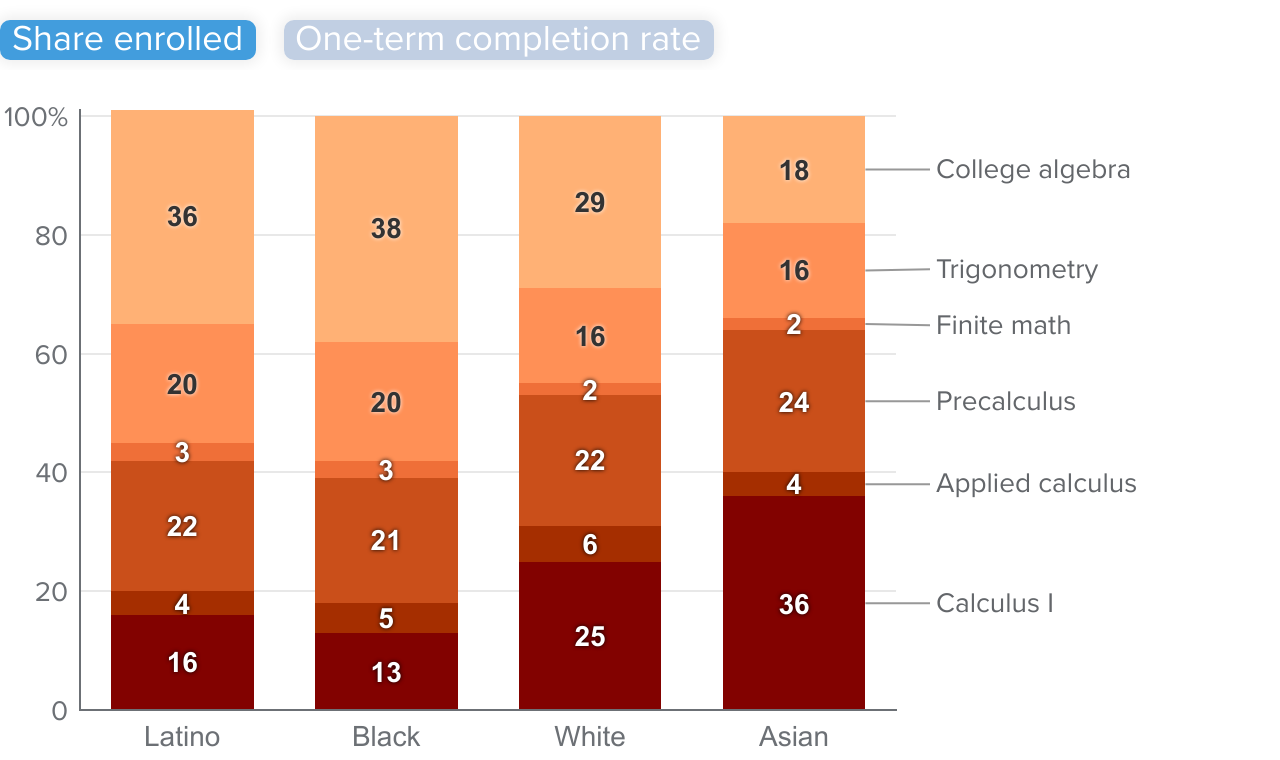
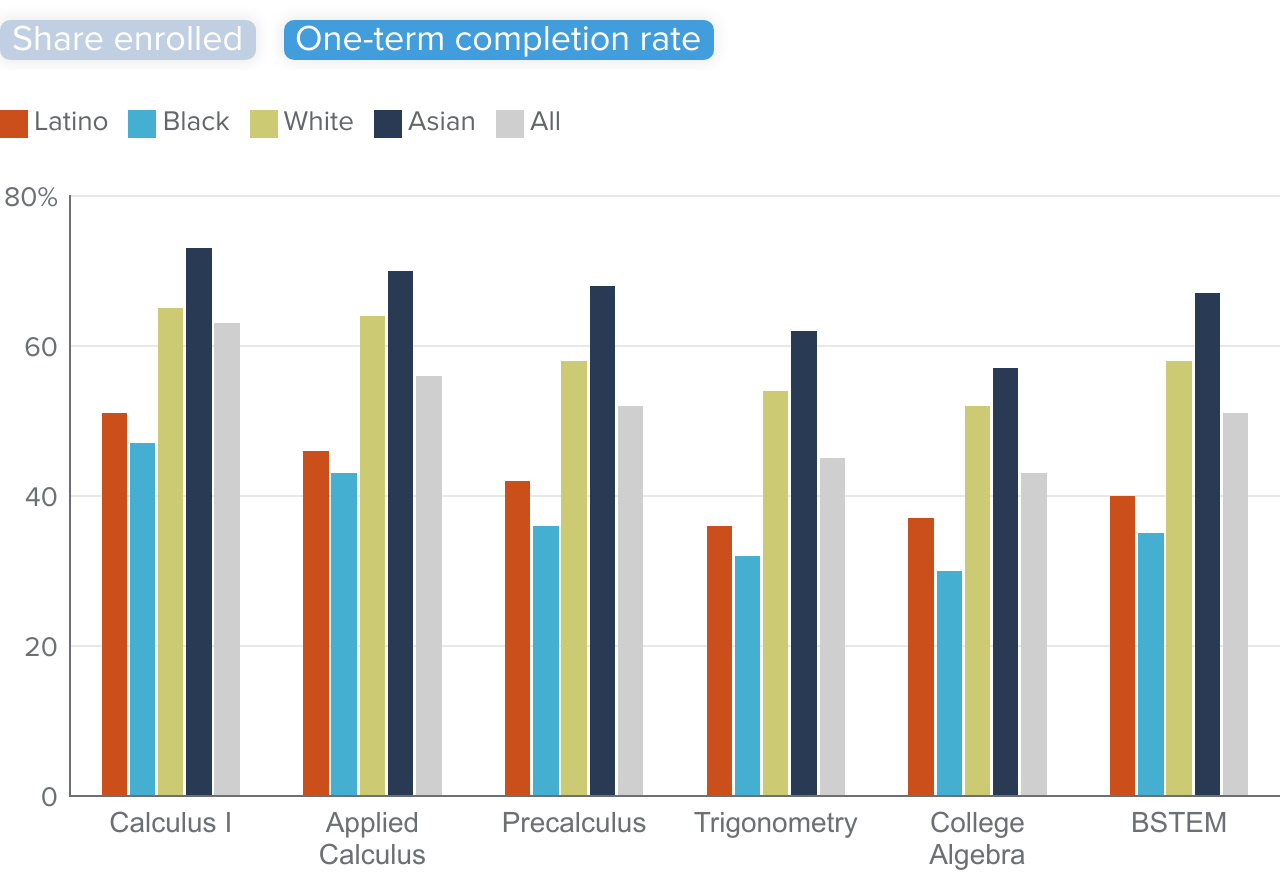
Latino and Black men starting in the BSTEM pathway are more likely than their white and Asian peers to take college algebra or trigonometry as their first course. Between fall 2019 and fall 2023, 37 percent of first-time BSTEM Latino men and 39 percent of Black men enrolled in college algebra compared to 29 percent and 19 percent of white and Asian men, respectively. Similarly, about 20 percent of Latino and Black men enrolled in trigonometry versus 16 percent of their white and Asian peers (Figure 8, first tab). These two courses have lower success rates compared to calculus I, applied calculus, and precalculus (Figure 8, second tab) as well as higher rates of attrition and lower Calculus I throughput (The RP Group 2024).
This enrollment gap may be partly due to the fact that Black and Latino students are less likely to have received the traditional math preparation for calculus in high school. However, Latino and Black STEM students who did complete advanced high school math are also overrepresented in preparatory coursework (The RP Group 2024).
Concerns about these preparatory courses were part of what Assembly Bill 1705 intended to address. Among other stipulations, AB 1705 sets new standards for placement and first math enrollment to ensure that students pursuing STEM degrees begin in transfer-level coursework that best positions them to complete calculus requirements. This legislation calls for colleges to provide evidence that STEM students benefit from enrollment in transfer-level preparatory coursework (e.g., College Algebra, Trigonometry, Precalculus) before they attempt Calculus I.
Recent research examined enrollment in the STEM calculus pathway and subsequent persistence to and completion of Calculus I and found that preparatory college coursework was associated with lower Calculus I throughput relative to direct enrollment in calculus across all levels of high school math preparation and placement (The RP Group 2024). This indicates that the fact that more Latino and Black men are starting in transfer-level preparatory coursework may have a negative impact on their progress toward a STEM degree.
Latino and Black men are more likely to start in college algebra or trigonometry than their white and Asian peers
SOURCE: Authors’ calculations using MIS data.
NOTES: First-time math male students starting in a transfer-level course in the STEM path. Average fall 2019 through fall 2023 cohorts. Tab 1: Enrollment distribution by first BSTEM course attempted. Tab 2: One-term completion rates by first BSTEM course attempted.
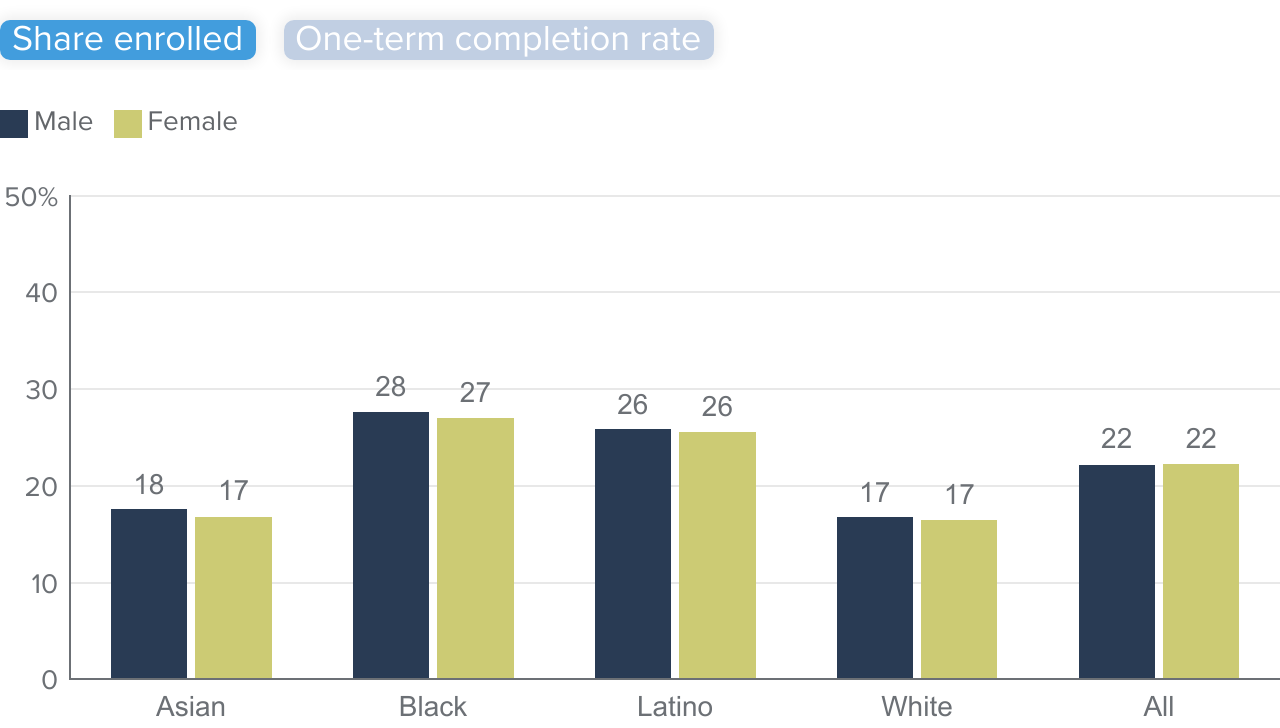
Latino and Black men are more likely to enroll in corequisite courses compared to their white and Asian peers but less likely to complete the courses. Corequisite remediation—a curricular model where students enroll directly into the transfer-level course and receive concurrent academic support—has been a key component in the AB 705 era. In fall 2023, more than 25 percent of Latino and Black first-time math students started in corequisite courses, compared to 17 and 18 percent of Asian and white students. Latina and Black women participate in corequisite courses at the same rate as their male counterparts (Figure 9, first tab).
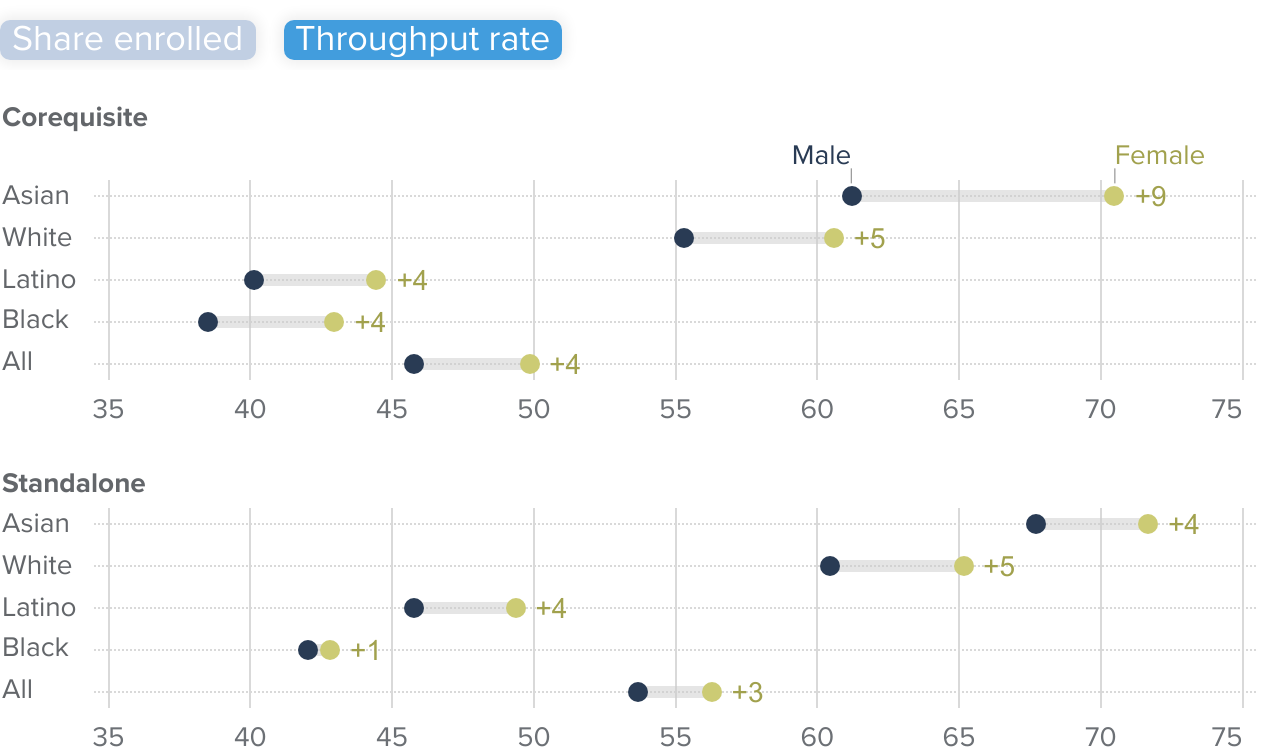
Among students who started in transfer-level courses with corequisite support in fall 2023, 40 percent of Latino men and 39 percent of Black men successfully completed it in one academic term—significantly below completion rates among white (55%) and Asian (61%) men.
One-term completion rates among students who took transfer-level courses without corequisite support (standalone courses) are higher among each group; however, completion gaps between Latino men and white and Asian men are of similar magnitude among corequisite students and students in standalone sections. Meanwhile, completion gaps between Black men and white and Asian men are slightly higher in standalone sections (Figure 9, second tab).
Latino and Black students are more likely to enroll in corequisite courses
SOURCE: Authors’ calculations using MIS data.
NOTES: Tab 1: Share of first-time math students in fall 2023 starting in a corequiste course. Includes enrollment in enhanced courses. Tab 2: One-term throughput rates and gender gap between female and male students.
Only about one in five Black and Latino men who are unsuccessful on their first attempt at transfer-level math complete the course in a second attempt. Among students who started in a transfer-level course in fall 2022 but did not successfully complete it on their first attempt, 20 percent of Latino and 17 percent of Black male students completed the course as of fall 2023, compared to 33 percent of Asian and 27 percent of white male students (Figure 10). About a third of Latino and Black students did not retake the course as of fall 2023 despite still being enrolled in the system. Finally, 23 percent of Latino men and 28 percent of Black men were no longer enrolled in the system after fall 2022. Unsuccessful Latina and Black female students leave the system at slightly lower rates.
Latino and Black men are less likely to complete transfer-level math after an unsuccessful first attempt than their white and Asian peers

SOURCE: Authors’ calculations using MIS data.
NOTES: Outcomes measured as of fall 2023. Based on 1,950 Asian women; 2,610 Asian men; 3,786 white women; 4,781 white men; 15,840 Latina women; 14,256 Latino men; 1,337 Black women; and 1,404 Black men who started directly in transfer-level math in fall 2022 but did not successfully complete it in their first attempt. In parenthesis is the share of each group in the total number of “unsuccessful” students (50,745).
AB 705’s Impact on Transfer and Completion Is Not Yet Clear
Despite the large completion gaps we have highlighted between Black and Latino men and their white and Asian peers, AB 705 has been a very successful reform. The number of Latino and Black men successfully completing transfer-level math in one term has increased by 94 percent and 114 percent, respectively, between fall 2018 and fall 2023. The importance of this change should not be overlooked: completing this early milestone significantly boosts these Latino and Black men’s chances of reaching their academic goals.
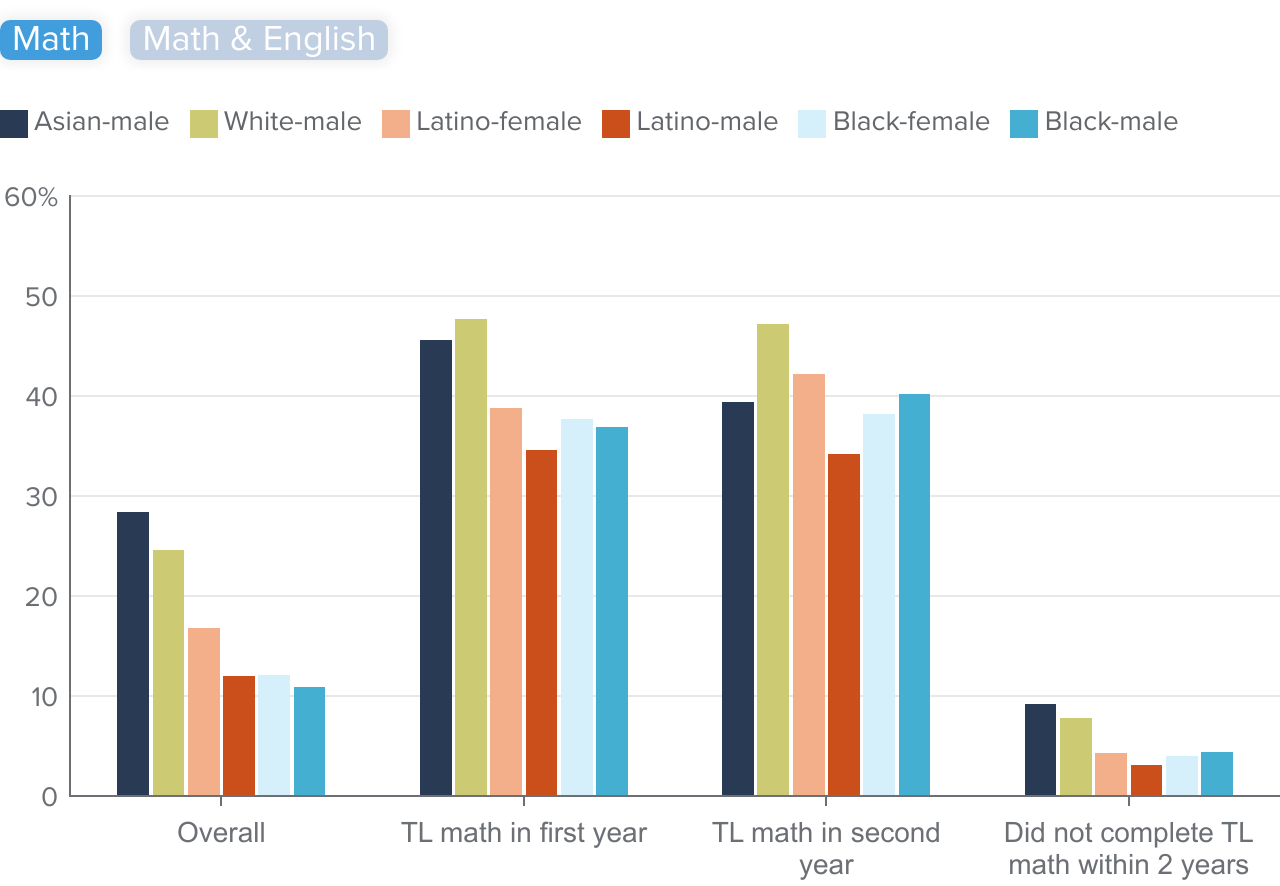
Over the next few years, we could see an increase in the number of students eligible for transfer. Figure 11 shows that transfer rates are significantly higher among students who successfully complete transfer-level math early in their community college career. For example, 35 percent of Latino men and 37 percent of Black men who successfully completed a transfer-level math course during their first year in community college transferred within four years. Transfer rates are about 5 and 8 percentage points higher for Latino and Black men who completed both transfer-level math and English during their first year (Figure 11, second tab). AB 705 implementation has enabled more students to reach this important early milestone in their first year in college, which could potentially translate into more students transferring in the medium term.
Transfer rates are highest among students who complete transfer-level math early
Four-year transfer rates
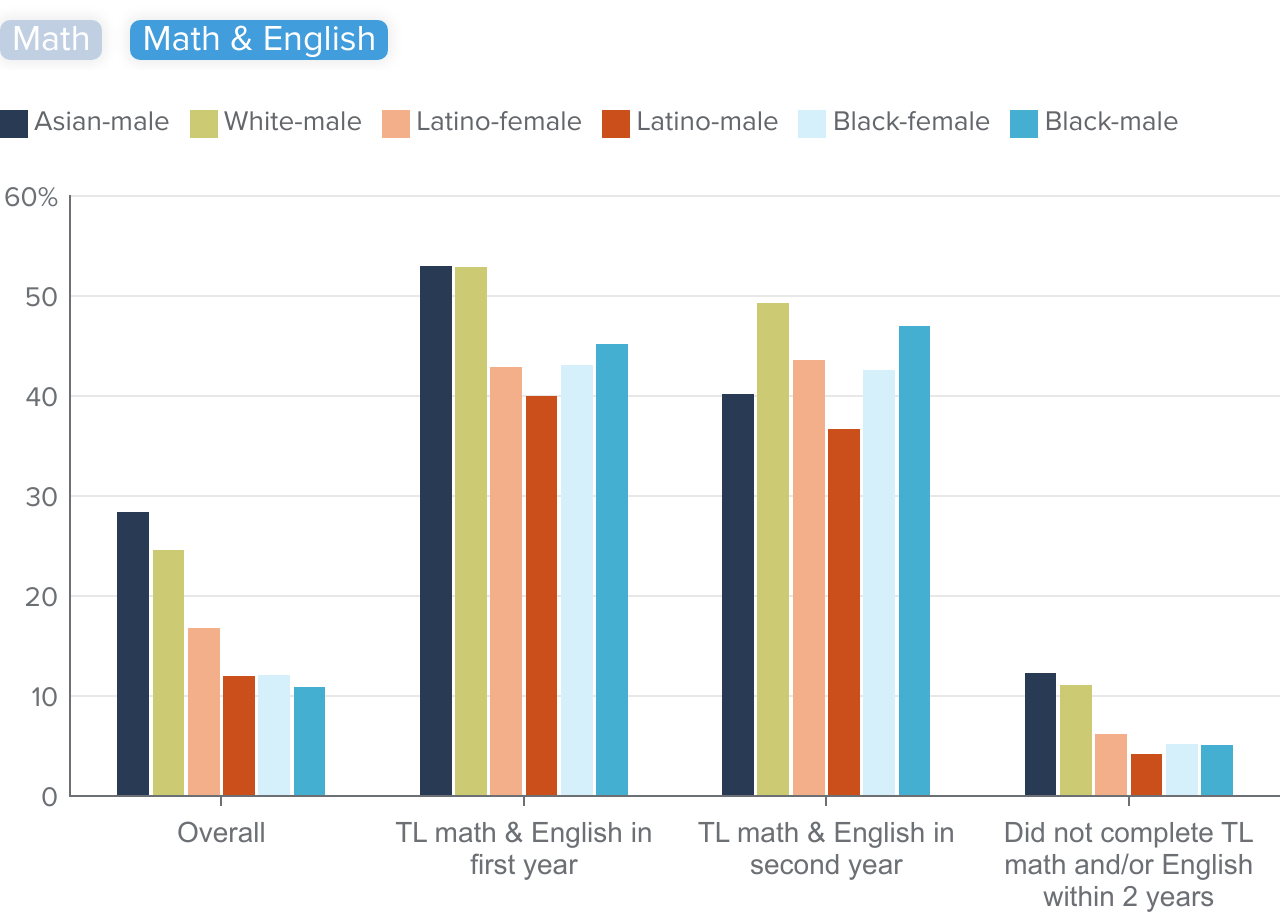
SOURCE: Authors’ calculations using MIS data.
NOTES: Fall 2019 cohort of first-time, degree-seeking/transfer-intending students. We identify students that transferred as those who earned at least 12 units as a non-special-admit student and were enrolled in a community college in the year before enrolling in a four-year institution. We follow enrollments in four-year institutions up until the fall 2023 term. Groups are mutually exclusive.
Comparing the fall 2015–entering cohort with the fall 2022 cohort, the share of Latino men successfully completing transfer-level math during their first year in college increased remarkably from 12 to 27 percent, and the share of Black men completing these courses in their first year rose from 6 to 18 percent (Figure 12). Likewise, the share of male Latino first-time students completing both transfer-level math and college composition during their first year increased from 7 percent to 20 percent. Black men saw smaller improvements, from 4 percent to 11 percent.
The share of students successfully completing transfer-level math during their first year has increased significantly post AB 705

SOURCE: Authors’ calculations using MIS data.
NOTES: Fall cohorts. Restricted to degree/transfer-intending students.
Persistence remains a key challenge. While expanded access to introductory transfer-level courses has helped many Black and Latino men make progress toward their educational goals, persistence remains a key challenge. As we see in Figure 13, among degree-seeking and transfer-intending students, 59 percent of Latino and 66 percent of Black male students are no longer enrolled in their fourth year since initial enrollment, and they left the system without attaining a degree or transferring. Latina and Black female students are 10 percentage points less likely than their male counterparts to exit the system. Asian and white students are less likely to leave the system, and gender gaps within these groups are narrower, compared to Latino and Black students. Among all students who were no longer enrolled in college, most left the system after their first year (Technical Appendix Table B7). It is worth noting the big contrast that exists in terms of four-year outcomes among those who completed transfer-level math in their first year and those who did not (second and third tabs in Figure 13).
Latino and Black men are significantly more likely to stop out than their peers
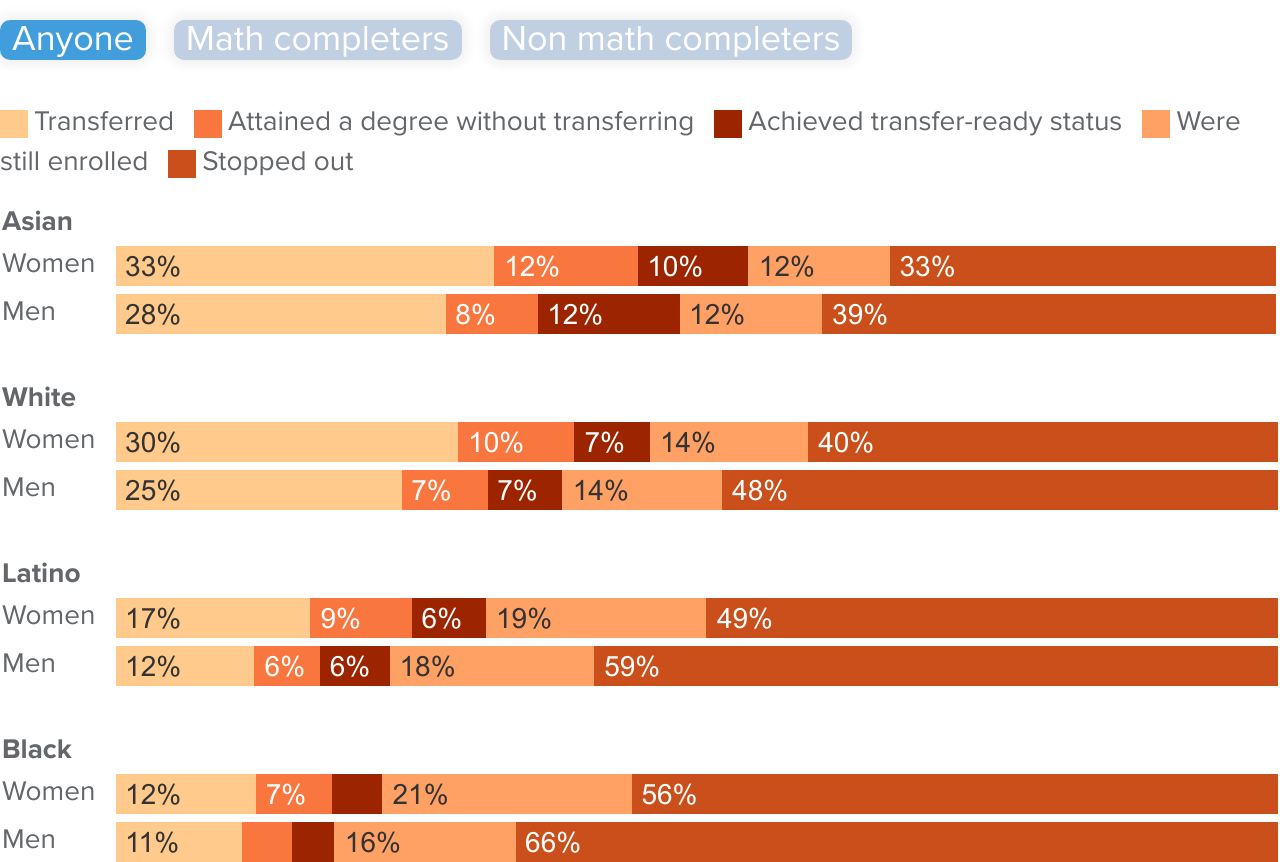

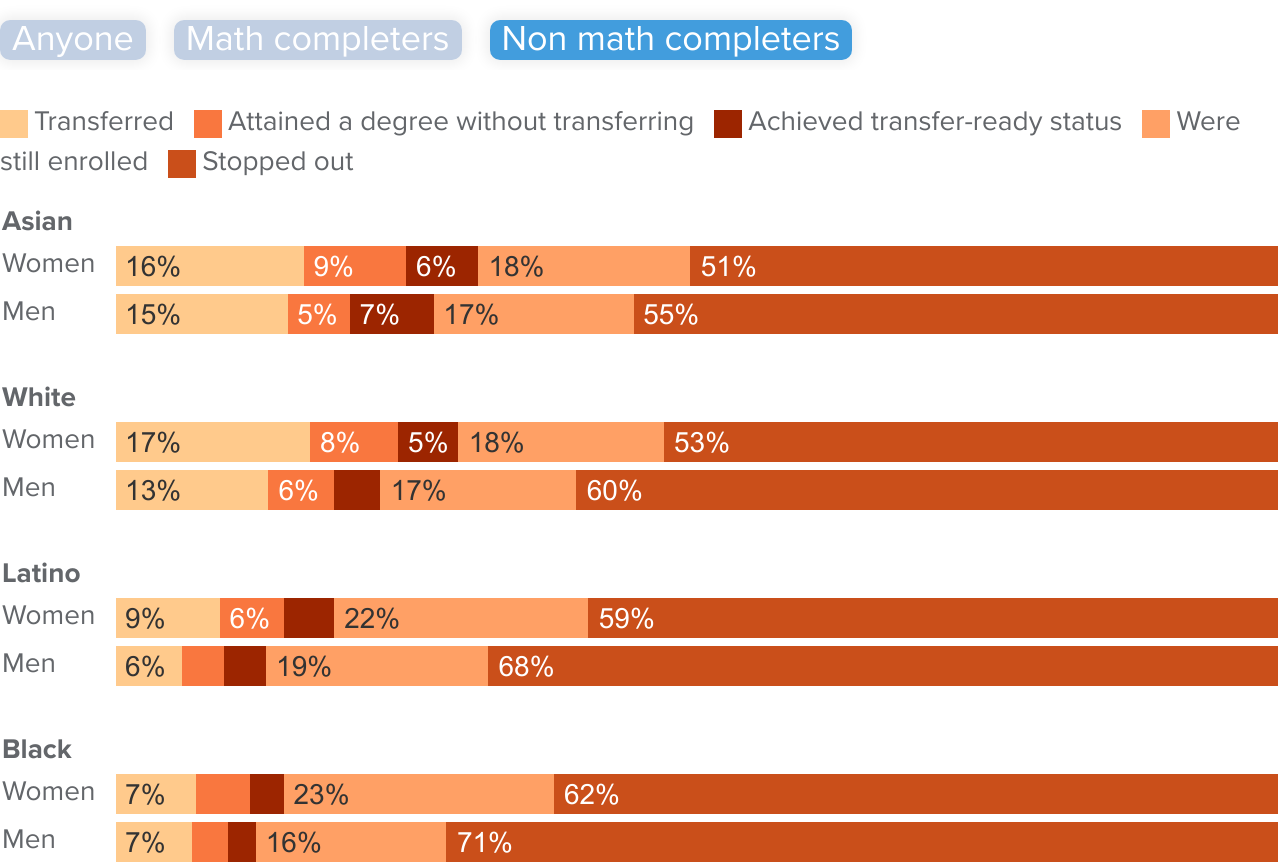
SOURCE: Authors’ calculations using MIS data.
NOTES: Tab 1: All first-time students. Tab 2: First-time students who completed a transfer-level math course in their first year. Tab 3: First-time students who did not complete a transfer-level math course in their first year. All analyses are restricted to the fall 2019 cohort of first-time, degree-seeking/transfer-intending students. We identify students who transferred as those who earned at least 12 units as a non-special-admit student and were enrolled in a community college in the year before enrolling in a four-year institution. We follow enrollments in four-year institutions up until the Fall 2023 term. All other outcomes are followed through the Spring 2023 term. Students achieve transfer-ready status when they complete 60 transferable units, including transfer-level math and English, with a GPA of 2.0. We identify students who were “still enrolled” as those that were enrolled in a least one credit course in the fourth school year after initial enrollment (between the Fall 2022 and Spring 2023 terms). Students who we identify as “stopped out” were not enrolled in what would be the fourth school year after their initial enrollment. We should note that some of these students may have re-enrolled and/or earned an award after the Spring 2023 term. They may also have transferred after the Fall 2023 term.
Strong labor market opportunities for workers without a college degree are luring many students—especially those experiencing economic hardship—away from community college. While students leave the system for multiple reasons—including college costs and loss of motivation (Nguyen and Cheche 2024), work seems to be an important driver. Wages are higher for young people than they were in the past. Between 2019 and 2023, low-wage workers experienced historically fast real wage growth, which has increased the immediate opportunity cost of attending college (Lafortune and Bohn 2023).
The trade-off is especially relevant among young men without college degrees, who tend to earn higher wages than their female counterparts. The typical Latino and Black male aged 18 to 27 with some college education earns about $27,000—13 percent and 35 percent more than the typical Latina and Black female, respectively (Figure 14). Latino and Black young men often find jobs in construction or warehousing, which pay significantly more than the jobs Latina and Black young women often land, such as in restaurants or retail.
Young men without college degrees tend to earn higher wages than their female counterparts
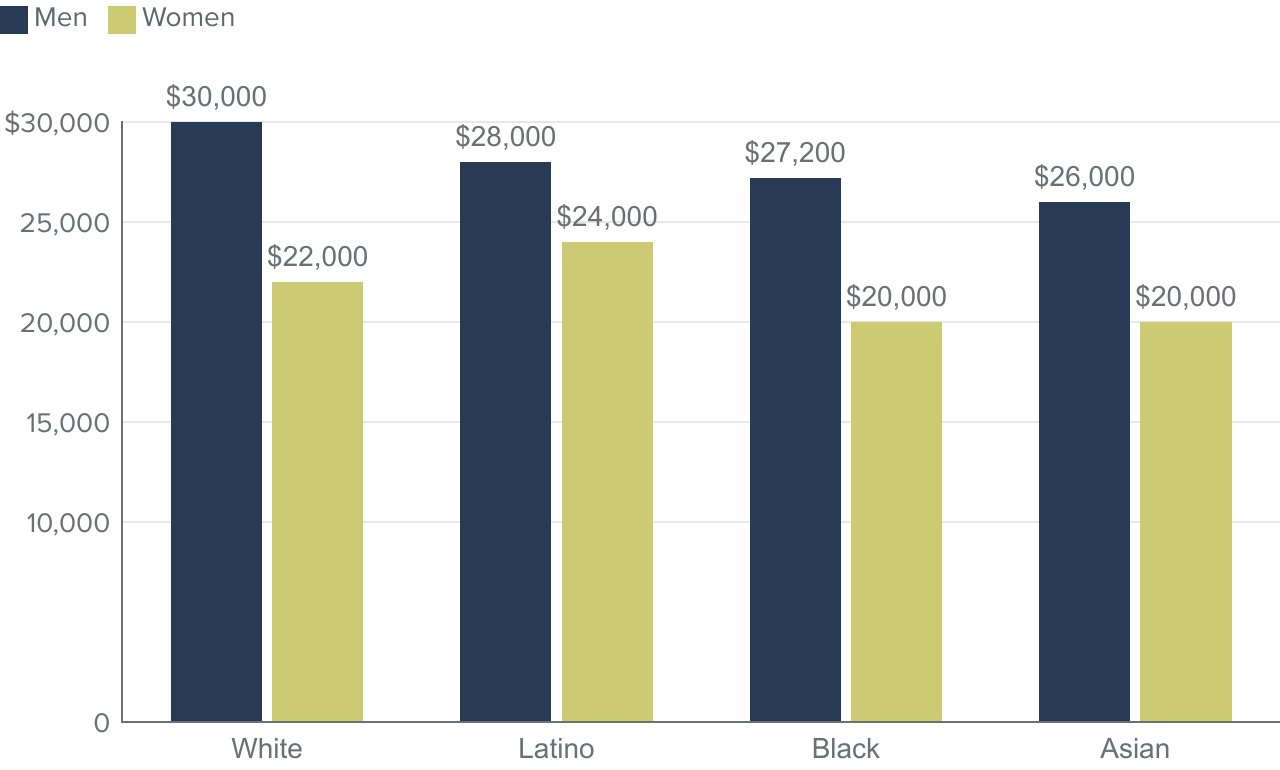
SOURCE: 2021 and 2022 American Community Survey, 1-Year Estimates.
NOTE: Median wages for adults ages 18 to 27 with only some college education and who are not enrolled in school.
While men who drop out of college do not face a significant wage penalty in the short term, the penalty accumulates significantly over time—especially for Black men. By the time they are in their thirties (28 to 38 years old), Latino and Black men with some college education but no diploma earn at the median $45,000 and $35,000, respectively, while their female counterparts with bachelor’s degrees earn 20 and 71 percent more. Thus, it is essential that young, current, and future students are given accurate information on their future wage potential and the long-term labor market prospects attached to college degree attainment.
In addition to more young Latino and Black men choosing work over school, we have seen an increase in young adults who are disconnected from both work and school. The number of Californians who are 16 to 24 years old, not enrolled in school, not employed, or not looking for a job increased sharply in 2020. While the number of disconnected youth declined in 2022, it remains above pre-pandemic levels (Payares-Montoya 2024). Black and Latino males are overrepresented among this population, making up 33 percent of disconnected youth but 28 percent of the total population in that age group.
Gains in introductory transfer-level math and English course completion will not translate to more Latino and Black students achieving their academic goals unless colleges are more effective at engaging, retaining, and supporting them throughout their college journey.
How Can Community Colleges Address the Needs of Black and Latino Men?
A critical challenge to specifically addressing the needs of Black and Latino men in college is that there are relatively few empirical studies on this student population. In their review of 70 academic articles, Huerta et al. (2021) report that they “found few quantitative studies exclusively focused on the experiences of men of color” and that “of the quantitative designs, the sample sizes were too small to generalize.” More empirical studies using big data are needed.
Furthermore, while qualitative research on Black and Latino men in college is growing, it has primarily consisted of single case studies, life histories, and broader-scoped theoretical and cultural analyses, as opposed to multi-site case studies with large sample sizes. Additionally, a lot of this work is specifically focused on neither community colleges nor effective programs to support Black and Latino men. The paucity of rigorous empirical data and analysis suggests that much more research is needed to fully understand the problems and solutions.
Still, the foundational work that has been conducted by researchers as well as practitioners should inform the next steps. In this section, we attempt to connect our findings to research, current practice, and expert insights gathered through two PPIC-organized convenings with key leaders and researchers in the space (see text box). Together, this work provides the basis of our research and policy recommendations.
Identifying and Addressing Factors that Affect the Educational Trajectories of Black and Latino Men
Harris III and Wood (2016) and Huerta et al. (2021) provide foundational analyses of the research on men of color in college, outlining the factors that have a significant impact on their educational trajectories. For our purposes, such factors can be broadly categorized as originating and/or prevailing at a societal, individual, or campus level.
- Societal factors include racist stereotypes, poor economic conditions, and systemic inequities resulting from historical exclusionary policies and practices—factors that are manifested at a broader level, yet inevitably shape students’ educational experiences as learners, often before they arrive on campus.
- Individual factors shape students’ educational identities, and can potentially be addressed by colleges, though they tend to be more deeply rooted. These include non-cognitive and psychological factors such as student’s self-confidence, self-efficacy, and perception of worthiness of a postsecondary education, which themselves are often shaped by broader stereotypes and societal perceptions. Huerta and colleagues also show that cultural factors, such as heightened economic pressures to fulfill the role of a breadwinner and stigmas against help-seeking behavior, similarly affect how men of color navigate higher education. Lastly, Harris III and Wood contend that more tangible environmental factors—such as employment opportunities, family commitments, and access to basic needs—constrain student’s ability to persist in their education.
- Campus-level factors are more easily addressed by colleges. These include a student’s access to and use of academic and student services, sense of belonging on campus, and relationships with other students, staff, and faculty.
These factors are widely applicable to broader groups of students. One conclusion from our quantitative findings is that while transfer-level course completion rates under AB 705 remain lowest among Black and Latino men, gaps between men and women are relatively small. This suggests that the focus of current policy and reform efforts to improve equity in completion should remain on reducing racial/ethnic gaps.
However, it is important to address the needs of men of color—specifically Black and Latino men—given that they still experience worse longer-term outcomes (Vasquez et al. 2020). Harris III and Wood (2022) argue that it is the “dynamic interactions that take place between and within these factors that ultimately shape student success for men of color in community college.” Thus, while the separate challenges faced by Black and Latino men may not be unique, it is the intersectionality of race and gender that often compound their significance and create challenging educational experiences.
Our second key conclusion from our quantitative work provides support for this argument. Disproportionately low progress made toward transfer among Black and Latino men reflects both significant disparities across racial and ethnic groups and generally larger gender gaps among Black and Latino students compared to their Asian and white peers. In turn, moving towards equity in transfer will, at least in part, necessitate targeting the intersectionality of race and gender (Camacho et al. 2021).
Improving introductory transfer-level course completion among Black and Latino students
Achieving racial equity in transfer-level course completion likely requires changes within the classroom and in course design. While more work is needed to identify student needs and find effective ways to address them, colleges could focus on several key areas.
Course instructors. Research on introductory transfer-level math completion in California’s community colleges shows that faculty are the most crucial factor in determining a student’s success in the course (Dadgar et al. 2023). Specific instructional practices, such as providing students with feedback and opportunities for growth, offering accommodations equitably, and encouraging students to seek support, are positively associated with successful math completion, especially among Black and Latino students. Dadgar and colleagues (2023) also point towards the important role instructors play in addressing critical campus-level and societal factors by fostering belonging and directly addressing racial equity within the classroom. Other research has similarly emphasized that students’ sense of faculty availability and sympathy is critical for students’ help-seeking behavior (Lancaster and Lundberg 2019).
Still, Dadgar and colleagues (2023) concede that more work is needed to scale effective pedagogical and classroom practices, as well as investigate the types of supports faculty need in order to adopt evidence-based instructional practices. Insights from our convenings with experts and practitioners shed light on the need for more research on how instructors can better listen to understand students’ cultures, and how cultural factors influence their behaviors and choices in college. For example, extensive research has documented the harmful impact of stereotype threat on Black and Latino men (Camacho 2021; Fischer 2010; Steele 1997). When students experience negative stereotypes of their racial and/or ethnic group, it can make them hyperaware of their identities and impact their academic performance.
Corequisite courses. Corequisites have the potential to motivate help-seeking behavior, address potential psychological obstacles, and remove barriers to accessing key academic support. Yet there are questions about the persistence of equity gaps in corequisite course completion. Research from Texas community colleges, which serve large numbers of Latino and economically disadvantaged students, suggests that corequisites are more conducive to student success than traditional prerequisite remediation (Meiselman and Schudde 2022; Miller et al. 2021). Our previous work found that corequisite courses at some colleges were actually contributing to more equitable outcomes in transfer-level English and math, producing higher completion rates among Black and Latino students compared to standalone courses (Cuellar Mejia et al. 2023). At other colleges, however, corequisites produced worse outcomes and were not narrowing equity gaps.
Much more research is needed to understand why corequisites may be seeing success and growth in some contexts and not in others, including determining the impact of differences in student composition across colleges, as well as variation in college-determined factors such as course design and placement practices. Participants from our convenings also suggested that more work is needed to determine how corequisite courses can help validate and affirm men of color, specifically.
Learning communities. Across the CCC, the Puente and Umoja learning communities have established a key foundation to build upon instructional and classroom innovation aimed specifically at improving outcomes among Latino and Black students. These learning communities take an interdisciplinary approach by incorporating instructional, counseling, and mentoring components, generally aimed at Latino and Black students who plan to graduate and transfer to four-year institutions. Staff from these programs provide rigorous training on culturally relevant and responsive pedagogy and curriculum, as well as help colleges implement programs and strategies to support students better.
Research suggests that these programs are effective. A pre–AB 705 study found that Umoja students were approximately twice as likely as their non-Umoja peers to complete transfer-level English (50% vs. 26%), and 8 percentage points more likely to complete transfer-level math (18% vs. 10%) in three years (Purnell et al. 2019). Umoja students were also more likely to persist across terms, earn an award, and make progress toward transfer. Other research has similarly found better outcomes among Puente students, including in transfer-level course completion. Still, more work is needed to evaluate the impact of these programs in the context of AB 705. Additionally, the reach of these programs remains limited—only about half of the system has programs like these and participation is low.
Improving transfer rates among Black and Latino men
Improving longer-term outcomes among Black and Latino men in community college likely requires tailored supports that effectively address the specific factors inhibiting their progress towards transfer. In line with their theoretical frameworks, Huerta et al. (2021) and Harris III and Wood (2022) have published detailed recommendations.
Centering student experiences. To address the societal and individual factors that might uniquely affect Black and Latino male students, the authors emphasize the need to center student experiences and build the capacity among educators, through professional development, “to serve men of color more equitably and responsibly” (Harris III and Wood 2022). A challenge to meeting this need is that many professional development activities tend to avoid race altogether (Hernandez-Hamed et al. 2020). Additionally, more coordinated efforts around providing basic needs can help reduce the burden of resource constraints (Olaniyan et al. 2023), while deliberate efforts to connect students to career pathways may address cultural factors that could disincentivize investing in higher education.
Boosting self-confidence and motivation. The authors suggest that practitioners and faculty help boost students’ self-confidence and motivation, create culturally engaging campuses, and redefine traditional ideas of masculinity that may influence student approaches to education. Such recommendations are inherently difficult to implement because they require practitioners with competencies to serve men of color and broader cultural shifts within institutions. Furthermore, more research is needed to understand the effect of adopting such strategies, and identifying the campus policies and practices that are most effective in meeting the needs of Black and Latino men, specifically. Participants from our convenings similarly suggested that more research is needed on how the intersection between culture and masculinity may inform decisions by men of color about, and navigation of, specific career pathways.
Fostering a sense of community and belonging. To address campus-level factors that affect the educational trajectories of men of color, including their sense of belonging and connection to their college, Huerta and colleagues (2021) provide recommendations that are more immediately actionable. The authors argue that instituting mentorship and peer-advising programs is crucial to developing relationships, fostering a sense of community, and promoting help-seeking behavior. In addition to professional development aimed at improving pedagogy, the authors also recommend that colleges institute allyship training to help faculty and staff better support and work with men of color on campus. Lastly, the authors advocate for the cultivation of men-of-color- specific spaces that feel safe and supportive to Black and Latino men and inform strategic efforts to improve college completion.
Leveraging Current Efforts to Support Black and Latino Men in Community College
Many men-of-color-specific programs at California community colleges provide a range of services, including academic counseling, tutoring, transfer and graduation support, mentorship, scholarships, networking opportunities, and community building. Importantly, they directly address the campus-level factors—sense of belonging and relationships—that have been shown to affect the educational trajectories of Black and Latino men. Given their reach and diversity in personnel and expertise, such programs and initiatives also help address key psychological, cultural, and environmental factors that affect men of color’s educational identities while informing instructors on effective pedagogical and classroom practices. Yet, considering that men of color continue to have lower academic success, more work is needed to leverage the expertise and scale the reach of these targeted efforts.
It is challenging to scale effective programs and practices. For one thing, programs that support Black and Latino men are often adopted unevenly across colleges. An analysis of community college student equity plans found that promising practices such as early alert systems in gatekeeper courses are not used consistently (Harris III et al. 2017). Some practitioners fear that these systems could be used in performance evaluations or infringe on academic freedom. This underscores the importance of providing high-quality professional learning experiences to full-time and part-time faculty and staff.
Relatedly, Harris III and colleagues (2017) argued that to support men of color, educators must have opportunities to learn competencies and characteristics of an effective instructor of men of color. Participants in our convenings similarly suggested that instructors are unprepared to include course curriculum that affirms men of color or discuss concepts like academic help-seeking, stereotype threat, and gender inclusion.
Experts who participated in our convenings also noted that Black and Latino men are frequently viewed through a deficit lens—not viewed as “college material” and assumed to be ill-prepared for higher education. Programs and services can help men of color, specifically Black and Latino men, to unlearn problematic stereotypes about their identities. Bush and colleagues (2023) argue that community college students, especially Black men, must frequently leave their identities at home in order to navigate higher education systems that are rooted in Eurocentric values. Participants in our convenings argued that colleges need to make a broader cultural shift and reassess their role in helping students achieve success.
Given these challenges, what ought to be done to better support men of color? Recommendations suggested during our convenings focused on curriculum, data practices, and the hiring, training, and recruitment of faculty with proven track records teaching diverse groups of students. A student right-to-know campaign and policy to have more data transparency on faculty course success rates disaggregated by race and ethnicity was suggested by convening participants. The goal of this proposed idea is to help students make more informed choices about their courses and instructors, at least until training and professional development is provided for all faculty and staff. Colleges that have done this have found that it helped departments unpack existing racial inequities and take steps toward eliminating them (Sosa et al. 2018).
In the classroom, participants noted that work-based learning can provide students with relevant workforce skills, especially in English and math courses. Revised minimum qualifications for community college faculty that emphasize equity and teaching competencies to serve diverse group of students were also recommended. Finally, participants frequently emphasized that more research is needed on how to successfully expand the model of men-of-color-specific initiatives like A2MEND, MOCAN, and male success centers that are seeing success at a small scale but have yet to reach a substantial share of students across all of the state’s colleges.
Conclusion
AB 705 has dramatically transformed the community college landscape in California by expanding access to a key early milestone in the transfer pathway. Access and success have increased significantly, but large racial and ethnic gaps in completion rates persist—Black and Latino students, in general, continue to see lower success in transfer-level math and English than their white and Asian peers. And while gender gaps across racial and ethnic groups in introductory transfer-level course completion are relatively narrow, they widen along the pathway toward college completion: Black and Latino men continue to have significantly lower rates of transfer and degree attainment and higher rates of stopping out than their female counterparts.
Increases in access have, thus far, been the main driver of progress in successful transfer-level course completion among Latino and Black men. To further advance student success now that there is universal access, colleges will need to determine how to better address academic and non-academic needs. There seems to be consensus among experts in the field that high-touch, holistic, student-centered supports can help increase retention and success.
Persistence continues to be the biggest challenge. Strong short-term labor market opportunities for those without a college degree are likely luring away students, especially Latino and Black men, who are less likely to be enrolled full time. This pull toward work is intensified by the systemic inequalities that Latino and Black men face throughout their college experience. More work is needed to understand why many students—including many who do complete introductory transfer-level courses—are leaving the system before they earn a degree or transfer and how best to support them throughout their community college journey. Men of color are significantly more likely to stop out than their peers, a gap that has not meaningfully narrowed since systemwide implementation of AB 705.
More quantitative research is needed on how programs targeted towards men of color impact their postsecondary outcomes. More quantitative research is also needed on which corequisite models are working for students of color, and men of color in particular. To some degree, such research relies on making data more available. At the same time, however, a more collaborative use of data, especially between institutional research offices and faculty, is needed to ensure the practices that are scaled are evidence-based and the students and areas in need of more support are identified with enough time to provide effective intervention.
Experts who participated in our Men of Color in College convenings consistently pointed to the need for college administrators and faculty alike to commit to better serving men of color. This includes championing curricular, structural, and broader cultural reform efforts that directly address the societal, individual, and campus-level factors that have been shown to affect the educational trajectories of Black and Latino men.
From the perspective of our convening participants, key cultural and environmental factors such as heightened economic pressures and short-term employment opportunities should be addressed by a stronger emphasis on work-based learning and providing students with stronger connections to career opportunities. Similarly, the prevalence of negative stereotypes and systemic inequalities, which lead to low self-confidence and self-efficacy, should be countered by a stronger emphasis on professional development that can equip faculty and student services staff with the pedagogy, tools, and resources needed to serve men of color more effectively.
A more immediate need is to develop or expand men-of-color-specific spaces and mentorship programs that help connect students to academic and student services; build stronger relationships between students, staff, and faculty; and cultivate a broader sense of belonging. These kinds of ambitious initiatives are not without precedent; some colleges and instructors are already employing them. While more research is needed to design new solutions, it is equally important to expand efforts that are working.
Topics
Access Equity Higher EducationLearn More

Testimony: Remarkable Progress in Student Success Spurred by Reforms at California’s Community Colleges

Video: How Are Black and Latino Men Faring after Developmental Education Reform?

Without School or Work, Some California Youth Are Left Disconnected from the Economy

College Gender Gap Starts Early and Extends across Races

Tracking Progress in Community College Access and Success

Community College Math in California’s New Era of Student Access