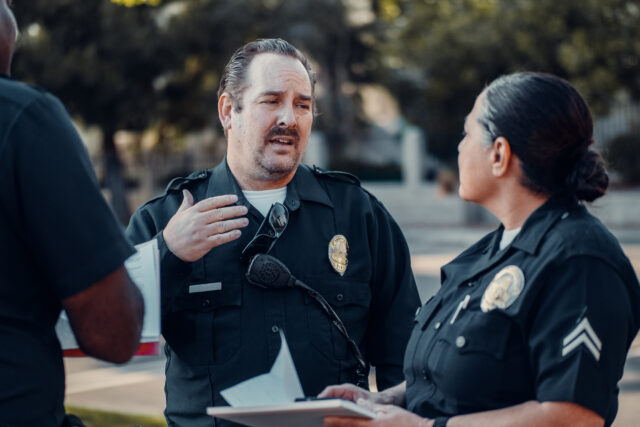
In recent years, California has seen increased interest and investment in improving response options for behavioral health crises using intervention teams that include health providers either as alternatives to or in collaboration with law enforcement agencies. There is growing evidence that these types of teams can improve outcomes by reducing reports of crime and arrests and increasing access to medical services. But law enforcement agencies are still first responders to many behavioral health crises. What do we know about these interactions?
Behavioral health issues—due to mental health conditions and/or substance use—can contribute to erratic behavior and an inability to follow verbal commands, which can escalate a law enforcement encounter and create safety risks for all involved. In the most extreme cases, these interactions can lead to serious injury or death. In addition, declines in law enforcement staffing over the past decade mean that police departments may have limited capacity and/or training to respond to behavioral health calls. In fact, some agencies are working to respond to fewer of these types of calls.
The Racial and Identity Profiling Act (RIPA) of 2015 requires California law enforcement agencies to report data on each stop, including their perceptions of whether an individual has a mental health condition and/or disability. RIPA reporting does not include perceptions of substance use. The eight largest police departments stopped 2 million individuals in 2023; they reported that 2% had either a mental health condition and/or were put on a psychiatric hold because they posed a risk to themselves or others (about 41,000).
There are relatively large differences across the state in the share of police encounters where officers perceive mental health conditions, disabilities, and/or place someone on a psychiatric hold. For example, the Oakland Police Department reports considerably higher shares of behavioral health conditions than PDs in other cities. San Diego PD reports that over 4% of encounters lead to psychiatric holds, while Fresno PD and San Jose PD report less than 1%. And Sacramento PD and San Francisco PD report relatively high shares of encounters with people with disabilities.
While we do not have information on all injuries incurred during police encounters, AB 71 (passed in 2015) requires all law enforcement agencies to report detailed information on serious injuries and deaths among officers and community members during police encounters to the California Department of Justice (DOJ). Here we focus only on injuries to community members. According to DOJ Use of Force Incident Reporting data, many individuals who are seriously injured or killed each year during encounters with law enforcement seem to be struggling with behavioral health issues.
On average, about 435 community members were seriously injured and 150 were killed during law enforcement encounters in California each year between 2017 and 2023. In nearly half of use-of-force incidents that resulted in serious injury or death, the person injured was armed with a dangerous weapon—about 45% among those with at least a serious injury and about 80% among those killed.
More than half of these incidents also involved reported behavioral health conditions. About 40% of serious, nonfatal injuries involved a reported drug or alcohol impairment and 30% involved a reported mental health condition, including “erratic behavior.” As with the RIPA data, these reports are based on officer perception; however, a 2021 PPIC report found that this data corresponded with hospital discharge records.
Mental health conditions were reported in a higher share of fatal injuries—over 40% each year from 2017 to 2020, ticking up to nearly 60% in 2022. While the share seemed to decline in 2023, reporting changes in the DOJ use-of-force data make comparisons less reliable. Over the same period, only about one in five law enforcement encounters resulting in death recorded a drug or alcohol impairment.
California is continuing to refine its approach to behavioral health crises and investing billions in increased treatment capacity. The passage of the CRISES Act (AB 118) in 2021 marked a step toward supporting community-based crisis intervention through state grants, and now Medi-Cal has funding to further bolster these efforts. In parallel, some cities—such as Stockton—are experimenting with strategies such as creating registries of individuals with behavioral health challenges to help officers de-escalate encounters. Ongoing evaluation of how these resources are allocated and the impact of alternative response models on both individual outcomes and public safety will be essential.