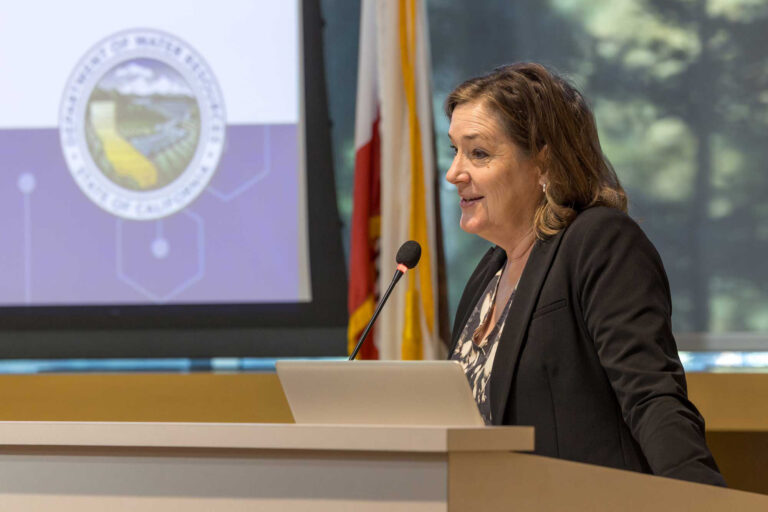

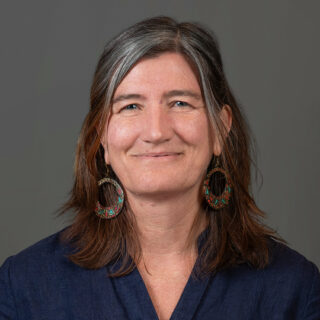
California Department of Water Resources (DWR) director Karla Nemeth left the department last month after nearly nine years of service. Before she takes over as the director of the Association of California Water Agencies (ACWA), we sat down with her to talk about how DWR changed during her tenure, what (still) keeps her up at night, and what advice she’d offer California’s next governor.
Why has managing water at DWR become so complicated?
DWR was established in 1956, after a devastating flood in northern California. World War II veterans were drafted to engineer a huge system that would deal with flooding and move a lot of water vast distances for water supply. So a very linear era with narrow objectives birthed both the State Water Project and the department. We live in a very different world today. With extreme weather and older infrastructure, both day-to-day and season-to-season management are much harder, and the cumulative damage to groundwater basins and river systems over the last 100 years is catching up with us. The stakes are just off-the-charts.
We started bringing together 300 DWR experts, supervisors, and managers for one big meeting, twice a year. Every fall we’d talk about how the water year was setting up, flood and drought risks, information gaps, and opportunities to manage better. Then every spring, we’d talk about how the water year went. When you have engineers, operators, geologists, hydrologists, and biologists all comparing notes, it can get pretty creative. Everyone starts to understand the value of managing State Water Project pumps, groundwater recharge, or floodplains for fish in real time. And we all fell in love with better forecasting—I know I did!
What are you most proud of?
I’m proud that the department became expert implementers of groundwater management. When the groundwater legislation was signed, we knew it was the most important piece of water legislation in at least a generation. It’s a huge thing to be entrusted with a brand-new program—one that needed governance, technical expertise, and regulatory decisions. There’s much more to do—groundwater management lies in its implementation—but I think DWR’s done a good job.
I’m also proud of our leadership culture around multidisciplinary science. We’ve integrated not just across disciplines but across the people managing an emergency, the people doing long-term planning, and everyone in between.
We’ve also made it safer to try new things. We can and do disagree, but in the end to make progress we have to commit. Part of that involves revisiting decisions without recrimination. That gets everybody more comfortable with incremental risk-taking, because everybody’s learning and following new information as it becomes available.
What does the future hold for the Sacramento–San Joaquin Delta?
I worry about the Delta all the time. It faces physical challenges with climate change and political challenges with emotions that run high. Despite years of downsizing, the tunnel project remains an unfortunate diversion from the Delta’s broader issues. I worry about levees threatened by seepage underneath them as much as overtopping. The state can and should deal with both Delta conveyance and levees. I’ve hoped for a partnership, but that’s been stalled for the last eight years. I find that heartbreaking.
What’s the future of the Central Valley Project and the State Water Project?
That also keeps me up at night. It’s nearly impossible to overstate the enmeshment of the State Water Project and the federal Central Valley Project. Deep cuts at the Bureau of Reclamation are concerning, and I’m worried that the system’s not performing as well as we’ve come to expect. We need to get as much as possible out of these projects to meet urban, agricultural, business, and environmental needs, and that will take ongoing and unprecedented cooperation. They have always been two parallel systems. In 2010, along with many other water governance reforms, the Little Hoover Commission explored the benefits of merging them. It’s complicated, but in this age of climate and affordability pressures, enabling our system to work more efficiently and reliably may be enough to motivate us to work through the potential.
What advice would you give the next governor?
If I could sit down with the next governor, I would first urge him to become familiar with the incredibly dynamic nature of California’s hydrology and how we manage it. The organizational structures we have in place today won’t meet the water challenges we already face, much less those in the near future. We will have to evolve. Water needs are intensely local and diverse. Listen to everyone—but challenge them to be part of a vision for the whole state.
Second, get behind the backbone infrastructure projects: large-scale groundwater recharge, large-scale water recycling, the tunnel, and Sites Reservoir. They are big, but they are the most affordable solutions over the long haul. Don’t let a single project take all the oxygen in the room. We need them all, and they work together: surface water, groundwater, recycled water.
Finally, I would remind him that DWR doesn’t solve everything, but it can be better a better partner to local water districts, regulatory agencies, environmental groups, and environmental justice groups, just by doing the work it’s already doing better. Help your departments do that.
My list is much longer than that, but that’s enough. There’s water work to be done in every part of the state. I loved my time at DWR, and I’m looking forward to taking the helm at ACWA. I want to see ACWA at the forefront of consequential water management strategies that set California up for the next century, including passing the baton to the next generation of water leaders—and preparing them to run with it.