

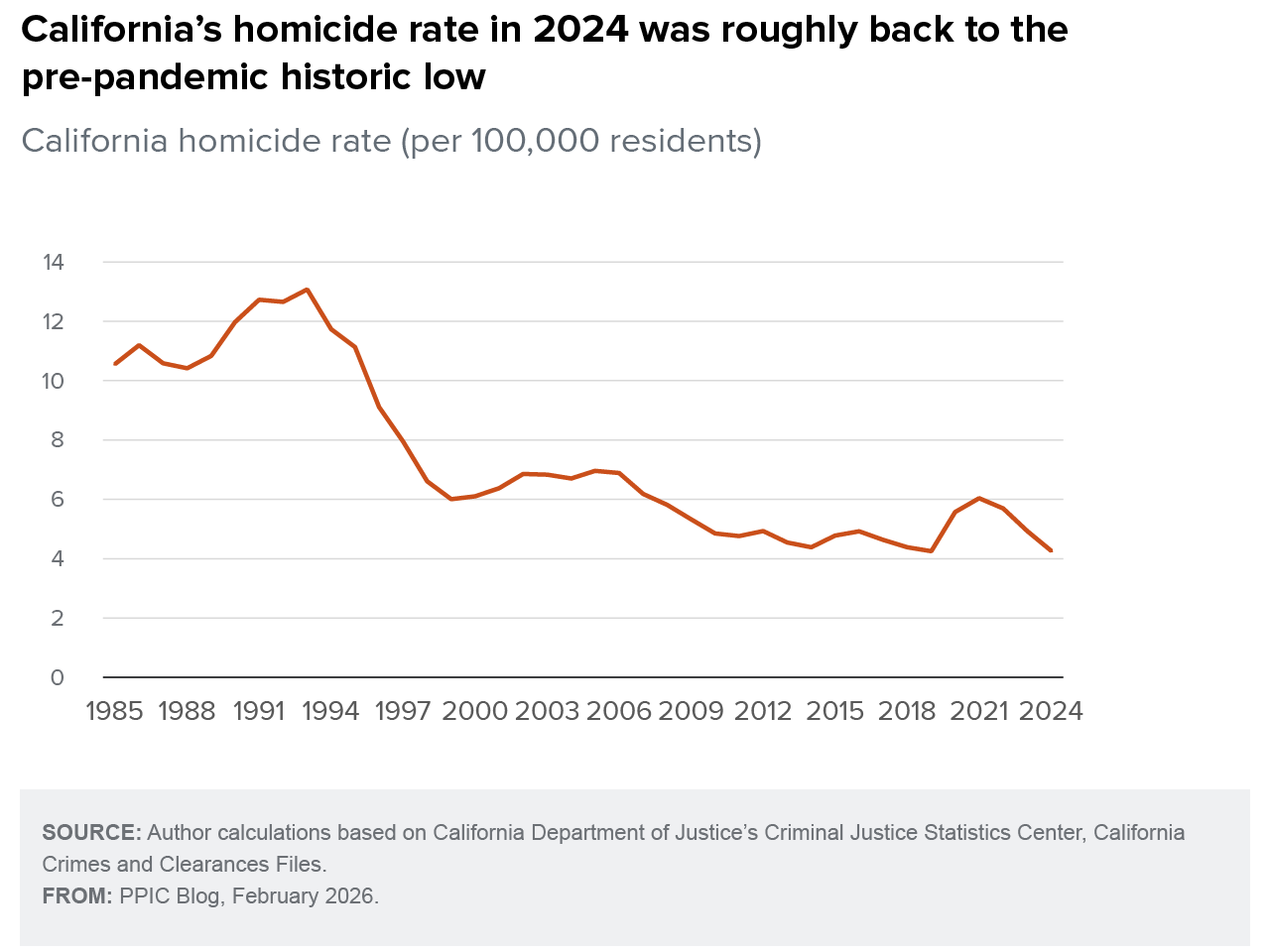
Homicides in California—and the nation—surged during the early years of the pandemic. But recently they have been on the decline, and after a 13.5% decrease in 2024 (the year of latest data), the homicide rate in California has returned to historic lows. The 2024 decreases are widespread throughout the state, including in 12 out of 15 of the most populous counties. To examine this trend more closely, we use official crime numbers from the California Department of Justice (CADOJ). (For more on crime data sources and competing findings—including reports of steeper declines in homicides—see below.)
Just before the pandemic hit, California’s homicide rate had reached a historic low: 4.2 homicides per 100,000 residents in 2019. It then surged to 6 homicides per 100,000 residents in 2021. Since then, it has been on the decline, reaching 4.3 in 2024. In fact, the number of homicides in 2024 was lower than the number in 2019 (1,670 and 1,690 respectively), but given the California’s population decline, the rate in 2024 is slightly higher.
Monthly numbers show that the surge in homicides started during the first few months of the pandemic and remained elevated until summer of 2021. Since then, while seasonally fluctuating, the number of homicides per month has trended down and by December 2024 it reached 110, the lowest monthly number reported since at least 1985.

The 2024 decrease in homicides was widespread across the state. Twelve of California’s 15 most populous counties saw decreases. Homicides decreased by least 10% in 10 of these counties and by at least 20% in four of them, all in the San Francisco Bay area (San Francisco, San Mateo, Santa Clara and Alameda). In nine of these large counties, the 2024 homicide rates were below pre-pandemic levels. But in four of them it was still 20% or higher in 2024 than in 2019: Alameda (39%), San Joaquin (28%), San Mateo (23%) and Los Angeles (20%). Ventura County is the only outlier within this group of large counties, with an increase of 14% in 2024—but Ventura had one of the lowest homicide rates in the state and also did not experience a surge during the pandemic.
Homicides decreased notably in mid-size counties—those with a population between 100,000 and 550,000 residents (by 32% in counties with populations between 250,000 and 550,000, and by 24% in counties with population between 100,000 and 250,000). But they increased by 10% in counties with populations of less than 100,000 residents. Despite the increase in smaller counties, their homicide rates remain below pre-pandemic rates—as it did in the mid-size counties.

The obvious question is, what caused this widespread decline? Since it occurred across the state—and the country—we need to look for broad factors. And given that it appears to reflect a return to the previously low pre-pandemic rates, a good starting place is to consider what led to the unprecedent sudden increase in 2020. While it is impossible to identify the full range of specific causes, plausible contributing factors involve the broad and truly significant disruptions aimed at preventing the spread of the COVID virus.
All parts of the criminal justice system were affected, preventing law enforcement, corrections, and courts from operating the way they did before the pandemic. Other notable disruptions included shelter-in-place policies, school closures, and a temporary spike in unemployment. The pandemic also significantly limited the ability of local governments and community-based organizations to provide support and services, including violence prevention programs.
One important example of the challenges caused by the pandemic: law enforcement’s ability to solve crime, typically measured by what is known as the clearance rate. This rate decreased during the pandemic—very notably so for homicides, from about 65% 2019 to 55% in 2021. Clearance rates for all major offense categories increased in California in 2024, and for homicide it is essentially back to the pre-pandemic level.
Today, the deep disruptions cause by the pandemic have mostly disappeared. The decrease in homicides is especially encouraging, and monthly 2024 data, along with preliminary crime data for 2025, suggest continued declines. Nonetheless, crime rates are subject to notable swings. Continued monitoring of crime trends, and more efforts to identify drivers of these trends, are essential.
An important note on crime data. A recent, widely-cited report from the Council of Criminal Justice (CCJ) looked at national crime trends in US cities, including Long Beach, Los Angeles, and San Francisco. Because their sources differ from ours, they analyzed trends through 2025—and found much steeper declines in homicides.
The CCJ report includes a caveat that some of the preliminary homicide numbers they use do not line up with other sources. This includes findings for Los Angeles: the CCJ numbers indicate 140 homicides in 2025 whereas the preliminary LAPD reported number is 230. Our analysis of 2024 numbers also show notably fewer homicides in the CCJ report (216) than those from CADOJ (280). Using the preliminary LAPD numbers for 2025 and CADOJ numbers for 2024, we find a decrease in homicides in Los Angeles in 2025 by 22%, compared to 44% in the CCJ report.