
In a special statewide election last fall, California voters approved Proposition 50, a congressional districting gerrymander designed to help Democrats gain five US House seats in response to a pro-Republican gerrymander in Texas. There was no guarantee the measure would be successful, but it ultimately passed by a large margin. A closer look at voter turnout reveals an important reason for this success: Democratic voters turned out at especially high rates, even as the composition of the electorate in other respects was largely unchanged from 2024. To the extent that it reflects widespread Democratic enthusiasm, this turnout bodes well for the party in the midterm elections. But it offers a mixed message about the broader representativeness of the electorate.
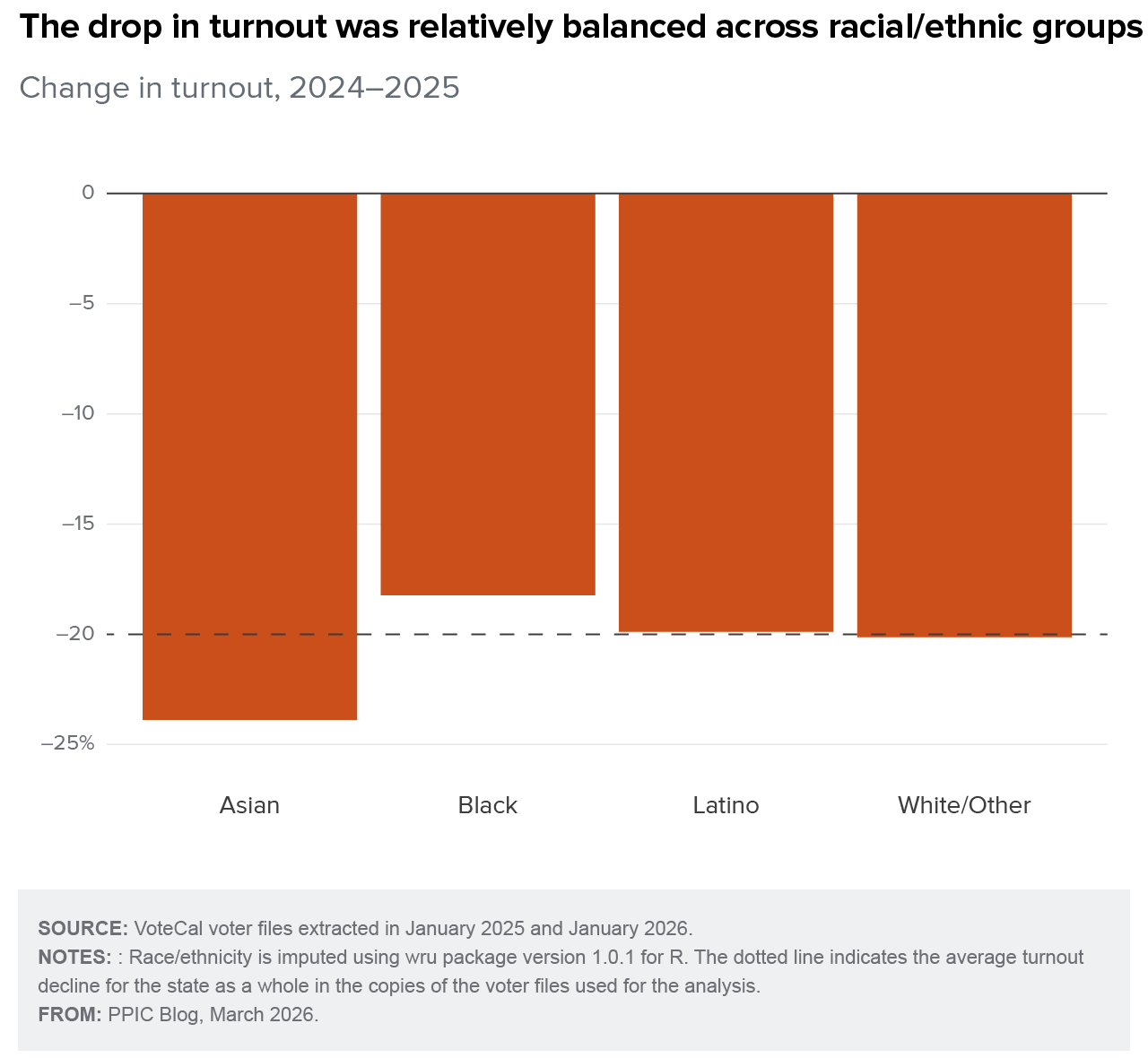
Overall turnout for the Prop 50 election was similar to turnout for a high-engagement midterm. But that still placed it far below turnout in the most recent presidential election. Turnout fell from 71% to 50%, and dropped among every major demographic group. In other words, the question is not whether some groups saw turnout rise so much as whether declines were smaller for some than for others.
For racial/ethnic groups, turnout declines from 2024 were largest among Asian Americans, and similar across all other groups.
There were larger differences across age groups: older Californians matched their historical pattern of showing up in lower-profile elections, with greater declines for all voters under 55. Nonetheless, the youngest voters (aged 18–24)—who tend to be the least consistent about voting when there is no presidential contest—maintained their turnout slightly better than those aged 35–44. There were no differences between men and women.

The biggest difference was linked to party registration: turnout among Democrats was much closer to 2024 turnout, while declines among Republicans and other registered voters were greater than the statewide average. As a result, the electorate voting on Prop 50 was about 3.5 percentage points more Democratic than the electorate in November 2024.

While this was a large partisan shift, it was not enough by itself to explain the outcome. The vote for Prop 50 was over 6 points higher than the vote for Kamala Harris in 2024. Independents appeared to cover the rest of the shift: according to exit polling, they voted 57% to 43% in favor of Prop 50, in contrast to their relatively lukewarm support for Harris in 2024.
What, if anything, does all this tell us about turnout in the November midterm elections and beyond? If the partisan turnout for Prop 50 points to a broader upswing in enthusiasm, the Democrats may start with a leg up this fall. When it comes to California’s efforts to broaden the electorate, the verdict is more mixed. On the one hand, turnout among underrepresented voter groups wasn’t especially bad compared to the 2024 election. But 2024 was itself a step backward from the fall of 2020, when the state hit record highs in both overall turnout and turnout among underrepresented groups. If the goal is a more representative electorate, the 2020 election is the most appropriate standard, and there is still more work to be done.
Topics
2026 Election elections party registration Political Landscape Proposition 50 redistricting US House of Representatives voter turnout votersLearn More

Key Takeaways from the Proposition 50 Election

Prop 50 Draws Record High Voter Interest, Approval of Congress Hits Record Low
What’s at Stake in Proposition 50?

How Would the Prop 50 Redistricting Plan Affect Racial and Geographic Representation?
How Many Seats Would Democrats Gain under California’s Mid-Decade Redistricting Plan?
