

This is the third in a multi-part series examining how artificial intelligence may impact California water.
The explosive growth in data centers is fueling concerns in California, as well as across the country, about water and energy use. Some have gone as far as to propose a water usage fee on data centers. However, others argue that data center water use is just a drop in the bucket compared to other uses or that most data centers are moving toward less water-intensive practices, such as reusing water in closed-loop systems.
To help us understand what we do and don’t know about California data centers and water use, we spoke with Dr. Marie Grimm, an environmental policy research fellow at UC Berkeley’s Center for Law, Energy, & the Environment, about their new report “Regulating Data Center Water Use in California.”

What is a data center, and how does it use water?
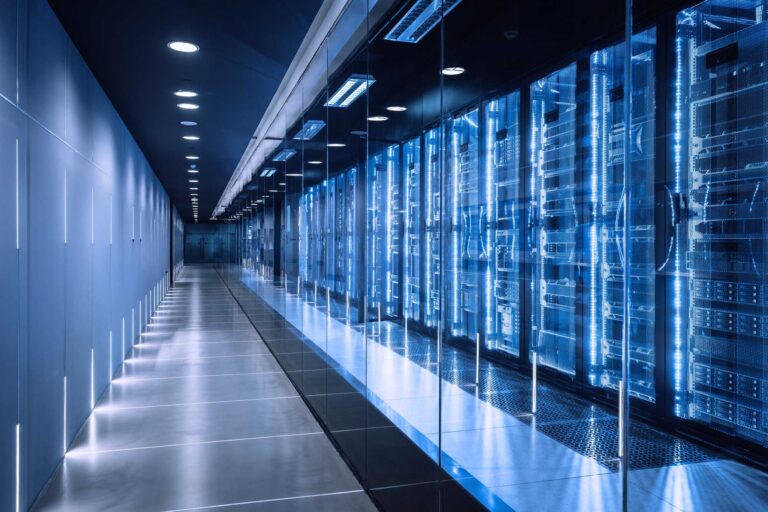
A data center is a facility that houses servers, digital storage systems, and network infrastructure. We use data centers every day—this Zoom meeting is probably running through a data center.
These facilities primarily use water onsite for cooling because servers generate heat, and you need to keep them cool to keep them running. Factors that influence how much cooling is needed include the outside temperature, the facility size, the computing capacity, and the type of cooling system. When a data center takes in water, some is consumed and evaporates, some is discharged, and some is reused multiple times before it’s discharged.
While most people think about water used onsite, water is also used in electricity generation and the supply chain. In our study, we focused specifically on direct onsite water use because water is a local concern, and that’s where conflicts happen.
How are data centers affecting—or not—California water management?
That’s the hard question that we need to answer. We don’t know how many data centers we have in California because there’s no set definition. There are at least 270 data centers in California, but numbers vary.
We also don’t have specific numbers on how much water these data centers use. When we look at water use by individual data centers, the numbers vary widely. For example, one data center estimated its annual water use at 2.8 acre-feet annually; another planned data center in the Imperial Valley is estimated to use 750,000 gallons of water per day (about 840 acre-feet annually). That’s a huge range.
Last fall the governor signed into law a bill focused on data center energy use, while vetoing one on water use. How are water and energy use connected in data centers?
Water and energy tradeoffs are complex. On-site, there’s a cooling tradeoff: if a facility uses less water, typically it consumes more energy. Indirect water use is more complicated, because that depends on the energy source. Nuclear or coal generally use more water than solar or wind, for instance. Data center energy use has gotten a bit more attention overall, for multiple reasons, I suspect. For example, debates over how data center energy demand could raise rates for households are ongoing and, from what we’ve heard, we suspect that electricity is a bigger cost to data centers than water.
There have been recent proposals to impose water use fees on data centers. Are data centers very different from other industries?
The key difference right now is that we’re seeing a boom in development, and we don’t know the implications.
I looked at other industries for comparison, like the bottling industry, and I didn’t find information on their water use either. That raises a question: in a water-stressed state like California, should we be increasing reporting requirements more broadly?
That said, data centers are getting bigger, and depending on the cooling system, their water use can be very dense based on their footprint.
A hyper-scale data center can use a lot of water. Those things are big, and they need to go where there’s space—which I suspect is typically in smaller communities in rural areas where decisionmakers wear a lot of hats and may need help addressing what a data center might mean for that community. The state can collect and analyze information and support capacity building in local communities so they can make an informed decision on what’s best for their community.