
Millions of Californians rely on the health care safety net.
- The health care safety net is a patchwork of programs and providers that deliver coverage and care to people with low incomes, no private insurance, and/or special medical needs.
- Medi-Cal—California’s Medicaid program—is its cornerstone, providing health coverage for around 14.5 million Californians in October 2025 and serving as the primary funding source for safety net providers. The federal government pays for about 60% of the nearly $200 billion program. The state General Fund and other sources like provider taxes and local government funds supply the remainder.
- Additional state and local programs, like California Children’s Services and county medically indigent programs, pay for health care services for low-income residents with specific health conditions and those not eligible for Medi-Cal.
- Core safety net providers—including county hospitals, health clinics, and emergency departments—are located throughout the state and treat patients regardless of their ability to pay or their immigration status.
- Given the large role of the federal government in financing California’s health care safety net, the federal bill HR 1 introduces significant uncertainty around future Medi-Cal enrollment and funding for providers and programs.
California’s health care safety net has expanded—but millions remain uninsured.
- California’s uninsured rate declined dramatically over the past decade, as Medi-Cal coverage expanded and Covered California offered subsidized options for health insurance under the Affordable Care Act (ACA).
- Still, about 2.3 million Californians reported being uninsured in spring 2025. Most are adults under 65 (2 million), about two-thirds (1.5 million) are Latino, and 36% (800,000) are noncitizens. Nearly three in ten (700,000) have incomes below 150% of the federal poverty line, making many eligible for either Medi-Cal or no-cost coverage through Covered California.
- California’s uninsured population is expected to increase in coming years due to federal and state policy changes, putting additional pressure on state and local programs and on safety net providers.
Latino, noncitizen, and low-income Californians have higher uninsured rates
Percent uninsured
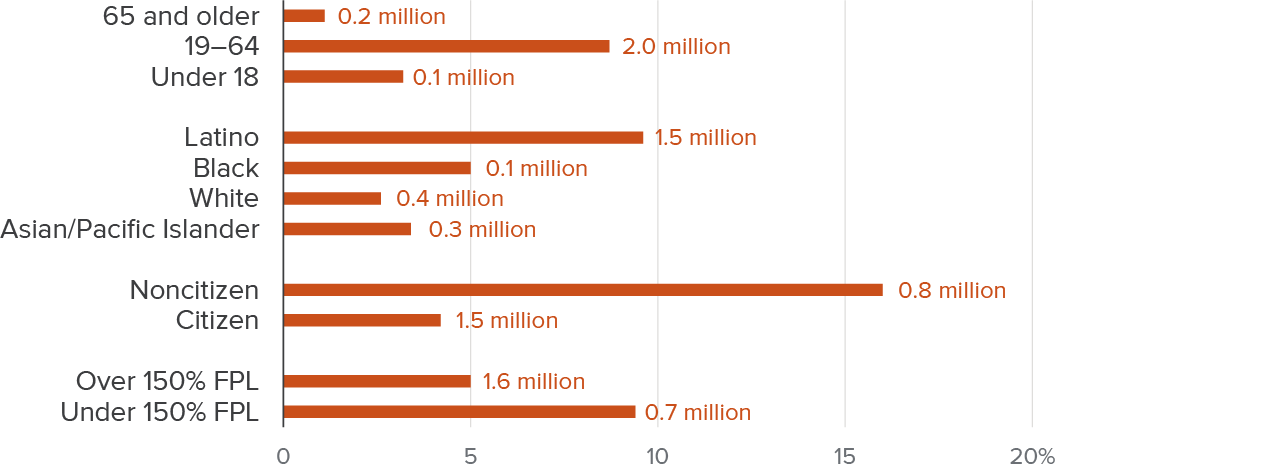
SOURCE: Current Population Survey, Annual Social and Economic Supplement, 2025.
NOTES: Survey data was collected February to April of 2025. Respondents were asked to report any health coverage at the time of the survey. FPL refers to the federal poverty level; 150% indicates an annual income of $23,475 for a single person in 2025. Bars represent the percentage of individuals uninsured within each demographic group.
Primary care clinics play a critical role.
- About 1,200 state-licensed health clinics reported roughly 30 million visits in 2024, an increase of 2.3 million since 2023.
- In 2024, these clinics served over 8.8 million patients, or one in five Californians. In some regions, they treated nearly one-third of all residents.
- Primary care clinics rely heavily on Medi-Cal for about 70% of their net revenue. Additional funding sources include federal grants, patient fees, other insurance coverage, and smaller public programs.
County hospitals are essential safety net providers.
- Twelve large counties—home to about 60% of California’s population—operate county hospital systems. In addition to providing care, these hospitals help train physicians and operate high-level trauma centers.
- All county hospitals—and other hospitals that serve high shares of uninsured and Medi-Cal patients—receive supplemental federal funding to help cover costs because Medi-Cal pays hospitals less than Medicare and private insurance. County hospital systems also typically receive funding from county sources.
- In 2024, Medi-Cal patients accounted for nearly 63% of hospitalizations at county hospitals and nearly half at other hospitals that receive supplemental funding—compared to 39% at all other hospitals.
Emergency departments are “the safety net of the safety net.”
- Federal law requires emergency departments to provide necessary treatment to all patients who seek care. In 2024, 332 hospital emergency departments in California provided 24-hour access to health services.
- About 15.5 million visits were made to California’s hospital emergency departments in 2024, a 5% increase from the previous year. Around 13% of these visits resulted in hospital admission.
- Emergency departments are front-line providers for people experiencing homelessness. In 2023–2024, patients identified as homeless made more than 900,000 visits (3% of total); some hospitals report much higher shares, though challenges in screening for homelessness mean these counts are underestimates.
Changes to federal and state policy will have major implications.
- Starting in 2028, HR 1 will reduce Medi-Cal payments for hospitals and limit the use of state taxes on providers and managed care organizations to fund the program. These changes will result in an estimated $340 billion cut in total federal Medicaid spending over a 10-year period.
- The Federal Rural Health Transformation Program, also established through HR 1, supports rural health care systems with a five-year, $50 billion investment to help buffer the impact of some of these cuts. California will receive $233 million of the $10 billion allocated for 2026.
- The state provides some financial assistance to California hospitals and clinics through loan programs and grants, though not nearly enough to make up for the expected federal cuts.
Topics
Health & Safety Net Immigrants in California Political Landscape Poverty & Inequality