

Key Takeaways
To help build a skilled workforce and sustain economic prosperity, California set a 70 percent postsecondary attainment goal in the 2022–23 state budget, declaring that some education or training after high school is necessary for most adults. That same year, Assembly Bill 181 established the Golden State Pathways Program (GSPP) with a $500 million investment. This initiative aims to create smooth transitions from PK–12 to postsecondary education and careers in high-wage, high-skill, high-growth industries. The program is part of California’s broader strategy to advance educational equity, align education with workforce needs, and boost postsecondary readiness for high school students, especially those from underserved groups that face systemic barriers in educational settings, including English Learners, low-income students, and foster youth.
In this report, we explore the early implementation of the GSPP, including how funds have been distributed and how local education agencies (LEAs) plan to use the funds to enhance existing career pathways.
- As of February 2025, roughly $426 million of the GSPP funds have been allocated to 372 LEAs in all regions of the state. As stipulated by law, most of the total funding has gone toward implementation ($376 million, or 88%). These grants support LEAs that wish to expand, enhance, or continue existing career programs and pathways.
- LEAs that received implementation grants enroll nearly half (46%) of the state’s 9th–12th graders. We estimate that about 532,200 high school students will participate in the program. This represents 60 percent of students enrolled in these LEAs and nearly 28 percent of the state’s high school students.
- LEAs that received implementation grants serve more diverse students than the statewide average. Namely, low-income (67% among grantees vs. 61% statewide) and Latino (60% vs. 57%) students are overrepresented among grantees. Meanwhile, representation by gender and among Asian and Black students is relatively proportionate, and white students are underrepresented. However, data on student participation are needed to determine whether the program will improve equitable access to career pathways across student groups. Grant awards also varied notably by region, with the Greater Los Angeles and Northern regions receiving a larger share of grant funds relative to their share of high school students.
- GSPP priority sectors—technology, health care, education (including early childhood), and climate-related fields—comprise over three-quarters of funded implementation grants. The most common pathways include programs in health science and medical technology, information and communication technologies, education and child development, and art, media, and entertainment.
- Our interviews with grantees highlighted key challenges and opportunities. There is considerable excitement about using GSPP to support work-based learning through funded internships and pre-apprenticeships. However, once GSPP funds are exhausted, finding the resources needed to sustainably develop and maintain work-based learning programs, acceleration strategies (such as dual enrollment, in which high school students enroll in college courses for credit), and student supports with annual one-time allocations may prove challenging, particularly in an environment of fiscal restraint.
Introduction
In 2022, the California Legislature passed the Golden State Pathways Program Grant Act (Assembly Bill 181), which aims to promote pathways in “high-wage, high-skill, high-growth” areas, encourage cross-sector collaboration, enable access to workforce training, and support workforce development. To accomplish these goals, the bill provides funding for grants to help local education agencies (LEAs) develop and expand high school programs related to college readiness, college acceleration (e.g., dual enrollment, in which high school students enroll in college courses for credit), career technical education (CTE) coursework, and work-based learning.
Prior to the Golden State Pathways Program (GSPP), California has had a long history of supporting initiatives intended to develop or bolster career pathways for students, with significant federal, state, local, and philanthropic investments directed toward workforce development and training, including CTE. Research indicates that participation in CTE during high school is associated with positive academic and labor market outcomes, including high school graduation, college enrollment, earnings, and more (see Lindsay et al. 2024 for a research synthesis). In 2022, about 18 percent of California high school graduates completed a CTE pathway and roughly 9 percent took at least one CTE dual enrollment course (Boochever et al. 2025). While high school CTE can potentially improve educational and wage outcomes, the effects may vary across student subgroups and industry sectors (Kemple 2008; Dougherty 2018; Hemelt and Lenard 2018).
Historically, the view that high school students were either on an academic or vocational pathway resulted in a division between CTE and college preparatory programs. Between the 1970s and 1990s, CTE pathways focused on vocational education for students who were going directly into the workforce and not attending college. However, people have since recognized that most high-demand, high-mobility career opportunities will require some form of postsecondary education—traditional college, CTE, or both—spurring the incorporation of college preparatory academics into CTE pathways. Over the last four decades, the state has directed funding to help establish career-themed academies, strengthen the CTE curriculum for defined pathways and industry sectors, develop high-quality CTE programs, support cross-sector engagement, and promote college and career pathways. In addition, private philanthropic partners have added to this momentum with key initiatives related to career pathways and college readiness (e.g., the Irvine Foundation’s Concurrent Courses Initiative in 2008 and Linked Learning in 2015). Nationally, the 2006 reauthorization of the federal Perkins legislation supported these efforts by eliminating the prohibition on funding for programs intended to help students enter careers that require a bachelor’s degree or higher (Stern 2010; Visher and Stern 2015).
The Golden State Pathways Program represents one of the state’s major recent initiatives to integrate career pathways and college readiness across the state. In this study, we explore the early implementation of the GSPP, specifically the program’s implementation grants. We begin with an overview of the GSPP and describe the research supporting GSPP elements. Next, we use publicly available grant award and school district data to describe the districts, pathways, and regions that were funded. Through an analysis of implementation grant applications and interviews with grantees, we further explore how LEAs plan to use this funding to enhance existing career courses and pathways. (See Technical Appendix A for more details on data and methods.) We conclude with policy issues to watch as GSPP implementation continues.
Overview of the Golden State Pathways Program
Established in 2022 by Assembly Bill (AB) 181, the Golden State Pathways Program is a state initiative that aims to promote pathways in “high-wage, high-skill, high-growth areas,” encourage cross-sector collaboration, enable access to workforce training, and support workforce development. Priority sectors include technology, health care, education (including early childhood), and climate-related fields. GSPP is a component of California’s broader strategy to improve educational equity, workforce alignment, and postsecondary readiness for high school students—particularly those from historically underserved communities, including English Learners, low-income students, and foster youth.
Specifically, GSPP aims to achieve the following:
- Create pathways to high-demand careers that allow students to move smoothly from high school to college and the workforce while meeting the state’s labor market needs.
- Foster collaboration for innovative pathways that encourage partnerships among schools, colleges, employers, and community groups to build or expand college and career pathways aligned with local labor markets.
- Increase access to postsecondary and workforce opportunities and enable more students to access college, training, and good jobs that match local, regional, or state workforce needs.
- Develop a skilled and diverse workforce to address critical statewide needs, such as greater diversity among professionals in child care and PK–12 education.
To achieve these goals, the legislation provided $500 million in one-time funding through the state budget to support planning, implementation, and consortium grants for eligible LEAs, including school districts, charter schools, regional occupation centers and programs, and county offices of education (see text box). The program is administered by the California Department of Education (CDE) in partnership with the California State Board of Education and California Labor and Workforce Development Agency.
To be eligible for a GSPP grant, an LEA must commit to creating or enhancing pathways for students that provide the following:
- An integrated program of study where all courses meet A–G requirements for admissions to the University of California (UC) and California State University (CSU) and at least one of the other measures of college/career readiness as defined by California State Dashboard’s College/Career Indicator (e.g., completing a CTE pathway, participating in a registered pre-apprenticeship, or work-based learning). LEAs are encouraged to add career-focused content to A–G courses, and A–G courses can be offered through programs like UC/CSU extended learning programs or UC Scout, an online platform providing access to select A–G and AP courses for public schools and their students at low or no cost.
- Opportunities to earn 12 college credits applicable toward completion of a degree, certificate, or credential. This can be achieved through courses offered via a dual enrollment partnership (e.g., College and Career Access Pathways, Early College High School, or Middle College High School) and/or local agreements, Advanced Placement (AP), or International Baccalaureate (IB) programs.
- Opportunities to participate in work-based learning in partnership with regional businesses, government organizations, and nonprofits. This would include career awareness and exposure; emphasize paid internships, pre-apprenticeships, or apprenticeships; and help build social and professional connections for future career development.
- Integrated support services to address students’ social, emotional, and academic needs.
Additionally, the GSPP Act asked that LEAs develop and implement pathways that leverage funding from various public, private, and philanthropic sources to support program sustainability.
Research Evidence on GSPP Components
The GSPP framework comprises several key components as outlined above. The integration of these components draws influence from Linked Learning (referenced in the GSPP Act), which is a model that similarly combines rigorous academics, comprehensive support services, career technical education, and work-based learning for college and career preparation. In this section, we summarize the research evidence of the key GSPP elements to formulate hypotheses for future impacts of GSPP and/or understand how components of GSPP may interact.
College Readiness. While success in higher education depends on several factors, academic preparation is one of the most important considerations. Rigorous high school coursework not only demonstrates college readiness but also leads to stronger outcomes in high school and postsecondary education (Adelman 1999; Smith et al. 2017; Woods et al. 2018). In California, A–G coursework—required for eligibility to the state’s public four-year institutions—is largely considered the way to achieve college readiness. However, only 45 percent of high school graduates complete A–G coursework, with large disparities across racial/ethnic groups: 72 percent of Asian students complete these courses, compared to 51 percent of white students, 37 percent of Latino students, and 34 percent of Black students. Meanwhile, only 37 percent of low-income California high school students complete A–G courses (Ugo and Assan 2025). The GSPP grant is designed to help narrow these gaps by advancing pathways that are aligned with A–G requirements.
Aligning high school graduation requirements with A–G requirements improves both high school and college outcomes. A recent study examining districts that have A–G as the default college prep curriculum for graduation, compared to those that do not, demonstrated a statistically significant positive effect, showing a 9.2 percentage point increase in A–G completion, a 4.6 percentage point increase in UC/CSU enrollment, and a 3.6 percentage point increase in high school graduation. Historically marginalized groups, including Black, Latino, Pacific Islander, and Native American students, all saw increases of over 9 percentage points with respect to A–G completion rates (Luu 2024).
Career Readiness. Along with college readiness, GSPP aims to focus equally on career readiness for students, including use of the state’s Work-Based Learning Continuum of Activities. Beyond A–G alignment, GSPP’s career readiness strategy includes other measures, such as completing a CTE pathway, participating in a registered pre-apprenticeship, and work-based learning.
Research on career readiness shows that CTE participation can lead to positive outcomes in academic achievement, graduation rates, postsecondary education, and employment. CTE provides high school students with the opportunity to expand their exposure to and preparation in different career sectors. While CTE can potentially improve educational and wage outcomes, the effects may vary across student subgroups and industry sectors (Kemple 2008; Dougherty 2018; Hemelt and Lenard 2018). Career readiness training in high school can provide industry-relevant skills while also providing a path to higher education.
According to the California Legislative Analyst’s Office, as of 2024, approximately 66 percent of CTE courses (about 11,000) in California high schools are approved to meet A–G requirements. Aligning CTE courses with A–G enables students to prepare for both college and career simultaneously, increasing courses’ real-world relevance. Estimates suggest that 72 percent of jobs will require postsecondary education or training by 2031, with 42 percent of all jobs requiring at least a bachelor’s degree, emphasizing the importance of preparing students with the necessary academic and job skills (Carnevale et al. 2023).
College Acceleration. Acceleration strategies that help high school students gain formal exposure to college-level coursework have been shown to improve academic outcomes. For example, both descriptive and causal research on dual enrollment finds that students see a variety of benefits, including higher rates of high school completion, college readiness, attendance, retention, and academic achievement (Rodriguez et al. 2023; Berger et al. 2013; Edmunds et al. 2017; Taylor et al. 2022). Research on AP coursework and Early College High School partnerships generally shows positive academic effects compared to students who did not participate, but it is important to note that after controlling for student characteristics, the effects tend to be smaller, likely because these programs attract more academically prepared and ambitious students (Warne 2017; Berger et al. 2013). Notably, a study of the California Concurrent Courses Initiative, which integrated dual enrollment into career pathways, found that participation in a career-focused dual enrollment program was positively associated with high school graduation and early college outcomes (Rodriguez et al. 2012).
Work-Based Learning. Research has shown value in internships and other career-focused activities that are designed to introduce students to career options and real-world applications of academic content (Johnston 2020). Work-based learning can contextualize what students learn in the classroom, helping them understand the linkage between education and career. This can be a strategy to engage students and spark interest in a particular field. To be effective, work-based learning should be embedded in or clearly linked to programs of study and should accelerate learning by satisfying postsecondary requirements and ideally count for academic credit, which requires educators and employers to collaborate on aligning academic and work-based learning objectives (Cahill 2016). Additionally, work-based learning can help increase students’ social capital by enabling professional connections and mentorship opportunities that support students as they enter career and/or college, and by helping remove systemic barriers to the resources they need to succeed in education and the workforce (Ross et al. 2020). These opportunities are especially important for individuals who are the first in their family to attend college and work in a professional setting.
Integrated Student Supports. Counselors and advisors can act as resources in providing students with information, guidance, and tools as they prepare for college and/or career. The literature on college access suggests high school counselors play a key role in improving students’ knowledge about college, especially for students from low socioeconomic backgrounds (Ruiz de Velasco et al. 2016; Jackson et al. 2024; Venezia, Kirst, and Antonio 2003). In particular, recent research has shown positive effects on students’ academic preparation, educational attainment, socio-emotional development, college readiness, college enrollment, and the skills they need to succeed to the workplace (Adam 2023; Belasco 2013; Mulhern 2023).
As noted above, the GSPP program’s integration of student supports is inspired by the Linked Learning model, which embeds comprehensive services into pathways that align with college and career goals. An evaluation of student outcomes using this model showed that sustained student support—defined as supportive atmosphere, student engagement, differentiated instruction, academic intervention, guidance and counseling, and college and career planning—may lead to improved high school and postsecondary outcomes. A separate report analyzed integrated student supports within Linked Learning pathways and found that effective integration of academic, technical, and support services is important for student success (Ruiz de Velasco et al. 2016).
How Have Funds Been Distributed?
To participate in GSPP, LEAs submitted requests for applications from August to September 2023 that described how they intend to develop, provide, and expand career pathways. Applicants and grant recipients will receive technical support from a Lead Technical Assistance Committee and eight Regional Technical Assistance Committees to establish and expand pathways. GSPP will provide funding for five fiscal years, with funds expected to be used by June 2028. After several delays, the state published a list of GSPP awards in February 2025 for planning, consortium, and implementation grants.
In this section, we use GSPP grant allocation data and CDE data to present a descriptive analysis of grant awards. First, we provide a general overview of the total investment across different types of grants, including the number of awards, LEAs, and pathways being funded. Next, we focus the remainder of our analysis on the implementation grants to better understand early implementation of GSPP. We highlight trends in grant allocation, summarize characteristics of GSPP grantees, and compare grantees to non-grantees and statewide averages. Lastly, given the program’s objective to meet statewide and regional labor market needs, we explore regional variation in funding allocation and the pathways implemented.
Implementation Grants Make Up the Vast Majority of GSPP Funds
As of February 2025, roughly $426 million has been allocated to 372 LEAs in implementation, planning, and consortium grants (Table 1). This comprises 543 grants that will enable the development and expansion of over 1,660 pathways across multiple industry sectors. As stipulated by the law, most of the total funding was allocated to implementation grants (88% of total awarded), with 220 LEAs receiving 374 implementation grants to support 1,345 pathways. Planning and consortium grants together comprised about $50 million (12% of total funding awarded) for 152 LEAs. Approximately $75 million remains to support Regional Technical Assistance Centers and planning grant recipients as they shift to implementation.
Implementation grants represent the highest share of allocated GSPP funds
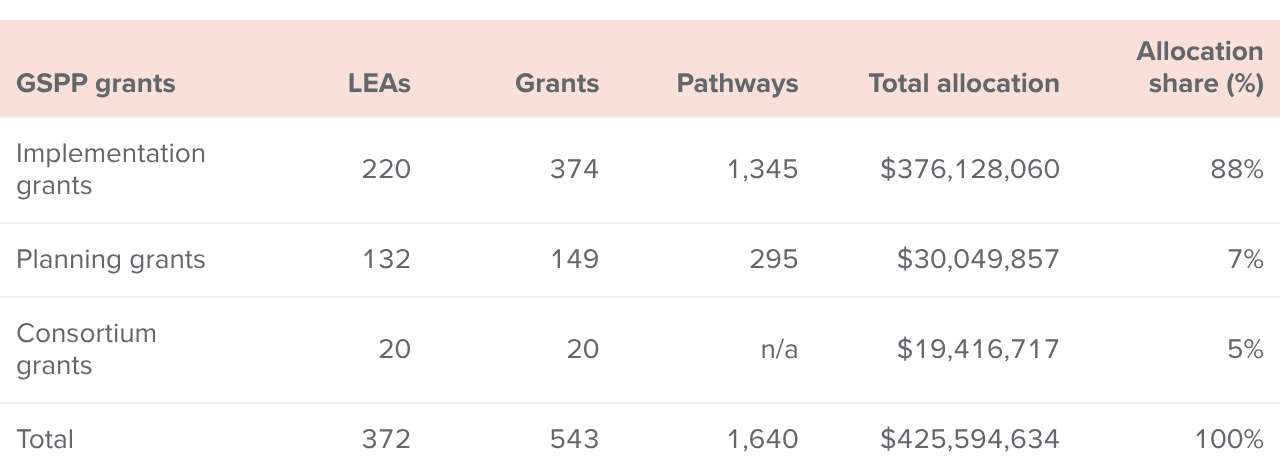
SOURCE: Authors’ calculation using California Department of Education, GSPP Allocation data, February 2025.
NOTES: A total of $500 million was allocated to GSPP. Allocations in this table represent 85 percent of the total allocation. Regional Technical Assistance Committees received some funding but have not been included as this form of ad hoc, as-needed support was not established during our research phase. Some of the remaining GSPP funding balance may also be used to support planning grantees in the implementation phase. The 20 consortiums may have multiple pathways being implemented.
Implementation grantees enroll nearly half of all high school students
California Department of Education (CDE) enrollment data for the 2023–24 academic year show that about 882,000 (46%) of the state’s 9th–12th graders are enrolled in LEAs that received GSPP implementation grants. Using student participation data provided by LEAs in their GSPP implementation applications, we estimate that nearly 532,200 high school students (60% of secondary enrollment) in these LEAs will participate in the program (Figure 1). This represents nearly 30 percent of all 9th–12th graders in the state.

School districts received the largest share of implementation grants
Implementation grants awarded a total of $376 million to 220 LEAs, including school districts (and county offices of education), charter schools, and Regional Occupational Centers and Programs (ROCPs). As summarized in Table 2, school districts received the largest share of implementation grant funding ($320 million, or 85% of the total), followed by charter schools ($41 million, 11%), and regional occupational centers and programs ($14.9 million, 4%).
School districts received the largest share of GSPP implementation grant funding
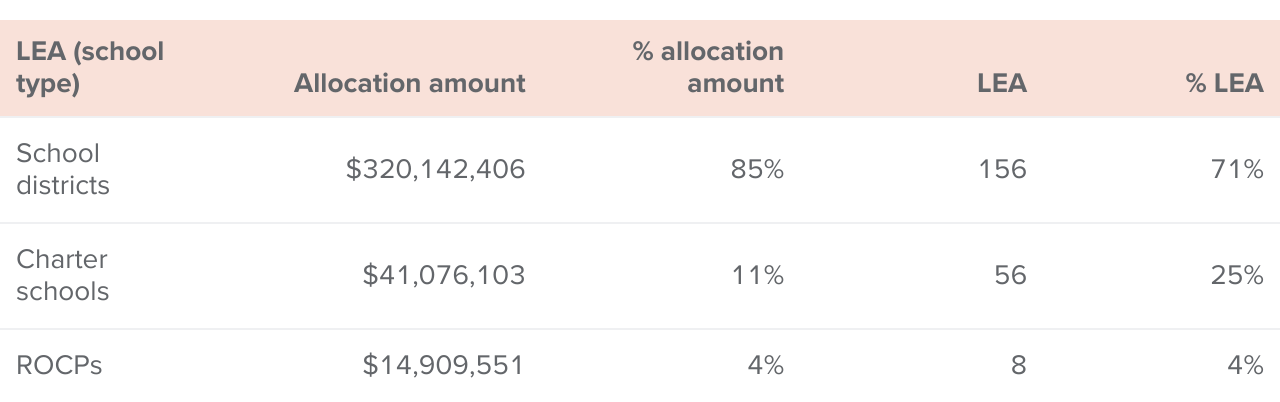
SOURCE: Authors’ calculation using California Department of Education, GSPP Allocation data, February 2025.
NOTES: ROCPs refer to Regional Occupational Centers and Programs. ROCPs provide career and technical education courses to prepare high school and adult students to enter the workforce, pursue advanced training in postsecondary educational institutions, or upgrade existing skills and knowledge.
Implementation Grantees Serve a More Diverse Student Population
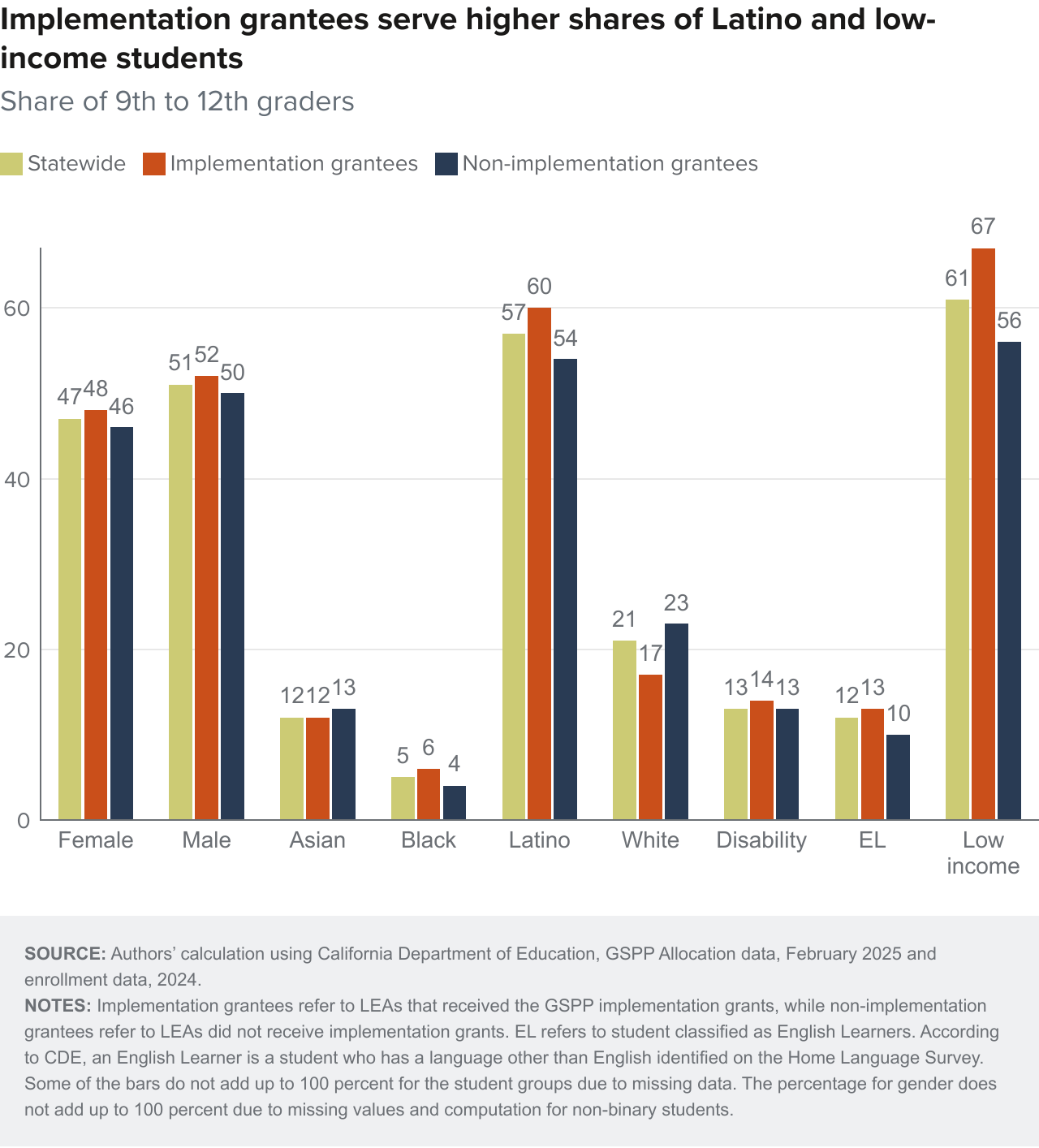
When we examine the demographic characteristics of GSPP implementation grantees, we find that they serve a more diverse student population than the statewide average (Figure 2). For example, Latino students are overrepresented (60% among grantees, 57% statewide). Asian and Black students comprise 12 percent and 6 percent of enrollment among implementation grantees, roughly proportional to their population statewide (10% and 5%, respectively). White students, on the other hand, are underrepresented and enroll at higher rates statewide.
Notably, we find that low-income students are overrepresented, accounting for 67 percent of students among implementation grantees, compared to 61 percent statewide. Meanwhile, the distributions of English Learners, disability, other racial/ethnic groups, and students by gender are fairly balanced.
Health-related pathways are especially common
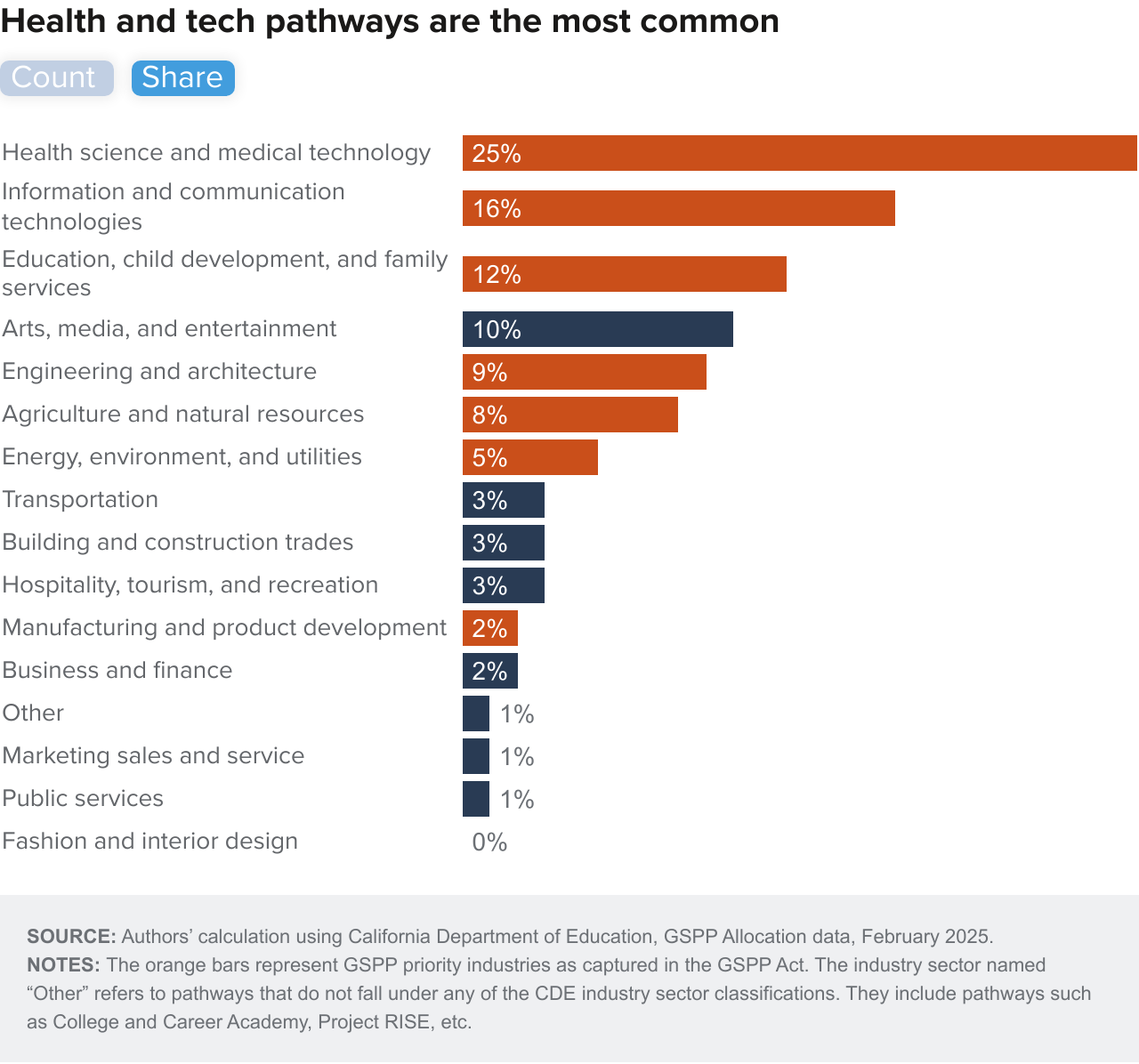
Implementation grants support more than 1,300 pathways in diverse industry sectors. A breakdown of pathways categorized based on CDE industry sector classification shows that health science and medical technology is the most common pathway, accounting for a quarter (333) of all funded pathways (Figure 3). Information and communication technologies is the second-most common, representing 16 percent (209) of the funded pathways. Education and child development (164) and art, media, and entertainment (128) also constitute a considerable number of pathways.
The orange bars in Figure 3 represent GSPP priority industries as captured in the GSPP Act. Together, these sectors make up 77 percent of pathways implemented under the program (see Technical Appendix B). Specifically, health-related pathways remain the most prevalent (25%), with STEM/climate resilience pathways accounting for the second-largest share (24%), followed by information and communication technologies (16%) and education (12%).
In addition to priority industries, the GSPP Act encouraged the implementation of pathways that lead to high-wage, high-skill, or high-growth jobs in the state economy. A snapshot of some of these pathways includes digital media pathways at twelve schools, cybersecurity pathways at seven schools, and an artificial intelligence (AI) pathway at one school.

Regional Analysis of Implementation Grants
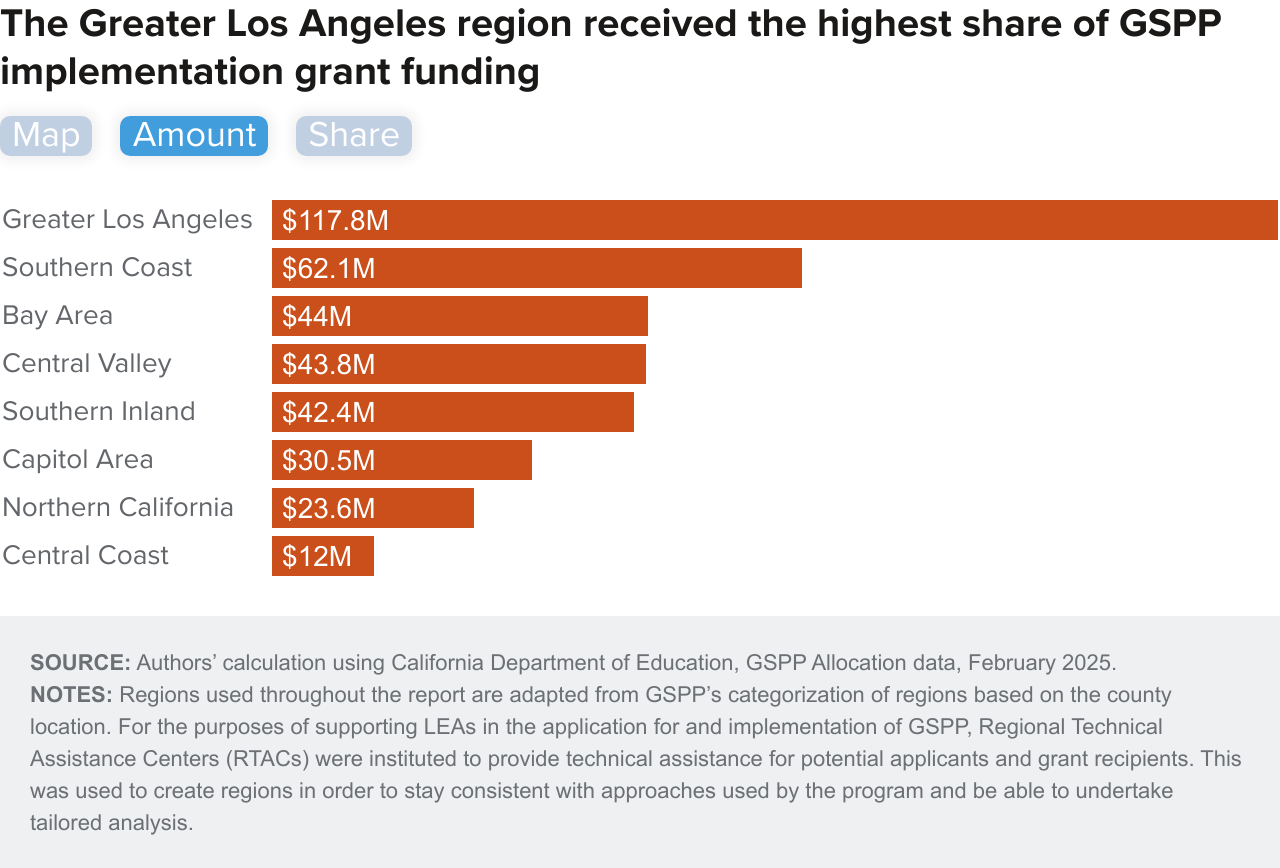
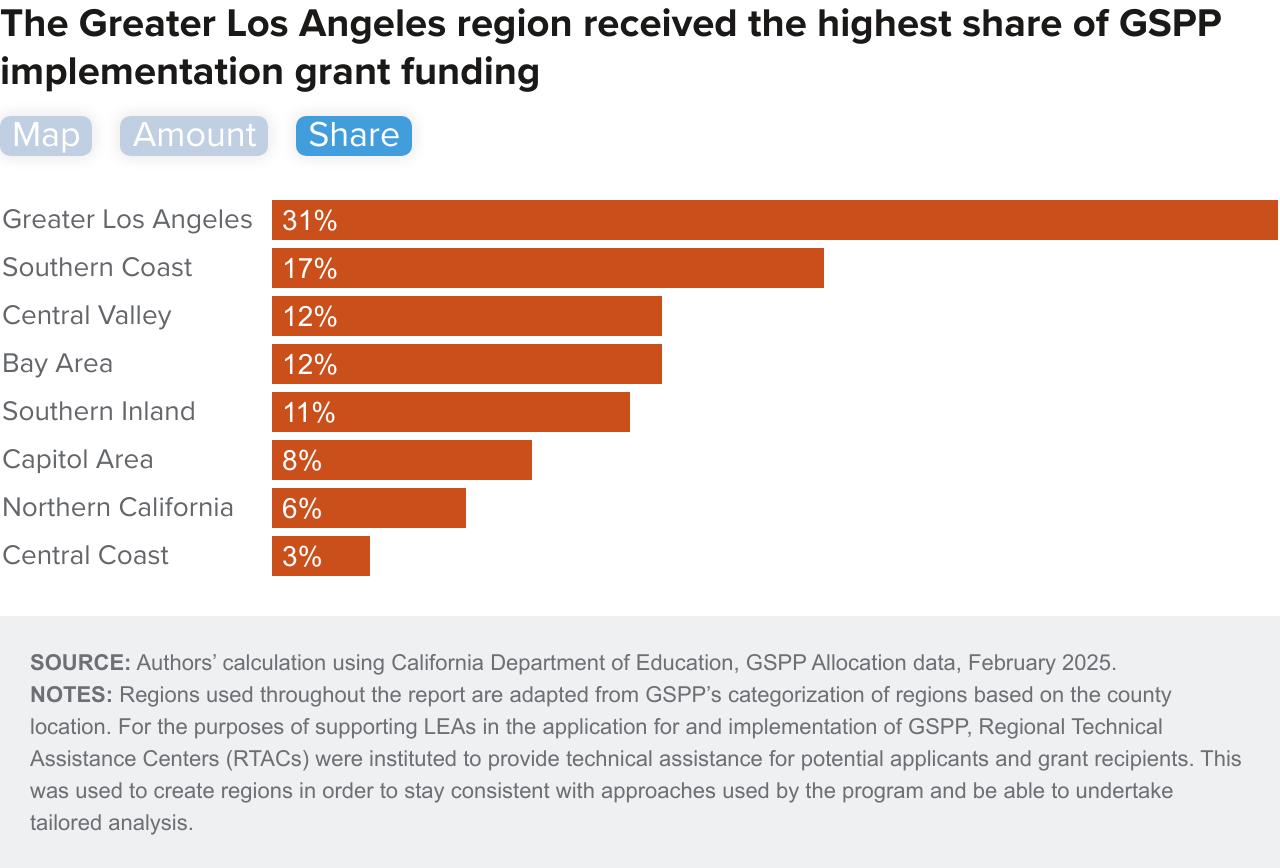
Across regions, Greater Los Angeles received the largest allocation, nearly $118 million, representing 31 percent of total implementation grant funding (Figure 4). The Southern Coast received a substantial amount ($62 million), accounting for 17 percent of the total allocation. The Bay Area, the Central Valley, and the Southern Inland regions received relatively similar funding levels, while the Capitol Area (8%), Northern California (6%), and Central Coast (3%) received smaller allocations.

Some regions received an outsized share of funding
To assess the distribution of GSPP implementation grants at the regional level, we examined the share of statewide high school enrollment compared to the share of statewide enrollment in GSPP grantees by region.
Overall, the distribution of implementation grants does not align with regional public school enrollment. An analysis of the data shows that while some regions received a share of funding allocation proportional to their enrollment, others received a higher or lower share (Figure 5). For example, two regions received an outsize proportion of funding relative to their student population: Greater Los Angeles (31% of funding vs. 23% of statewide enrollment) and Northern California (6% vs. 2%). On the other hand, the Bay Area, the Southern Inland region, the Capitol Area, and the Central Coast received a lower share of funding allocation compared to their share of statewide enrollment. Both the Southern Coast and the Central Valley received a share of funding allocation proportional to their enrollment.

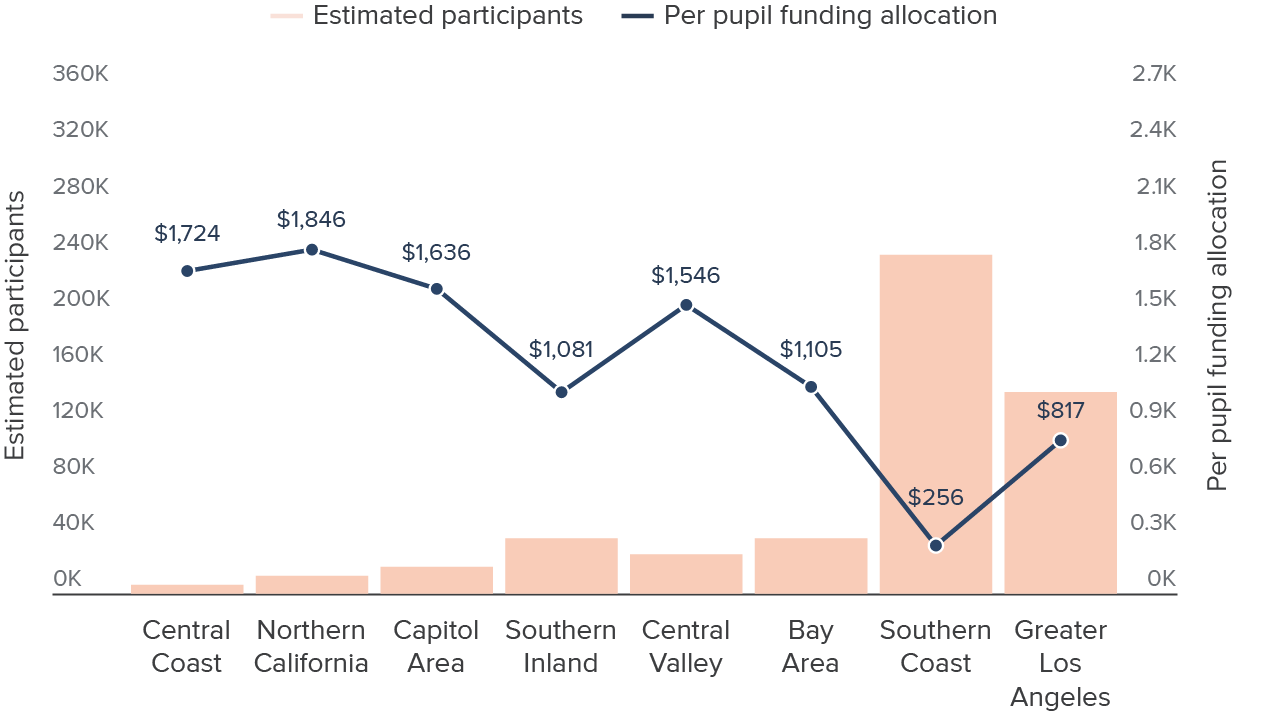
Analyzing the per pupil investment can offer valuable insight into the funding resources available to expand GSPP pathways. Variation may be a result of differing student populations or differences in the resources needed to support existing pathways (e.g., health pathways are costlier to develop than business pathways).
Regions with smaller estimated participant counts, such as Northern California ($1,846) and the Central Coast ($1,724), have the highest per pupil funding allocation (Figure 6). This indicates more available dollars per pupil, on average, to fund the program and may provide a more sustainable means of meeting other long-term needs such as infrastructure and human resource development. In contrast, Greater Los Angeles ($817) and the Southern Coast ($256) have lower per pupil allocation due to their large number of estimated GSPP participants.
Northern California and Central Coast have the highest estimated per pupil funding allocation across regions
SOURCES: Authors’ calculation using California Department of Education – GSPP Allocation data, February 2025 and Enrollment data, 2024.
NOTES: To generate per pupil allocation, the authors divided regional implementation grant allocation by the total number of 9th-12th grade enrollment by region. The Southern Coast region’s estimated GSPP participation is disproportionately high as a result of the Orange County Department of Education’s estimate that they will reach all high school students (over 150,000) in Orange County by incorporating GSPP into science courses.
Regional Variation in Industry Sectors
The distribution of pathways across California’s regions reflects unique economic drivers, local market demands, and workforce priorities. There is notable regional variation in industry sectors and priorities for career pathways (see Technical Appendix B12).
While nearly all regions prioritize health care and information communication technologies pathways, the prevalence of other pathways differs across regions. For example, agriculture and natural resources is most prevalent in the Central Valley, Capitol Area, and Northern California. Also, urban and coastal regions (Greater Los Angeles, the Bay Area, and the Southern Coast) show higher concentrations of technology, media, and engineering-related pathways. Finally, rural and inland areas lean more heavily on pathways in education, agriculture, and public service sectors.
Our analysis of GSPP implementation grantee applications summarizes information provided on successful applications. This analysis includes information on the extent to which grantees deemed courses and pathways as “high-wage, high-skill or high-demand,” and the extent to which LEAs plan to incorporate acceleration models and expand work-based learning for each region and county (see these interactive maps for snapshots by region and by county). For example, while the implementation grantee applications from the Northern and Central Valley Regions show plans for near-universal use of dual enrollment (100% and 97%, respectively), the Northern Region plans to establish College and Career Access Pathways (CCAP) agreements among 46 percent of sites included in the grant, whereas the Central Valley plans to use CCAP agreements among only 25 percent of sites.
Early Implementation Plans
To better understand grantees’ local context and plans for GSPP implementation funding, we conducted 15 semi-structured interviews with 16 individuals between February and April 2025 (see Technical Appendix D). Interviewees held staff or administrative roles at the district or high school level and were highly engaged in the GSPP application process and/or implementation planning efforts. Interviewees included at least two LEAs from each region of the state and included LEAs that planned to implement a variety of GSPP pathways in priority and non-priority sectors. In our analysis, we explore how LEAs with more experience in college and career integration are supporting deeper alignment with the key GSPP elements (i.e., college and career readiness, college acceleration, work-based learning, and student supports). Understanding their experiences, including barriers, can provide insight into policy and implementation issues and guide future recommendations.
It is important to note that although GSPP implementation grant funding allocations were delayed, GSPP applications included multi-year plans. As such, grantees described their plans for implementation, most emphasizing that significant work was set to begin during the upcoming school year (2025–26).
LEAs identified pathways based on local programmatic and economic need as well as GSPP grant criteria. Implementation grantees selected career-focused courses and pathways where collaboration with community colleges and/or workforce already exists, but program elements are not yet fully aligned with GSPP. Interviewees generally told us that implementation grants will be used as needed for their local context. This could include efforts to expand individual career-focused courses into pathways, align CTE courses or pathways with A–G requirements, integrate career pathways with acceleration models, increase opportunities for work-based learning, and/or expand integrated student supports. A college and career executive described discussing with colleagues which elements to focus on when developing GSPP pathways: “are you fleshing out the A–G part, are you fleshing out the work-based learning part, the dual enrollment part…?”
Grantees indicated that existing career courses and pathways sometimes suffered from lack of resources for development and maintenance. In creating implementation plans, interviewees said they considered local economic need and alignment with the grant priority sectors. As one director of college and career explained: “We looked at the goal of the grant and… we had two sectors that we thought aligned really well… They were doing really good work, but [we asked,] what were some of the gaps aligned with the goals of GSPP? And then how could we utilize that funding to actually move the work?”
While state and national CTE initiatives often focus on high-demand and/or high-wage fields, GSPP also prioritizes locally relevant high-demand fields that may not lead to particularly high wages, like early childhood education. A recent CTE instructor-turned-administrator described expanding a standalone career-focused course into a CTE pathway to help alleviate local childcare and teacher shortages: “We’re hoping that this [early education] pathway gives students another job opportunity that [may even] lead them to getting a teaching credential and then teaching in town. So, we’re hoping to kind of beef up hiring from within.” Notably, based on the analysis of applications, the majority of GSPP implementation grantees indicated in their applications that they plan to develop pathways in either high-skill, high-demand, or high-wage occupations (87%).
LEAs are planning to implement integrated programs designed to increase college readiness, despite perceptions of CTE as distinct from college-going. Historically, A–G was limited to college prep courses; however, LEAs told us that GSPP will be used to integrate A–G requirements into career-focused courses and pathways. Our analysis of applications reveals that 83 percent of GSPP implementation grantees plan to expand integrated college and career programming. Many interviewees had already begun this work via other initiatives or funding sources (e.g., the 2021 A–G Completion Grant program). In fact, one CTE program administrator noted, “85% of [our] CTE courses are already A–G [aligned].”
Schools and districts interviewed also consider GSPP a lever to increase universal access to A–G courses. A career readiness director noted that, historically, “African American or brown students, [emergent bilingual students], and our students with disabilities… end up in classes that are not A–G.” This LEA and others described using GSPP to implement a two-step process to reduce structural barriers to college and career readiness: first to ensure that all high school classes offered meet A–G requirements, and second to enhance the college-going culture within career pathways. A college and career administrator explained: “Our goal is that all students meet A–G [requirements] when they leave high school [because that’s their] opportunity to continue on to postsecondary, to college… we want to make sure all kids get the best education that they can.”
Some leaders interviewed told us about anticipated challenges to achieving universal access to other parts of GSPP. For example, one college and CTE district leader noted that English Learners often take two to three English courses per term, which can prevent participation in courses outside of curricular requirements. However, their district has already begun to align English Language Development Standards with career-focused courses to expand student exposure to rigorous coursework through GSPP. In terms of structural barriers to participation in work-based learning, they also described a “requirement for [foster students] to have so many hours with their family during [the week, which] leaves them no time to do extracurricular activities.”
LEAs also described concerns about buy-in for integrating college preparedness into career courses and pathways, since historically some stakeholders have interpreted CTE as an alternative to college prep coursework. As LEAs plan for GSPP, many described developing and disseminating strategic communications about the pros and cons of offering, investing in, and implementing A–G alignment for CTE courses to teachers, counselors, administrators, and school board members as well as students and their families. In places with particularly high costs of living, grantees told us that aligning career courses and pathways with A–G requirements can provide an opportunity to help students understand locally relevant jobs that would result in a living wage. In effect, interviewees described GSPP as a way to help students and other stakeholders shift mindsets from “college or career” to “college and career.”
Of note, the state currently funds UC Scout, a technology platform included in the GSPP legislation, that provides A–G courses at no cost to public school students through independent subscriptions or high schools (with some cost to institutions for the latter). During the 2023–24 academic year, more than 35,000 students from over 1,000 middle and high schools used UC Scout. Despite the availability of this resource and its reference in the legislation, none of the implementation applicants or grantees identified UC Scout as part of their GSPP work.
LEAs plan to implement multiple college acceleration models simultaneously, primarily through traditional dual enrollment and College and Career Access Pathways (CCAP). LEAs interviewed described many different acceleration models, including courses or pathways “articulated” through agreements with individual colleges or universities, dual enrollment (i.e., traditional, CCAP, Early or Middle College High Schools), AP courses, and IB programs. Each model can be used to provide high school students with an opportunity to earn college credit either before high school graduation or after college enrollment.
Interviewees noted that their LEAs offered articulated courses or pathways with a local community college or university. One district-level college and career administrator said they have “6,000 kids a year [that] get articulated credit with the community college.” Despite the prevalence of articulated courses, the CTE coordinator from a small district noted, “I envision we’re going to convert all [of] our articulated courses to dual enrollment courses” as part of GSPP. While other districts described shifting which acceleration models they used, only a few others mentioned such wholesale changes.
Approximately 150,000 (or 30%) high school graduates in 2024 participated in dual enrollment (Rodriguez et al. 2025). While dual enrollment can be implemented in multiple ways based on how LEAs and their postsecondary partners navigate federal, state, and local policies, it is by far the most common acceleration strategy among GSPP implementation grantees. Based on our review, 96 percent of implementation grantees plan to use dual enrollment as a college acceleration strategy as part of GSPP. Interviewees described expanding dual enrollment for career-focused courses and pathways. Some told us about plans to develop CCAP agreements, including the opportunity to expand dual enrollment as one type of “college or career” pathway (per 2016 legislation). Further, 34 percent of GSPP implementation grantees plan to establish dual enrollment through CCAP, which can include CTE courses and programming.
In their implementation applications and during interviews, LEAs also mentioned AP and IB, largely to maintain their traditional college readiness efforts. According to applications, about one-third of LEA grantees already incorporate AP as part of their GSPP career courses or pathways, and 35 percent plan to use AP as part of their GSPP implementation work. While included in implementation plans, AP and IB were not described as a primary acceleration strategy for GSPP. Some grantees expressed that these two models were less likely to significantly expand access to college credit given the burden on students to take and pass a costly exam or request college credit after college enrollment. LEAs did not discuss making significant changes to IB programs. Only 3 percent of grantees plan to use IB as part of GSPP implementation.
Many interviewees mentioned deliberations about when it was advantageous to maintain or expand specific acceleration models. Oftentimes, the primary challenge was K–12 teaching capacity. Whereas K–12 teachers can provide instruction leading to college credit via articulated, AP, or IB courses, LEAs must adhere to partner community colleges’ minimum requirements to implement dual enrollment. To that end, some grantees told us that they plan to use GSPP funds to subsidize K–12 instructor skill development (e.g., completion of a master’s degree in a relevant subject area to meet locally defined minimum qualifications).
LEAs are planning to enhance work-based learning opportunities, but GSPP is unlikely to address known resource and capacity challenges. According to our analysis of applications, 81 percent of grantees already have work-based learning activities and 26 percent have summer work-based learning programs. In interviews, grantees told us about efforts to use the state-adopted work-based learning continuum to shift from “random acts of work-based learning” to more mature programs. Some LEAs described developing or enhancing activities and instructional strategies that serve many students (e.g., career exposure lectures or field trips). Others told us about plans to accelerate development of deeper career experiences, like internships, pre-apprenticeships, or apprenticeships. A college and career administrator noted, prior to GSPP, “we didn’t have the systems and support and the structures” for “robust” work-based learning.
LEAs also described plans to add staff capacity to help navigate school, employer, and industry policies, facilitate or support local collaborations (e.g., through steering committees), and recruit instructional staff. However, leaders highlighted concerns about capacity: a college and career administrator shared, “it’s very hard to get people to leave [industry and become] a teacher.” Of note, multiple interviewees told us that GSPP funds are critical to support work-based learning, yet the primary capacity challenges for implementation—curriculum design, teaching capacity, and funding for collaboration—have no permanent solution. Further, a superintendent described capacity and demand issues in this way: “Work-based learning is a challenge in rural communities because we are 99% private businesses… they’re usually family operated, they have one to two individuals in the business, so supervision and mentorship of new [workers] is very challenging.”
Multiple grantees mentioned plans to incorporate work-based learning experiences within their district or school offices as a strategy to lower barriers for student participation by using a known location with familiar staff. However, even these aspirations may require significant staff capacity. One curriculum and instruction leader lamented, “what’s been a struggle, to be totally honest with you, is we thought we would run those internships through our own district… have students who are interested in information technology… work alongside our IT professionals.” But she noted, “Our unions actually were not okay with it” due to perceptions that students would be replacing positions.
Grantees also plan to use GSPP as a funding source for paid work-based learning activities. Grantee applications revealed that while 84 percent have internships, only 10 percent are paid. Similarly, while 35 percent of grantees have apprenticeship experiences, only 2 percent include student pay or stipends. One instructional lead noted, “our kids need to make money during the summer, so if we want them to participate in internships, we have to pay them; otherwise, they’re going to work [somewhere else]… they don’t have the opportunity to just not work in the summer… or during spring break or winter break.” This interviewee also noted that their district had managed to incorporate paid work-based learning opportunities using funding connected to their LCAP (Local Control Accountability Plan) allocation. Despite aspirations for more mature programming, grantees anticipate challenges navigating the logistics required to co-design, set up, advertise, select, and monitor work-based learning experiences, regardless of location or pay structure.
LEAs plan to expand or enhance academic and non-academic supports, some of which will only be available to GSPP students. Implementation grantees mentioned plans to provide both academic and non-academic support to facilitate students’ access to and completion of GSPP-funded pathways. LEAs also indicated that GSPP funding for academic and non-academic supports would be deployed no sooner than summer 2025 and more robustly during the 2025–26 school year.
According to our application analysis, 79 percent of grantee LEAs already provide student support services. Interviewees described expanding upon existing knowledge and infrastructure. For example, one college and CTE coordinator noted, “we’re building out wraparound supports for our students in these dual enrollment pathways with AVID strategies,” including modules on how to use the college’s learning management systems (e.g., Blackboard or Canvas) and how to obtain help from faculty members. Applications revealed that 75 percent of grantees plan to implement support services only for students in GSPP courses and pathways. Eighty-five percent of grantees plan to provide a new support service, including, for example, expansion of afterschool academic supports (including for dual enrollment students), staff training on social emotional development, reassignment of existing counselors, in-class tutoring by local university students, and family engagement events to improve awareness of college and career readiness.
Plans for non-academic support must also take into account existing challenges. For example, multiple LEAs told us about challenges with transportation that may be exacerbated if career-focused courses or work-based learning requires students to remain at school outside of regular hours, or if work-based learning is offered off-campus. In both scenarios, public transportation may be less frequent and less available. One director of educational services noted, “the single biggest barrier for our downtown children is to be able to get up the hill [to industry partners]… we don’t have a solution.”
In addition, a few LEAs described the benefits of mental health support to help students navigate the less traditional, career-focused, academically rigorous curriculum. When asked about non-academic supports, a college and career administrator shared the following question that helped guide their efforts: “How do we make sure that we are supporting kids and giving them what they need to be successful without putting extra stress or expectations [on them]?”
LEAs described plans to use multiple funding streams to supplement the multi-year GSPP initiative. Grantees identified many initiatives with funding available to supplement GSPP on their applications, including, but not limited to, the state-level CTE Incentive Grant, the A–G Incentive Grant, the K–12 Strong Workforce Program, and CCAP implementation grants; they also noted leveraging federal Perkins dollars. A college and career district leader told us: “There are so many sources of different funding…. And we’re also getting a lot more philanthropic funding and corporate sponsorship.” Fifty-two percent of GSPP applicants noted plans to access private or philanthropic funds to supplement GSPP.
Interviewees described casting a wide net to supplement GSPP funding. One curriculum and instruction administrator told us that their LEA is using a Middle College High School grant, multiple CCAP grants, CTE implementation grant funding, and Perkins Act funding to support work-based learning initiatives, adding, “I mean, we’re using everything we can get our hands on to try to make the work successful.” Grantees described weaving together funds to expand summer school offerings, pay student interns or apprentices, fund secondary instructor master’s degrees, or fund positions to focus on district-wide and cross-segment collaboration (i.e., to design and implement articulation, dual enrollment, or work-based learning). An academic administrator specified using CTE incentive grant funds and Local Control Funding Formula funds for student competitions and CCAP funds for field trips. Meanwhile, multiple GSPP grantees described using Local Control Accountability Plan (LCAP) funds for paid internships and K–16 collaborative grants to support teachers earning master’s degrees, especially in English and math, which are key subjects for high school and college success.
For some, the combination of annual allocations from different funding streams translated into mixed messaging about one-time versus ongoing funds. One career readiness director noted, “When you look into [the investments in CTE],” funding has been somewhat reliable in California, even though it has not been guaranteed. This suggests that while sustaining these career programs and pathways in the long term is possible, LEAs will likely need support in continuously identifying and securing funding to support these efforts.
Overall, the five most commonly cited funding sources in grantees’ applications were:
- Career and Technical Education Incentive Grant (established in 2020)
- K–12 Strong Workforce Program (2018)
- Carl D. Perkins Grants (2006)
- School Plan for Student Achievement (2018)
- Local Control Accountability Plan (2014)
Each funding source is currently an ongoing allocation that is disseminated each fiscal year. Some grantees also plan to incorporate contributions from parents as part of their GSPP funding strategy.
Policy Issues Moving Forward
As GSPP implementation continues, we highlight several critical policy areas for policymakers and other stakeholders to consider.
Standards for career readiness, college readiness, and university admissions requirements are not fully aligned. GSPP calls on LEAs to align high school CTE courses with A–G requirements and encourages implementation of dual enrollment. While grantees are committed to integrating college readiness into CTE courses and pathways, on average, GSPP-related courses will likely represent fewer than half of the high school subject areas relevant for UC and CSU admissions eligibility (i.e., A–G requirements). According to one college and career administrator, “typically, a CTE class falls into the G category, college prep elective,” and rarely, if ever, do these CTE courses satisfy the E requirement (language other than English) or an F requirement (visual and performing arts). Thus, as an instructional administrator noted, even with the best implementation, students may be compliant in the A–G courses they take as part of GSPP, but if they are unable to access the remaining subject area requirements, they will be ineligible for admission to UC or CSU.
As more LEAs implement college readiness standards, adequate academic and non-academic supports are necessary to ensure students’ success in a challenging curriculum. There is evidence that traditionally underserved students, including low-income and first-generation college students, can succeed in academically rigorous courses, as evidenced by Early and Middle College High Schools, which employ implementation models that include robust structures for support (Zinth 2016). Requiring A–G courses for high school graduation can also improve college readiness rates overall, and outcomes could be further improved with additional support for students identified as off track (Betts et al. 2016).
Policymakers and other stakeholders should consider the following:
- Evaluate A–G completion rates among GSPP participants overall and disaggregated by demographic group. Given research that aligning high school graduation with A–G standards boosts college readiness rates, and the fact that nearly half of all high school graduates complete A–G and nearly two-thirds of CTE courses are A–G aligned, policymakers should consider whether A–G should be the statewide standard for all high school coursework (Gao, 2021; Luu 2024; Ugo and Assan 2025). This step would help GSPP meet its goal of preparing students for college and career. Such a shift might require reframing the A–G curriculum as not just about college preparation, but as a necessary core curriculum that is relevant for all students regardless of whether they enter college, the workforce, the military, or pursue other opportunities after high school. Over a longer time frame, it will also be important to monitor whether changes in college preparation or high school graduation requirements are leading to changes in postsecondary enrollment and success.
- Track the use and effectiveness of academic and non-academic supports to help students complete A–G requirements. Some steps in this area include measuring outcomes for students in and outside of GSPP courses and pathways as well as assessing the use of UC Scout, the state-funded technology platform referenced in the GSPP Act that makes select A–G and AP courses available at low or no cost to public school students and their schools.
- Conduct a cost-benefit analysis of college and career-related initiatives to understand the startup and ongoing costs to the state and institutions to implement programs like GSPP (see, for example, Parsi et al. 2010). Such an analysis would shed light on the cost of implementing the various reforms encouraged under GSPP and also assess the benefits to students as they transition from high school to college and/or career, helping to clarify the return on investment and whether the program has advanced the state’s priorities.
Commitment to dual enrollment is high despite multiple acceleration models, each with unique implementation needs. Grantees are integrating dual enrollment into CTE courses and pathways. However, many have concerns about implementation given the necessity of collaborating with colleges on curricular design and instructional capacity demands (see Lundy-Wagner 2016). Research on previous state and local initiatives consistently reveals that high schools face challenges obtaining buy-in from community colleges to identify, design, and implement dual enrollment (McLaughlin et al. 2018). In at least a few cases, LEAs described invoking or planning to invoke Senate Bill 1244 to collaborate with community colleges outside their designated geographic or catchment area to implement CCAP dual enrollment. Requiring CCAP partnerships as part of the GSPP implementation may help address geographic disparities reported in dual enrollment and accelerate the number of agreements. Research also shows that expanding dual enrollment through CCAP shows promise for improving equitable representation among participants with respect to the overall high school population (Rodriguez et al. 2024; Yang Zhou et al. forthcoming). However, slow progress in fully executing CCAP agreements may surface other policy challenges. As of December 2024—eight years after CCAP legislation—the California Community Colleges Chancellor’s Office reports only 98 agreements between nearly 1,200 public unified and high school districts and 72 community college districts.
Policymakers and other stakeholders should consider the following:
- Monitor the expansion and contraction of acceleration models, namely dual enrollment (i.e., CCAP and non-CCAP), AP, and IB. Examining course offerings, student enrollment, completion rates, college credit earned prior to high school graduation, and other metrics will help shed light on the role acceleration models are playing in helping students meet key college requirements while in high school. Examining the instructional staffing and other costs associated with each acceleration model will also help ensure a shared understanding of policy opportunities and constraints.
- Assess the impact of acceleration models on student trajectories in college. Of special interest will be exploring whether GSPP dual enrollment programs are providing effective onramps for students to enroll in and complete a related pathway in college. Furthermore, with connections to labor market data, future analyses could shed light on whether GSPP pathways are indeed leading to stronger employment and earnings outcomes.
- Evaluate the presence and type of dual enrollment programs within and across districts, as well as the number and location of CCAP agreements established between K–12 districts and community college districts, including those in service of GSPP. This should include an exploration of the use of Senate Bill 1244 to understand the challenges and opportunities high schools encounter in attempting to partner with geographically proximate community colleges for dual enrollment.
The policy goal of equity is unclear. GSPP includes an explicit commitment to equity that is not well specified. As a result, grantees have taken different approaches to the issue. Some LEAs described GSPP funding as an opportunity to ensure that students without plans to immediately enroll in college after high school have exposure to postsecondary education and careers. One CTE coordinator described the grant as “getting kids to have a vision that more than one thing can lead to postsecondary education… And that there are different ways to get there. And just because they’re not interested in traditional schooling… at the moment doesn’t mean [they] won’t change their minds.”
Some LEAs’ equity focus involves disaggregating data on pathway participation by demography and special populations (i.e., gender, disability status/special education, foster youth, English Learners, and alternative school status). In contrast, a few leaders described taking a “rising tide lifts all boats” approach, focusing less on data and more on communication strategies to ensure all students understand their pathway choices.
Policymakers should consider the following:
- Create a clear set of state equity goals related to college preparation and career readiness to help inform the necessary refinement of both state and local policy and practice (e.g., as noted in the Dual Enrollment State Policymaker Development Guide). Setting state goals for each component of GSPP alongside the already available resources can improve strategies for effective investment.
- Publicly report data on access to, participation in, and completion of GSPP pathways, including breakdowns by student subgroup and region. Special attention should be given to whether GSPP is improving A–G completion rates across student groups, dual enrollment, and work-based learning.
- Examine the effect of GSPP on both labor market and postsecondary outcomes for the state overall, across regions and different student groups. To better understand changes in educational and career trajectories, it will be important to disaggregate the data by region and key student characteristics, including gender, race/ethnicity, income, and English Learner status.
Annual one-time funding allocations to supplement GSPP will likely prove inadequate during times of fiscal restraint. GSPP is a one-time, multi-year funding source. Several LEAs described GSPP funds as distinct from programmatic funding, which is typically allocated annually based on the state budget and its fluctuations. Interviewees mentioned using GSPP funds for activities such as expanding K–12 instructional capacity, upgrading facilities or purchasing materials, funding college and/or career navigation staff, and supporting collaboration with college and employer partners. Nearly all interviewees described the GSPP application and funding structure in positive terms, despite the delays in allocation. A college and career administrator noted, “There was really some strong foundational work that was done in writing the grant [including defining annual outcomes over a five-year period] that is going to make implementing much easier.”
While funding flexibility was appreciated, interviewees noted that GSPP does not overcome long-term challenges. For example, as teachers shift assignments, there is no sustainable funding to address colleges’ minimum qualifications for instructors in dual enrollment programs. In addition, although LEAs are excited to expand work-based learning, there are preexisting challenges to implementation, especially concerning the sustainability of these programs (e.g., Ross et al. 2020; Cahill 2016, Darche, Nayar, and Reeves Bracco 2009). Further, GSPP provides one-time funds to help LEAs expand student opportunities in ways unlikely to be sustained after the grant period, yet there is an expectation of long-term management. Nonetheless, understanding the challenges of the first years of implementation can provide both local and state leaders with insight into potentially adjusting programming or funding allocations for optimal student success.
Policymakers should consider the following:
- Monitor student participation and outcome data (at least annually) to make appropriate funding, policy, and/or practice adjustments at the state and local level during the grant period, combining data from GSPP reports with data from other sources. Publicly available data from K–12 and higher education segments can help in these efforts. However, the greatest potential lies in maximizing the capabilities of the state’s Cradle to Career data dashboards to enable a detailed look at GSPP participants’ academic and labor market outcomes.
- Assess the estimated costs of implementing each component of the GSPP to identify opportunities to improve efficiency moving forward. For example, the cost implications of adopting UC Scout to help support the goal of ensuring more students are prepared for college.
- Explore the extent to which GSPP funds are supplementing or supplanting existing resources, as well as whether and how GSPP goals align with existing initiatives to support program sustainability. The state should also consider providing guidance for LEAs on weaving multiple funding streams together during the grant term and after the grant expires. This could include opportunities for regional technical assistance leads to provide support identifying and securing new sources of funds.
Conclusion
With the launch of GSPP, the work of integrating career pathways and college readiness is underway at local education agencies across the state. Our research finds important challenges and opportunities associated with aligning career education and A–G requirements, implementing multiple acceleration models, deepening work-based learning, and expanding student supports. To inform ongoing GSPP implementation efforts, we offer a few reflections.
First, GSPP is ambitious. LEAs have embraced the work to improve the transition from high school to college, expand career opportunities, and improve economic mobility. By having A–G completion, college acceleration, work-based learning, and student support as core elements, GSPP could help improve college and career outcomes for students who have been systematically underprepared and underrepresented in higher education and in the careers with the strongest economic returns. This includes students from low-income backgrounds and those who would be first in their family to attend college.
Second, our analysis of implementation grantee applications, publicly available data, and interviews surface opportunities for stronger coordination between K–12, higher education, and workforce partners. Given that most future jobs will require postsecondary education, the alignment within and across educational institutions and industry is more essential than ever to help students learn the foundational knowledge, skills, and abilities needed to succeed in the labor market. Our research identified possible challenges in monitoring progress because GSPP did not specify measurable goals for improving students’ college or career readiness.
Given that the state has set a 70 percent postsecondary attainment goal, GSPP could aim for all high school students to graduate A–G ready. In this way, all high school graduates would be adequately prepared to eventually pursue a postsecondary credential or degree, even if they choose to enter the workforce immediately after high school. In addition, current public data on student outcomes are limited to indicators like college and career readiness, high school graduation, and college-going for different demographic groups at the school or district level. In the future, ensuring these data are reported for GSPP participants overall and by demographic groups and regions will be critical to assessing whether the program is effectively serving students and the state. Current efforts to build a statewide longitudinal database and public data dashboards can help support these efforts.
Despite the implementation challenges, LEAs have embraced GSPP’s charge. More research will be needed to help us better understand policy gaps and opportunities, including how LEAs are weaving funds to implement and sustain their programs, as well as whether GSPP is helping to improve key indicators, including dual enrollment course-taking, college and career readiness, and college-going, among others. Future linkages to labor market data would also help policymakers assess the impact of GSPP on expanding and diversifying California’s skilled workforce in the pathways offered.
Topics
Access Equity Higher Education K–12 Education Poverty & Inequality Workforce Needs