
Table of Contents
- Key Takeaways
- Introduction
- Trends in Dual Enrollment Math
- Dual Enrollment Math and College Enrollment
- Dual Enrollment Math and Community College Success
- Opportunities and Challenges with Implementing Dual Enrollment Math
- Conclusion and Recommendations
- Notes and References
- Authors and Acknowledgments
- PPIC Board of Directors
- Copyright
Key Takeaways
Over the last decade, landmark legislation, multi-million-dollar investments, and the research, policy, and advocacy communities have helped inform and support the growth of dual enrollment in California. Dual enrollment, or taking college courses while in high school, can also give students greater access to math—a core subject that has long been the biggest barrier to high school and college success. Furthermore, certain dual enrollment programs promote gains in academic outcomes among student groups who have been underserved by higher education in the past.
- Each year, greater numbers of students take dual enrollment math. In the high school graduating class of 2022–23, roughly 20,000 students enrolled in a dual enrollment math course, compared to just over 12,200 students in 2016–17. →
- The vast majority of dual enrollment math students enroll in transfer-level math. The share of math dual enrollees taking transfer-level math in high school, or courses that count toward transfer credits from community college to a four-year college, has grown from 65 to 93 percent over nine cohorts. →
- Math dual enrollees have better college outcomes. Overall, math dual enrollees enroll in college at higher rates (especially at the University of California). For those who matriculate at a community college after high school, math dual enrollees have higher GPAs and accumulate enough credits to put them about a year ahead of their community college peers who did not take dual enrollment courses. They also complete community college degrees or transfer at higher rates than their peers who did not take dual enrollment courses. →
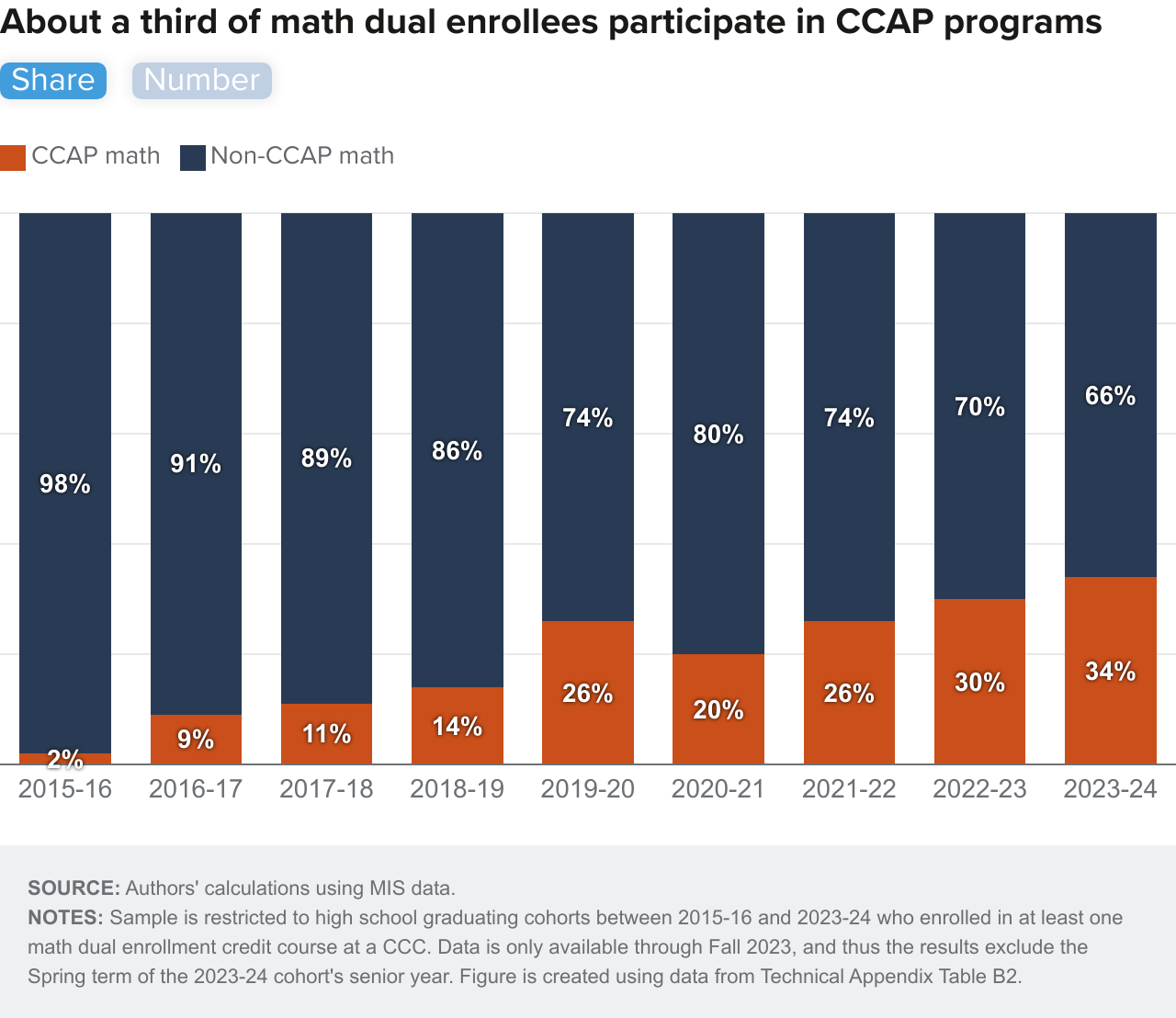
- College and Career Access Pathways (CCAP) improved equity among underserved student groups. In the class of 2022–23, one-third of math dual enrollees participated through CCAP—a dual enrollment program that expands access to underserved students. Latino, Black, and first-generation students comprised a higher share of CCAP than non-CCAP math, and completion rates for CCAP math are higher for underserved students. However, more work is needed to fully close the equity gap. →
- CCAP is making gains with degree outcomes, but more work is needed on transfer. In the most recent cohorts, the three-year associate degree completion rate is around 40 percent for CCAP math dual enrollees, compared to about 35 percent for non-CCAP peers. However, transfer rates to four-year colleges are lower for CCAP students than non-CCAP students. →
Expanding access to gateway math through dual enrollment is a step in the right direction for putting California students on the path to college. CCAP can further this goal by prioritizing math access for underserved groups. Dual enrollment math programs overall will benefit from stronger support for students and staff, a boost in the supply of math courses, and collaboration between high school and college instructors.
Introduction
When high school students take and pass a college general education course like college math through dual enrollment, they earn college credits. Furthermore, through a practice known as dual credit, the dual enrollment course can count toward both high school and college graduation. This practice provides fiscal and academic benefits: the state would not need to pay twice for the same course, and students would not need to repeat a course in college that they completed in high school, a misalignment problem that has long plagued math across the K–16 pipeline (Park et al. 2020).
Dual enrollment can also help address issues of learning loss by giving students access to college courses as soon as they complete high school-level prerequisites. This approach is especially important with math, given that about one-quarter of high schoolers do not take math during their senior year, and over half would be eligible for college math after completing algebra 2 or the equivalent (Reed et al. 2023).
A focus on math is warranted. Historically, the math requirements needed for college preparation and completion have been gatekeepers that have held students back from achieving their educational goals (Cooper et al. 2022; Reed et al. 2023; Cuellar Mejia et al. 2023a; 2023b). The opportunity window to remove that gatekeeper is especially strong now. Considerable momentum has gathered across the policy, research, practice, and advocacy communities on two critical fronts: to broaden access to dual enrollment and to improve math equity through better representation of the California students who take courses.
This momentum includes two landmark reforms passed by California’s legislature: Assembly Bill 705, which increases access to transfer-level math and English, or courses that can be used to transfer into a four-year college, and Assembly Bill 288, which expands dual enrollment to more students (see text box). The state has also invested $700 million to support dual enrollment through initiatives like the College and Career Access Pathways (CCAP) grants, Middle College High School and Early College High School grants, and the Golden State Pathways Programs (GSPP) grants.
Additionally, state- and system-level agreements and initiatives aim to encourage high school students to complete college credits. These agreements include multi-year compacts between the governor and the California State University (CSU), the University of California (UC), and the California Community Colleges (CCC) as well as the CCC’s Vision 2030 strategic plan; all include completion of at least 12 college credits as a goal. Most recently, the state’s efforts to establish a Master Plan for Career Education have elevated the role of dual enrollment in helping to ensure that Californians can acquire the skills necessary to access “high opportunity” careers.
In the last few years, strong interest has emerged around encouraging a fourth year of high school math/quantitative reasoning for freshman admissions to the University of California and the California State University. While making this coursework an admissions requirement sparks resistance from advocates, the advocates do support equitable access to gateway math and English courses (Campaign for College Opportunity 2024; Ed Trust-West 2024a; Public Advocates 2024) and dual enrollment (Ed Trust-West 2024b; Muñoz et al. 2022). Offering a fourth year of math/quantitative reasoning through a dual enrollment course that awards dual credit could help address these concerns.
A solid track record of research consistently documents the importance of completing transfer-level math early and its effects on academic outcomes, including completing a degree and transferring to a four-year college (Cooper et al. 2022; RP Group 2019; Brohawn et al. 2021; Cuellar Mejia et al. 2023a; 2023b; Melguizo et al. 2021). A wealth of evidence supports the benefits of participating in dual enrollment at key milestones along the high school and college pathway, including college access and completion (Allen and Dadgar 2012; An 2013; Fink 2024; CLP and KCCD 2022; Liu et al. 2020; Rodriguez et al. 2012; 2023; Ryu et al. 2023; Speroni 2011; Taylor et al. 2022).
Research has also documented the benefits of completing 12th grade math (Wainstein et al. 2023) on early college outcomes in California—notably, of attaining math and quantitative reasoning skills for stronger academic and career outcomes, including degrees that align with careers as well as boosting the likelihood that Black and Latino students enter STEM careers (Just Equations and Career Ladders Project 2022; Burning Glass Institute and Strada Institute for the Future of Work 2024; Minaya 2021; Speroni 2011).
In this study, we explore the challenges and opportunities to using dual enrollment as a strategy to improve access and success in math. We aim to better understand how to leverage two pieces of legislation, equitable math placement (AB 705) and the expansion of dual enrollment though the College and Career Access Pathways programs (AB 288), to accelerate student progress in math and close the opportunity gaps for students from underrepresented groups.
Trends in Dual Enrollment Math
Each year, greater numbers of high school students in California participate in dual enrollment and gain early exposure to college coursework (Rodriguez et al. 2023; 2021; Kurlaender et al. 2021; Friedmann et al. 2024). Over 130,300 students participated in dual enrollment in the class of 2023, the most recent cohort with data across all eight high school terms (Technical Appendix Table B1). This number represents roughly 26 percent of the 2023 class, up from 15 percent in 2017, which reflected the early phase of CCAP and the period prior to AB 705.
Dual enrollment grew strongly in the five years leading up to the COVID-19 pandemic (Figure 1). Although a plateau seems to appear after the pandemic, the estimated number of dual enrollees grew 15 percent year over year with the class of 2024, to nearly 150,000 students. This growth suggests what we might expect in the near future, especially as schools and colleges carry out the dual enrollment expansion supported by synergies in state funding, policy, and advocacy efforts.
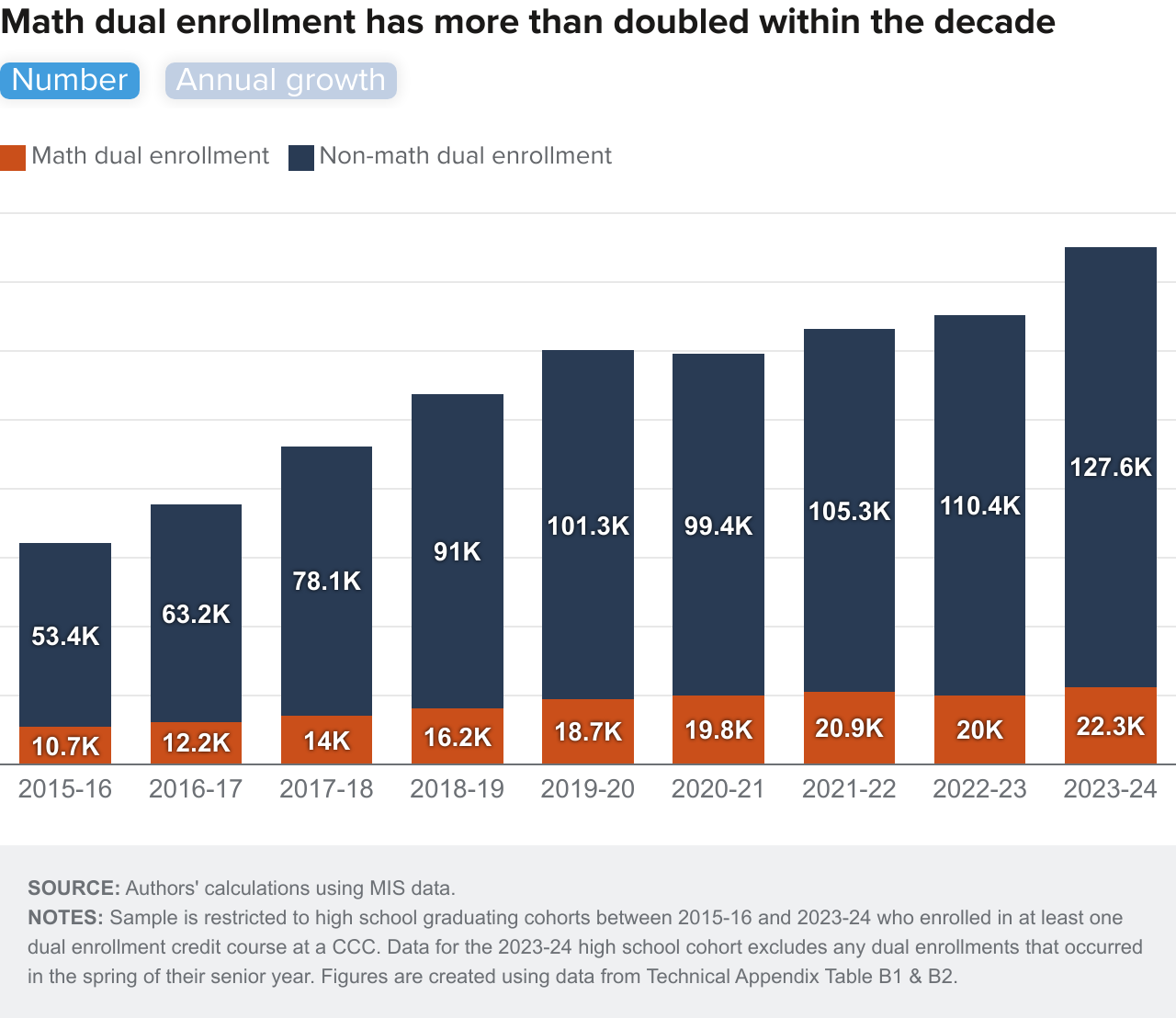
Dual Enrollment Math Continues to Grow over Time
The number of students taking a dual enrollment math course grew from roughly 12,200 to about 20,000 students between the graduating classes of 2017 and 2023 (Figure 1, above). Despite this strong growth, the share of dual enrollment students who take a math course has remained relatively stable, comprising roughly 15 to 17 percent for the above cohorts. Overall, more students are taking math, but growth is slightly slower than for overall dual enrollment (64% vs. 67% when comparing the 2016–17 and 2022–23 high school cohorts).

Most math dual enrollees (70%) in the 2022–23 graduating cohort took only one math course. Among those who took multiple courses, the most common combination was calculus 1 plus other higher-level math courses (Technical Appendix Table B16).
The courses students take also vary across different math pathways. A third of dual enrollment students enroll in statistics courses for the Statistics and Liberal Arts Math (SLAM) pathway and over half are in courses for the Business, Science, Technology, and Mathematics (BSTEM) pathway (Figure 2), such as college algebra or precalculus.
Demographics for Math Dual Enrollees Differ from Those in Other Courses
Dual enrollees in math are less likely to be first-generation or Latino students (Figure 3). Specifically, only a quarter of math dual enrollees are first generation compared to about a third of dual enrollees in other courses. Likewise, about 35 percent of math dual enrollees are Latino, compared to 48 percent in other courses.
Conversely, Asian students are more highly represented among dual enrollees in math than in other courses (27% vs. 15%). In math courses, half of dual enrollees in higher-level college math courses are Asian, while Latino and first-generation students are more represented in college algebra, trigonometry, and statistics or liberal arts math courses (Technical Appendix Table B15).

In addition, math dual enrollees are more likely to be from the San Francisco/Bay Area and less likely to be from Los Angeles/Orange County compared to non-math dual enrollees (Technical Appendix Figure B1). For the 2022–23 cohort, 30 percent of math dual enrollees were from the Bay Area and 21 percent from LA/Orange County, compared to 20 percent and 31 percent for non-math dual enrollees in the two regions.
CCAP Math Has Gained Popularity
College and Career Access Pathways (CCAP) programs have fueled growth in dual enrollment math. Since CCAP launched through Assembly Bill 288 in 2016, the share of dual enrollees taking math courses through CCAP has more than tripled from 9 percent in 2016–17 to 30 percent in 2022–23 (Figure 4), or from 1,142 to 5,999 students. Meanwhile, the number of non-CCAP math dual enrollees had smaller growth, from 11,078 to 13,995 students.
This CCAP math expansion may be due in part to AB 288’s focus on broadening access to dual enrollment to students who have been undeserved by higher education. The legislation provided flexibility that helped remove logistical hurdles by allowing schools to offer dual enrollment on high school campuses exclusively to high school students. The language of the law also provided colleges and high schools with a framework for reaching agreements to offer courses.
Underserved students comprise higher shares in CCAP math compared to non-CCAP math (Figure 5), with higher enrollment among Latino students (46% CCAP math; 30% non-CCAP math), first-generation students (32% CCAP math; 23% non-CCAP math), and Black students (3.2% CCAP math; 2.8% non-CCAP math). Still, while CCAP overall is more representative of the K–12 population, further efforts are needed to achieve equity in CCAP math.

For the 2022–23 cohort, regional differences are apparent, with greater representation in CCAP math compared to non-CCAP math in Los Angeles/Orange County (+11 percentage points) and the San Diego/Imperial (+7 percentage points) regions (Technical Appendix Figure B2). Representation is much lower in the San Francisco/Bay Area region (-18 percentage points).
Most Math Dual Enrollees Take Transfer-Level Courses
Dual enrollees in math are increasingly likely to enroll in transfer-level math courses while in high school: the share who took transfer-level courses shot up from 69 percent in 2016–17 to 91 percent in 2022–23 (Figure 6). In particular, the share increased by 5 percentage points between the 2018–19 and 2019–20 cohorts. The increase was slightly larger than in previous cohorts and coincided with the fall 2019 implementation deadline for AB 705, which expanded access to transfer-level courses in English and math at California’s community colleges. The number of students who took transfer-level math rose from 12,121 in 2018–19 to 14,886 in 2019–20, while those taking non-transferable courses decreased from 4,074 to 3,844.

Latino dual enrollees in 2022–23 are more represented, and first-generation students are almost equally represented, in transfer-level courses compared to non-transferable courses only (Technical Appendix Figure B3). This is a positive shift from the early pre-AB 705 era of the 2016–17 cohort, when these groups were less represented in transfer-level courses. However, Black students are still underrepresented among dual enrollees taking transfer-level math courses.
Across regions, students from the Central Valley and Inland Empire have gained representation among those taking transfer-level math courses in 2022–23 compared to 2016–17 (Technical Appendix Figure B4). Across cohorts, students from San Diego/Imperial have consistently been more represented in transfer-level math than non-transferable math. In contrast, San Francisco/Bay Area students are less represented in transfer-level math than in non-transferable math in 2022–23.
Course pathways also reflect different patterns among student groups in 2022–23 (Figure 7). Specifically, first-generation, Black, and Latino dual enrollees in transfer-level math are more represented in the SLAM pathway than in the BSTEM pathway. Conversely, male students are more prevalent in the BSTEM pathway.

More Students Are Completing Transfer-Level Math
More students are now completing transfer-level math in high school, and this is a notable trend in CCAP programs. The number of CCAP students completing transfer-level math has exploded—from 734 in 2016–17 to 4,741 in 2022–23, including a nearly three-fold increase from 2018–19 to 2019–20 that aligns with AB 705 implementation (Figure 8). Meanwhile, the number of non-CCAP students completing transfer-level math also grew, from 6,389 in 2016–17 to 10,460 in 2023–24. The share of students who complete these courses among those who enroll has remained consistently high at approximately 80 to 90 percent.
Completing transfer-level math and English courses is a critical milestone on the path to transfer and college completion. By completing these courses during high school, students gain a head start on their college education and reduce the time and cost required to earn a degree, making them more likely to persist and succeed in their college journey (Speroni 2011). Completing a dual enrollment math course also boosts the likelihood of entry and persistence in high-demand and high-returns STEM majors, especially for Black and Latino students (Minaya 2021).

First-Generation Students Are Less Likely to Complete Transfer-Level Math
Although the overall rate of dual enrollees completing transfer-level math is high, it varies widely by race and first-generation status (Figure 9). Among the 2022–23 cohort, first-generation students are less likely to complete these courses compared to their non-first-generation peers. Additionally, Black and Latino students are less likely than their white and Asian counterparts to complete the courses.
While these patterns are consistent for both CCAP and non-CCAP programs, completion rates are higher in CCAP for first-generation and Black/Latino students. Although these differences may reflect factors external to CCAP programs, CCAP shows potential for supporting more equitable outcomes in transfer-level math completion.

Dual Enrollment Math and College Enrollment
Overall, the college-going rate for math dual enrollees exceeds that of all high school seniors in the state (69% vs. 63%). In particular, math dual enrollees are more likely to enroll in University of California (UC) compared to students who did not participate in dual enrollment math.
Only 8 percent of all high school seniors in the 2021–22 cohort enrolled in UC within one year of graduation, compared to 17 percent of math dual enrollees (Figure 10); math dual enrollees were 9 percentage points more likely than all high school graduates to enroll at a UC or CSU (29% vs. 20%). The overall college-going rate is higher among CCAP math dual enrollees than their non-CCAP peers, particularly through enrollments in California Community Colleges (CCC) and California State University (CSU).
Some differences in college enrollment patterns may stem from early exposure to college math coursework through dual enrollment, which better prepares students. Other patterns may reflect factors among students who self-sorted and were selected to enroll in math courses through dual enrollment and/or CCAP programs. For example, our interviews with high school administration, teachers, and counselors revealed varying minimum requirements for qualifying to enroll in dual enrollment math courses (see “Opportunities and Challenges with Implementing Dual Enrollment Math ” section in this report and Technical Appendix A: Region-High School Interview Table). Also, educational goals, college-going culture at high schools, available resources, and family support may differ between CCAP math dual enrollees, non-CCAP math dual enrollees, and regular high school students.

Among math dual enrollees in the 2021–22 cohort, CCAP students generally have higher college-going rates within one year of graduation across various demographic groups, including gender, race/ethnicity, and first-generation status (Figure 11). However, Black students in CCAP programs show a lower college-going rate compared to their non-CCAP peers. Female students in either program are more likely than male students to enroll in four-year institutions, including UC, CSU, and other four-year colleges.
First-generation students enroll at higher rates in CCC and CSU compared to non-first-generation students. Across racial groups, Latino students are more likely to enroll in CCC and CSU, while Asian students are more likely to enroll at UC. Furthermore, white and Black students have higher enrollment rates in four-year institutions other than UC and CSU compared to other racial groups. Also, Black students are more likely to enroll in a public four-year university than a CCC.

Dual Enrollment Math and Community College Success
Building on the head start that dual enrollment provides in college-level coursework, we explore whether math dual enrollees outperform their peers in college who did not participate in dual enrollment. This analysis focuses on 2015–16 to 2021–22 high school graduates who enrolled in the California Community College system as degree or transfer-intending students.
Math dual enrollees can differ from regular first-time college students who did not participate in dual enrollment during high school. For example, factors such as motivation, academic preparation, available resources, and family support may vary. In addition, math dual enrollment can contribute to college success by increasing college readiness, boosting students’ confidence and cognitive engagement, and reducing the time and cost required to complete college degrees through early exposure to college coursework.
Math Dual Enrollees Show Stronger Early Momentum in Community College
Early momentum metrics, including completing gateway courses and accumulating units in early years of college, are strong indicators of long-term college success (Belfield, Jenkins, & Fink 2019). To focus on momentum, we included courses completed during high school through dual enrollment in the analyses and compared students’ completion of gateway courses by the end of their first year as they transition into their second year of college. Math dual enrollees show stronger early momentum than regular first-time college students who had no exposure to any college courses through dual enrollment during high school.
Math dual enrollees in both CCAP and non-CCAP programs are much more likely to complete transfer-level math by the end of their first year of college compared to non-dual enrollees (Figure 12). Across cohorts, 72 percent of math dual enrollees in CCAP programs and 70 percent in non-CCAP programs completed transfer-level math (56% of CCAP math dual enrollees and 52% of non-CCAP math dual enrollees completed while still in high school), compared to only 26 percent of non-dual enrollees. This pattern is consistent across demographic groups, including gender, race/ethnicity, and first-generation status.
Over time, the rate of math dual enrollees who completed transfer-level math rose more than it did for non-dual enrollees. From the 2016–17 cohort to the 2021–22 cohort—the most recent cohort with data for a full academic year of their first college year—completion rates rose by 19 percentage points for CCAP math dual enrollees and 18 points for non-CCAP, compared to 14 points for non-dual enrollees. For the first time within our cohorts, the completion rate for CCAP math dual enrollees exceeded that of non-CCAP dual enrollees in the 2019–20 cohort.

Similarly, math dual enrollees in both CCAP and non-CCAP programs accumulate significantly more units by the end of their first year of college compared to non-dual enrollees (Technical Appendix Figure B5). On average, CCAP math dual enrollees accumulate 37 units, non-CCAP students accumulate 39 units, and non-dual enrollees accumulate 15 units—that is, math dual enrollees are about one year ahead of their non-dual enrollee peers.
Over time, both CCAP and non-CCAP math dual enrollees increased units accumulated by the end of the first college year from around 35 to 40 units, while the number remained steady at around 15 units for non-dual enrollees.
Early momentum differs among demographic groups
First-generation, Black, and Latino math dual enrollment students are generally less likely to complete transfer-level math and accumulate fewer units by the end of their first college year compared to non-first generation and white and Asian counterparts. Among math dual enrollees who are first-generation, Black, and Latino, CCAP students are more likely to complete transfer-level math and accumulate more units by the end of their first college year compared to their non-CCAP peers.
Math Dual Enrollees Show Better Performance by Their First College Year
On average across cohorts, math dual enrollees have higher GPAs by the end of the first year at community college than non-dual enrollees, although CCAP students have lower GPAs than non-CCAP students. This pattern holds true across demographic groups. And students who completed transfer-level math courses through dual enrollment have an even higher GPA than an average math dual enrollee.
Additionally, the average GPA by the end of the first college year increased from 2.6 for the 2016–17 cohort to 2.9 for the 2021–22 cohort among math dual enrollees in CCAP, and from 2.8 to 3.1 for non-CCAP dual enrollees. In contrast, the average GPA for non-dual enrollees remained around 2.3 during the period (Figure 13).

More Math Dual Enrollees Complete a Degree or Transfer
Math dual enrollees across cohorts are more likely to earn an associate degree or transfer to a four-year institution within three years of community college enrollment. Additionally, they tend to complete their degrees or transfer more quickly, with higher completion rates within one, two, and three years compared to their non-dual enrollee peers (Technical Appendix Figure B6). Among math dual enrollees, associate degree completion rates are higher but transfer rates are lower for CCAP students compared to non-CCAP students.
While about 35 percent of math dual enrollees completed an associate degree within three years, the rate rises to 42 percent among those who completed transfer-level math courses through dual enrollment (Figure 14). Similarly, while the transfer rate in three years is 26 percent for CCAP math dual enrollees and 32 percent for non-CCAP, it is 38 percent for those who completed transfer-level math through dual enrollment.

Initially, the share of math dual enrollees who complete an associate degree in three years was lower among CCAP than non-CCAP students, but the trend has reversed with more recent cohorts. For the 2018–19 and 2019–20 cohorts, the completion rate is around 40 percent for CCAP students versus about 35 percent for non-CCAP students (Figure 15). However, transfer rates to a four-year institution within three years are consistently higher for non-CCAP math dual enrollees than CCAP students over time.

Opportunities and Challenges with Implementing Dual Enrollment Math
As suggested by our quantitative data and corroborated by our qualitative observations, the growth in students participating in dual enrollment math appears to be driven by those who are accessing courses through CCAP programs. Our interviews reveal shifts in culture and logistical barriers that previously prevented many students from accessing dual enrollment courses (i.e., location, time, mode, and instructor). Although avenues for California high school students to enroll in community college courses have existed for decades, some high schools began offering dual enrollment only when Assembly Bill 288 established CCAP partnerships. Though CCAP helped expand dual enrollment as a whole, these shifts were especially important for math because the math curriculum varies drastically by district and builds upon itself. Through CCAP, high school and community college partnerships could better utilize the student-teacher relationships and support at high schools to ensure greater success in math courses.

How CCAP Improved Access to Dual Enrollment
Moving away from “random acts of dual enrollment” to create a college-going culture. The CCAP legislation provided more language for stakeholders to support a college-going culture to high school students. Some interviewees expressed a desire to move away from “random acts of dual enrollment”; that is, encouraging students to take college-level courses regardless of whether the courses led to a career or academic program of study. This hope was mentioned in tandem with a desire to create structured pathways for students to work towards a postsecondary degree while in high school. For example, the dual enrollment administrator at College A explained,
“Over time, we tried to grow [our dual enrollment offerings] and expand it pretty extensively, and then in the last three to five years […] it wasn’t about scaling up. It was being more meaningful in our course offerings. So everything that we offer leads to some sort of pathway degree certificate. […] I know the state calls it ‘random acts of dual enrollment,’ and we were very much that way in the very beginning. It was basically ‘anyone who could teach, we would approve,’ but now we really are selective and try to make sure that those classes that we offer are more meaningful. […] So we have transfer pathways at most of our high schools, or we try to explore certificate offerings.”
An example of the language of the law that supports the movement in this direction states that:
Through dual enrollment partnerships, school districts and community college districts could create clear pathways of aligned, sequenced coursework that would allow students to more easily and successfully transition to for-credit, college-level coursework leading to an associate degree, transfer to the University of California or the California State University, or to a program leading to a career technical education credential or certificate (AB 288 Holden 2015).
Although ultimately vetoed for fiscal reasons, Assembly Bill 359 (AB 359 Holden) aimed to further clarify the goals of AB 288, calling out the benefits of dual enrollment as “an equity-based solution to increasing a college-attending culture.”
Shifting the location of instruction. Prior to CCAP, dual enrollment courses were often in-person on the community college campus. In this traditional model, high school students enrolled in college courses that were open to the general community college population.
High School A shared that with sufficient collaboration, their partner community college offered in-person courses at the high school campus during the school day even before CCAP. However, members of the community outside of the high school were also eligible to enroll in a few cases. (These cases were rare, and community members often dropped the course when they realized most students were high school age.) CCAP agreements addressed this concern by allowing courses to be exclusive to high school students.
Shifting the time to accommodate a high school schedule. In the past, courses students took through dual enrollment were aligned with the college’s schedule. Under CCAP agreements, many courses are now offered during the regular high school bell schedule because the location of the courses are on the high school campuses.
Nonetheless, local context determines course offerings: some districts restrict dual enrollment offerings exclusively to high school bell schedules, while some offer dual enrollment courses only as electives during zero-periods and after hours.
Enabling greater success with online courses. One pitfall to restricting enrollment to high school students is an inability to meet minimum course sizes if there is a lack of interest at that high school. Through online dual enrollment, community colleges can offer the same course to students from different high schools. In some cases, this allows schools to meet minimum class sizes and offer courses that would otherwise be cancelled due to low enrollment.
Interviewees noted that online courses improve accessibility because community colleges that serve larger geographic areas can offer their courses to high school students without burdening students or faculty with long travel. However, many instructors noted that online instruction comes with its own set of instructional challenges. Main concerns included student engagement and opportunities to establish human contact. These concerns were most commonly addressed by having a high school teacher physically present to supplement the students’ online learning. The approach ranged from a high school teacher of the same subject area tutoring students in the same online course, to having any high school teacher available to students taking a variety of courses. In these settings, learning could take place in an in-person, synchronous environment with potential for collaboration between college instructors and high school teachers.
Encouraging more high school math teachers to teach dual enrollment through CCAP. Because CCAP made it easier to offer college courses at high schools, not all demand for dual enrollment math courses was best met by math faculty at the community college campus. According to our interviewees, most colleges and high schools preferred the course instructors to be local high school math teachers.
Oftentimes, the instructor was a local high school teacher who met the minimum qualifications to be hired as an adjunct faculty member at the community college. The high school preferred this situation because the teachers were familiar with the students and school; sometimes the community college also preferred this arrangement because faculty who work only for the community college are not incentivized to go to the high schools because they do not receive separate compensation for transportation and time. High school leaders and high school math teachers believed having an on-site high school instructor guaranteed the students would receive more individualized support. Some added that students preferred the high school math teacher as well. Many also cited the teaching credentials of the high school teachers as a guarantee the instructor would be trained in classroom management and accustomed to the age group, whereas a traditional community college professor may not be.
If a high school did not have a teacher who met minimum qualifications to teach math at the community college level, community college faculty would teach the course. However, this approach introduced administrative complications as community college schedules and high school schedules do not align: not only are calendars and holidays different, but college courses span a single semester with longer hours of instruction, while the typical high school class is taken for a full school year and may have shorter class periods. Therefore, faculty may not be available to be physically present for the required number of classroom hours. Many high schools responded by designating a high school teacher as a supporting teacher for the class: the community college faculty would lecture on some days, while the remaining classroom hours would be fulfilled by a high school math teacher in the classroom on days the faculty was not at the high school.
Furthermore, some high school teachers teach regular courses as adjunct faculty of the community college in addition to their high school load; some community college faculty were prior high school teachers and had teaching credentials and experience in the high school classroom setting. Regardless, professional development and establishing shared norms for both the high school or college-based instructor were considered crucial. As a math faculty at College F noted:
“…maybe [the high school teachers] don’t really have a lot of experience teaching college. Or if they’re college teachers, they don’t have any experience teaching high school students. So there are needs to fill those gaps and people’s knowledge of the two systems. They don’t really mesh well together. We use different language. We have different regulations we have to follow, and people really don’t understand those differences […]”
Policy Reform Streamlined How Community Colleges Envision Dual Enrollment
Spikes in transfer-level math enrollment and completion coincided with the fall 2019 deadline for implementing AB 705 (see Figure 5 and Figure 11, earlier). Although other factors may contribute to this trend, our qualitative findings substantiate that AB 705 likely drove these spikes due to how it changed the ways community colleges envision dual enrollment offerings for math.
Most interviewees referred to AB 705 and AB 1705 when discussing factors that influence dual enrollment math offerings. Although the bills do not unilaterally ban community colleges from offering non-transferable math courses (such as algebra courses), when these policies passed, it led to an understanding among our interviewees and their leaders that community colleges would no longer offer math courses that are not transferable to four-year universities—whether to the general public or to dual enrollment high school students. Consequently, some community college interviewees cited a focus on offering transfer-level math courses as dual enrollment, especially as the types of math courses local high schools request have also shifted to transfer-level math (such as statistics courses). For example, a math faculty member at College E explained,
“Prior to AB 705, there was a lot of demand from our high schools [for non-transferable dual enrollment math]. Because in our area, we have a lot of students who only go through algebra 1. […] And so, historically, [… the high schools] would come and say, “You know, could you offer your algebra 2 as a dual enrollment?” Of course, we’re no longer allowed to teach those algebra courses. […] At the end of the spring semester, [the dual enrollment administration] were saying [they] don’t get a ton of requests anymore, and most of what we do get are for statistics.”
In particular, many high school interviewees envisioned dual enrollment as an alternative (but not a replacement) to advanced placement to access college-level credit in high school. For example, when explaining the reason for offering a dual enrollment statistics course, a math teacher at High School E noted,
“We wanted to start off by trying to serve the students who weren’t currently being served with our current AP pathway.”
Among our nine community colleges interviewed, only one reported receiving requests from high schools to offer non-transferable math as dual enrollment. No interviewed high schools reported offering non-transferable-level math via dual enrollment.
Recruitment and Selection Impacts Math Access and Success
Each site employed different methods of recruitment for dual enrollment math, and these have implications for student access to dual enrollment math.
Setting minimum requirements. According to the culture of the high school, different conditions apply for students to qualify to enroll in a dual enrollment math course. In other words, selection into dual enrollment math is at the discretion of each high school. For example, High School A emphasizes student choice and responsibility and allows high school students to enroll in a dual enrollment math course at the high school if they have passed (C or higher) their prerequisite math coursework. On the other hand, High School D tries to ensure the success of all students who enroll in their dual enrollment math courses by being more restrictive with its eligibility policy, resulting in a course pass rate of over 90 percent. However, only students with two semesters of A’s in prior coursework (or with the recommendation of a teacher, an A and B) can enroll, regardless of the student’s future career or academic aspirations.
Recruiting through fixed high school pathways. In one case, a community college visited the middle schools that fed into the partner high school pathways to promote the high school’s dual enrollment program: a fixed set of dual enrollment courses each student was expected to take during their four years in high school. While this allowed the community college to predict future enrollment and create camaraderie among program participants, this system also barred students who could not make the long-term commitment from taking any course, because the courses were available only to the pathway students.
Providing access through special math-focused initiatives. In another case, an external organization called College Bridge (see text box below) helped build relationships between local community colleges and their high school partners so that programs could target students from underrepresented demographics, such as those with GPAs below the range to be considered high achieving in math. Educators and administrators from both the high school and community college gathered to identify students who were less likely to be college-bound, and College Bridge facilitated personalized invitations and an introductory presentation to the targeted demographic.
Challenges to Aligning High School and Community College Interests
Because dual enrollment implementation is not standardized, unique community interests and local high school and community college relationships require stakeholders to be creative. Interviewees identified the greatest challenge in offering dual enrollment as navigating the interests and concerns of two distinct educational systems that are highly localized and have historically developed independently. This introduces high start-up costs to collaboration and alignment. Several points of contention occur before dual enrollment can even be offered, although elements regarding the courses themselves are also up for debate. To effectively offer dual enrollment, stakeholders must prioritize establishing and maintaining good, collaborative relationships between the two institutions.
Differing calendars. Interviewees unanimously cited the challenges of scheduling. Due to differing calendars stakeholders may not always anticipate problems around coordinating schedules. For example, high schools and community colleges have different academic breaks, so dual enrollment instructors must work with two different academic calendars to meet the unit hours for the college course. College courses are on a semester basis, and high school students typically enroll in year-long classes, so high schools might also need to determine what will happen for the remainder of the school year after students complete the college courses.
Administrative timelines. Community colleges reported planning course offerings one year in advance, while high schools work on shorter timelines. High schools must project the demand for a dual enrollment course to request it from the community college in a timely manner and ensure an instructor is secured for the course.
Awarding credit. While dual enrollment courses are community college courses and guarantee community college credit, they do not always award high school credit. Most of the high schools where we interviewed arrange dual enrollment math courses to fulfill high school graduation requirements, but one high school awards only elective credit.
Previous legislative proposals have attempted to address this inefficiency. For example, the vetoed Assembly Bill 359 would have required that starting in the 2025–26 academic year, CCAP partnerships certify that any dual enrollment course taken through CCAP provide students with dual credit at both the community college and high school they attend.
Districts also differ in whether dual enrollment courses grant high school GPA bumps similar to those received by traditional honors or AP courses. The mechanics behind the awarded credit create different course-taking incentives across California. For example, in one district where dual enrollment courses awarded a GPA bump greater than did AP courses, an interviewee observed dual enrollment attracted students hoping to compete for high school valedictorian and salutatorian to have an advantage on college applications. In another district where no GPA bump existed for dual enrollment but a 1-point GPA bump existed for AP and honors courses, an interviewee noted dual enrollment course offerings were less predictable because recruiting the minimum number of students to open a course was difficult.
The professional boundaries of teachers and faculty. With dual enrollment positioned between high schools and community colleges, instructors in both institutions have concerns over professional boundaries. Both high schools and community colleges have their own systems in place for determining who will teach what class each year, and these systems can be in direct conflict. Although the issues are normally resolved, in one case, the high school teacher ultimately did not teach the course as anticipated. We expect such collisions to become less frequent as dual enrollment becomes offered more regularly and instructors in both institutions have clearer expectations of what to expect in their context.
Multiple high school teacher unions at the sites we talked to have also expressed concern that the expansion of dual enrollment would lead to lower enrollment in other courses and subsequently affect job security for teachers. In more than one instance, interviewees reported high schools needing to establish Memoranda of Understanding around dual enrollment in response to teacher unions.
These tensions can lead schools to restrict the forms and settings of dual enrollment they offer. Consequently, many schools that offer dual enrollment math during the school day distinguish dual enrollment courses from AP courses in terms of content. For example, a high school may offer AP calculus but also dual enrollment statistics. Other schools allow dual enrollment courses only outside of regular high school hours to distinguish scheduling high school from college courses. In moving forward with expanding dual enrollment, stakeholders will need to establish clear boundaries and understanding of the purpose of dual enrollment and who will teach it.
Course content. Because high school and community college math courses are not standardized, determining student placement in dual enrollment courses is a complicated process. While articulations exist between community colleges and four-year institutions, some community colleges have informally initiated similar processes with their more consistent partner high schools to eliminate gaps in math education. However, establishing articulations with every high school presents practical challenges, including the need to coordinate meetings and identify appropriate personnel to undertake the work.
Conclusion and Recommendations
With the support of state policy, funding, and coordination, California has built the foundation to use dual enrollment to improve access and success in math, one of the most challenging gatekeepers across the K–16 pipeline. Overall, our study finds that providing access to dual enrollment math benefits the whole student population. As the law intended, College and Career Access Pathways (CCAP) is also increasing enrollment and completion of gateway math among students who have been underserved in higher education, including Latino, Black, and first-generation students. Still, while this means CCAP is closer to achieving equity in dual enrollment math access and success, more work is needed to fully close the equity gap.
Overall, math dual enrollees have stronger college-going outcomes, including higher rates of attendance at the UC. Among those who enroll at the CCC, math dual enrollees had stronger early momentum metrics and stronger degree completion compared to their non-dual enrollee peers. However, CCAP students have lower transfer rates to four-year colleges compared to non-CCAP students.
Our interviews revealed that supporting historically underserved students and achieving equitable outcomes in college-related outcomes requires intentional efforts from all stakeholders. Critical efforts include recruiting and training staff to enroll, teach, and support dual enrollment students as well as aligning the goals and incentives between high schools and the community college, especially around labor issues. For example, one incentive that should be straightforward is whether high school credit (or dual credit) is awarded for college courses.
Expanding access to gateway math through dual enrollment has the potential to improve college access and success. To help ensure implementation is centered around equity for students, we provide the following recommendations:
Ensure that CCAP math enrollment prioritizes underserved groups. We recommend that K–12 and community college partners use data to recruit students and improve representation among CCAP’s focus populations, including students who are not already college-bound or who are underrepresented in higher education. Our interviews suggest that some CCAP partnerships may be unaware of the intent of the law or may not have a clear understanding of how they will recruit.
We strongly recommend placing a greater focus on recruiting students who are not on track to college because of the math requirement. Offering different math options at the college level raises expectations for underserved students and provides an opening to explore career paths in STEM, business, health, education, and other high-demand and high-skill careers. A notable selling point for these gateway courses is that taking and passing just one college math or statistics course will fulfill the entire math/quantitative reasoning requirement for the degree in many programs of study, including those in social sciences, liberal arts, and some career technical fields.
Support successful course completion through academic resources and by investing in high school-college partnerships. High school and college counselors and instructors could do more to promote tutoring and student services (including basic needs supports) at both the high school and the college levels by including links to the resources on the course syllabus or its online learning management site. Students often do not know or are unable to access academic and non-academic support due to logistical or other issues (Rodriguez et al. 2021; 2023). Robust online tutoring and counseling are key to addressing logistical concerns. Currently, the University of California offers free access to A–G college prep and advanced placement (AP) course materials to all public high schools through the state-funded program known as UC Scout. These free resources could be integrated into support for dual enrollment math courses.
Structured professional development as well as collaboration on course design and on how to implement courses and support—such as efforts piloted by Math Bridge—can be part of a larger strategy for boosting successful completion. The state’s investment of $64 million is a recent example of how California has supported equitable placement, support, and completion of gateway math and English (AB 705/1705).
Find innovative ways to increase the supply of dual enrollment math. Providing access to college math as soon as students complete prerequisites would help avoid the learning loss that can occur if they take only the minimum two years required for high school graduation or do not take math during their senior year. However, community colleges would have difficulty meeting demand with the current offerings and faculty capacity if all seniors completed the prerequisites for college math (e.g., algebra 2 or the equivalent)—more than half of seniors in 2018–19 (Reed et al. 2023). K–16 systems may need to find innovative ways to expand access to this course using high-quality and well-supported online programs.
The UC and CSU systems can build on UC’s online college prep platform to help make enough introductory math courses available for high school students. The platform already offers state-funded free online college prep and AP courses to all public high schools through UC Scout; an updated approach would be similar to the University of Texas at Austin’s OnRamps program, which offers online dual enrollment courses in STEM and humanities to students across Texas.
Community colleges and high schools have experimented with online offerings by setting up dual enrollment class periods at the high school with a high school teacher or other qualified staff member present to facilitate and provide support. When college and high school instructors collaborate in this way, concerns about instructor job security, course rigor, and student success in online courses can be ameliorated.
Collaborate rather than compete. Multiple teacher unions have expressed concern that expanding dual enrollment will lead to lower enrollment in other courses and affect job security or established teacher practices. If left unaddressed, competition for students as well as tension between dual enrollment and non-dual enrollment instructors and others can derail student-centered reforms.
Local political pressures should reframe the situation to promote collaboration over competition. For every dual enrollment course that awards high school credit, both a high school teacher and qualified dual enrollment instructor could work together to boost the likelihood of student success. Such an approach can also help address instructor minimum qualifications.
Share data to maximize efficacy and efficiency. Linked data systems are needed to fully realize the promise of dual enrollment. Such data systems could automate enrollment and standardize the awarding of dual credit and GPA bumps. Linked data systems could also ensure that courses fulfil high school graduation and A–G requirements. Currently, both largely depend on whether students enroll in a district that shares data and has policies in place to apply such credit toward high school requirements. There seems to be an appetite for moving in this direction. While Assembly Bill 359 was vetoed due to its fiscal implications, the bill would have required CCAP partnerships to certify that students receive dual credit at the community college and high school.
The California College Guidance Initiative is working on ways to add dual enrollment coursework into high school transcripts and college applications. The upcoming Cradle to Career data system is also well poised to enable a more comprehensive assessment of the equity and impact of programs like CCAP.
Topics
Access Completion Equity Higher Education K–12 EducationLearn More

Dual Enrollment in California

Making Gains in Gateway English and ESL through Dual Enrollment

Good Results for High Schoolers Taking College Math Via Dual Enrollment

Tracking Progress in Community College Access and Success

Improving College Access and Success through Dual Enrollment