
Table of Contents
- Key Takeaways
- Introduction
- Trends in Dual Enrollment English Participation
- Dual Enrollment English Courses
- Dual Enrollment English and College Enrollment
- Dual Enrollment English and Success in Community Colleges
- What Drives Variation in Implementation and Access to Transfer-level English?
- Opportunities and Challenges with Implementing Dual Enrollment English and ESL
- Case Studies of Dual Enrollment ESL Implementation
- Conclusion
- Notes and References
- Authors and Acknowledgments
- PPIC Board of Directors
- Copyright
Key Takeaways
Taking college courses while in high school—known as dual enrollment (DE)—gives students greater access to core subjects like English and math. Along with legislation, in the past few years California has invested nearly $700 million to support K–12 and community college districts to expand and support dual enrollment—and to help accelerate gains among historically underserved student populations such as Latino, Black, and first-generation students.
In this descriptive study, we explore the challenges and opportunities of using dual enrollment English and English as a Second Language (ESL) as a strategy to improve access to and success in college. It is important to note that our results show associations between participating in DE and improving student outcomes—not causal relationships. We find:
- Each year, greater numbers of students take dual enrollment English. Although only about 6 percent of 12th graders took an English dual enrollment course in 2023–24, participation has grown significantly—from fewer than 10,000 in the 2016–17 high school cohort to almost 30,000 in 2023–24. For the class of 2024, this represented nearly 1 in 5 dual enrollees. Importantly, participation through the College and Career Access Pathways (CCAP)—a program that expanded access to underserved students—comprises 45 percent of all English dual enrollees.→
- The vast majority of dual enrollment English is at the transfer level. The share of students in dual enrollment transfer-level English courses has grown from 81 percent (2016–17) to 98 percent (2023–24) of all English dual enrollment. The vast majority (94%) of those students enroll in college composition courses that satisfy lower-division general education requirements for the University of California (UC) and California State University (CSU).→
- CCAP improved dual enrollment English among underserved student groups. The growth in CCAP English dual enrollees has powered the overall increase. Latino, Black, and first-generation students represent a larger share of CCAP than non-CCAP English participants. These historically underserved students are also more likely to meet the college composition requirement through dual enrollment under CCAP. Still, continued efforts are needed to fully close gaps across demographic groups.→
- English dual enrollees have better college outcomes than students who do not participate in dual enrollment at all. Among those who enroll in a community college after high school, students who took English courses through dual enrollment are more likely to fulfill the college composition requirement, earn higher college GPAs, and accumulate enough credits to be almost a year ahead of their peers who did not participate in dual enrollment by the end of the first year of college enrollment. They also complete associate degrees or transfer to four-year institutions at higher rates than their non-dual enrollment peers.→
- CCAP English dual enrollees have shown slightly greater improvements in college outcomes over time compared to non-CCAP English dual enrollees. The share fulfilling the college composition requirement by the end of the first year of college enrollment has increased more under CCAP and now exceeds that of non-CCAP students. Unit accumulation and cumulative GPA by the first year, as well as associate degree completion within three years, have also improved slightly more among CCAP students.→
- Dual enrollment ESL course offerings are much less common than dual enrollment English courses and are emerging in a variety of forms according to the needs and interests of the local community. Dual enrollment ESL participation has decreased in recent years, likely resulting from the fall-off in international immigration into California and decline in high school English Learner population. Many of the campuses we interviewed referred to ESL populations as a largely untapped demographic for dual enrollment and articulated upcoming efforts to develop access for them. Both courses in the core ESL sequence—which end in transfer-level college composition—and lower-unit vocationally oriented courses were offered as dual enrollment according to the needs and interests of the partnering schools and students.→
Introduction
In California and across the country, interest has surged in expanding access to dual enrollment (DE)—the opportunity to take college courses while in high school. Informed by abundant evidence of associated stronger high school and college outcomes, the state has enacted legislation to remove logistical hurdles and include historically underserved student populations (see text box). In the past few years, California has invested nearly $700 million to support K–12 and community college districts in these efforts. Moreover, system-level agreements and initiatives—including the Master Plan for Career Education, the CCC Roadmap, the UC and CSU Compacts, and the Golden State Pathways Program—increasingly promote increased access to DE and the completion of at least 12 college credits during high school.
With these mounting efforts, it is critical to determine which courses should be prioritized to maximize dual enrollment’s potential to accelerate degree completion and reduce college costs. It is counterproductive to give students access to courses that do not meet the requirements across all CCC, CSU, and UC institutions—or that exceed the number of courses needed. Dual enrollment practitioners have expressed concerns about expansion that results in more “random acts of dual enrollment”—course offerings not aligned with a specific general education or major requirement. Random acts of dual enrollment can give students a false sense of progress if only a fraction of their dual enrollment credits get them closer to achieving their intended educational goals.
While dual enrollment course offerings are often driven by high school requests and the ability of colleges to recruit faculty to teach them, intentionally selecting and offering courses that are portable across colleges and meet key graduation requirements can improve system efficiency and address college affordability concerns. Ample research indicates that completing college math and English courses as early as possible in a student’s career has positive impacts on college outcomes (see text box). Indeed, our recent report explored the challenges and opportunities to offering dual enrollment math in California and found promising results for boosting math and college outcomes. Clearly, prioritizing these courses would be beneficial for both students and the state.
A variety of mechanisms can produce promising outcomes for dual enrollment English and ESL. We summarize them below:
- Learning. In general, college-level English or ESL courses can equip students with more advanced reading, writing, and critical thinking skills, positioning them for greater high school, college, and career success. In the age of artificial intelligence, tech and educational leaders have also highlighted the importance of strong critical thinking skills. Giving high schoolers college-level opportunities to develop these skills could be beneficial.
- Reduced financial and time costs to a college degree. Although many forms of dual enrollment exist throughout California, the same course taken through any kind of dual enrollment at a community college is less expensive per unit than its average cost at a traditional four-year university. Moreover, if students complete their college composition while in high school, they meet a key requirement for a college degree and can take other courses or complete their degree sooner afterwards.
- Smoother transition to college. Increasing participation in transfer-level English courses, including college composition, could support a smoother transition into college—especially in high schools where students only need to meet the state’s minimum three years of English high school graduation requirements. Access to transfer-level English courses as soon as students complete high school prerequisites could help to avoid learning loss that might occur between the time a student takes their last high school English course and the time they enroll in college composition.
- Exposure to college and socialization into a college-going culture. Dual enrollment English and ESL can give high schoolers—especially English Learners (ELs)— an avenue for improved high school and college outcomes through more options for rigorous coursework and more exposure to a college experience (Hooker et al. 2021). State data reveal that students who remain ELs at the end of high school typically have been ELs for at least six years (over 70%), and have low A–G completion rates, low graduation rates, and low college enrollment rates (Price et al. 2024).
- Dual sources of support. When students take dual enrollment courses, they are both fully high school students and fully college students. This means students have access to academic and non-academic supports in their high school as well as those offered at the college, such as counseling or tutoring (Rodriguez et al. 2025). Compared to taking the same course after graduating high school, taking the course through dual enrollment may allow for more focused support coming from two institutions.
Understanding the distinctions among and between ESL and English courses at local colleges is important. All dual enrollment is offered by colleges—typically community colleges—that historically serve postsecondary adult populations. Whether dual enrollment or not, coursework is identical to all other courses under the same course code at the given college. Therefore, differences between dual enrollment English and ESL are unique to each college and often developed with adult populations in mind.
Course content at community colleges’ English and ESL departments may look similar at face value—both provide students the opportunity to acquire English language skills. But ESL has developed as a separate field. Multilingual learners of English are better served in pedagogically distinct ways from what is offered in traditional English departments. This is especially the case in earlier levels, where learners are developing not just reading, writing, and critical thinking skills, but also listening and speaking skills. As such, whereas English is considered a part of core academics and a discipline in and of itself, ESL had traditionally been considered part of basic skills (or remedial) education at California community colleges. It is important to note that Assembly Bill 705 helped change some of this framing as it clarified that ESL was not remediation; rather ESL students are foreign language learners acquiring a new language.
This difference is also reflected in the range of course levels offered—colleges offer ESL courses that span from beginner-level English language proficiency (listening and speaking, for example, which does not have an English department equivalent) to those that are transfer-level composition courses (e.g., advanced composition and reading, which do have English department equivalents).
Therefore, we report our analysis for dual enrollment English and ESL as distinct but related to one another. Offering both subject areas as dual enrollment ultimately serves different high school populations and has different implications, even when both also share the same purpose of dual enrollment: saving costs for students, encouraging college participation by improving access, and improving the odds of college success.
In this descriptive study, we explore the challenges and opportunities to using dual enrollment English and ESL as a strategy to improve access and success in college. We aim to better understand how to leverage two pieces of legislation—reforms to English and ESL assessment and placement (AB 705) and the expansion of dual enrollment though the College and Career Access Pathways programs (CCAP; AB 288)—to accelerate student progress in English and ESL and help to close the opportunity gaps for students from underrepresented groups.
First, we use California Community College systemwide data to examine English and ESL dual enrollment course-taking (i.e., participation), and the extent to which course-taking changed after the passage of AB 288 (establishment of CCAP) and AB 705 (course placement reform). (See Technical Appendix A for details about our descriptive data). Second, through a descriptive analysis we show the college outcomes of dual enrollment English students, including college enrollment and community college outcomes. We also examine whether course enrollment and success reflect equitable shares by assessing how different groups compare to their shares in the overall high school population and the non-dual enrollment population across key student characteristics, including race/ethnicity, gender, and first-generation status. Third, we use data from 24 semi-structured interviews with regional leaders, English instructors, counselors, and administrators in six regions in California to illuminate the key factors that lead to variation in dual enrollment English and ESL implementation across the state. We also identify the opportunities and challenges behind implementation. We conclude with policy recommendations derived from the research.
Trends in Dual Enrollment English Participation
Dual enrollment has expanded significantly in California, reaching a growing share of high school students (Figure 1). Among 12th graders in the 2023–24 graduation cohort—the most recent for which we have four years of high school data—30 percent participated in dual enrollment, up from just 16 percent in the 2016–17 cohort (which represents the early phase of CCAP and the period prior to AB 705). Dual enrollment expanded rapidly in the five years leading up to the COVID-19 pandemic. Although this growth slowed down during the pandemic, the share of 12th graders participating increased from about 25 percent during COVID to 34 percent in 2024–25. This continued growth points to the potential for further expansion, especially as schools and colleges build on momentum from aligned state funding, policies, and advocacy efforts. Participation in English also increased but remains low: about 6 percent of 12th graders took a dual enrollment English course in 2023–24, compared to 2 percent in 2016–17.

Dual Enrollment English Continues to Grow over Time
Each year, more high school students have enrolled in an English course through dual enrollment (Figure 2). The number grew from fewer than 10,000 in 2016–17 to almost 30,000 in 2023–24.
Not only has the number of participants in English dual enrollment increased, but the share of dual enrollees taking an English course has also grown. While just 13 percent in the class of 2017 enrolled in an English course, that share rose to 21 percent in 2023 and dropped slightly to 20 percent in 2024 and 18 percent in 2025.
Dual enrollment in English has increased in both participation and share among all dual enrollees
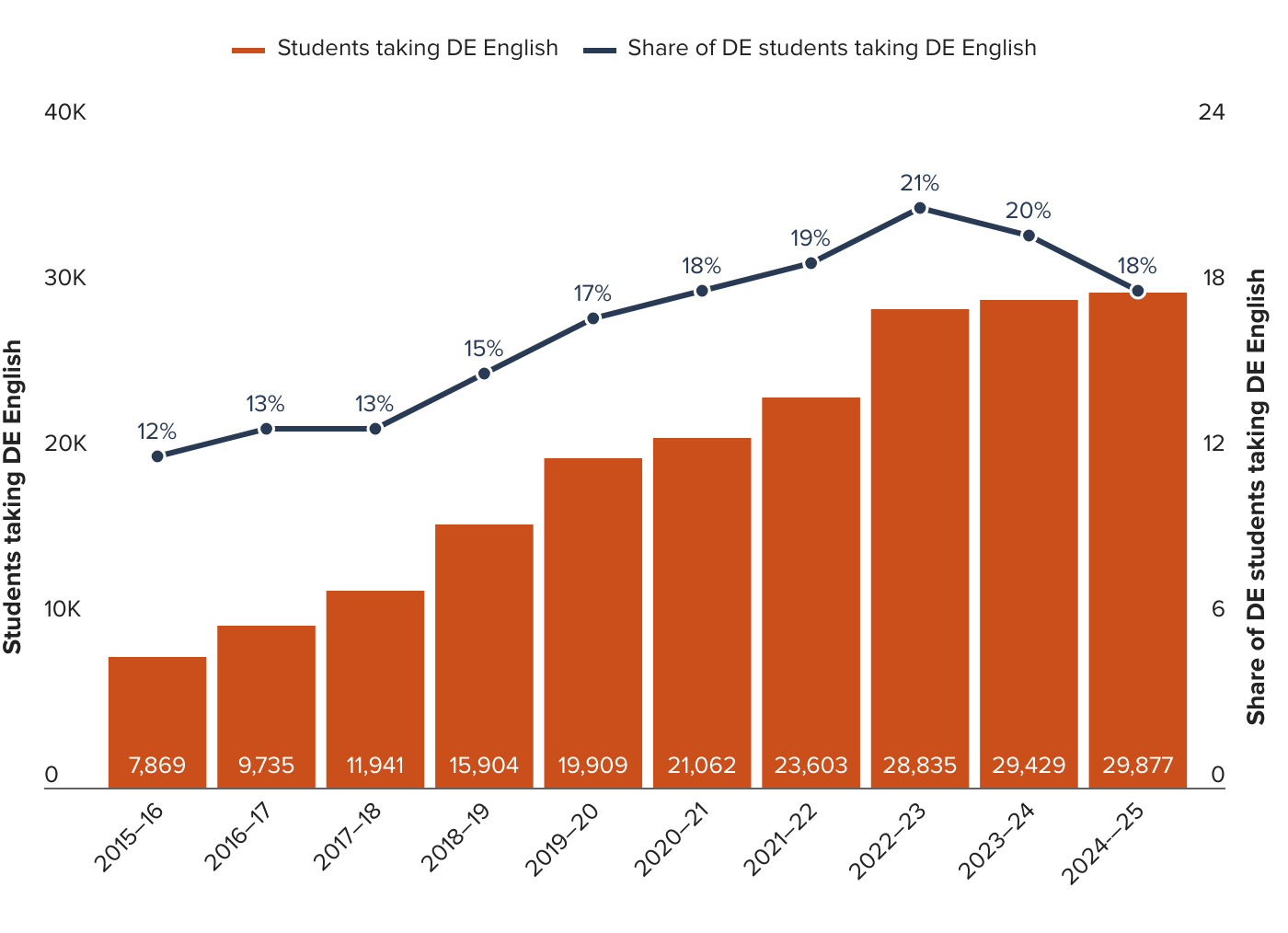
SOURCE: Author’s calculations using MIS data.
NOTES: Sample is restricted to high school graduating cohorts between 2015-16 and 2024-25 who enrolled in at least one dual enrollment credit course at a CCC. Data for the 2024-25 high school cohort excludes any dual enrollments that occurred in the spring of their senior year.
Demographic Characteristics of Dual Enrollees in English Are Similar to Those of All Dual Enrollment Participants
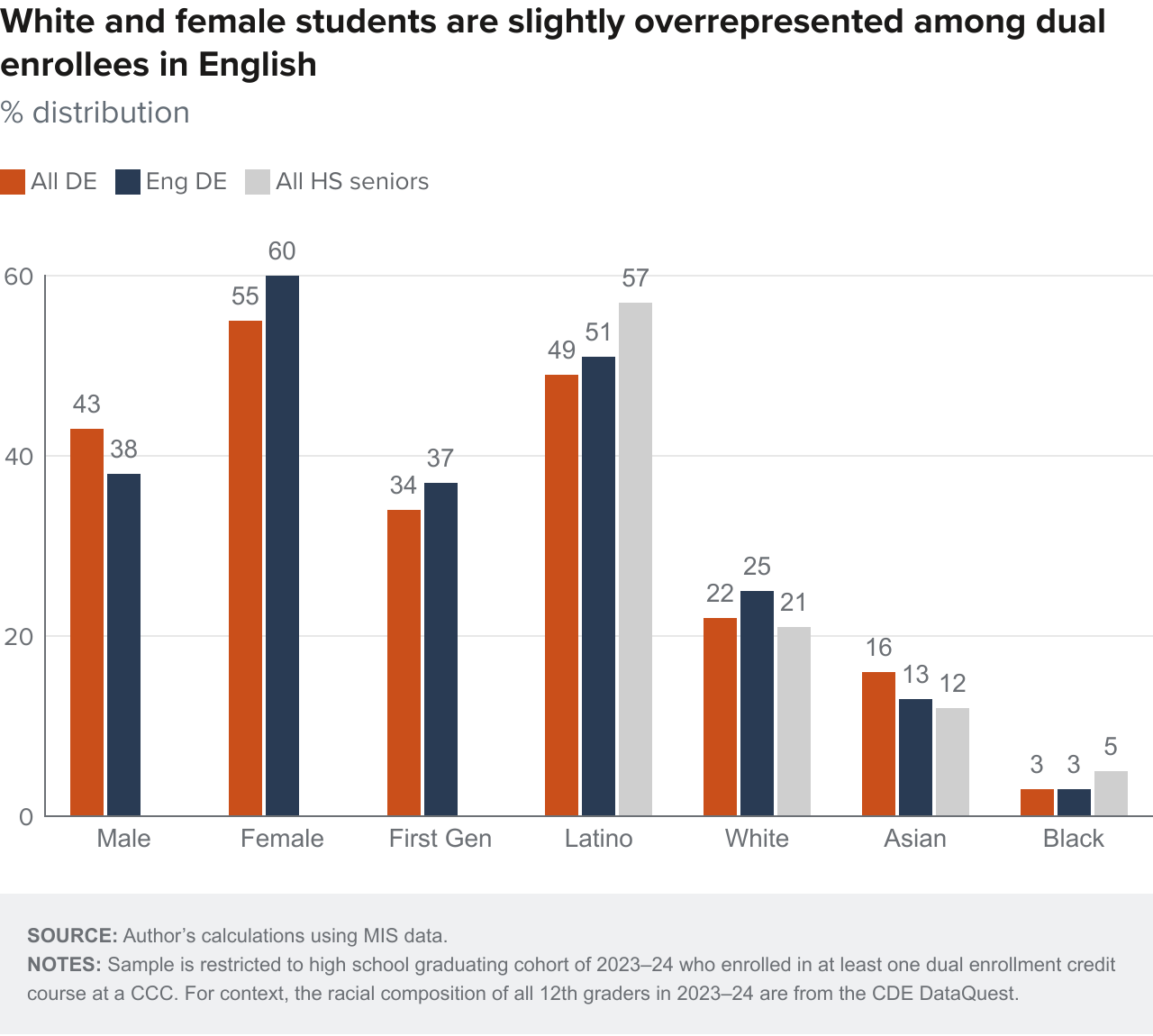
The demographic profile of dual enrollees taking English courses is generally similar to that of all dual enrollment students, though white and female students are slightly overrepresented (Figure 3). In the 2023–24 cohort, 60 percent of English dual enrollees are female, compared to 55 percent overall of all dual enrollment students. Similarly, 25 percent of English dual enrollees are white, compared to 22 percent overall. In contrast, Asian students make up 13 percent of English dual enrollees, slightly lower than their 16 percent share overall.
Latino and Black students are underrepresented in English dual enrollment relative to their share of high school seniors. Latino students account for 51 percent of English dual enrollees—similar to their share among all dual enrollees (49%) but lower than their overall representation among high school seniors (57%). Similarly, Black students make up 3 percent of English dual enrollees and 3 percent of all dual enrollees, both below their 5 percent representation among high school seniors.
In addition, enrollment in DE English courses is more likely to be in the Central Valley and less likely in Los Angeles/Orange County or the San Francisco Bay Area compared to dual enrollment in all subjects (Technical Appendix Figure B1). Specifically, for the 2023–24 cohort, 29 percent of English dual enrollees attend a school located in the Central Valley, while only 17 percent of all dual enrollees attend a school from the region. In contrast, 19 percent of English dual enrollees attend a school from Los Angeles/Orange County and 12 percent from the San Francisco Bay Area, compared to 29 percent and 19 percent from these regions among all dual enrollees.
CCAP English Has Increased in Popularity
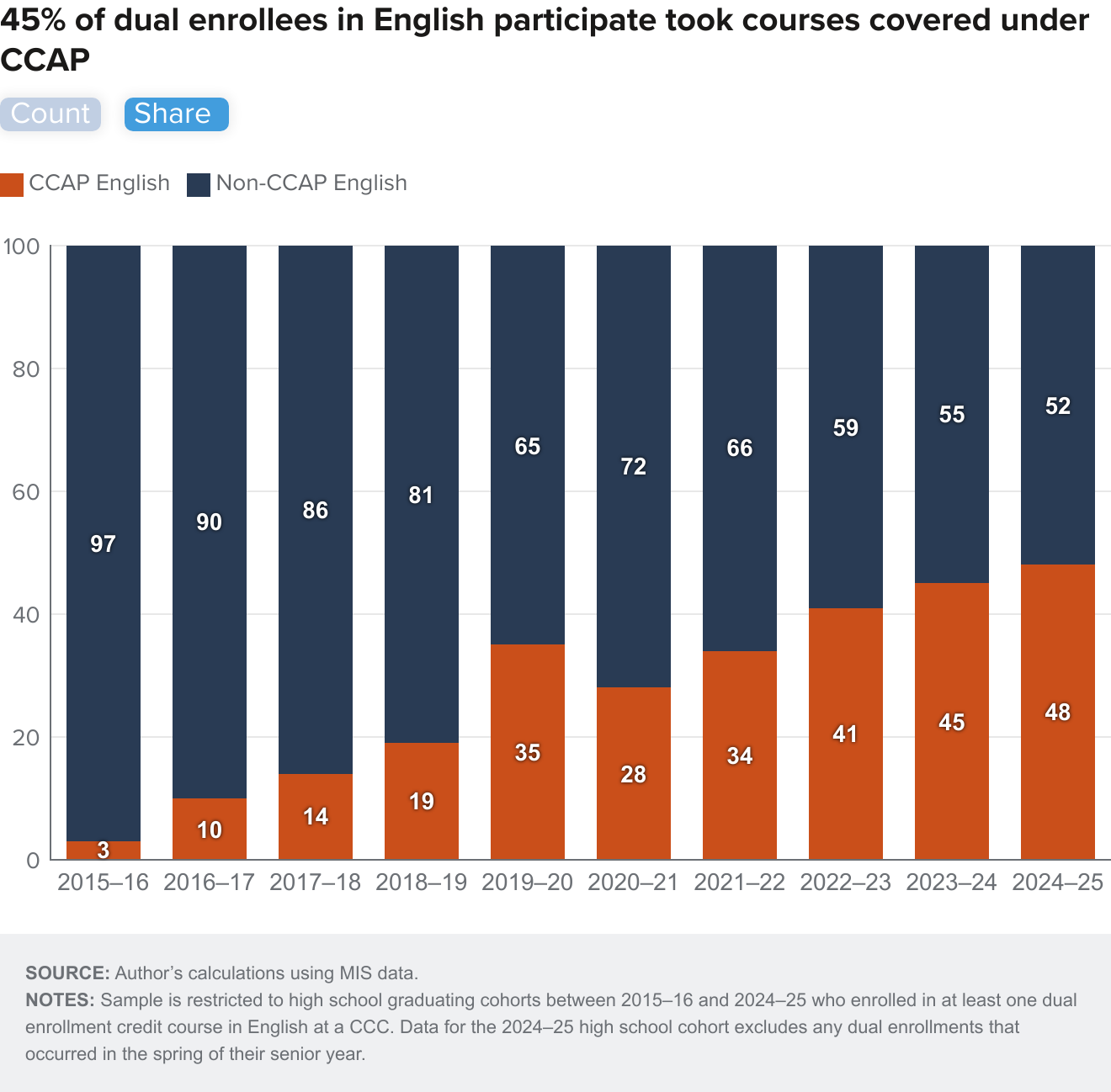
As participation in dual enrollment English has increased, the share of English dual enrollees taking courses covered under College and Career Access Pathways (CCAP) has also grown. Since CCAP launched through Assembly Bill 288 in 2016, the share of English dual enrollees in CCAP rose from 10 percent in the 2016–17 cohort to 45 percent in 2023–24 (Figure 4).
As noted earlier, AB 288 helps address logistical barriers in traditional dual enrollment by allowing courses to be offered exclusively on high school campuses for high school students. While similar arrangements may have been possible under individual MOUs between high schools and campuses prior to CCAP, interviewees noted these typically required higher levels of dedication and coordination to establish. CCAP allowed high schools and colleges without pre-existing relationships to begin offering dual enrollment, and some high schools that already offered DE English have also shifted from using separate MOUs to establishing CCAP partnerships.
The growth in CCAP English dual enrollees has powered the overall increase in English dual enrollment. Specifically, the number in CCAP grew from 956 in the class of 2017 to 13,304 in the class of 2024. Meanwhile, the number of English students through other non-CCAP dual enrollment approaches—which still constitute the majority—also increased, but at a smaller scale, from 8,779 to 16,125.
In comparison to our findings on dual enrollment math participation, we find that DE English participation has grown substantially both in CCAP and non-CCAP. Whereas about a third of math dual enrollees participate in CCAP math, half of English dual enrollees participate in a CCAP DE English course. This can be explained by how the differences between dual enrollment and alternatives to dual enrollment are different for English and math, making DE English both easier to offer for schools and more popular to take for students than DE math. (For a further discussion on this phenomenon, please see the “Opportunities and Challenges with Implementing Dual Enrollment English and ESL” section of this report.)

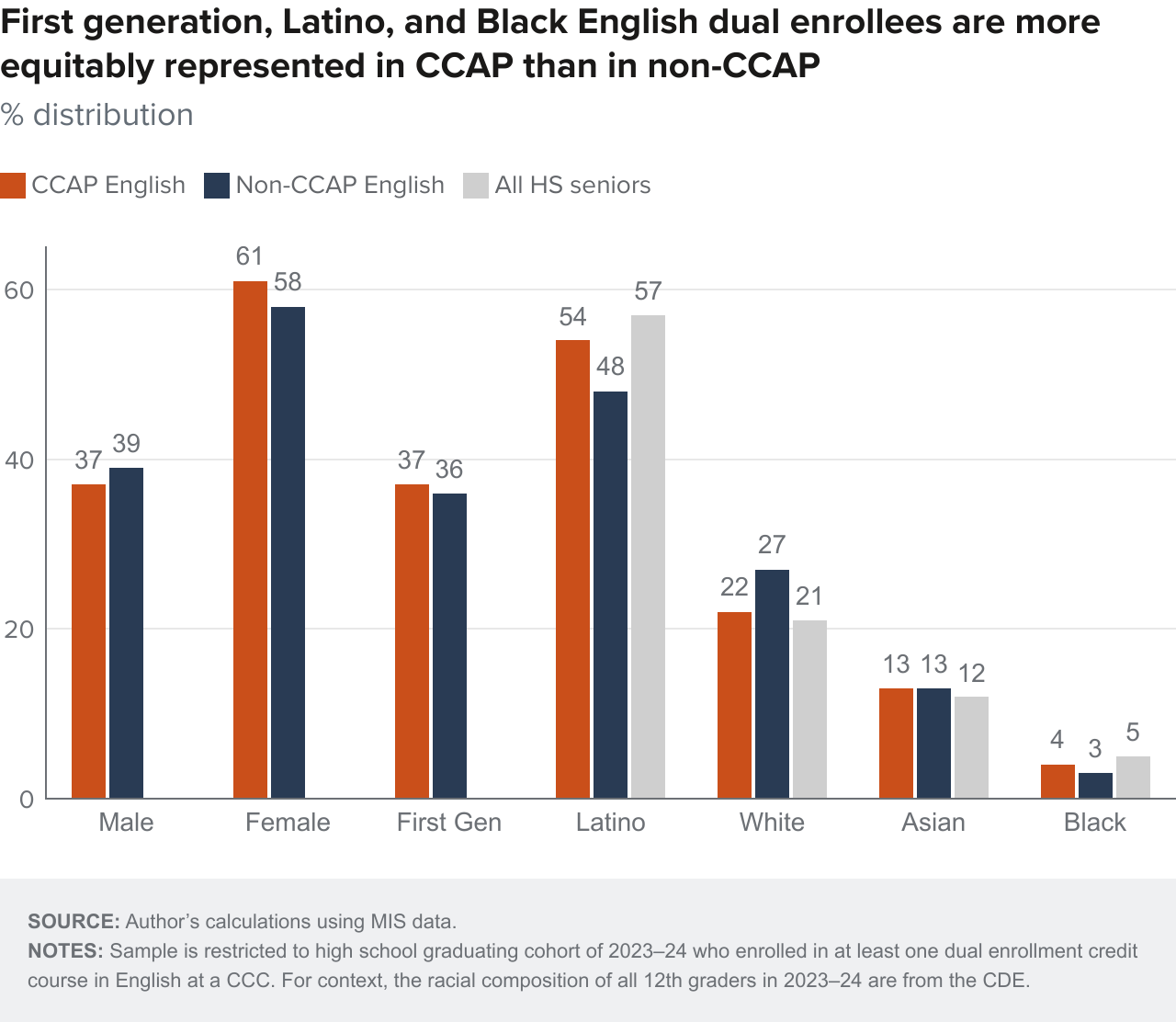
AB 288 established CCAP with an aim to expand dual enrollment access for students historically underserved in higher education and/or those who might not otherwise go to college. Among English dual enrollees in the 2023–24 cohort, underserved students make up a larger share in CCAP than in non-CCAP (Figure 5). Specifically, 37 percent of CCAP English dual enrollees are first-generation students, compared to 36 percent in non-CCAP; 54 percent are Latino, compared to 48 percent in non-CCAP; and 4 percent are Black, compared to 3 percent in non-CCAP. While CCAP is more representative of the K–12 population than non-CCAP, participation among underserved student groups remains below their overall share of high school seniors.
Across regions, students who attend a school from the North/Far North region make up a larger share of English dual enrollees in CCAP than in non-CCAP, with a difference of 7 percentage points (Technical Appendix Figure B2). In contrast, students from Central Valley, South Central Coast, and San Francisco Bay Area are less represented in CCAP than in non-CCAP, each with a gap of 5 percentage points.
Dual Enrollment English Courses
Completing transfer-level courses is an important milestone for students making progress toward a bachelor’s degree, as these courses count for credits at UC/CSU. In particular, such courses in English help build a strong academic foundation and signal readiness for more advanced, college-level coursework. One key example is college composition—a specific type/subset of transfer-level English course that fulfills Area 1A (college composition) of the Intersegmental General Education Transfer Curriculum (IGETC). IGETC is a set of lower-division general education courses accepted by both UC and CSU, and college composition plays a central role by equipping students with essential English skills for success across disciplines.
Most English Dual Enrollees Take Transfer-Level English and College Composition Courses
The share of English dual enrollees taking transfer-level English courses has steadily increased from 81 percent in the 2016–17 cohort to 98 percent in 2023–24, reaching near-universal levels in recent cohorts (Figure 6). The increase was especially notable before the 2019–20 cohort, coinciding with the Fall 2019 implementation deadline for AB 705—a policy that required placement into transfer-level English and math courses at California’s community colleges. Notably, enrollment in college composition also grew, from 74 percent in the 2016–17 cohort to 92 percent in 2023–24. Of all dual enrollment students taking a transfer-level English course, the majority (94%) take college composition.

Eighty Percent of English Dual Enrollees Are Fulfilling the College Composition Requirement
Even though English courses are considered highly rigorous for dual enrollment, more than 85 percent of students who enrolled in transfer-level English through dual enrollment successfully completed it during high school. While access to dual enrollment English has increased, success rate in transfer-level English courses has remained steady across cohorts. In line with trends in transfer-level English enrollment, the increase in completion among dual enrollees was particularly strong after AB 705 (i.e., the 2019–20 cohort).
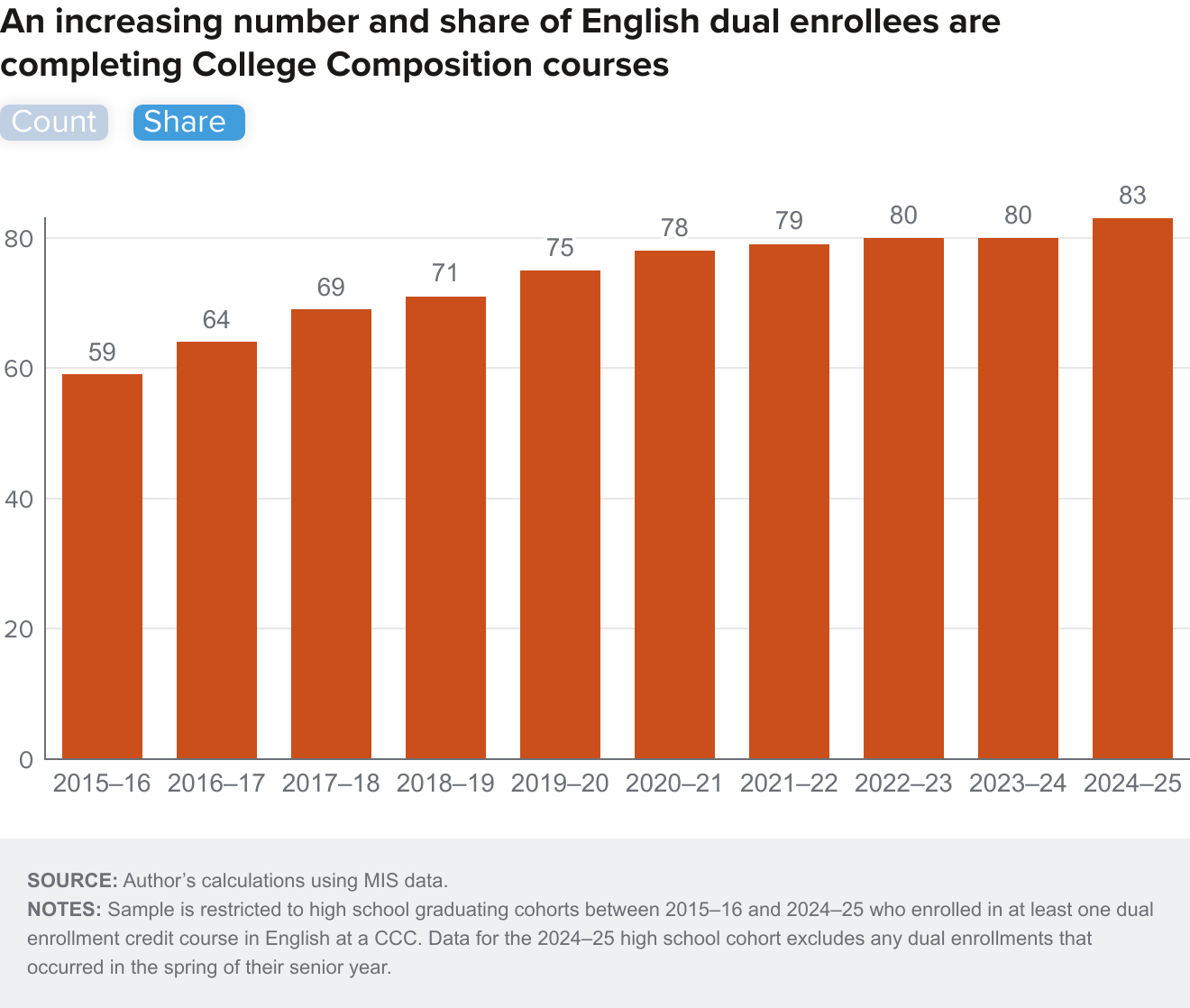
The number of students fulfilling the college composition requirement through dual enrollment increased from 6,258 in the 2016–17 cohort to 23,486 in 2023–24 (Figure 7), which also reflects that the share rose from 64 to 80 percent over that time.

Historically Underserved English Dual Enrollees Are More Likely to Fulfill the College Composition Requirement in CCAP
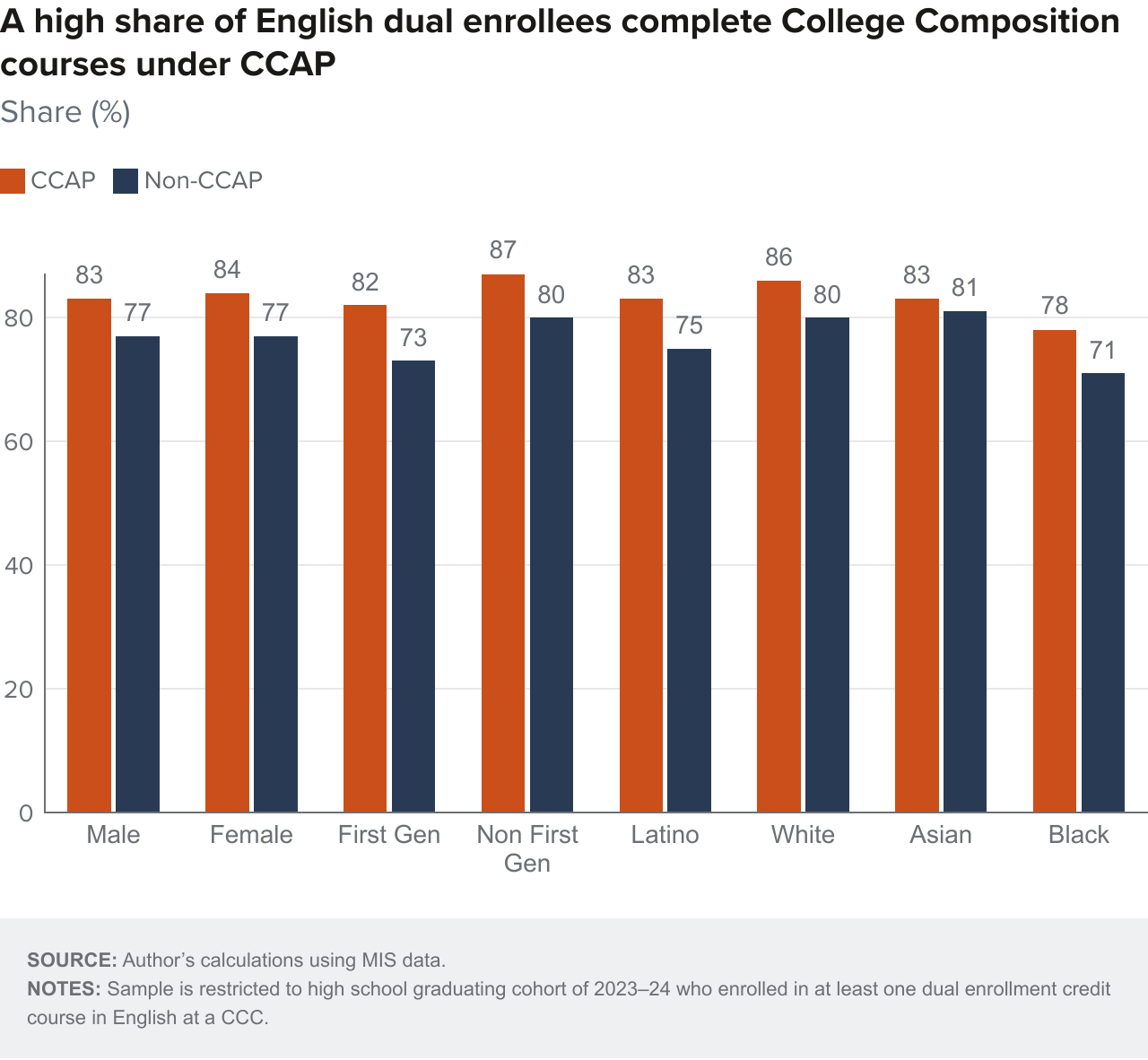
Among English dual enrollees, the share who successfully fulfilled the college composition requirement during high school is high across demographic groups (Figure 8). For historically underserved students, the completion rate often exceeds 70 percent. In the 2023–24 cohort, the rates are 82 percent in CCAP and 73 percent in non-CCAP for first-generation students, 83 percent in CCAP and 75 percent in non-CCAP for Latino students, and 78 percent in CCAP and 71 percent in non-CCAP for Black students.
Still, first-generation students show lower completion rates than their non-first-generation peers, and Latino and Black students show lower rates than their white and Asian counterparts. This reflects persistent gaps in course success even as access has expanded. Completion rates are consistently higher in CCAP dual enrollment than in non-CCAP dual enrollment across all demographic groups. The difference is especially pronounced among first-generation, Latino, and Black students than their counterparts.
Dual Enrollment English and College Enrollment
The overall college-going rate is slightly higher among English dual enrollees than all high school graduates in the state. In the 2021–22 cohort, 70 percent of English dual enrollees versus 67 percent of all high school graduates enrolled in college within one year of high school graduation (Figure 9), particularly in public four-year institutions (24% vs. 20%, with 11% vs. 8% in UC and 14% vs. 12% in CSU).
Among English dual enrollees, students in CCAP have higher college-going rates than their non-CCAP peers, particularly to public four-year institutions. In the 2021–22 cohort, 72 percent of English dual enrollees in CCAP—versus 68 percent of those in non-CCAP—enrolled in college within one year of high school graduation (12% vs. 11% to UC and 18% vs. 12% to CSU).
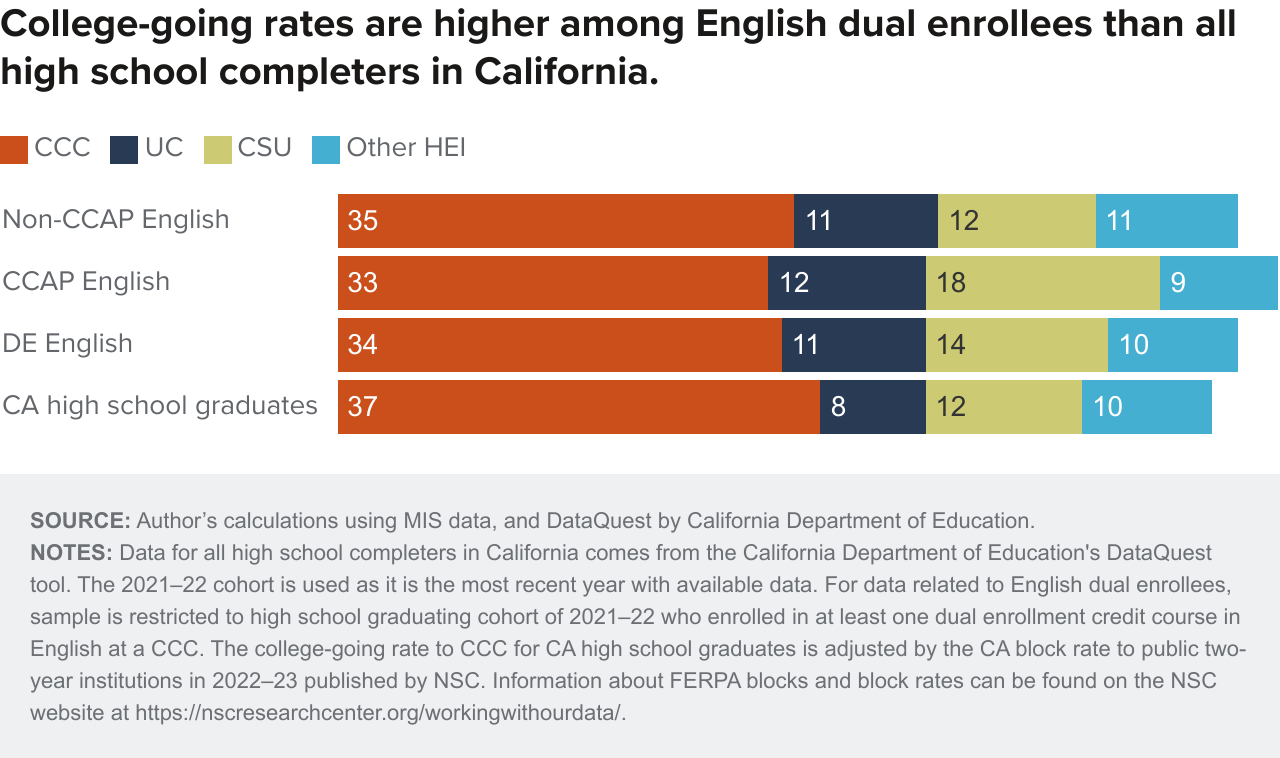
This pattern holds across all demographic groups (Figure 10). For example, although Black dual enrollees in English have a lower college-going rate than other racial groups, those who participate in CCAP have a much higher rate than their non-CCAP peers (67% vs. 56%). The gap is especially notable in enrollment at CSU (15% vs. 10%) and institutions other than CCC, UC, and CSU (21% vs. 11%). Similarly, among Latino and first-generation students, the overall college-going rate is about 3 percentage points higher for those in CCAP compared to non-CCAP, with even greater differences in enrollment to CSU.


Dual Enrollment English and Success in Community Colleges
English dual enrollment can support students’ college success by strengthening their readiness, building confidence and cognitive engagement, and helping them complete degrees more efficiently by reducing the time and cost through early exposure to college coursework. This section examines whether dual enrollees in English have stronger college outcomes than their peers who did not participate in dual enrollment. We focus on high school graduation cohorts from 2015–16 to 2022–23 who enrolled in the California Community College system as a degree- or transfer-intending student after high school. However, students who participated in English dual enrollment may differ from their non-dual enrollment peers in several ways—such as motivation, access to resources, high school academic record, and family support. So differences in college outcomes may reflect more than just the effect of participation in English dual enrollment.
English Dual Enrollees Show Stronger Early Momentum in Community College
Early momentum metrics—including completing gateway courses, accumulating units, and performance in the first years of college—are strong predictors of long-term college success (Belfield, Jenkins, and Fink 2019; Yanagiura 2023). One of dual enrollment’s advantages is that it gives students a head start on their college journey. Not surprisingly, we find that current community college students who took English courses through dual enrollment during high school are more likely to fulfill the college composition requirement by the end of their first year than students who did not participate dual enrollment (Figure 11). In the 2022–23 cohort, the most recent with available data, 83 percent of CCAP English dual enrollees and 84 percent of non-CCAP English dual enrollees completed a college composition course (83% of the CCAP students and 69% of the non-CCAP students already fulfilled during high school through dual enrollment). In comparison, only 48 percent of non-dual enrollees fulfilled this requirement by the end of their first college year.
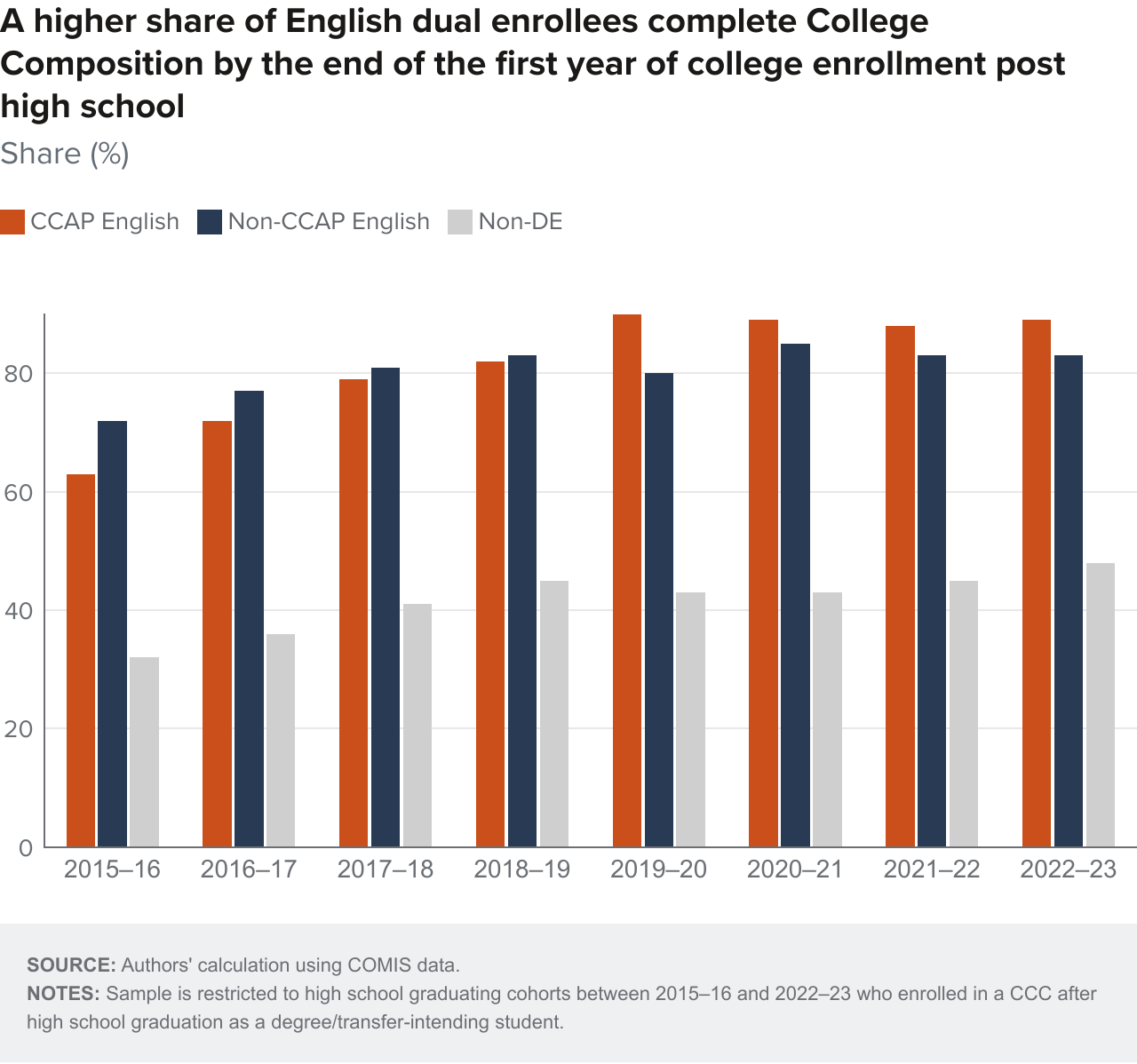
Over time, although CCAP English dual enrollees initially had lower college composition completion rates than non-CCAP English dual enrollees, their rates increased more substantially. Among CCAP English dual enrollees, the share fulfilling the college composition requirement by the end of the first college year rose by 17 percentage points from the 2016–17 cohort to the 2022–23 cohort, compared to 6 percentage points among non-CCAP English dual enrollees.
English dual enrollees in both CCAP and non-CCAP programs also accumulate more college units by the end of their first year of college enrollment compared to non-dual enrollees. In the 2022–23 cohort, current community college students who were previously CCAP English dual enrollees accumulated an average of 37 units (including credits earned both through dual enrollment and during the first college year post high school), non-CCAP English dual enrollees earned 39 units, while non-dual enrollees earned just 17 (Figure 12). This puts English dual enrollees nearly a full year ahead in terms of unit accumulation than non-dual enrollees.
Between the 2016–17 and 2022–23 cohorts, average units earned by the end of the first college year rose by almost four units among CCAP English dual enrollees. In contrast, the increase was fewer than three units among non-CCAP English dual enrollees and around one and one-half units for non-dual enrollees.

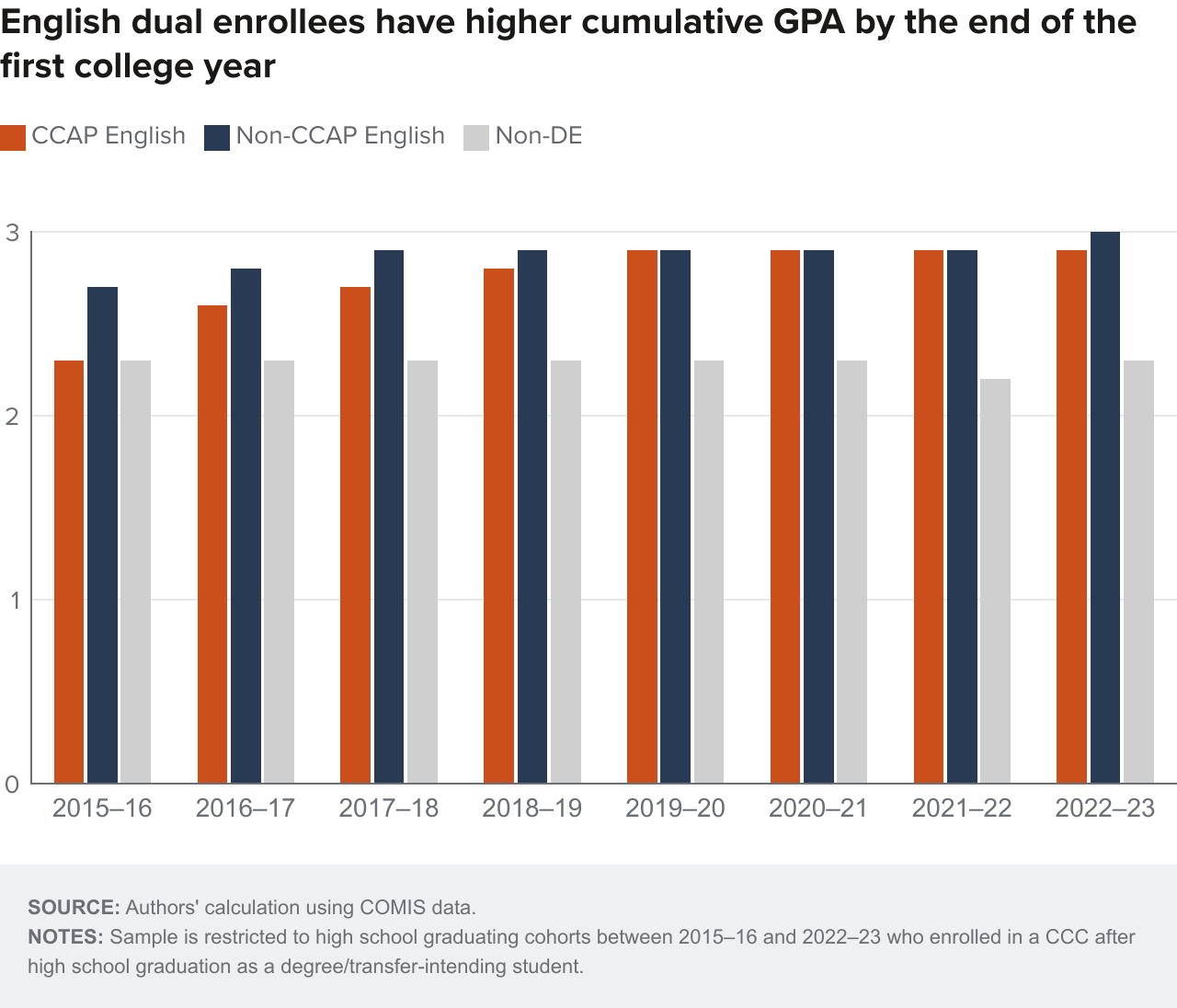
Moreover, students who took English courses through dual enrollment during high school have higher cumulative college GPAs (CGPAs) by the end of their first year at community college than students who did not previously participate (Figure 13). In the 2022–23 cohort, the average first-year GPA was around 3.0 among English dual enrollees, compared to 2.3 for non-dual enrollees. Also, the average first-year GPA rose steadily from 2.6 in the 2016–17 cohort to 2.9 in the 2022–23 cohort among CCAP English dual enrollees, and from 2.8 to 3.0 among non-CCAP English dual enrollees over the same period. For non-dual enrollees, the GPA remained steady at 2.3.
Early Momentum Is Stronger among English Dual Enrollees across Demographic Groups
While students across all demographic groups who were English dual enrollees demonstrated stronger early momentum after college enrollment than those who did not participate in dual enrollment during high school, historically underserved students show lower early momentum compared to their peers. First-generation students are less likely to fulfill the college composition requirement, accumulate fewer units, and earned a lower college GPA by the end of their first year of college enrollment than students who are not first-generation. Similarly, Latino and Black students show lower rates of college composition completion and earn fewer units and lower first-year college GPA compared to white and Asian students (Figure 14).


More English Dual Enrollees Complete a Degree or Transfer
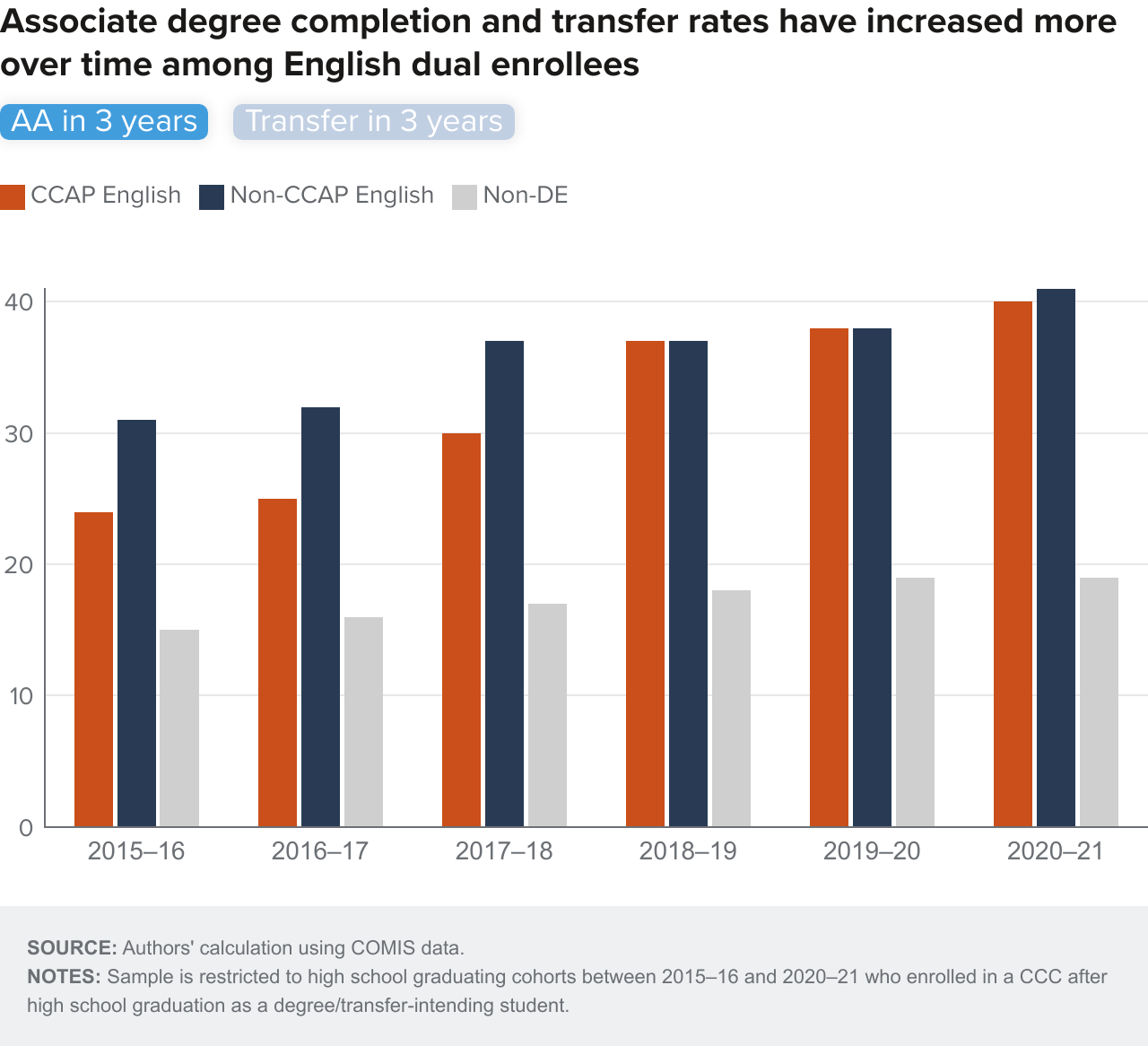
English dual enrollees across cohorts are more likely to earn an associate degree or transfer to a four-year institution within three years of enrolling in community college than non-dual enrollees. In the 2020–21 cohort, 40 percent of CCAP English dual enrollees completed an associate degree and 30 percent transferred to a four-year institution. Among non-CCAP English dual enrollees, 41 percent completed an associate degree and 35 percent transferred. In contrast, only 19 percent of non-dual enrollees completed an associate degree, and 19 percent transferred within three years (Figure 15).
Between the 2016–17 and 2020–21 cohorts, the three-year associate degree completion rate increased by 15 percentage points among CCAP English dual enrollees and by 9 percentage points among non-CCAP English dual enrollees. In contrast, the rate for non-dual enrollees increased by only 2 percentage points (Figure 15). Similarly, the three-year transfer rate rose by 8 percentage points for CCAP students and 10 percentage points for non-CCAP students, compared to only a 4-percentage-point increase among non-dual enrollees.

What Drives Variation in Implementation and Access to Transfer-level English?
Participation in DE English and DE ESL courses is expected to offer a variety of positive outcomes. One such outcome is the completion of transfer-level English courses. Dual enrollment could improve access to transfer-level English through three different scenarios: (1) students take a transfer-level DE English course, (2) students take DE ESL courses that encourage them to enroll in transfer-level English after graduating high school, or (3) students take a series of DE ESL courses and then take a transfer-level English course, all while in high school (this appears to be quite rare). [For an example, please see the “Case Studies of Dual Enrollment ESL Implementation” section.]
As previously noted, the distinctions between DE English and DE ESL offerings at each campus largely mirror the broader organizational differences between English and ESL programs in each campus context. Given that community colleges have historically developed in response to the unique needs of their local communities—and continue to be more directly influenced by local demographics than are four-year universities—this context is critical to understanding implementation practices and barriers to access.
Below, we present the key factors that emerged from the interview process that impact the ways in which DE English and DE ESL can facilitate the aforementioned three scenarios.
Relationships between English and ESL Departments
The distinctions between English and ESL departments at community colleges manifest structurally. Some colleges we interviewed referred to a high level of collaboration between departments, with some faculty even being affiliated and teaching courses in both departments. In contrast, other campuses drew a stronger divide between English and ESL. For example, English would be a separate department (sometimes with other subject areas) while ESL might be affiliated with an office or program on campus, such as adult education. As one ESL professor explained, this is because students enrolling in ESL at the community college were historically older adults who were not enrolled in other courses with the goal of pursuing a postsecondary degree. With the increase of K–12 students enrolling in community college, colleges have to respond differently depending on how they are already organized.
This variance in the distinction between English and ESL also leads to differing levels and types of communication between faculty in English and ESL. Although this would not impact students who never take coursework in the ESL department, it would have implications for the trajectories of students who begin their English education in the ESL department and theoretically must transition to coursework in the English department.
In the case of transfer-level college composition courses—those that fulfill the IGETC1A requirement for transfer—some campuses mainly offer English courses with additional units of ESL support offered in conjunction through the ESL program or department, while others offered core English courses or ESL department-equivalents taught by ESL department faculty.
Our interviews found the former to be more common, while the latter developed in some interviewed campuses because faculty recognized that multilingual students could be better supported by delivering the same content using the pedagogical approaches and expertise of ESL department faculty. Because the qualifications to teach for the English and ESL departments are generally similar, some English departments opted to offer sections of college composition taught by an instructor from the ESL department. This allowed students from the college’s ESL sequence to be in a mixed classroom with native English-speaking students. Some other colleges created a separate ESL college composition course rather than a regular English course with additional units of ESL support. Having a separate ESL course also had the benefit of being fewer units and less of a time commitment for students. This process of developing and getting courses approved, however, followed an extensive procedure. One college professor recounted:
We did a couple of presentations through the California Acceleration Project where we had to make sure we showcased how the [ESL corequisite units of support] worked in helping students. And that’s where I realized we should just create an [ESL equivalent of the freshman college composition course].
Once we saw the data of the success of multilingual students in the new course, […] it’s taken us a couple of years to put it in the books because it got approved locally, but then we have to submit it to the UC for transferability. And they sent us back a notice a year ago. […]
We want to make sure that our students, instead of having a two-unit corequisite of language support, got four units of sustained writing and language instruction. So it was a pedagogical decision. […] Our department thought we should be teaching one [course] where we get to spend more time reviewing some of the academic vocabulary and the intentional reading strategies. And so I rewrote the curriculum for that class, and I had to be careful not to rewrite [the English department equivalent of the course], because then our curriculum committee would have said, “It’s the same class. What are you doing?”
Course unit count
The unit count of courses heavily impacts general course accessibility and the viability of offering that course through dual enrollment. While offering ESL courses that grant college credit would greatly benefit high school students in completing college degree requirements in high school, the viability of offering these courses is offset by the fact that transfer-level courses tend to be higher in unit count and require more hours in the classroom. One ESL professor noted:
We have a whole array of classes, but the classes tend to be heavy on the units. But the high schools can’t do a six-hour class a week. They don’t have time for that. So we tend to do our smaller unit ones, which tend to be our vocationally oriented ones. […] So we offer “[vocational ESL course],” “[vocational ESL course]” or a listening and speaking course, which is four units. We’ve even done “[ESL elective course],” which is two units.
While offering these lower-unit English and/or ESL courses through dual enrollment might still provide high school students with the benefit of experiencing college culture and being enrolled into the college system, they typically are not transfer level (i.e., cannot count towards a baccalaureate degree but may be applicable towards a certificate or associate degree).
Course resequencing and pedagogical approaches
AB 705 seems to have impacted DE ESL more than DE English because (1) ESL course sequences are more commonly designed as a linear sequence of courses to take and (2) more ESL courses at community colleges are non-transfer (or even non-credit) compared to English courses. In the process of resequencing ESL curriculum, college campuses took different approaches according to differing pedagogical philosophies. According to one college professor:
When AB705 first came out, we came up with our new sequence of classes, but [the ESL department of a neighboring college] said, “You can’t do it. There’s no way they can learn. It’s too fast.” So their curriculum is very different [from] our curriculum, and they still focus much more discretely on the separate skills.
Our bottom-level course and our top-level course—freshman composition—are aligned […] But all the in-between levels are very different. [The other campus’ curriculum] is still focused more on grammar and focused on the distinct skills separated, whereas ours is more focused on reading, comprehension, reading making meaning together as a group of students and creating analysis for the students to write about. Then after they write, then we can say, “Oh, look, there’s several of you have the same grammar problem. Let’s look at this grammar problem that you guys all had in your writing.” So we don’t teach any explicit grammar in our classes. It’s more whole language.
In other words, the ESL departments of both the college professor’s college and that of the neighboring college offer freshman composition—a transfer-level English course—as the final course of their ESL sequences. But because different ESL departments responded to AB 705 differently, the kinds of sequences high school students would experience to make their way to the final transfer-level English would also differ depending on the choices made by partner community colleges.
Opportunities and Challenges with Implementing Dual Enrollment English and ESL
Distinguishing Dual Enrollment English from Alternatives
When asked about challenges to offering college English courses through dual enrollment, some interviewees referenced the difficulty in distinguishing the college courses from high school English courses that already exist. In particular, interviewed instructors commented that the content of senior-year English and AP English classes were perceived as too similar to DE English by some school administrators and teachers, while the teachers qualified to teach the courses differed.
In contrast, multiple dual enrollment instructors highlighted the practicality of dual enrollment courses compared to AP due to the way in which learning is assessed. One English professor in Region D who was formerly a high school AP English teacher commented:
I know the AP curriculum. I don’t repeat any of that content. […] The biggest difference that I’ve noticed is AP Language and Composition is assessed at the end of the year by an exam where the students sit for two to three hours. The first hour of that exam is close-reading passages with multiple choice questions. It’s a very artificial way to assess a student’s preparedness for college through multiple choice. And that has not changed in 10 or 12 years. The College Board has not removed that aspect of their exam. So, part of what happens is you have to prepare kids to take timed multiple-choice tests.
We do none of that in college. In fact, we do the opposite, where if they research for their prompt, they are asked to spend multiple hours on each draft and the writing instructor at the college looks at the changes over each draft to see that the research gets deeper, and the writing gets more coherent.
None of that is true of AP because the exam is timed. They write three essays and the essays are about 50 minutes each. So even though they’re getting the same credit if they use their AP credits to replace a class or if they took a dual enrollment class on the college campus, the classes are very different.
Dual enrollment was also being used by high schools to offer college-level rigor while distinguishing themselves from neighboring high schools with different college-level offerings. An English teacher in Region F who has also taught regular college composition at the partner college noted their high school was an early adopter of DE English for this reason: “We are competing with our sister school for students. […] They have an international baccalaureate program that draws some of our students. So we have dual enrollment.”
Familiarity Might Make English Easier to Offer than Dual Enrollment Math
In contrast to our findings for dual enrollment math, we found that CCAP likely played a smaller role in the expansion of DE English and ESL, though it did coincide with its continued growth. This was because many high schools that began offering dual enrollment typically began offering DE English—particularly college composition—as one of their first dual enrollment courses. While CCAP may have provided many high schools and colleges better conditions to make offering DE English courses possible, and growth in DE English participation outpaces that of DE math, we found many high schools that would be interested in offering DE English had already began doing so through MOUs prior to CCAP. Common themes from interviews suggest this is likely because dual enrollment generally plays different roles for math versus English education. Table 1 below summarizes general comparisons found between interviewed sites (this is not intended to represent all dual enrollment implementation throughout California).
How schools distinguish between dual enrollment and alternatives is partially subject-specific
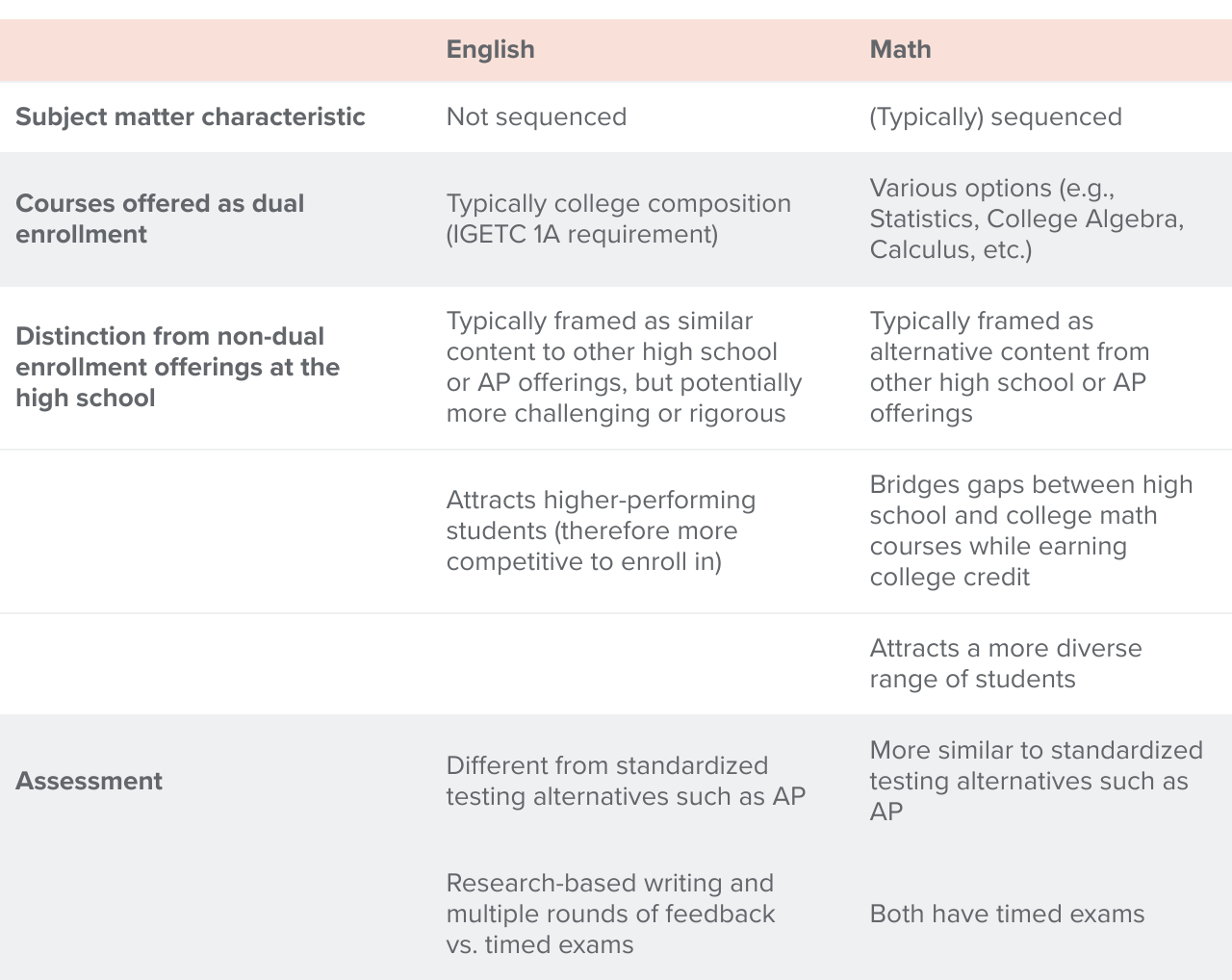
In sum, DE English may be less complicated to offer than DE math because there are fewer pedagogical factors to consider, and has the added benefit of reflecting college course assessment in a way that AP English courses do not.
Coordination and Negotiation
As noted in our dual enrollment math report, beginning to offer dual enrollment requires establishing relationships across institutions. However, many elements that must be agreed upon, such as instructor recruitment and pay, are without norms because dual enrollment partnerships are formed locally. This means individual community colleges and the high schools in their service area must negotiate each dual enrollment partnership manually and individually. This leads to extensive costs of time and resources, especially when there is high turnover for administrative positions at the high school district, college campus, or oftentimes, both.
Reliability for Longevity and Scaling, and Changing Partners
A main challenge to offering dual enrollment, particularly for sequenced subjects such as ESL, was a lack of trust and reliability in dual enrollment partnerships necessary to plan long term and scale course offerings. High school stakeholders from multiple regions mentioned the possibility of changing college partners despite longstanding collaborations, due to changes in budgets or circumstances on either side. As one high school administrator noted:
There’s no guarantee around whether we’re going to get an instructor. We schedule each semester prior to each semester. And it makes it really impossible to do any kind of cohorting and looping of kids when we’re talking semester-by-semester. Hypothetically, we could schedule for a year and get an instructor guaranteed to teach fall and spring. But can we loop for two years? Can we really ask that college instructor who’s not in our [high school] system to promise us that they’re not going to leave us for two years? That’s really hard, and because their lives are really dynamic […] We have changes all the time to faculty and we just have to remain adaptable and flexible. But then we’re designing a master schedule and we’re designing a whole learning experience and outcomes for students, and the principals have already communicated to families to then rely on precarious scheduling and faculty who aren’t in our system, and we don’t have guarantees around that.
Relatedly, a college administrator expressed uncertainty for future dual enrollment offerings due to funding constraints forcing a choice between offering courses for the general public and offering courses specifically for dual enrollment:
[Our ESL department] doesn’t pay for the dual enrollment courses, we have never had to take money out of our budget to pay those dual enrollment instructors. But this is changing, so if the high schools come to us and say, “Can you offer three courses?” what I would have to do is cut three classes that I offer on campus to offer those three dual enrollment courses […] and I’d be paying for all of them out of our budget. We’re never going to do that. […] Our mission is not to teach high school students.
Novelty and Alignment between ELD and Dual Enrollment ESL
Many interviewed colleges that did not offer ESL courses through dual enrollment expressed an interest in doing so but noted a lack in prospective enrollment as a barrier to moving further. As one professor noted, “We did some work with our research team to understand how many of our students who come from high schools were placing in ESL courses so that we can get a good understanding of if we could create sections of dual enrollment, and the numbers were dismal.”
In order for EL students to enroll in DE ESL courses without requiring extra time in other ELD courses, high schools and colleges would have to work through the complex task of understanding how a college ESL sequence would help EL students make progress toward exiting from EL status. This is why even when DE ESL is offered, it is typically offered as electives and separate from ELD curriculum. (For an example of such a case, please see the “Case Studies of Dual Enrollment ESL Implementation” section below.) Because those who would benefit from DE ESL are relatively small in number but already have comparatively less access to college courses, some colleges have begun offering DE ESL online to allow geographical access to course content and allow students from multiple high schools to enroll in the same course, fulfilling minimum course size requirements. (For additional trends in DE ESL, please see Technical Appendix C.)
Case Studies of Dual Enrollment ESL Implementation
Case 1: DE ESL Partnership with Cuyamaca College and Mountain Empire High School
The students get to see themselves challenged as college students, see themselves get enrolled as college students, see themselves get college credit, and then physically see themselves on that college campus. That is extremely transformative and in itself is education. So that’s the goal of this kind of program: to really help this population of students with resources that we may not have had previous to this program.
—Mountain Empire High School Teacher
Timeline of ESL curriculum change at Cuyamaca College and Mountain Empire High School
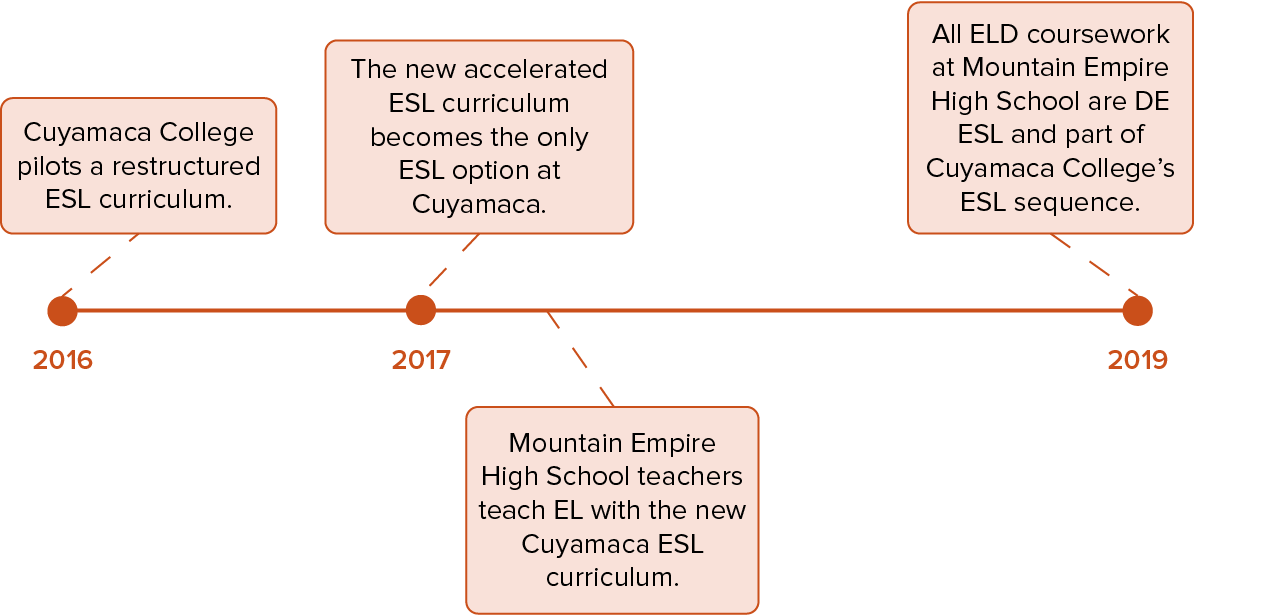
Cuyamaca College ESL faculty had been restructuring the college’s ESL curriculum before the passage of AB 705 through grant funding from the California Acceleration Project. Not only was the new ESL sequence intended to take a smaller number of terms to complete, but the pedagogical philosophy behind the restructuring was also different from that of the previous course sequence. After implementing a pilot of the novel curriculum in 2016 and confirming its success, the new sequence became the only ESL option in 2017.
Mountain Empire High School historically has a large population of ELs (Figure 17) but struggled to support the exclusively Spanish-speaking EL students. The local region is also very rural, with many students having limited access to internet and the closest college being roughly an hour drive away. The majority of students also live an hour or longer away from the high school. Unsurprisingly, teachers noted very few of the students attending Mountain Empire historically saw college as an option post-graduation. The average college-going rate of Mountain Empire ELs between 2015–16 and 2021–22 was about 39 percent, close to the state average of 43 percent. Nearly all of those who pursue higher education (97%) enroll in community college.
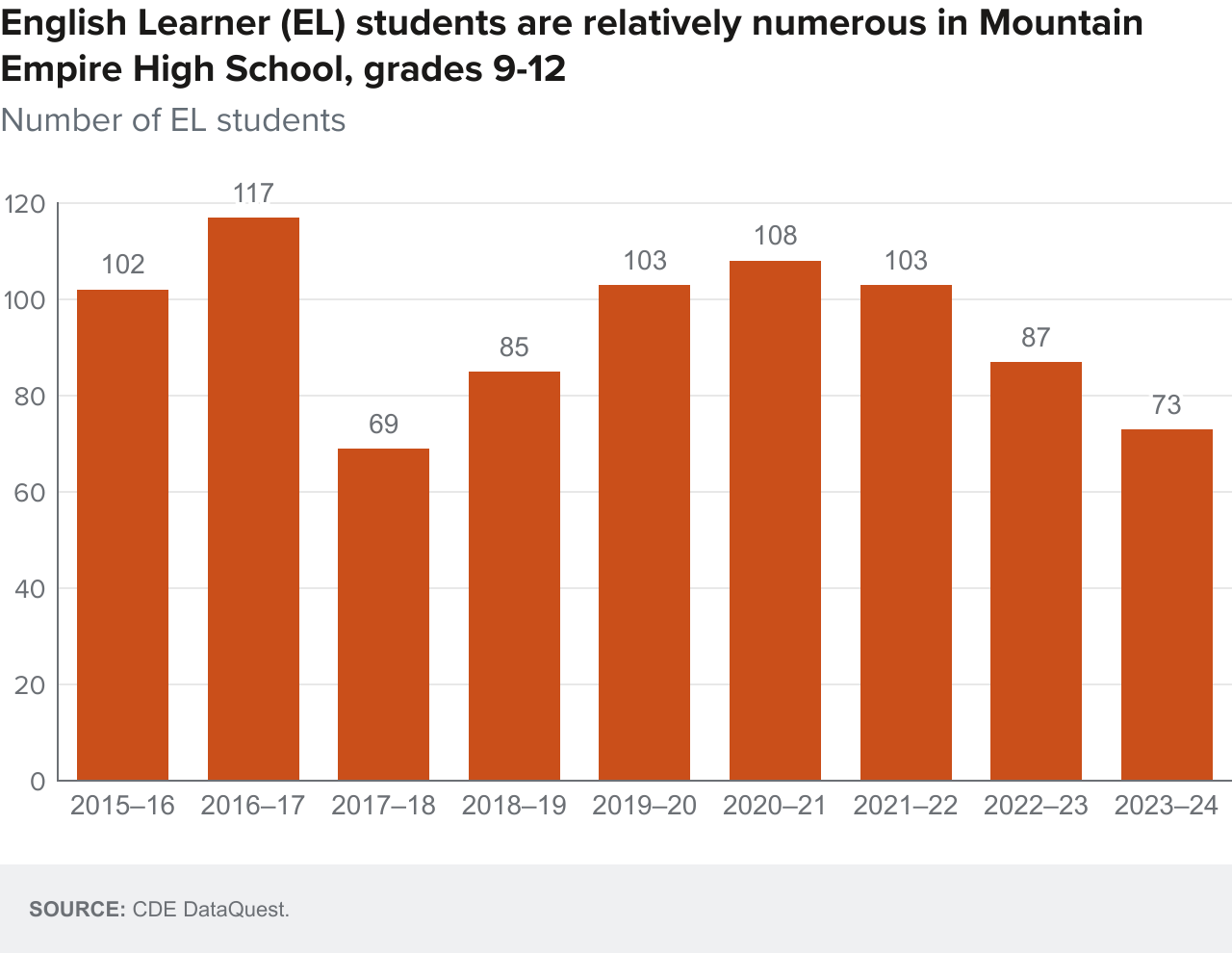
In 2017, the principal of Mountain Empire High School and the faculty at Cuyamaca College’s ESL department began devising a way for the new curriculum to be made accessible to the EL students through dual enrollment. The high school teachers who teach both ELD and English were invited to use the new Cuyamaca College curriculum. They would teach the college’s ESL sequence to their EL students through dual enrollment, and the college would compensate the teachers as their instructors through the high school district.
As of 2019–20, all ELD coursework at Mountain Empire High School are DE ESL courses. In other words, all EL students are taking DE ESL courses. This provided access to college coursework to a student population that has both geographical constraints against regularly visiting a college campus and unpredictable internet to enroll in online coursework. At present, DE ESL is taught exclusively by Mountain Empire’s English teachers, who are also invited once a year to teach the equivalent course on the Cuyamaca campus, which illustrates the level of support and quality of dual enrollment the students are receiving.
Because Mountain Empire uses Cuyamaca College’s ESL course sequence to meet ELD requirements, the high school places students in the appropriate DE ESL courses using the scores that high school ELs earn on their annual summative ELPAC (English Language Proficiency Assessments for California) assessments. Because DE ESL courses at Cuyamaca and Mountain Empire are used for K–12 required English Language Development, an additional measure of success could be the rate at which Mountain Empire Students exit EL status (or are reclassified). However, reclassification rates have shown a great deal of year-to-year variability. For example, reclassification rates climbed from zero in 2020–21 to 16 percent in 2022–23, and back down to 7 percent in 2023–24. (According to a high school DE ESL instructor, Mountain Empire had a difficult time reclassifying students during the pandemic due to remote instruction—an experience common across school districts (Hill and Deng 2025).
According to teachers and administrators, the DE ESL program also showed great promise for offering college-going opportunities to students in a very rural area who have never seen a college or seen themselves as college-going. As part of the program, students go on an annual field trip to explore the Cuyamaca campus and attend their identical ESL course taught by a college professor on the campus with mainstream college students. According to one high school instructor:
What’s interesting about English Language Development [at our school] is that this pinpoints a really underrepresented group of students: rural multilingual learners who are [recent immigrants], and this is a really niche group of students who are very underrepresented in education research, as well.
[Dual enrollment] is huge because many of them can see themselves getting an associate’s degree. They’ll say, “I don’t know about a bachelor’s degree, but maybe I’ll try for an associate’s degree” And that’s a huge step, because if they started their high school freshman year in the beginning-level [ESL] course, and then their sophomore year they do the middle level, and then they pass that and their junior year they do the upper level, then in their senior year they’re taking college-level English. And they’ve saved themselves time. […] Dual enrollment [allows] students to see [more than one] pathway through. […]
And I’m not saying that it works on every student, but it does change the culture of a student community and a school community. […]
Overall, this partnership demonstrates a rare and exemplary case where ELD and DE ESL integration, through much initial investment and close collaboration, could lead to consistent high school ELD outcomes but also introduce high school ELs in a rural area to college.
Case 2: Lily College’s DE ESL Partnerships with High Schools in Region B
Lily College has established CCAP partnerships with a school district in Region B, with four high schools in the district offering DE ESL. Unlike Mountain Empire, the partner high schools in Region B do not replace their EL instructional programs with DE ESL offerings. Therefore, DE ESL is offered in addition to ELD coursework and grants elective high school credit. The high school district has a longstanding history of establishing MOUs with Lily College, and each high school within the district offers very different courses as DE ESL according to the needs of the student population. As an interviewee from the high school district explained:
For [High School 1], they really want to support their students who are going to be going to [Lily College] to advance more quickly through that sequence, and to gain the necessary skills to be college ready and eventually be ready for the [college composition course]. For schools like [High School 2] and [High School 3], the intent there is really supporting those kids to be successful in their job or career, and to have really basic communication skills to be able to thrive in the workplace.
To serve different populations of ELs, one high school in the district even offers two different DE ESL courses:
[The high school is] actually doing two sections and it’s for two different groups of kids. [One course] is more job readiness. And that’s for kids who are working. They are supporting themselves and they are new arrivals. […] And then the other course is the second level of the ESL sequence at [Lily College]. [The students] are at least two courses away from being ready for the [college composition course], so this is a really great way to get students to advance through the sequence sooner. […] a lot of these students are going to [Lily College] so we want to be strategic about where they get placed while in a dual enrollment context so that by the time they matriculate into [Lily College] they’re already on the third or fourth level.
The total of 12th-grade EL students at the four high schools combined has remained at about 200 since 2018–19. Among those in the partner high schools, over 90 percent are Latino, and over 70 percent speak Spanish. Interviewees reported that the main population of ELs are recent arrivals, explaining why almost half have been ELs for three or fewer years, compared to 19 percent of 12th-grade ELs statewide.
This correlates with low scores on the English proficiency assessment given to ELs (the ELPAC) at the partner high schools—67 percent of 12th grade ELs in the Lily College partner high schools score at the lowest level, whereas statewide, only 28 percent of 12th grade ELs have score at that level. The college-going rate for recent EL high school completers in high schools partnering with Lily College was 32 percent (lower than the state average of 43% for EL students).
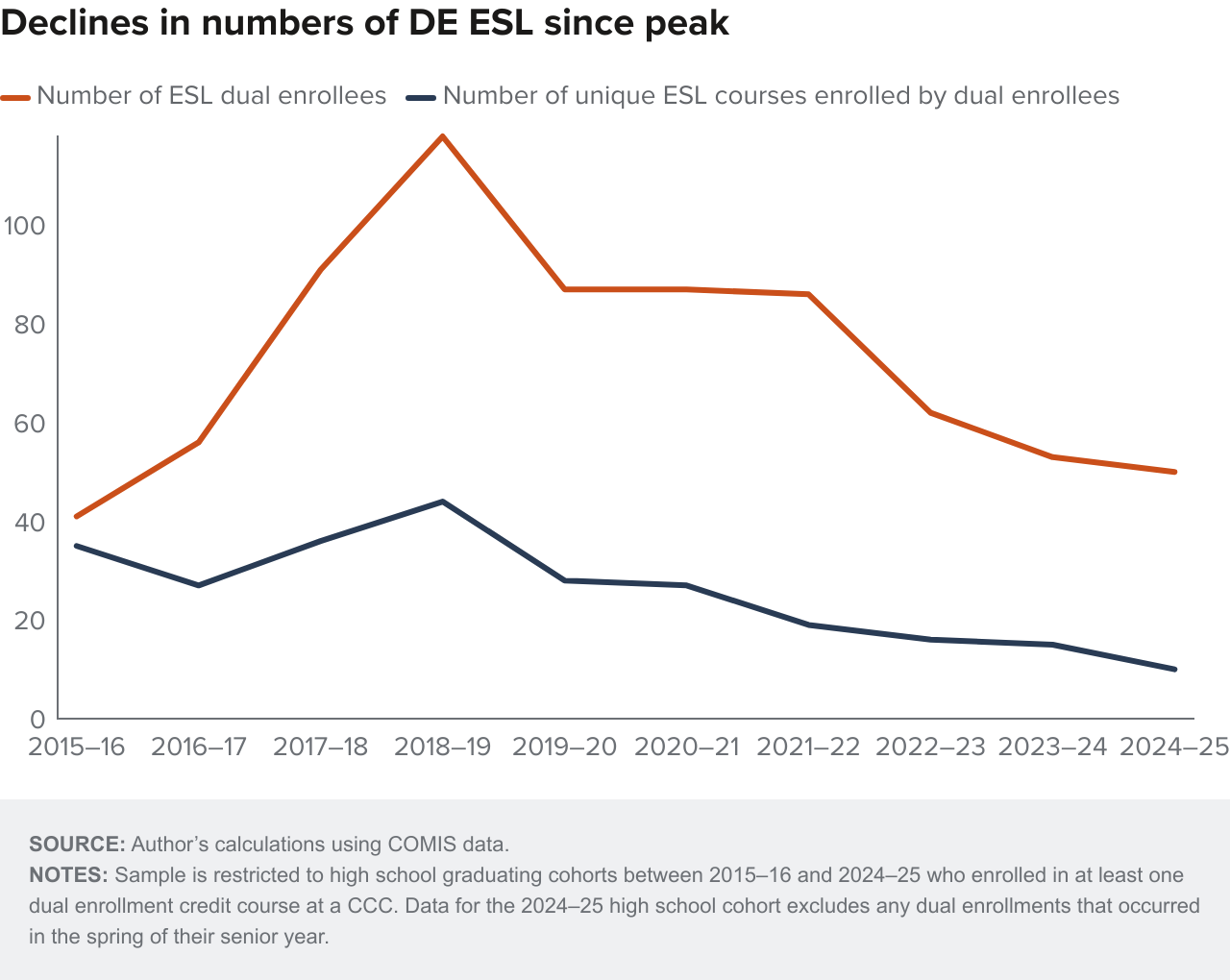
Overall, DE ESL enrollment and unique DE ESL courses offered have decreased at Lily College (Figure 18). This is consistent with the stagnating EL population in the region over recent years, as well as college budget constraints leaving less funding available for offering dual enrollment courses.
Conclusion
Dual enrollment in California has experienced significant growth over the last nine years. Among 12th graders in the class of 2024, we estimate that about 30 percent participated in dual enrollment, up from just 16 percent in 2016. A closer examination of dual enrollment English reveals that roughly 6 percent of the class of 2024 took the course, up from 2 percent in 2016. While representing a relatively small share of all high school seniors, our study finds that the subject is becoming more popular among participants over time—growing from fewer than 8,000 in 2016 to almost 30,000 in 2024. This has resulted in an increasing number of students taking and completing gateway English courses through dual enrollment. Moreover, increased offerings through College and Career Access Pathways (CCAP) helps expand participation among the historically underserved in higher education—including Latino, Black, and first-generation students. Still, continued efforts are needed to fully close gaps across demographic groups.
Overall, our descriptive (not causal) analysis finds that English dual enrollees show strong college-going outcomes, particularly with high rates of enrollment at public four-year institutions. Among those who enroll at a California community college, English dual enrollees demonstrate stronger early momentum, better early college performance, and higher degree completion and transfer rates compared to their non-dual enrollment peers. Over time, CCAP English dual enrollees have shown slightly greater improvements in college outcomes compared to non-CCAP students.
Our interviews revealed that challenges exist in ensuring dual enrollment English and ESL are offered to begin with, and while CCAP substantially reduced barriers to offering DE English, our interviews showed additional external factors contribute to whether DE English and DE ESL are offered at a high school, and if so, in what form.
Informed by our research, we provide the following recommendations:
Establish a repository for CCAP partnerships across the state. Our research found that one of the greatest difficulties to offering CCAP dual enrollment courses for core subjects such as English and ESL is that the many elements that must be negotiated to offer the courses are without norms. A state-wide list of conditions that must be discussed for CCAP partnerships, such as instructor qualifications, mode of instruction, course request procedures, etc. and a repository of the actual partnerships would save stakeholders time in understanding what elements of a partnership must be negotiated. Having this information publicly available would also help stakeholders learn from other cases across the state and prevent implementation from varying too dramatically according to the negotiating power or difference in institutional knowledge of each individual high school or college.
Support dual enrollment students and their instructors. As access to dual enrollment expands to students who have been historically underserved, it will be important to ensure students and instructors are well supported to maximize the likelihood of successful completion of college composition through dual enrollment. Our qualitative research found that supporting faculty in curricular redesign efforts to embed corequisite support was key.
Expand access to transfer-level dual enrollment ESL. With few students taking dual enrollment ESL, we identify an important opportunity to expand access to English Learners in California. Based on our case studies, boosting dual enrollment in transfer-level ESL and coordinating to replace high school English language development (EDL) courses with DE ESL show promise. Improving access to more rigorous college coursework has the potential to improve college readiness and success for a population that has long been underrepresented in higher education. As dual enrollment expands to more English Learners, ensuring the appropriate EL supports and unit load will be important.
Dual enrollment partnerships should use data to improve recruitment into English and ESL courses. Our analysis reveals that while dual enrollment participation still varies across race/ethnic groups, CCAP in particular is leading to more equity in the share who take dual enrollment. Less is known about whether they are intentionally recruiting students not on the college track—a CCAP focus population. We also found it challenging to fully understand whether dual enrollment opportunities are being provided equitably to English Learners, when compared to their share of the high school population. To date, the lack of linked statewide K–12 and community college data means individual partnerships need to take the lead on using data to inform this effort.
Maximize efficacy and efficiency by integrating policy and linked data. To fully realize the promise of dual enrollment, linked data systems to help automate enrollment, dual credit, and GPA calculations are needed. Linked data is also important to understand the value of dual enrollment expansion versus expanding access to other types of rigorous high school courses, like high school honors English and AP English classes for underserved groups. The good news is that with investments in the Cradle to Career data system the state has already begun to take important steps in this direction.
While our findings suggest dual enrollment is a promising strategy to improve college access and success, our data only permitted a descriptive analysis. Additionally, small sample sizes and the lack of linked data limited our ability to conduct a more thorough examination of dual enrollment ESL. Going forward, causal research with linked K–12 and college data will be necessary to demonstrate the extent to which dual enrollment is better than other college acceleration options offered in high school, and whether California’s English Learners are being well served.
Topics
Access Completion Equity Higher Education Immigrants in California K–12 Education PopulationLearn More

Expanded Dual Enrollment English and ESL Looks Promising for College Access and Success

Dual Enrollment in California

Adapting to Changes in California’s English Learner Population

Improving College Access and Success through Dual Enrollment