In current debates about cash bail, opponents raise concerns about its disproportionate impact on lower-income defendants, while proponents argue that bail is necessary to maintain public safety and reduce flight risk. An emergency policy during the COVID pandemic gives us an opportunity to examine the connection between bail and future risk of rearrest to offer insight into improving pretrial detention procedures.
At the outset of the pandemic, the Judicial Council of California issued a statewide emergency bail order to reduce viral transmission in courts and jails. The policy, sometimes called “zero bail,” retained cash bail for more severe offenses but set bail at zero dollars for most misdemeanors and felonies—sharply increasing the number of arrestees who were immediately released rather than detained in jail. This change drew concerns that crime, particularly violent crime, would rise as a result. Our research examines whether those released on zero bail were more likely to be arrested for additional offenses.
How Did Rearrests Change when Emergency Bail Orders Began?
In the 10 weeks following implementation, the emergency bail order increased the likelihood and number of rearrests within 30 days of the initial arrest. The likelihood of rearrest went up by 8.2 percentage points—driven by felony offenses—and was notably higher than the average share of 14.6 percent of people rearrested prior to implementation. This increase was concentrated in the six days after an arrest.
Based on the timing from an initial arrest, the increased rearrests were likely due to reduced incapacitation—that is, individuals suspected of committing a zero-bail-eligible offense were released and then rearrested when they would have previously been detained and prevented from committing any additional crimes—as opposed to reduced deterrence (individuals committing more crimes presuming they would be released if arrested). These effects seem especially salient early in the pandemic. The challenges of coordinating pretrial services and case management during this disruptive period may have played a role.
The impact on rearrests declined over time. While the statewide emergency bail order lasted for roughly two months, many county courts temporarily adopted similar policies. For the 27 counties that had an emergency bail order in place past 2020, there was a statistically significant increase in rearrests initially, but the effect diminished. Over the first year of implementation, the average effect was no longer statistically significant.
One important exception is that the rise in felony rearrests did not subside for the counties that extended an emergency bail order past 2020. In the first year of implementation, there was an average 10 percentage point increase in the likelihood of a felony rearrest when the initial arrest was of any offense type, much higher than the average share of 5.1 percent of individuals rearrested before implementation. Notably, we find no evidence of an increase in rearrests for violent felonies; in particular, lower-level offenders released on zero bail were not more likely to be rearrested for violent felonies, a concern raised by some observers.
Under emergency bail orders, rearrests for zero-bail offenses initially increased then subsided after a few months
Difference in likelihood of rearrest (% pt)
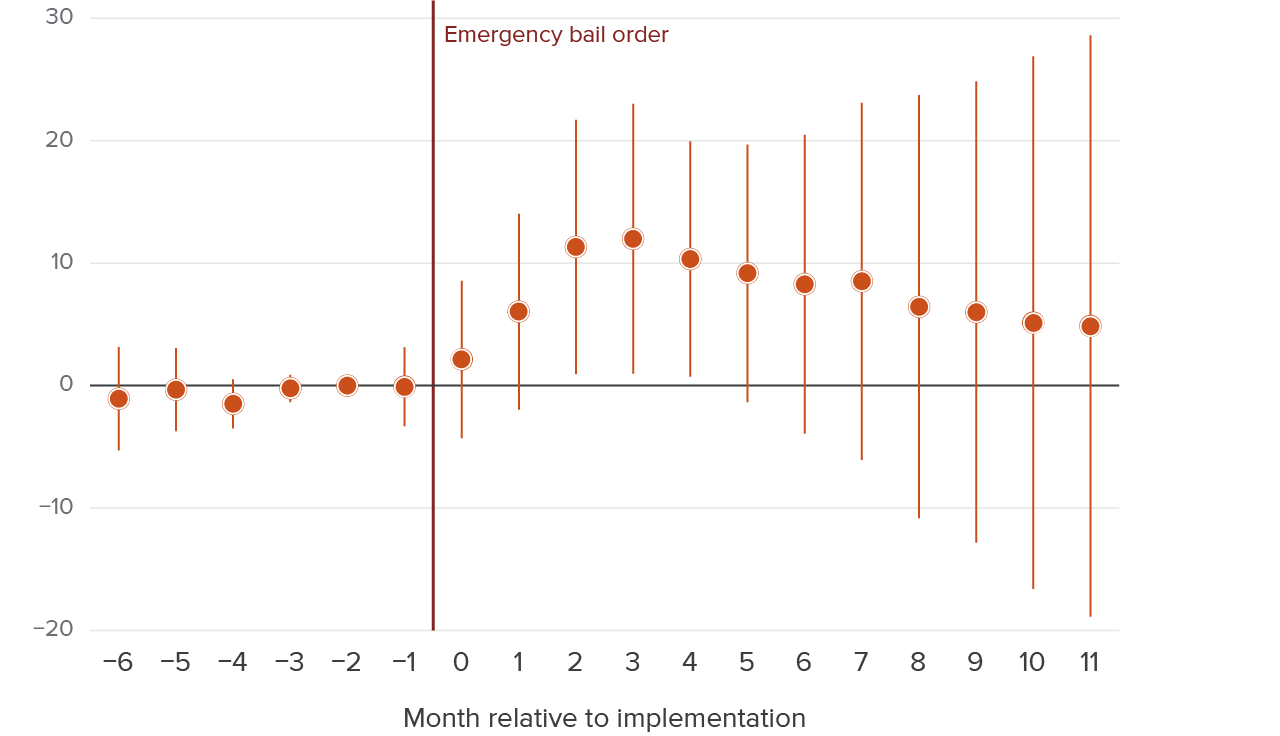
SOURCE: California Department of Justice: Automated Criminal History System (ACHS) data.
NOTES: The orange dots show the difference in likelihood of any rearrest for zero-bail offenses from January 2018 to April 2021 for the 27 counties that extended emergency bail orders beyond 2020; when the orange lines do not intersect with the horizontal black zero line, the estimate is considered statistically significant. The horizontal axis is the number of months relative to the implementation of an emergency bail order, which occurred in March or April 2020 depending on the county.
What Happened after Emergency Bail Orders Ended?
Though emergency bail orders led to increases in rearrests, lifting these orders had no significant effect on rearrests, regardless of offense type. Because felony rearrests experienced enduring increases after the implementation of emergency bail orders and were unaffected after orders ended, they remained slightly elevated through 2023. It’s possible that counties have maintained some pandemic-era criminal justice practices, which slowed the return of felony rearrest rates to pre-pandemic levels.
It is still too early to examine longer-term impacts. But since other academic research suggests that pretrial detention may lead to increased reoffending in the long run, efforts to evaluate the impact over a longer period are critical to understanding whether less pretrial detention under emergency bail orders eventually led to fewer rearrests. Another line of inquiry that is outside the scope of this study is the public health benefit of reducing COVID cases in courts and jails, the original motivation for the policy.
Looking Forward
Assessing the impact of setting bail at zero dollars for a broad range of offenses in a large and diverse state like California can help guide current policy discussions on bail reform. Our findings highlight at least some short-term risks to implementing a blanket policy on pretrial detention. In particular, the effects of emergency bail orders in California suggest that, on its own, the offense for which someone is arrested may not always be an accurate indicator of future risk of offending, particularly for felonies. Pretrial risk assessments could be a promising approach, as understanding the full range of individuals’ previously committed offenses and their severity may be useful in determining whether they should be detained in jail or released to the community during the pretrial period. Future research in this area should consider several factors, including public safety risk, equity implications of bail reform (including implications for disparate racial outcomes), and the economic burden of a cash bail system.
Topics
Criminal JusticeLearn More
Video: What Happened When California Suspended Bail during COVID?

Assessing the Impact of COVID-19 on Arrests in California

California Jails and COVID-19

New Bail Ruling Could Affect Tens of Thousands of Californians

Reforming Pretrial Justice in California