
Key Takeaways
In April 2020, the Judicial Council of California responded to the COVID-19 pandemic by implementing an emergency bail order, sometimes called “zero bail,” to reduce viral transmission in courts and jails. The policy maintained cash bail for more severe offenses but set bail at zero dollars for most misdemeanors and felonies, sharply increasing the number of people who were immediately released after being arrested. Although the statewide mandate lasted for roughly two months, many county courts temporarily adopted similar policies, and until July 2022, most Californians lived in a county with an emergency bail order in place. California’s emergency bail orders dramatically altered the pretrial process and drew concerns that those released would commit additional crimes. This report examines the impact of these emergency bail measures on the likelihood of arrested individuals being rearrested soon after release.
- Emergency bail orders increased the likelihood and number of rearrests within 30 days of the initial arrest. The likelihood of rearrest went up by 8.2 percentage points in the 10 weeks following implementation of emergency bail orders—driven by felony offenses—and was notably higher than the average share of 14.6 percent of individuals rearrested prior to implementation. This increase was concentrated in the first six days after an arrest.
- For the 27 counties that had an emergency bail order in place past 2020, there was a statistically significant increase on rearrests initially, but the effect diminished over time. Over the first year of implementation, the average effect was no longer statistically significant.
- The rise in felony rearrests did not subside for the counties that extended an emergency order past 2020; in the first year of implementation, there was an average 10 percentage point increase in the likelihood of a felony rearrest when the initial arrest was of any offense type, much higher than the average share of 5.1 percent of individuals rearrested before implementation. However, we find no evidence of an increase in rearrests for violent felonies; in particular, lower-level offenders released on zero bail were not more likely to be rearrested for violent felonies, a concern raised by some observers.
- Though emergency bail orders led to increases in rearrests, lifting these orders had no significant effect on rearrests, regardless of offense type. Because felony rearrests experienced enduring increases after the implementation of emergency bail orders and were unaffected after orders were revoked, they have remained slightly elevated through 2023.
The disruptive nature of the pandemic was likely a key factor in the temporary increase in overall rearrests when emergency bail orders were in place. Notably, increases in felony rearrests did not subside over time or when emergency orders were revoked. While our data do not allow us to determine why this was the case, arrest and booking rates, as well as jail populations, have stayed well below pre-pandemic levels, suggesting the possibility that some pandemic-era practices may have persisted, which could possibly affect more recent felony rearrest rates.
Because their goal was to protect public health, emergency bail orders set a unilateral policy of detention or release based on the accused offenses—a marked difference from broader bail reform efforts that have implemented tools such as assessing arrested individuals’ risk to public safety and not appearing in court, as well as monitoring and/or providing pretrial services to the accused if they are released pretrial. Our findings suggest that pretrial detention policy may benefit from a more holistic measure than the arresting offense when assessing public safety risk, and pretrial risk assessments could be a promising approach.
Introduction
In the early months of the COVID-19 pandemic, the Judicial Council of California implemented an emergency bail policy to limit the number of individuals cycling through courts and jails to reduce viral transmission (Slough et al. 2020). The statewide order, in place from April 13, 2020, to June 19, 2020, set bail for most misdemeanors and felonies—including some more severe felonies—at zero dollars. Previously, individuals arrested for these offenses needed to post bail to avoid being detained in jail while awaiting arraignment (a hearing in which defendants are informed of the charges against them and enter a plea), trial, or sentencing. The statewide emergency bail order resulted in an increase in the number of individuals released immediately after they were arrested. Individuals arrested for offenses that did not qualify for zero bail were detained in jail unless they posted bail.
After the statewide mandate expired on June 20, 2020, 27 county superior courts representing 84 percent of the state’s population continued to set bail at zero dollars for many offenses. As the pandemic waned, more counties returned to the monetary bail system. But until July 2022, more than half of Californians lived in counties that still had an emergency bail order in place. These changes temporarily restructured California’s bail system and coincided with a significant and persistent decrease in jail populations.
The role of cash bail in public safety has been an important policy question in recent years. In 2020 and 2021, California experienced increases in some crimes, including homicides and aggravated assaults (Lofstrom and Martin 2021; Bonner 2022). The determinants of the rise in crime are debated, but some news publications, law enforcement officials, and prosecutors have posited that the statewide and county-level emergency bail orders were contributing factors because they may have led to the pretrial release of suspects at high risk of committing additional crimes (Rynor 2021; Salahieh, Kang, and Cheng 2021; Yolo County District Attorney’s Office 2023).
Policy debates also reflect concerns that the monetary bail system is unfair to those who cannot afford to post bail. Understanding the effects of changes to cash bail is a vital part of creating a more equitable justice system that operates based on public safety rather than a suspect’s wealth (Pretrial Detention Reform Workgroup 2017). Bail reform efforts have aimed to eliminate or reduce cash bail’s outsized impact on low-income detainees, often with a focus on providing increased resources for supervised release or individualized case-by-case judicial assessment. For example, Proposition 25, which California voters rejected in the November 2020 election, would have ended monetary bail and replaced it with a pretrial risk assessment tool to provide information for judges about the defendant’s risk of not appearing in court and the risk to public safety. Some of the votes against the measure were based on concerns that racial disparities would not necessarily improve, depending on how it was implemented (Harris and Lofstrom 2020).
Though both approaches are sometimes referred to as “zero bail,” the Judicial Council’s emergency bail order greatly differed from other bail reform efforts and legislative proposals in their motivation and application. While many bail reform efforts include pretrial changes like risk assessments, the statewide emergency bail order—and similar county-level measures—mandated a blanket bail amount of zero dollars for a large class of arrest offenses without considering other factors (e.g., criminal history), though it did allow law enforcement to petition for exceptions in the interest of public safety. As such, we may not expect the effects of pandemic-era emergency bail orders to be comparable to those of other bail reform efforts.
Understanding the impact of setting bail at zero dollars for a broad range of offenses in a large and diverse state like California can help guide the ongoing policy debates on bail reform and offer insight into the design of pretrial detention policy. In this report, we chronicle the effects of emergency bail orders and measure their impact on rearrests. We begin by providing background on California’s bail system and the use of emergency bail orders during the pandemic. Next, we examine trends in rearrests and jail bookings under emergency bail orders. Then, we isolate the impact of implementing and revoking emergency bail orders on rearrests generally and for specific offense types. We also examine effects on the timing of rearrests. Finally, in light of our findings, we discuss policy considerations regarding bail and public safety.
California’s Bail System before and during COVID
California’s monetary bail system typically governs who is released from jail prior to their arraignment or trial. When someone is accused of a criminal offense, the county’s bail schedule suggests a bail amount for that offense. In California, each county superior court develops its own bail schedule, resulting in a wide variation of bail amounts for the same offense across counties (Tafoya 2013). Bail is ultimately set by the judge after considering concerns about public safety and whether the arrestee is likely to appear in court. The accused person must pay the specified amount as a deposit to the court—known as posting bail—to be released from jail while their judicial proceedings continue. After the accused person satisfies all court requirements, most of the bail amount is refunded, with a portion withheld for court fees.
Because bail amounts regularly reach tens of thousands of dollars—the median amount in California is $50,000, five times the national median—accused people sometimes engage the services of bail bond companies to post bail (Tafoya 2015). Those who cannot afford to post bail—an estimated 60 percent of defendants nationwide—remain in jail (Back et al. 2017; US Commission on Civil Rights 2022). A 2017 PPIC analysis found that about 60 percent of individuals booked on misdemeanors or felonies in California remained in jail during their pretrial period (Tafoya et al. 2017). The disproportionate impact of cash bail on low-income defendants has been the primary motivation for several recent bail reform efforts across the state.
To reduce viral transmission in courts and jails during the pandemic, the Judicial Council’s statewide emergency bail order, in place from April 13, 2020, to June 19, 2020, set bail for most misdemeanors and felonies at zero dollars. Individuals arrested for zero-bail offenses, which comprised 59 percent of all arrests during the statewide order, were released immediately after being booked unless law enforcement or the district attorney petitioned a judge to set a different bail amount in the interest of public safety. While law enforcement could petition a judge for a higher bail amount, it is unclear to what extent law enforcement agencies and prosecutors pursued this ad-hoc option, and the data do not allow us to identify those events. However, given the public health concerns that motivated the reduction in jail population, it is likely that most arrests for zero-bail offenses led to an unrestricted pretrial release. In contrast, individuals arrested for offenses ineligible for zero bail were held in jail with a presumptive bail amount dictated by the county superior court’s 2020 bail schedule.
Offenses eligible for zero bail under emergency bail orders used to result in pretrial detention most of the time. From 2011 to 2015, about two-thirds of people in California booked into jail for lower-level felonies were detained pretrial, while about half of those booked on misdemeanors were detained (Tafoya et al. 2017). By reducing bail to zero for a broad and uniform range of offenses across the state, the Judicial Council’s order significantly altered the existing pretrial detention process. Some of the most common offenses eligible for zero bail were possession of drug paraphernalia, possession of a controlled substance, obstructing a police officer, and use of a controlled substance (see Technical Appendix Tables A2 to A14 for more of the most common eligible and ineligible offenses). Notably, the bail order excluded the penal code definitions of serious, sexual, and violent crimes, as well as some domestic-violence, assault, weapons, and driving-under-the-influence offenses (California Courts 2020; Technical Appendix Figure A1).
After the statewide policy expired on June 20, 2020, the Judicial Council granted county superior courts the authority to continue emergency bail orders (Balassone 2020). At that time, 27 county superior courts representing 84 percent of the state’s population continued implementing emergency or temporary measures that maintained some form of zero bail (Figure 1). Some counties modified the statewide order—for example, Los Angeles disallowed release on zero bail for individuals who were arrested while on zero bail for a previous offense. At the start of 2022, 22 county superior courts serving 75 percent of the state’s population still had emergency bail schedules. By February 2024—the last full month of our data—there were three counties with some form of emergency bail order still in place: Glenn, Sacramento, and San Bernardino. (In Figure 1, the uptick in the share of California’s population affected by emergency bail orders from May to September 2023 is due to the Urquidi court decision in Los Angeles County that reinstated zero-bail offenses for the Los Angeles Police Department and the Los Angeles County Sheriff’s Department. See Technical Appendix D for more details.)
The majority of California’s population was affected by emergency bail orders until July 2022
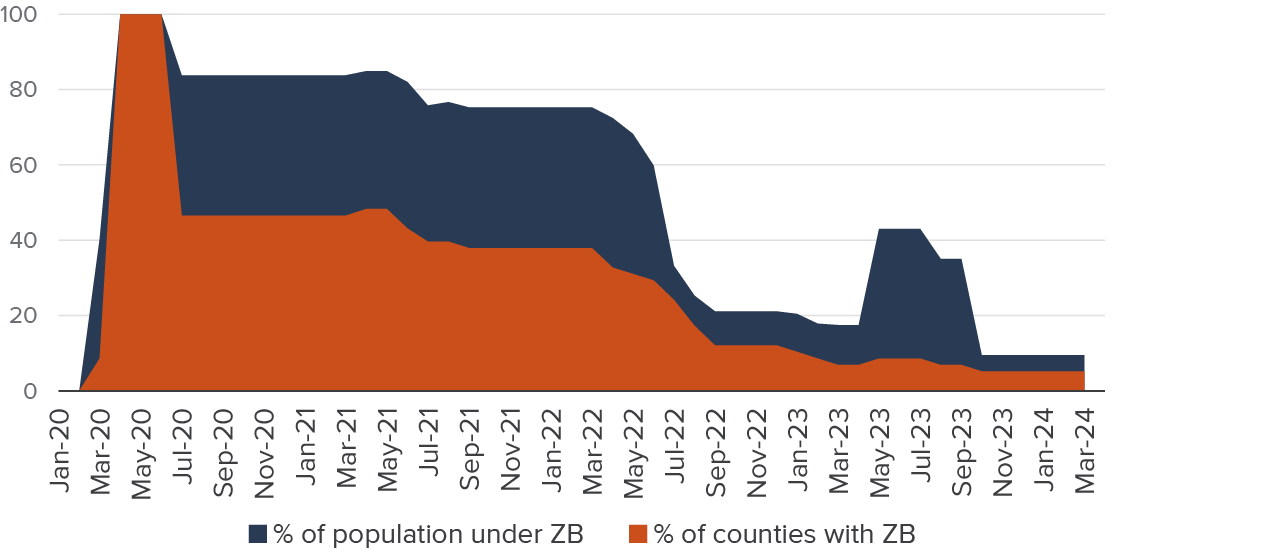
SOURCES: California county superior courts, Judicial Council of California.
NOTES: If a county had an emergency bail order in place for any period during a month, we count it for that month. Seven counties covering 44 percent of California’s population implemented county-level emergency bail orders about one to three weeks before the statewide order began on April 13, 2020. San Bernardino and Glenn Counties are counted as continuing their emergency bail schedules past June 2020 in this figure despite extending zero bail for misdemeanors only.
Trends in Rearrests and Bookings
The COVID-induced shift in public life led to unprecedented changes within California’s criminal justice system in the spring and summer of 2020. Alongside the Judicial Council’s statewide emergency bail order in April 2020, local law enforcement agencies issued directives to avoid unnecessary contact with community members and mandated “cite and release” orders to non-custodial arrest suspects for some offenses early in the pandemic (Premkumar et al. 2023). County jails and state prisons released many inmates early. Most courts closed temporarily, and many reopened with remote hearings (Harris 2023). Civil unrest in the wake of the murder of George Floyd in May 2020 also aligned with temporary changes in arrests that differed by racial group (Premkumar et al. 2023).
To understand the potential impact of emergency bail orders in California, we begin by examining descriptive trends for rearrests and bookings during this dynamic period.
Rearrests Experienced Significant and Enduring Declines
Widespread changes to the criminal justice system contributed to significant and enduring declines in arrests in California from the onset of the COVID pandemic through 2023, driven largely by decreases in misdemeanor arrests. The share of arrests that led to rearrests within 30 days—our main metric of interest—also decreased from about 15 percent to under 12 percent during this period.
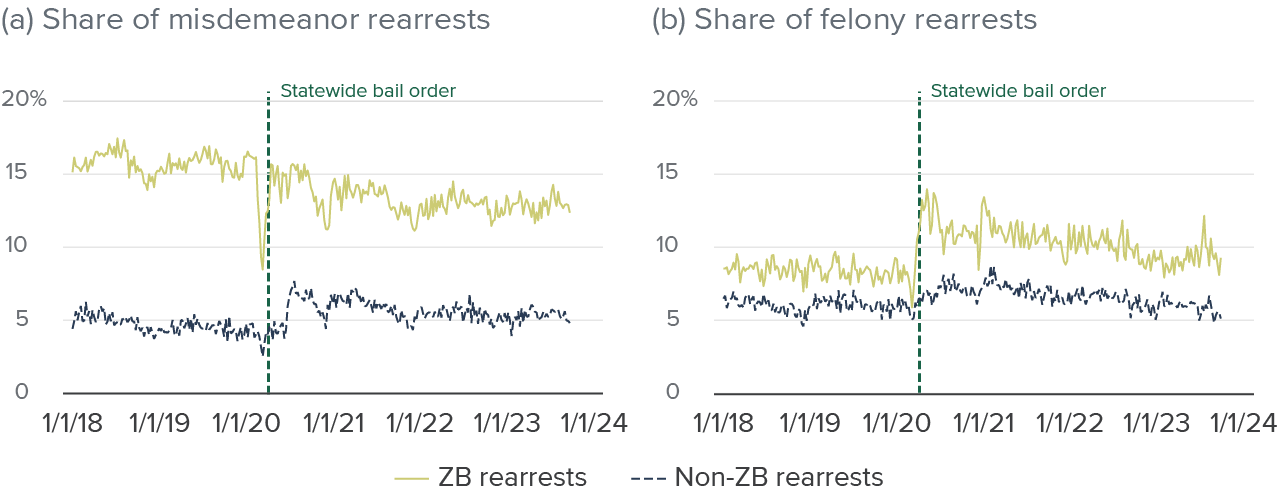
When we examine rearrests for misdemeanors and felonies separately, we find that rearrests for which the initial arrest qualified for zero bail (i.e., a zero-bail or ZB rearrest) decreased for misdemeanors from 2018 to 2023. Figure 2a shows that the share of weekly rearrests among those initially committing zero-bail misdemeanors (green line) dropped from just over 15 percent prior to the pandemic to under 13 percent by September 2023. The share of zero-bail misdemeanor rearrests reached a low of under 10 percent of weekly arrests in March 2020, coinciding with pandemic-induced shelter-in-place orders and reductions in public movement (Premkumar et al. 2023).
At the same time, the share of rearrests for zero-bail felonies (Figure 2b; green line) increased from about 8 to 13 percent around the time of the Judicial Council’s emergency bail order. Though the share of zero-bail felony rearrests did gradually decline to 9 percent by September 2023, it remained above pre-pandemic levels through at least 2023. These descriptive trends suggest that the overall drop in zero-bail rearrests was mainly made up of misdemeanor rearrests, which capture a significant portion of zero-bail offenses (Technical Appendix Figure A4).
Rearrest shares after a zero-bail release plunged for misdemeanors, but spiked for felonies, in March 2020
SOURCE: California Department of Justice: Automated Criminal History System (ACHS) data.
NOTES: Panel (a) presents the share of 30-day weekly misdemeanor rearrests from January 2018 to September 2023; both the initial and subsequent arrests of the rearrest are misdemeanors. Panel (b) presents the share of 30-day weekly felony rearrests from January 2018 to September 2023; both the initial and subsequent arrests of the rearrest are felonies. The green line in each panel denotes the share of zero-bail-eligible (ZB) rearrests. Offenses for the initial arrest of these misdemeanor and felony rearrests did not qualify for zero bail until the statewide order was issued in April 2020 (dashed dark green line). Following the implementation of the statewide order, the offenses for these initial arrests may have qualified for zero bail either under the statewide order (April to June 2020), or county-level orders (27 counties kept emergency orders in place after the statewide order expired in June 2020). In both panels, the dashed dark blue line represents the share of zero-bail-ineligible (non-ZB) rearrests—all of which had initial arrests for offenses that never qualified for zero bail even after the statewide emergency bail order was implemented.
Following the onset of the pandemic and the implementation of the statewide emergency order from April to June 2020, rearrests as a share of arrests for initial offenses that were not eligible for zero bail (i.e., non-ZB rearrests) increased slightly for both misdemeanors and felonies (Figure 2; dark blue lines). These numbers steadily returned to pre-pandemic levels (around 5% for misdemeanors and 6% for felonies) from July 2020 to April 2022, when 70 percent of the state’s population was still under emergency bail orders.
Jail Bookings and Populations Dropped Early in the Pandemic
The main purpose of implementing the statewide emergency bail order was to reduce COVID transmission by limiting the number of people cycling through courts and jails, particularly those held for pretrial detention. Around the same time as the statewide emergency bail order, a COVID-induced dip in arrests coincided with a decrease in jail bookings in California (Premkumar et al. 2023).
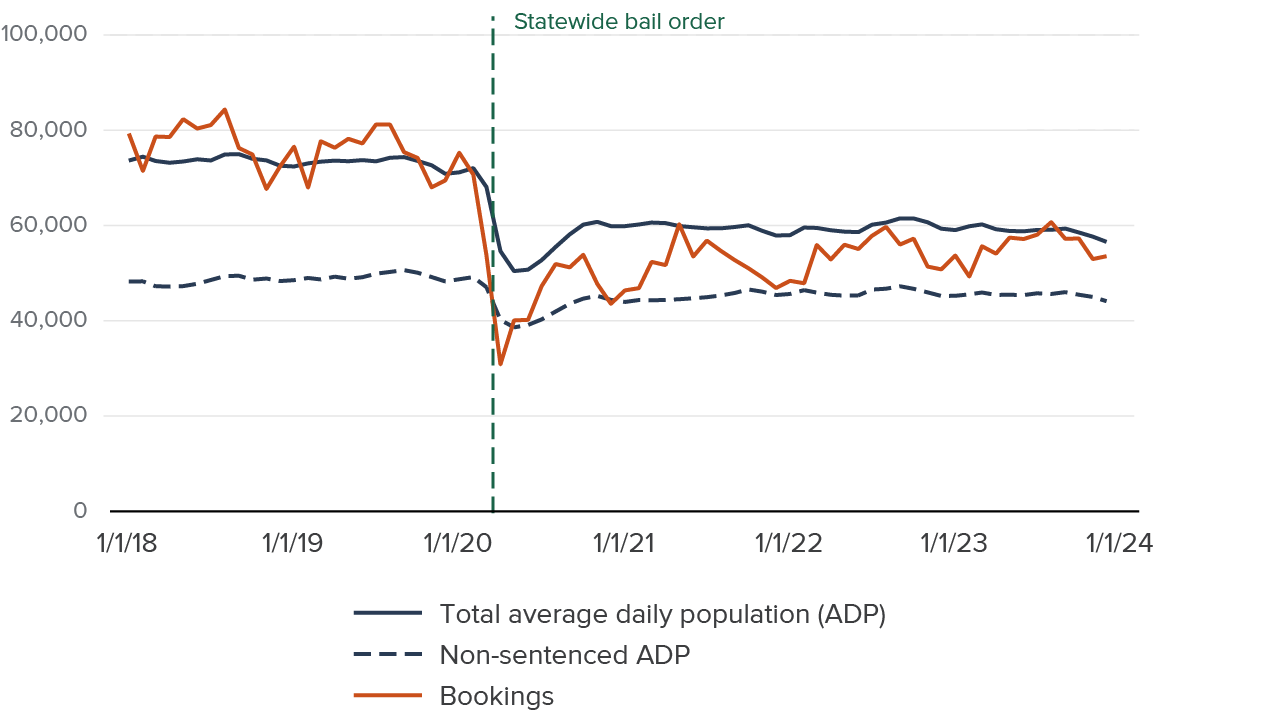
Figure 3 shows the sharp drops in monthly bookings into county jails and the average daily population (ADP) in jails at the start of the pandemic. It also depicts the drop in the non-sentenced ADP awaiting arraignment, trial, or sentencing—a helpful proxy for the number of people in pretrial detention. Bookings dropped from about 70,000 in February 2020 to a low of roughly 30,000 in April 2020 as local law enforcement agencies attempted to reduce stops, arrests, bookings, and jail populations. Bookings drifted back above 50,000 by the end of summer 2020, but like arrests, they never returned to pre-pandemic levels. After another dip in late 2020, monthly jail bookings remained steady between 50,000 and 60,000 from March 2021 to December 2023, a drop of roughly 25 percent compared to February 2020.
Jail bookings and populations dropped dramatically in March 2020, remaining below pre-pandemic levels through 2023
Monthly ADP and bookings
SOURCE: Average Daily Population and Monthly Bookings in California Jails, January 2018–December 2023, California Board of State and Community Corrections.
County sheriffs also adapted by releasing people from jail early. As shown in Figure 3, the statewide ADP dropped from 72,000 in February 2020 to a low of about 50,000 in May and June 2020. The population then slowly drifted upward to roughly 60,000 in October 2020 (Harris and Hayes 2021), where it remained relatively stable through the end of 2023 (Lofstrom, Martin, and Skelton 2024). The non-sentenced ADP followed a similar pattern, dropping from about 50,000 prior to the pandemic to below 40,000 in May and June 2020, before stabilizing around 45,000 from 2021 through 2023.
Examining the Impact of Emergency Bail Orders
In this section, we aim to isolate the impact of emergency bail orders on rearrests in California, attempting to remove any potential effects from the coinciding societal events, criminal justice system changes, and COVID policies. We begin by outlining the potential consequences of emergency bail orders and describing our methodology. Then we analyze the impact of implementing and revoking emergency bail orders on rearrests generally and for specific offense types, before considering effects on the timing of rearrests.
Potential Effects of Emergency Bail Orders
Theoretically, the statewide and county emergency bail orders could have put upward or downward pressure—or both—on crime and arrest levels. Prior to the pandemic, most individuals arrested on zero-bail offenses would likely have been held in pretrial detention at least until their arraignment (Tafoya et al. 2017; Lofstrom, Martin, and Raphael 2020). This detention physically prevented the crimes that some individuals might have committed if not detained, an effect known as incapacitation (Leslie and Pope 2017; Associated Press 2020). Additionally, during non-emergency periods, pretrial release was occasionally paired with conditions involving monitoring or case management that became less likely during the height of the pandemic. Therefore, by not detaining individuals or providing the typical pretrial resources, the emergency bail orders could have led to increased crime and arrest levels, particularly in the short term.
On the other hand, sending fewer people to jail for pretrial detention could have put a downward pressure on offending and, consequently, arrests. Research suggests pretrial detention may be criminogenic—that is, it may make detained individuals more likely to reoffend in the long term following release (Heaton, Mayson, and Stevenson 2017; Stevenson 2017; Dobbie, Goldin, and Yang 2018; Meitl and Morris 2019; Petrich et al. 2021). The relationship between pretrial detention and recidivism may be explained by negative effects on formal sector employment, receipt of public benefits, and preexisting family arrangements, as well as increased psychological strain on defendants who are incarcerated pretrial, diminished social ties, and reduced autonomy (Dobbie, Goldin, and Yang 2018; Toman, Cochran, and Cochran 2018; Wakefield and Andersen 2020; Meitl and Morris 2019).
Despite some studies finding that pretrial detention results in limited or decreased rates of reoffending in the short term, this reduction may ultimately be offset by the long-term criminogenic effect of pretrial detention (Leslie and Pope 2017; Dobbie, Goldin, and Yang 2018; Lacoe, Skog, and Bird 2022). By removing both the immediate incapacitation effects and long-term criminogenic effects of detention, the emergency bail orders might have exerted countervailing pressures on crime and arrest rates, each of which are experienced over different time spans.
Emergency Bail Orders Led to a Short-Term Increase in Rearrests
First, we examine the effects of implementing an emergency bail order on the likelihood of a rearrest within 30 days. Implementation took place in late March to mid-April 2020, with seven counties initiating an emergency order before the Judicial Council’s statewide mandate on April 13, 2020 (see Technical Appendix Figure A2 for timing).
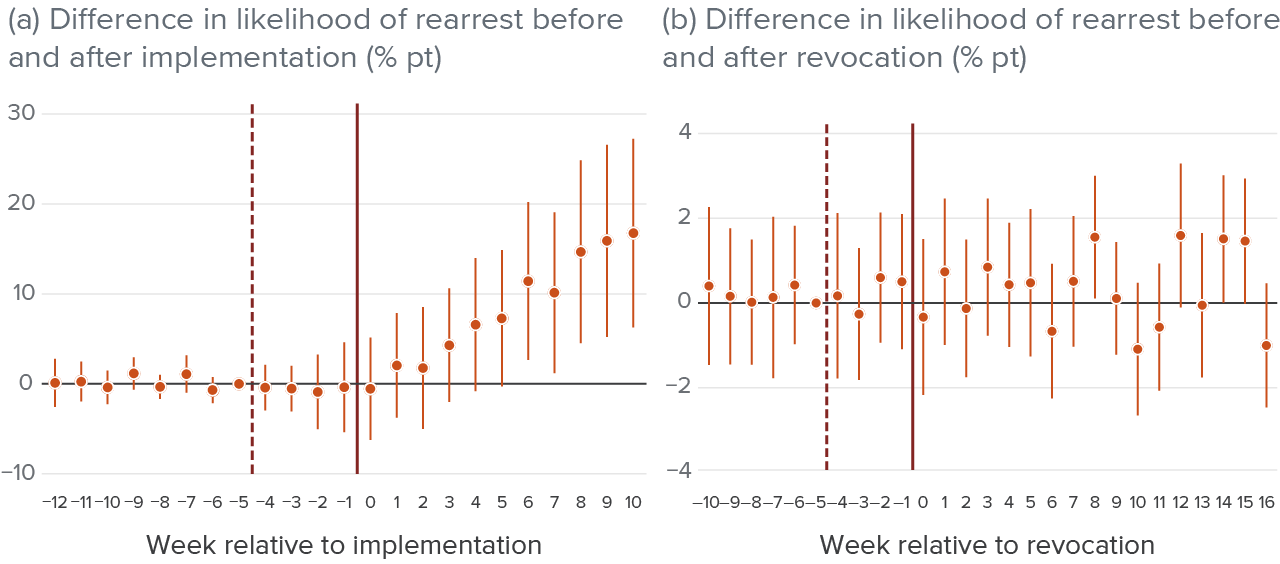
In Figure 4a, the orange dots (regression coefficients) show the week-by-week changes in the likelihood of rearrest before and after implementation of emergency bail orders (see Technical Appendix C for more details on the analysis). When the orange lines around those dots do not intersect with the horizontal black zero line, the estimate is considered statistically significant. The dashed red line indicates 30 days before the implementation of an emergency bail order, and the solid red line indicates the start of the emergency order. Thus, the dots to the right of the solid red line represent the weeks after implementation, while the dots in between the red dashed and solid lines represent weeks that could have potentially been affected (since we are focused on future rearrests within 30 days of an initial arrest, effects may appear prior to implementation). Figure 4b is similar but illustrates the effect of the revocation of emergency bail orders.
There was no significant difference in the likelihood of rearrest for zero-bail and non-zero-bail offenses before emergency bail orders were in place, as seen by the flat trend of the orange dots before implementation (to the left of the red dashed line) in Figure 4a. Then, as the first set of counties implemented emergency bail orders in late March to early April, we see a gradual increase in the likelihood of rearrest within 30 days for zero-bail offenses. This likelihood increases throughout the first 10 weeks after implementation and becomes statistically significant after six weeks. On average, over the first 10 weeks following implementation, someone arrested for a zero-bail offense was 8.2 percentage points more likely to be rearrested within 30 days, a notable increase from the 14.6 percent of arrested individuals rearrested within 30 days prior to implementation.
Implementation of emergency bail orders increased the likelihood of rearrests, but lifting orders had no significant impact
SOURCE: California Department of Justice: Automated Criminal History System (ACHS) data.
NOTES: Panel (a) shows the difference in likelihood of any rearrest for zero-bail offenses from implementation using the first sample frame, January 2018 to June 2020. Panel (b) shows the difference in likelihood of any rearrest for zero-bail offenses from revocation using the second sample frame, April 2020 to September 2023. The solid red line indicates the start of an emergency bail order. The dashed red line indicates 30 days before implementation. Because we calculate rearrests within 30 days of an initial arrest, effects may appear up to 30 days before implementation or before revocation.
Figure 4b shows the impact of revoking the emergency bail orders on rearrests. These revocations occurred from late June 2020 to July 2023, though some counties still had emergency orders in place through at least March 2024. If the retraction of these orders meant that arrest, booking, and pretrial detention decisions returned to pre-pandemic practices, then we would expect the revocation to lead to a decrease in rearrests, counteracting the increase that resulted from the implementation of the emergency bail measures. But in contrast with the implementation of emergency bail orders, we do not find any significant effects of their revocation on rearrests. This asymmetry may be driven by the staggered timing of when orders expired; this process took place over multiple years, after the most disruptive effects of COVID had subsided. Further, Premkumar et al. (2023) show that some criminal justice outcomes that were impacted by COVID did not return to pre-pandemic levels. Revocation of emergency bail orders thus took place in a vastly different context than their implementation, which may account for the lack of impact on rearrests.
For Counties with Longer Bail Orders, Effects on Rearrests Decreased over Time
To examine longer-term effects, we focus on the 27 counties that extended emergency bail orders past the Judicial Council mandate. This analysis allows us to examine changes in the effects a full year after implementation, through April 2021 or right before the first county revoked its emergency order.
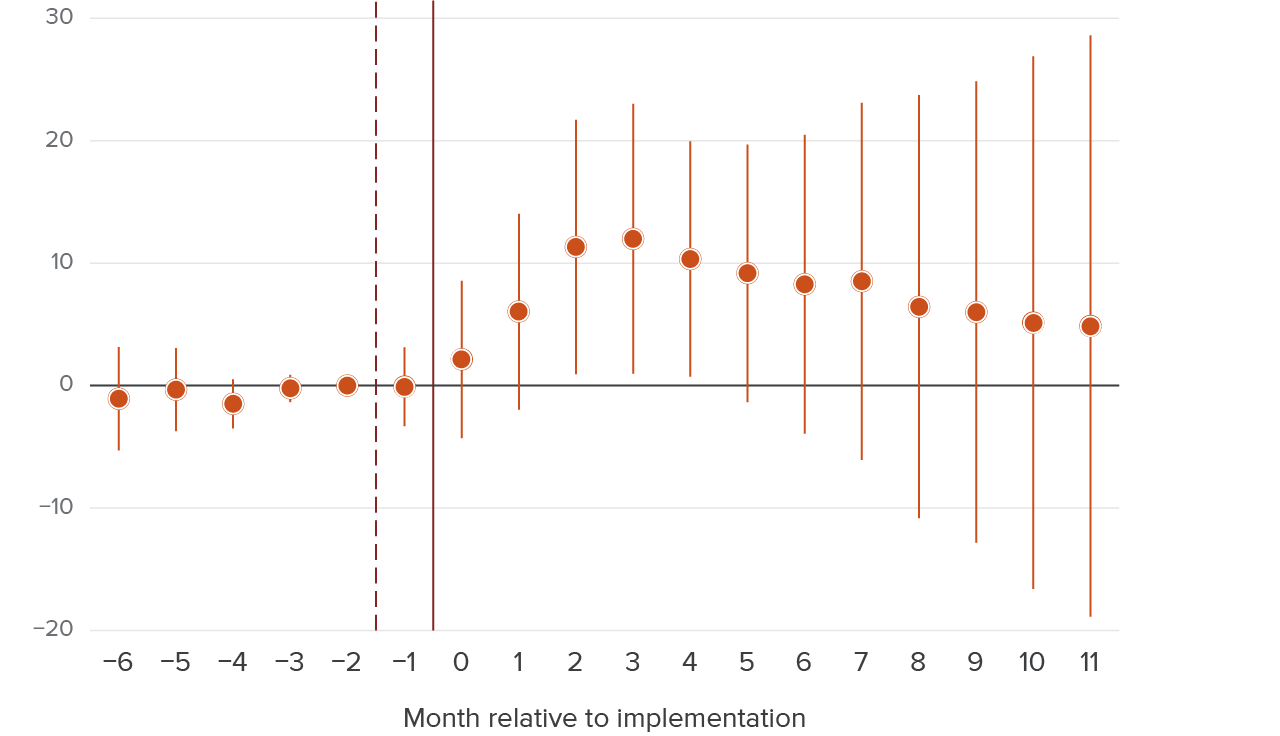
Figure 5 shows the impact on the likelihood of rearrest by the month in which the emergency bail order was implemented. Like Figure 4, there are no significant differences between zero-bail and non-zero-bail rearrests in the months prior to the emergency bail measures. We then see an increase in rearrests that becomes statistically significant about two months after implementation. The largest effects occur three months after implementation (a 12 percentage point increase). After four months, the effects start to attenuate and are no longer statistically significant. The average effect over the first year of implementation, all while emergency bail orders were in place, is not statistically significant.
Under emergency bail orders, differences in rearrests for zero-bail offenses began to subside after a few months
Difference in likelihood of rearrest (% pt)
SOURCE: California Department of Justice: Automated Criminal History System (ACHS) data.
NOTES: Figure shows the difference in likelihood of any rearrest for zero-bail offenses using a sample frame of January 2018 to April 2021 with the set of 27 counties that extended emergency bail orders beyond 2020. The horizontal axis is the number of months relative to the implementation of an emergency bail order, which occurred in March or April 2020 depending on the county. All of these counties keep their emergency order in place until at least April 2021 (11 months after implementation). The solid red line indicates the start of implementation. The dashed red line indicates 30 days before implementation. Because we calculate rearrests within 30 days of an initial arrest, effects may appear up to 30 days before implementation.
The Increase in Rearrests Was Driven by Felonies
One policy question concerns whether the emergency bail order’s effects on rearrests were concentrated among certain types of offenses, especially whether lower-level offenders who were released pretrial ended up committing more severe crimes. To explore this question, we examine the effects of emergency bail orders on the likelihood of a rearrest within 30 days across various rearrest types. When examining violent felonies, it is important to note that we consider both the California penal code definition of violent felony and a categorization of our own that is more expansive and occasionally contrasts with the penal code definition. As used in this report, the PPIC definition of violent felony fully encapsulates the penal code definition but includes other violent offenses as well. Notably, the felony category is also where we see the most variation in which offenses qualified or did not qualify for zero bail (Technical Appendix Table A14); the most common zero-bail felonies were theft and drug-related offenses and the most common non-zero-bail felonies were domestic violence, assault with a deadly weapon, and robbery (Technical Appendix Tables A3 and A5).
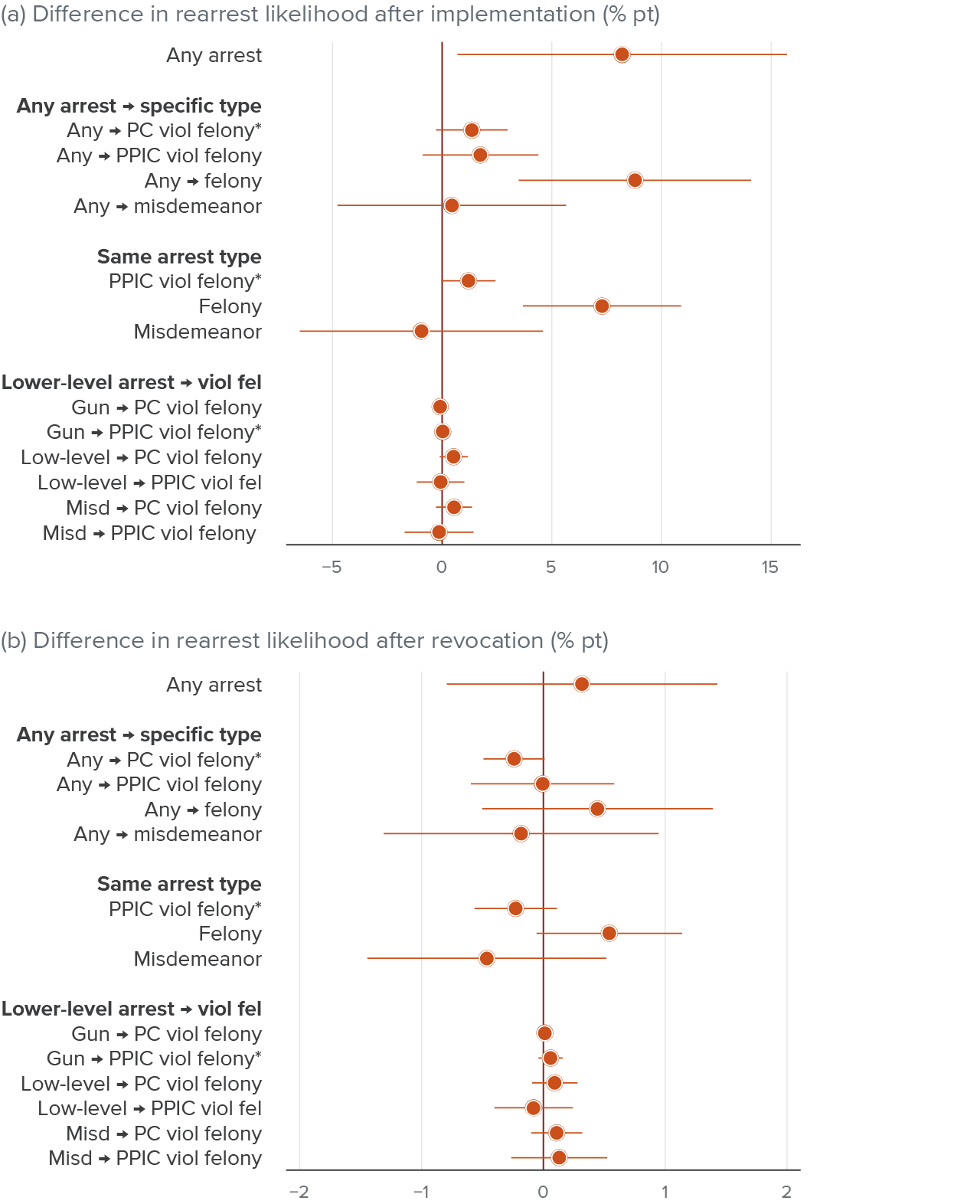
In Figure 6, the orange dots show the average of the weekly effects measured from the week of either implementing (Figure 6a) or revoking (Figure 6b) an emergency bail order to week 10 (for implementation) or week 16 (for revocation). When the orange lines around those dots do not intersect with the vertical red zero line, the estimate is considered statistically significant. An asterisk indicates a significant difference between zero-bail and non-zero-bail arrests for this offense type prior to the change in bail procedures, limiting our ability to make any causal claims for that rearrest category.
The top category in Figure 6a and Figure 6b (“any arrest”) shows the average effect on rearrests of any offense type; this is the same average of week-by-week changes discussed above in Figure 4. Next, we examine differences in the likelihood of rearrest for an initial arrest of any type that was followed by a rearrest for either a violent felony, any felony, or any misdemeanor. Then, we show results for rearrests for which the initial and subsequent arrests were of the same arrest type: both violent felonies (PPIC definition), both felonies, and both misdemeanors. Finally, we examine three types of lower-level arrests that were followed by a violent felony rearrest: a non-violent, low-level gun offense; a non-violent, low-level offense (primarily drug, property, or disorder crimes); and a misdemeanor.
Figure 6a shows that the increase in the overall likelihood of rearrests was driven by rearrests for felonies; the initial arrest could either be for any type of offense or for a felony. For these rearrest categories, we see increases of 8.8 and 7.3 percentage points, respectively, in the likelihood of rearrest, sizable increases over their average of 5.2 and 2.6 percent of individuals rearrested within 30 days prior to implementation. For felony rearrests that began with an arrest of any offense type, we see a flat pre-trend before implementation in Technical Appendix Figure A10a, validating the causal interpretation for this rearrest type, and a similar and steadily increasing impact in the weeks after implementation. We do not find statistically and meaningfully significant effects across any other rearrest type, including arrests for low-level offenses followed by violent felonies.
The increase in rearrests after implementation was driven by felonies, but revocation did not generally affect the likelihood of rearrest across rearrest categories
SOURCE: California Department of Justice: Automated Criminal History System (ACHS) data.
NOTES: Panel (a) shows the difference in likelihood of any rearrest for zero-bail offenses from implementation using the first sample frame, January 2018 to June 2020. Panel (b) shows the difference in likelihood of any rearrest for zero-bail offenses from revocation using the second sample frame, April 2020 to September 2023. “PC” refers to the California penal code. An asterisk by the rearrest type means that there are significant differences in zero-bail and non-zero-bail arrests prior to implementation, limiting causal interpretation.
When we focus on the 27 counties that continued an emergency bail order past 2020, the implementation effects were similarly driven by felonies (Technical Appendix Figure A8). However, unlike other rearrest types, the rearrests that ended in a felony did not subside in the year after implementation. In the first year, there was, on average, a 10 percentage point increase in the likelihood of rearrest for a felony when the initial arrest was of any offense type, a notable increase over the average share of 5.1 percent of individuals rearrested prior to implementation (Figure 7).
General-to-felony rearrests did not subside in the year after implementing emergency bail orders
Difference in likelihood of rearrest (% pt)

SOURCE: California Department of Justice: Automated Criminal History System (ACHS) data.
NOTES: Figure shows the difference in likelihood of general-to-felony rearrest for zero-bail offenses using a sample frame of January 2018 to April 2021 with the set of 27 counties that extended emergency bail orders beyond 2020. The horizontal axis is the number of months relative to the implementation of an emergency bail order, which occurred in March or April 2020 depending on the county. All of these counties keep their emergency order in place until at least April 2021 (11 months after implementation). The solid red line indicates the start of implementation. The dashed red line indicates 30 days before implementation. Because we calculate rearrests within 30 days of an initial arrest, effects may appear up to 30 days before implementation.
Conversely, Figure 6b above shows that the revocation of emergency bail orders from June 2020 to July 2023 had no statistically significant impact on rearrests of any offense type (after factoring in which rearrests have flat pre-trends), which comports with the lack of general effects we found in Figure 4b. These estimates are precise enough to allow us to rule out even relatively small changes in the likelihood of rearrests for each offense type. Unlike general rearrests, the fact that the increase in felony rearrests did not subside in the first year of implementation and felony rearrests were unaffected after the revocation of emergency bail orders is one explanation for why zero-bail felony rearrests remained slightly higher than pre-pandemic levels into 2023 in the descriptive analysis (Figure 2).
The effects of the emergency bail orders are similar if we look at the number of rearrests rather than the likelihood of rearrest, and the same is true for their revocation (Technical Appendix Figures A11a and A11b). This similarity in effect size suggests that the effects of implementation were largely driven by an increase in the number of people who were rearrested within 30 days, rather than an increase in the frequency of offending from individuals who were rearrested multiple times within that period.
Increased Rearrests Were Concentrated in the Initial Days after Release
The previous section’s results illustrate that, as emergency bail orders were implemented, general rearrests and felony rearrests (for which the initial arrest was of any offense type or was a felony) increased on average for zero-bail offenses. To garner information on when this increase in rearrests occurred, we plotted the likelihood of rearrest for each day up to 30 days after the initial arrest took place. Here, we focus on the time frame around the implementation of emergency bail orders (between January 2018 and June 2020) because that is when we see a significant change in rearrests.
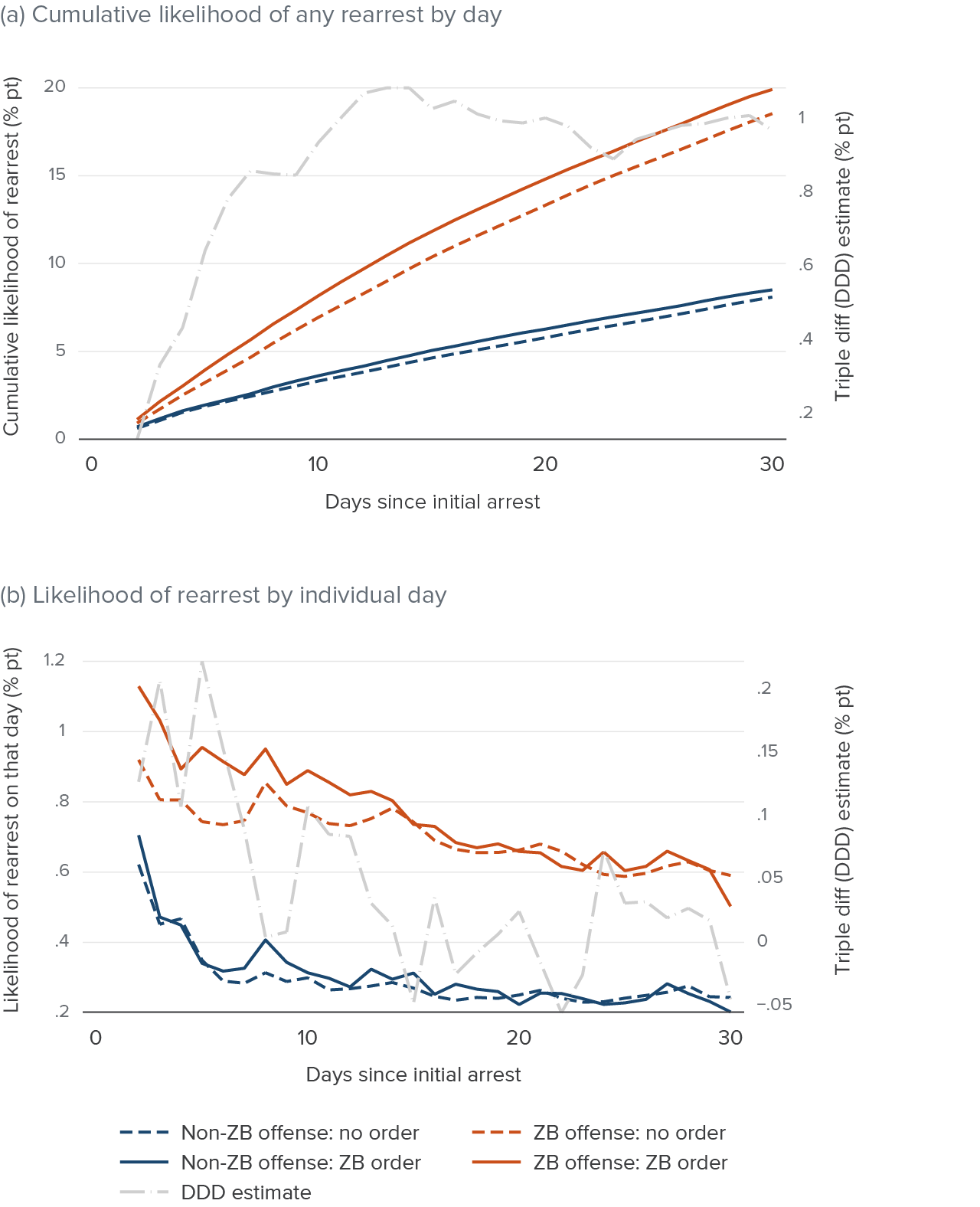
Figure 8a shows the cumulative likelihood of any rearrest occurring within 30 days of any initial arrest. The orange and blue curves (left vertical axis) represent the likelihood of being arrested within a certain amount of time from an initial arrest for zero-bail and non-zero-bail offenses (i.e., ZB and non-ZB offenses), respectively. The differences between the curves combine to provide the estimate shown in gray (right vertical axis).
First, Figure 8a illustrates that zero-bail offenses (orange) have a higher share of general rearrests than non-zero-bail offenses (blue) from January 2018 to June 2020, regardless of whether an emergency bail order was in place (solid line) or not (dashed line). Within 30 days, almost 20 percent of zero-bail offense arrests had a subsequent rearrest, compared to 8.5 percent for non-zero-bail offenses (left vertical axis). For both types of arrests, we find that the likelihood of rearrest was higher across all days when an emergency bail order was in place. The gray curve, which represents the difference in likelihood of rearrest for zero-bail offenses under an emergency bail order, exhibits a sharp increase over the first 12 days after arrest, peaking on day 14. The curve then gradually reduces by day 30 but stays positive. This indicates that the cumulative likelihood of rearrest was higher for zero-bail offenses that occurred after an emergency bail order was implemented.
While Figure 8a shows the cumulative likelihood of being rearrested, Figure 8b shows how each individual day contributed to the risk of being rearrested. The orange and blue lines (left vertical axis) show the likelihood of being rearrested on that specific day from an initial arrest and the differences between the curves combine to provide the estimate shown in gray (right vertical axis). While this estimate varies from day to day, most days following an arrest contributed positively to the likelihood of rearrest, with each day generally producing less risk than the day before. Overall, individuals were most likely to be arrested during the first six days after the initial arrest; rearrests during this time period are driving the estimates of the impact of implementation.
The likelihood of rearrest during an emergency bail order rose rapidly in the first six days after an initial arrest and peaked on the fifth day
SOURCE: California Department of Justice: Automated Criminal History System (ACHS) data.
NOTES: Panel (a) shows the cumulative likelihood of any rearrest from implementation in the first sample frame (January 2018 to June 2020). Panel (b) shows the rearrest risk of each individual day for the first 30 days after an initial arrest from implementation in the first sample frame (January 2018 to June 2020). Rearrests within 30 days of the start or end of an emergency bail order and in the 30 days leading up to the sample end date are excluded. “ZB order” indicates the period(s) in which an emergency bail order is in place in a county. Triple difference (DDD), shown in gray, estimates the impact of an emergency bail order on ZB offenses. The DDD estimate and curves do not use any controls, unlike the previously discussed regression coefficients.
We also investigated initial arrests of any offense that were followed by a felony rearrest within 30 days, since the analysis in the previous section highlights that these rearrests may be driving the effects on general rearrests. By definition, there was a lower likelihood of general-to-felony rearrests for both zero-bail and non-zero-bail eligible offenses when compared to general rearrests. While higher in the first few days after arrest, our estimates do not seem to be entirely driven by people being rearrested for a felony in the first few days following an initial arrest of any type, at least relative to general rearrests. The effect seems relatively more moderated throughout the 30 days (Technical Appendix Figure A15). In fact, when we look at rearrests for which the initial and subsequent arrests were felonies (Technical Appendix Figure A16), the effect of the implementation of these orders on zero-bail offenses remains even more constant over the course of the 30 days, excluding the first five. That may be a result of the comparison group being held in jail for longer because felonies are more severe, with the effects representing an incapacitation effect. As mentioned above, it is important to keep in mind that these are short-term effects; the possible effects of less pretrial detention leading to reductions in rearrests may not occur until later in the post-arrest process.
Conclusion
Concerns about the impact of cash bail on lower-income defendants and worries that changing the monetary bail system could lead to rising crime feature prominently in debates about reforming bail and pretrial detention. During the pandemic, statewide and county-level emergency measures set bail at zero for a broad range of misdemeanors and felonies. While their goal was to protect public health by limiting COVID transmission, these emergency bail orders also provide an opportunity to address a significant question in public safety discussions by examining the relationship between zero bail and future offending.
Our findings rigorously evaluate the effects of California’s emergency bail orders on the likelihood of rearrest for those who were released without bail. Though it is outside the scope of this report to evaluate the public health benefits accrued by curbing virus transmission in courts and jails, our findings can help inform broader discussions about pretrial detention across the state. Nevertheless, the unique circumstances and motivation surrounding the emergency bail orders mean that we must be cautious when generalizing our findings.
We find that during the early disruptive months of the COVID pandemic, implementation of emergency bail orders caused notable increases in both the likelihood and number of rearrests within 30 days. The initial implementation effects were driven by being rearrested for a felony. However, we find no evidence of an increase in rearrests for violent felonies; in particular, lower-level offenders released on zero bail were not more likely to be rearrested for violent felonies after implementation. About four months after implementation, as the most volatile period of the pandemic passed, the overall effect on rearrests began to wane, at least for the 27 counties that continued emergency orders through 2020. After a year, the average effect of implementation was no longer statistically significant. However, the rise in felony rearrests did not subside in the year after implementation.
This report also finds that the revocation of emergency bail orders, which took place from June 2020 to July 2023, did not affect rearrests, regardless of offense type. Because felony rearrests experienced enduring increases during the first year of implementation of emergency bail orders and were unaffected after orders were lifted, they remained slightly elevated through 2023. More research is needed to examine other possible contributing factors, including the extent to which arrest and pretrial detention practices that were implemented during the pandemic, including emergency bail orders, have reverted to pre-pandemic policies and approaches.
These findings suggest that, during the first few months of the pandemic, the emergency bail order potentially removed the presence of a short-term incapacitation and/or deterrence effect—that is, individuals were released and then rearrested when they would have previously been detained and prevented from committing any additional crimes, and/or individuals committed more crimes presuming that they would likely be released if arrested. These effects could have been especially salient in a disruptive societal state, which may be why the impact subsided four months after implementation.
We find that the rise in rearrests after the initiation of emergency bail orders was concentrated in the first six days after an initial arrest. These bail orders led to immediate release after people were arrested for zero-bail offenses; as time passed, those detained under arrests for non-zero-bail offenses could also be released from jail, likely reducing differences in rearrest patterns. In contrast, felony rearrests tended to occur over a longer time period compared to other rearrest types, likely because some of those held for their initial felonies did not get released until later.
Why did rearrests not return to previous levels after emergency bail orders were lifted? The difference in context between when orders were implemented and when they were revoked may provide an explanation. It is possible that the difficulty connecting people in jail with pretrial services and case management during the most disruptive part of the pandemic played a role. It is also plausible that the reoffending risk of someone being released at the height of the pandemic was different than when society was functioning relatively normally. Moreover, the timing and the extent to which counties returned to pre-pandemic arrest and booking practices are unclear. If these practices continued after emergency bail orders ended, they may have contributed to rearrest rates not returning to pre-pandemic levels. As time went on, it is also possible that counties and law enforcement learned and adapted from previous experience, possibly modifying the offenses considered eligible for zero bail. It is still too early to examine the longer-term impacts of revoking emergency bail orders on rearrests, but since the potentially beneficial effects of avoiding pretrial detention are less likely to materialize early on, efforts to examine and evaluate longer-term impacts are critical.
Our findings highlight at least some short-term risks to implementing a blanket policy on pretrial detention. In particular, the effects of emergency bail orders in California suggest that, on its own, the offense for which someone is arrested may not always be an accurate indicator of future risk, particularly for felonies. Pretrial risk assessments could be a promising approach, as understanding individuals’ previously committed offenses and their severity may be useful in determining whether they should be detained in jail or released to the community during the pretrial period. However, we do not evaluate either the existing cash bail system or other bail reform proposals to determine which may be most effective at promoting public safety. Future research in this area should consider several factors, including public safety risk, equity implications of bail reform (including implications for racial inequities), and the economic burden of a cash bail system.
Topics
Criminal JusticeLearn More
Video: What Happened When California Suspended Bail during COVID?

Assessing the Impact of COVID-19 on Arrests in California

California Jails and COVID-19

New Bail Ruling Could Affect Tens of Thousands of Californians

Reforming Pretrial Justice in California