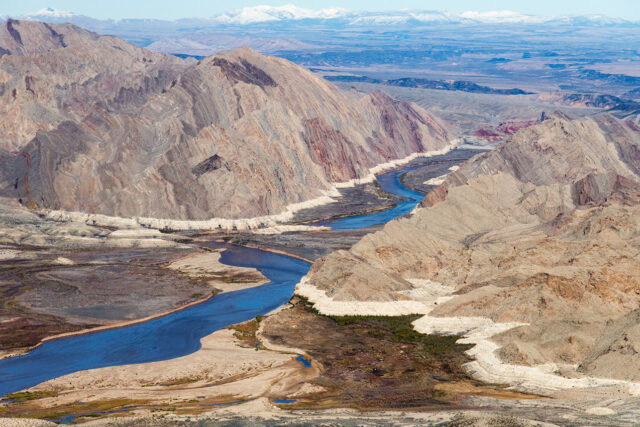
The Colorado River is a critical source of water for California and the western United States.
- Nearly 40 million people in seven states depend on water from the Colorado River system. Water from the river and its tributaries irrigates 5.5 million acres of farmland and supplies 30 tribal nations and Mexico.
- The river is divided into two subbasins. The principal “upper basin” states are Colorado, New Mexico, Utah, and Wyoming, and Arizona, California, and Nevada are the principal “lower basin” states. The 1922 Colorado River Compact allocates each basin 7.5 million acre-feet (maf) of water per year from the river’s mainstem, which the states share. The compact also allocates the lower basin an additional 1 maf per year to account for diversions from the Gila River and its tributaries in Arizona.
- Congress and the courts have recognized the water rights of 22 of the 30 tribal nations in the basin, which represent 3.2 maf per year of the total allocation. In addition, by treaty, Mexico is allocated 1.5 maf per year.
California is the largest water user in the Colorado River basin.
- California has the most senior water right in the lower basin, with an allocation of 4.4 maf per year. A 1931 agreement allocates this water among the Imperial Irrigation District, the Metropolitan Water District, the Coachella Valley Water District, the Palo Verde and Yuma irrigation districts, and the San Diego County Water Authority.
- Four tribal nations with reservations along the lower Colorado River, located partly or entirely within California, also share in this water. These tribes have diversion rights to 156,522 acre-feet per year to serve these lands. The tribal water rights are deducted from California’s 4.4 maf annual allocation.
- California’s share of the Colorado River irrigates approximately 770,000 acres and supplies water to more than 20 million people.
California is the largest user of the Colorado River

SOURCE: Author illustrations using maps from the US Bureau of Reclamation. (Totals do not equal 100 percent because of rounding.)
NOTES: The circle graph shows how the 16.5 million acre-feet (maf) are apportioned among the seven basin states and Mexico. (It excludes the additional 1 maf per year available to the lower basin to account for diversions from the Gila River and its tributaries in Arizona.) These allocations often exceed available supplies. Arizona’s mainstem allocation includes 2.8 maf as a lower basin state and 0.05 maf as an upper basin state. Tribal nations have rights to a significant share of this water in some states; some tribal rights are still awaiting settlement. Canals and aqueducts deliver most of California’s allocation to agricultural and urban export areas outside the river basin. Export areas in the upper basin include the Denver metropolitan area, Albuquerque, the Arkansas River Basin (Colorado), and Salt Lake City.
Over-allocated for years, the Colorado River has faced persistent drought since 2000.
- The Colorado River Compact allocated basin states more water than the watershed can sustainably deliver because of overly optimistic hydrolgic estimates made decades ago.
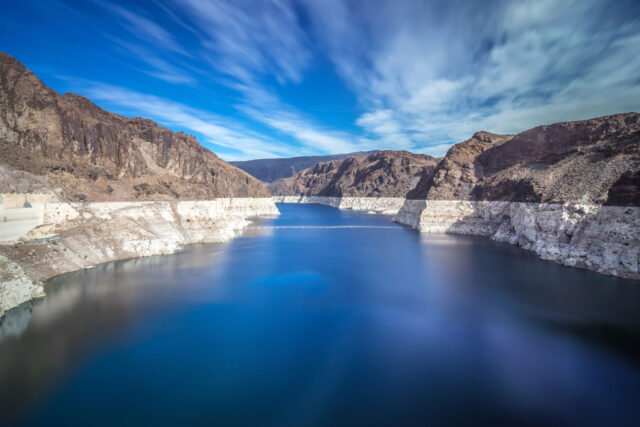
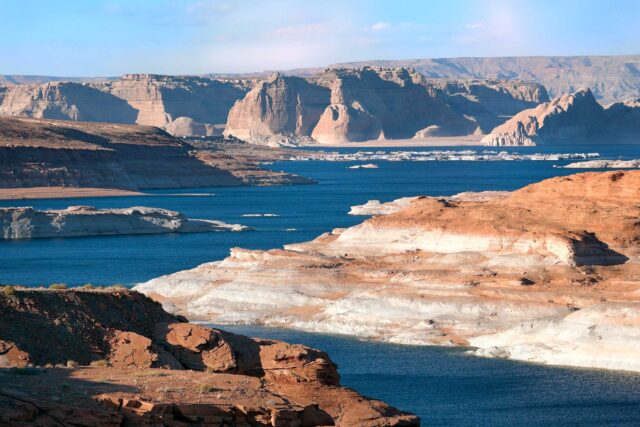
- For the past 25 years, Colorado River water use has exceeded the river’s annual supply by an average of 1 million acre-feet per year (see figure). This has created water shortages (especially in the lower basin and for Mexico), reduced hydropower generation, and resulted in historically low water levels in Lake Powell and Lake Mead, the largest reservoirs in the system.
- Warmer temperatures and diminishing snowpack are exacerbating these shortages.
The overuse of the Colorado River has had major consequences.
- Four of the 14 fish species native to the river—the Colorado pikeminnow, razorback sucker, bonytail, and humpback chub—are endangered or threatened. Federal and state agencies in the upper basin, along with several tribal nations and NGOs, have created a recovery program to restore and protect aquatic habitat.
- The Colorado River Delta in Mexico, once a vibrant network of wetlands, has been mostly dry for decades. In 2017, the United States, the seven basin states, and Mexico agreed to fund more environmental flows and restoration projects in the Delta.
- The Salton Sea, a saline lake in California’s Riverside and Imperial Counties fed primarily by Colorado River water, is shrinking. The increasing salinity and exposed lakebed have caused fish kills, bird deaths, air pollution, and other risks to human health. California has embarked on a 10-year program to restore wetlands, improve wildlife habitat, and suppress toxic dust.
Basin states are finding ways to share a shrinking river, but challenges remain.
- California has reduced its use of the Colorado River from more than 5 maf/year to its original 4.4 maf/year allocation, as the other lower basin states began using their full allocations in the 1990s. This was accomplished by improvements in irrigation efficiency, the lining of earthen canals, and water transfers.
- Examples include the Quantification Settlement Agreement and On-Farm Efficiency Conservation Program, the Palo Verde–MWD Water Transfer Program, and a pilot transfer program between MWD and the Quechan Tribe.
- In 2019, the US and the seven states agreed to a Drought Contingency Plan to manage shortages. The plan will expire at the end of 2025, however, and future drought planning and management is uncertain.
Despite demand management, demand still outpaces water supply in the Colorado River Basin

SOURCE: Adapted from US Bureau of Reclamation’s (USBR) Colorado River Basin Water Supply and Demand Study (2012), with updated historical supply and use data from USBR.
NOTES: The figure shows water use and supply as 10-year running averages. Water supply estimates for 2021–23 are provisional.
Topics
Drought Floods Freshwater Ecosystems Paying for Water Safe Drinking Water Water Supply Water, Land & Air