


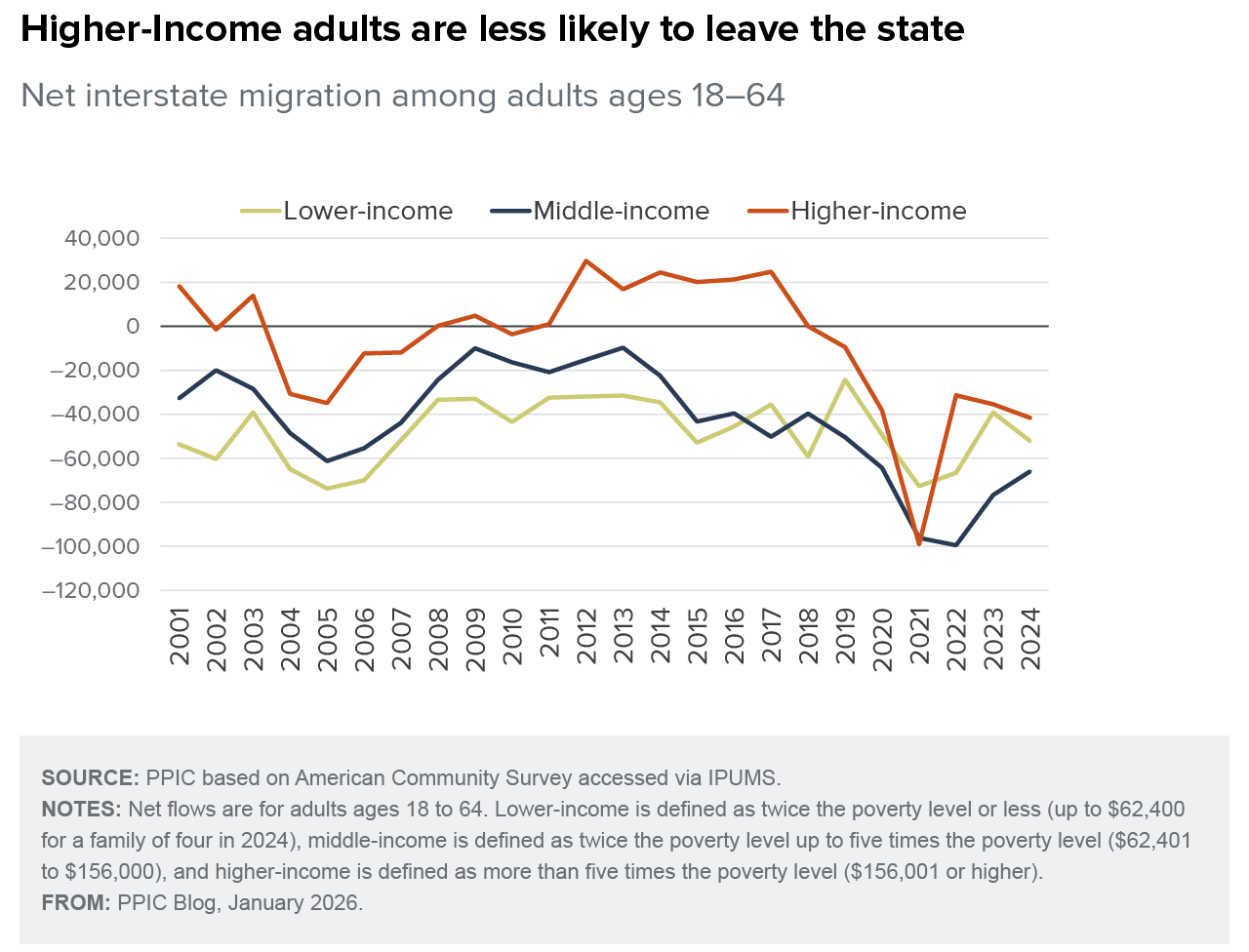
Over the past 25 years California has had its slowest rates of population growth ever recorded. The primary driver of this slowdown has been California residents moving to other states—a trend that remains near record levels, despite having abated somewhat since the pandemic. It is a remarkable turnaround for California—once the epicenter of population growth in the United States. The affordability crisis, especially housing costs, has played a key role, with lower-income households much more likely to leave the state than higher-income households.
Much has been made of the California exodus to other states, and rightly so. This migration, over the decades, has the power to reshape the state. From 2010 through 2024 (the year of the latest data) almost 10 million people moved from California to other states, while just over 7 million people moved to California from other parts of the country, according to the American Community Survey. In fact, according to Department of Finance estimates, the state has lost residents to other states every year since 2001.

During the height of the pandemic, the flows out of the state became so large that almost every demographic and socioeconomic group experienced net losses. For example, California used to gain college graduates even as it lost less educated adults. But in the last few years, the state has started losing college graduates as well —albeit still not to the same extent as less educated adults.
In a bit of good news, data from 2022 through 2024 show the net loss of college graduates has subsided considerably. Another bright note for the state: young college graduates in their 20s are least likely to be leaving.

Perhaps most striking, California now experiences net losses among higher-income households as well as middle- and lower-income households. The number of higher-income households moving to California declined a bit during the pandemic, but the number leaving the state increased dramatically (from less than 150,000 in 2019 to almost 220,000 by 2021).
The latest data show little change in the number of higher-income adults moving to California and a large decline in the number moving out (28% fewer leaving in 2024 versus 2021). The net effect has been a strong rebound from the pandemic.
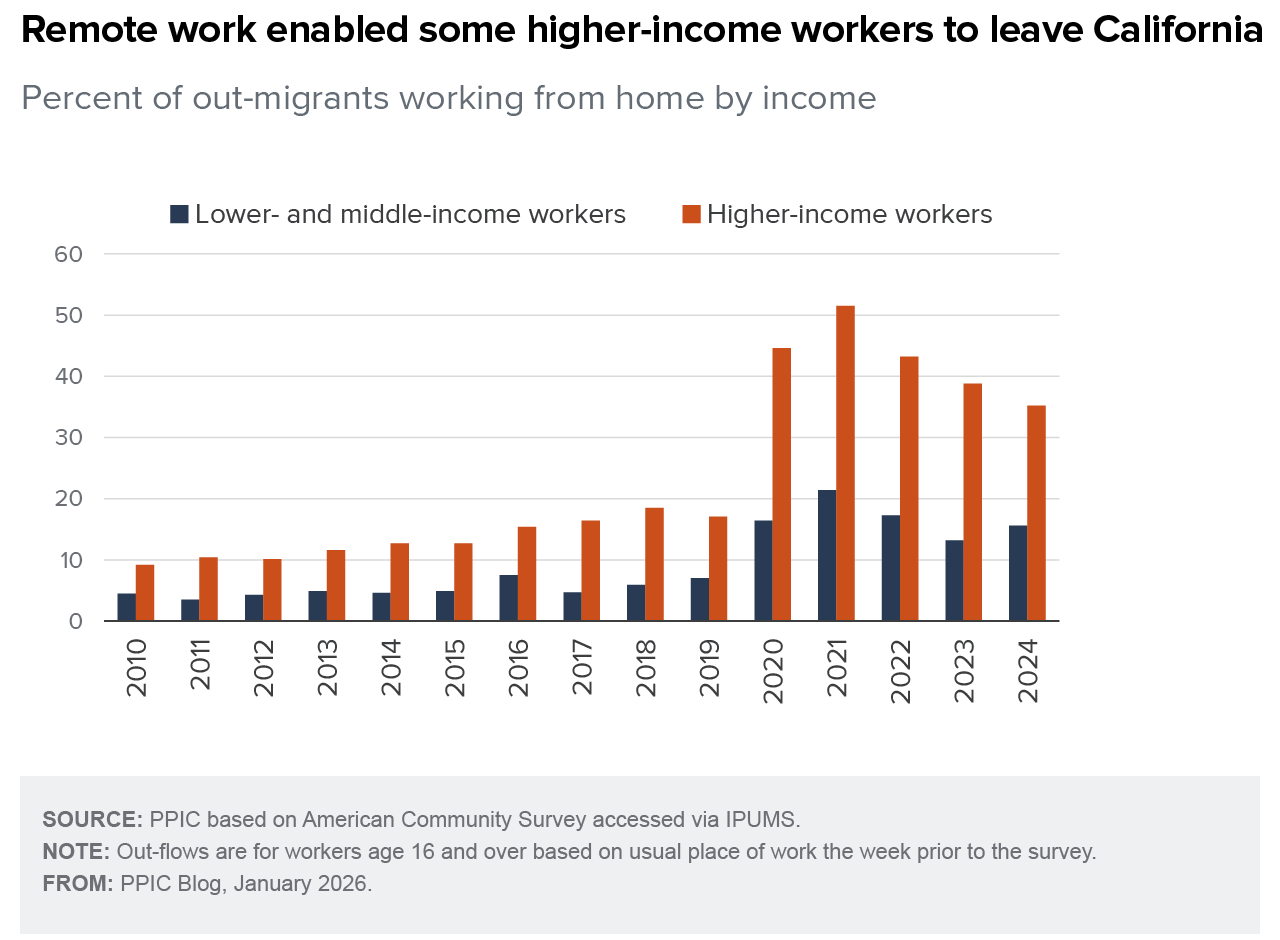
The losses of college graduates and higher-income households are likely related to the ability of many highly educated and highly paid workers to work from home. About two-thirds of the almost three million Californians who telework full-time (five or more days per week) have at least a bachelor’s degree, according to the Census Bureau’s Household Pulse surveys.
Over half of higher-income Californians leaving the state during the pandemic reported working from home. While that share has declined somewhat in recent years, the share remains far higher than prior to the pandemic.
While the migration of higher-income and more highly educated households is notable, their departures are still relatively small in proportion to their shares in the state as a whole. For example, over the past 10 years, California has had a net loss of 165,000 higher income adults and 75,000 college graduates—this is less than 2% of the current number of higher income adults and less than 1% of the current number of college graduates.
In contrast, the departure of lower-income adults is much more substantial, with a net loss of 532,000 adults over the past ten years, over 10% of the current number of lower-income adults in California. Similarly, the state lost over 8% of the current number of adults without a college degree.
Most people who move across state lines cite employment, housing, or family as the primary reason. Since 2015, California has experienced net losses of almost 900,000 people who cite housing as the primary reason, a sharp increase from 2004–14, according to the Current Population Survey. The PPIC Statewide Survey finds that 34% of Californians have seriously considered leaving the state because of high housing costs and 21% have thought of leaving because of the lack of well-paying jobs. Political outlook might also play a role for some movers, as conservatives are more likely to contemplate leaving the state than liberals and Republicans are much more likely to leave than Democrats. About half of those who leave the state buy a house in their new state, whereas only one-third of those moving to California buy a house.
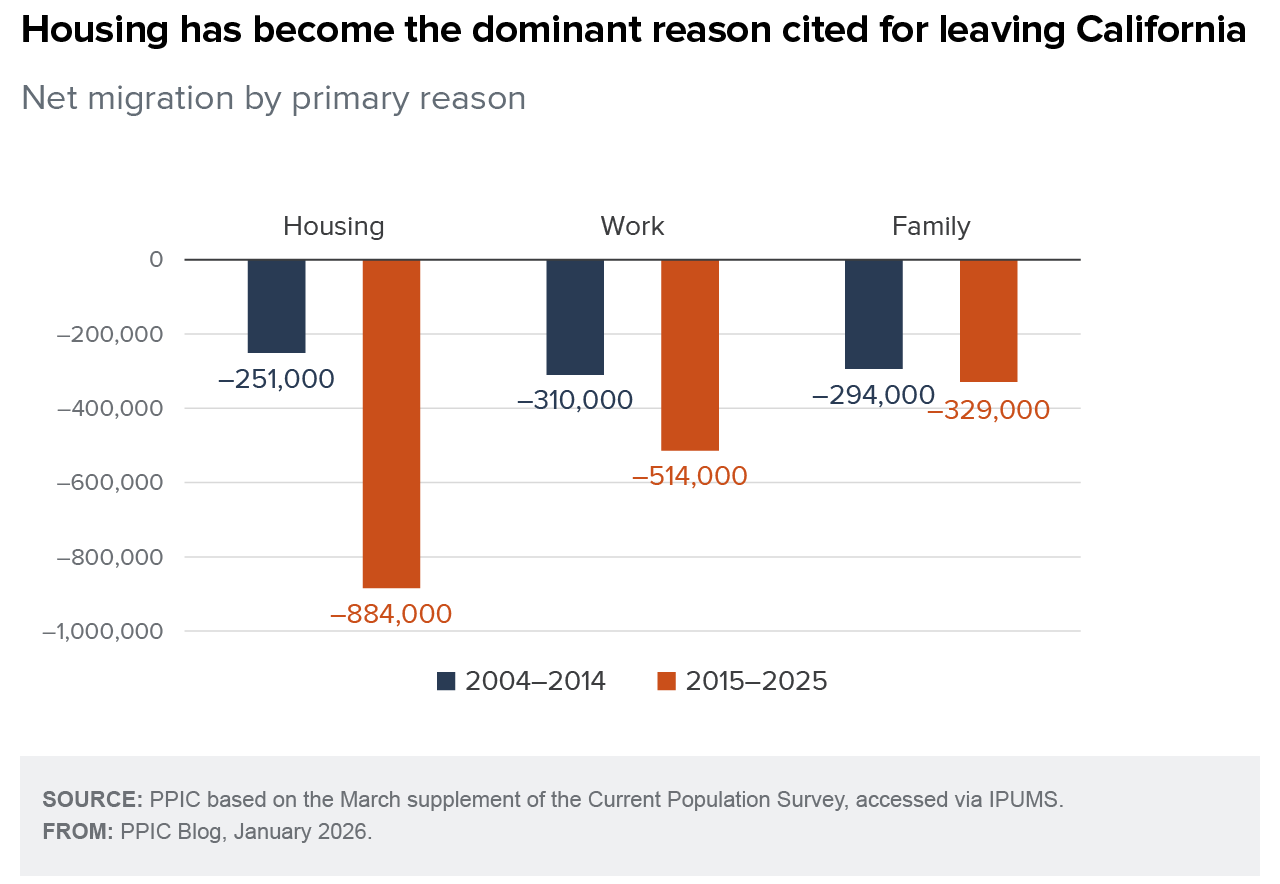
The picture painted by these trends illustrates the frustrations and economic challenges faced by many Californians. The state’s high cost of living, driven primarily by comparatively high housing costs, remains an ongoing public policy challenge—one that needs resolution if the state is to be a place of opportunity for all of its residents. At the same time, the most recent years of data suggest some recent positive changes.
Earlier versions of this post were published on May 6, 2021, March 28, 2022, March 21, 2023, February 7, 2024, and February 5, 2025.
Topics
future of work Housing Political Landscape Population remote workLearn More

Where Are Californians Going When They Leave the Golden State?

California’s Population

California’s Republican Exodus
As People Leave California, How Are Rental Prices Affected?
California’s Population Slowdown

What’s Behind California’s Recent Population Decline—and Why It Matters

Housing Costs Have Californians Considering an Interstate Move

California’s Plunging Birth Rates
