
Key Findings
Most Californians believe that the economy is the most important issue facing the state this year. The US economy’s job growth is slow and California has the highest unemployment rate in the nation. Many working Californians continue to struggle daily with the cost of living and housing affordability. The changing federal policy landscape has added to economic worries with executive actions, including tariffs, increased immigration enforcement, and federal downsizing. The rapid deployment of artificial intelligence is also raising concerns about current job security and future employment opportunities.
These are among the key findings of the Californians and Their Economic Well-Being survey that was conducted from October 16 to October 30:
 Californians have mixed opinions about the overall direction of the state, while most expect bad times financially for California during the next 12 months. Majorities describe themselves as somewhat satisfied with their own financial situation and expect their finances to be about the same a year from now. However, many lower-income Californians describe their financial situation as stressed or falling behind. Seven in ten adults say that the gap between the rich and the poor is getting larger in their part of California and that children growing up in California today will be financially worse off than their parents. Fifty-two percent approve of Governor Newsom and 27 percent approve of President Trump when it comes to their handling of jobs and the economy.
- Three in ten Californians, and half of lower-income residents, say that they or someone in their household has reduced meals or cut back on food to save money. About one in four adults say they worry every day or almost every day about housing costs and the amount of debt they have.
 About half of employed adults use artificial intelligence (AI) for work tasks, with use varying by age, education, income, and region. Half think that AI will decrease the number of jobs in their industry. One in three are concerned about losing their job or having hours cut due to AI.
- Most employed residents are very or somewhat satisfied with their job and report having stable hours, predictable pay at work, and at least a fair amount of job security. More than seven in ten employed residents report that their current job provides health care coverage, paid sick leave, and retirement savings. Majorities say that their current job provides opportunities for growth and advancement as well as education and training assistance; however, fewer than half of lower-income workers say these features are available at their job. Six in ten employed residents say that their current company or organization offers diversity, equity, and inclusion (DEI) training or meetings at work and think that it is a good thing for companies to adopt DEI programs.
- Seven in ten Californians approve of labor unions and think that labor unions are mostly a good thing for workers. Overwhelming majorities also agree that it is important for workers to organize so that employers do not take advantage of them. Eight in ten Californians, and majorities across partisan and income groups, agree that voting gives people like them some say in what the government does; similar shares say most elected officials don’t care what people like them think.
- Overwhelming majorities and majorities across partisan groups favor increasing government funding for job training programs so that workers have the skills needed for today’s jobs. Three in four Californians and majorities across income groups favor increasing funding so that child care programs are available for more lower-income working parents. Overwhelming majorities favor expanding eligibility and payments for the Earned Income Tax Credit for lower-income working families. Majorities are in favor of a minimum wage increase. Californians are divided on the government providing a universal basic income for all citizens, whether or not they work.
 About half of employed adults use artificial intelligence (AI) for work tasks, with use varying by age, education, income, and region. Half think that AI will decrease the number of jobs in their industry. One in three are concerned about losing their job or having hours cut due to AI.
Economic Conditions and Approval Ratings
Most Californians have a gloomy view of the economy, and many have expressed concerns about their financial situation in recent PPIC surveys. Today, the changing federal policy landscape and executive actions on federal spending, immigration enforcement, and tariffs add a layer of complexity for state and local governments’ fiscal policies and present new economic uncertainties for residents.
Californians have mixed views about the overall direction of the state, with 48 percent saying that things are generally going in the right direction and 51 percent saying that things are generally going in the wrong direction. But when asked about their economic outlook, 68 percent of adult residents expect bad times financially in California in the next 12 months. Fewer held these pessimistic views on the economy in our December 2024 survey (56%). Today, majorities of Democrats (60%), Republicans (87%), and independents (71%) are pessimistic. Majorities across income groups and state regions expect bad times financially in California during the next 12 months.

More than eight in ten adults view the availability of well-paying jobs in their part of California as a big problem (28%) or somewhat of a problem (58%). Californians are more likely to say that the availability of well-paying jobs is a big problem now than they were a year ago (20%). Today, African Americans (38%) are more likely than other racial/ethnic groups to see the availability of well-paying jobs in their region as a big problem (29% Latinos, 27% Asian Americans, 26% whites), and the share holding this view declines with age, education, and income.
One in four Californians say that the lack of well-paying jobs has made them seriously consider moving away from the part of California they live in now, with most (21%) saying they would prefer to relocate outside the state (4% in state). The results on moving preferences were similar last year (21% out of state, 5% in state). Today, Inland Empire residents (30% out of state, 4% in state) are the most likely and San Francisco Bay Area residents are the least likely (16% out of state, 3% in state) across regions to say they are seriously considering moving because of the lack of well-paying jobs in their part of the state.
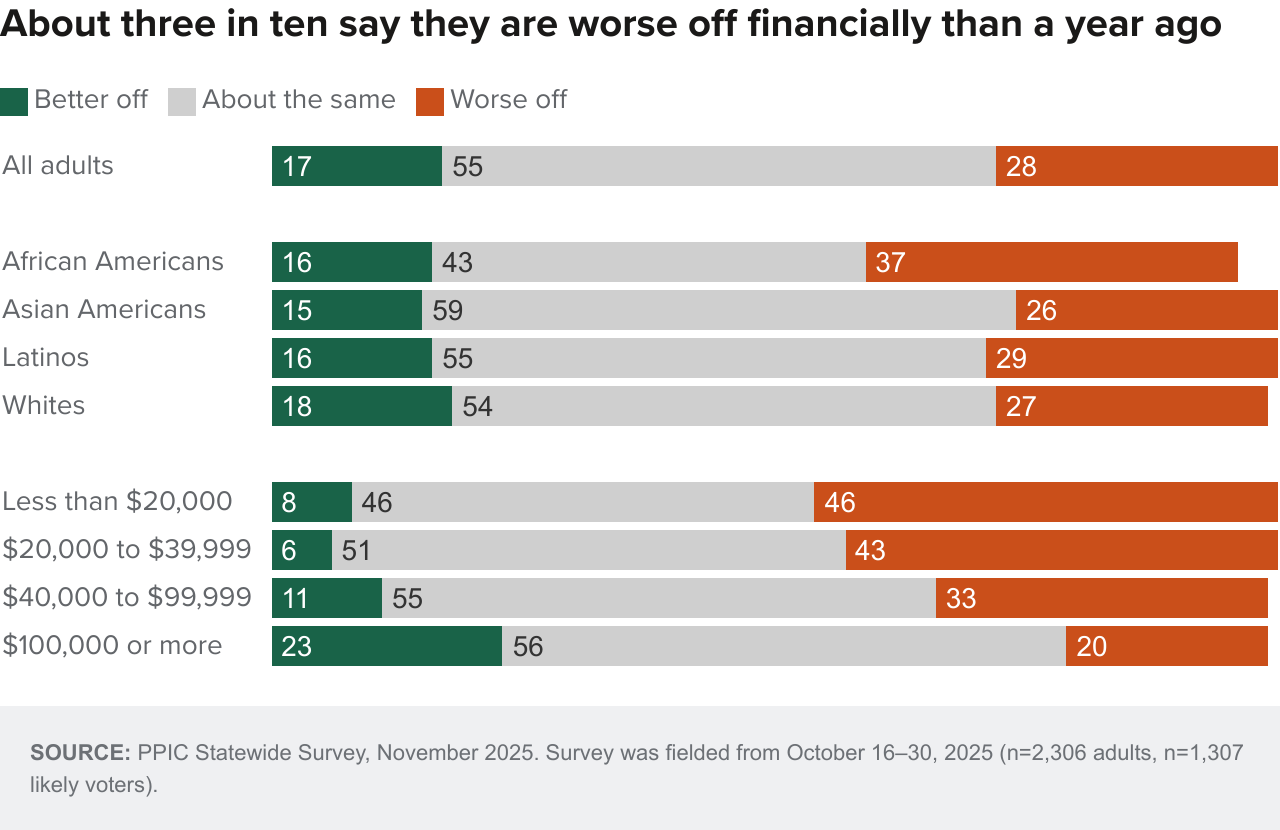
How are Californians assessing their own financial situation? About three in ten adults think they are worse off financially than a year ago; 55 percent say they are about the same, and 17 percent think they are better off financially. Perceptions of current finances were similar in the December 2024 survey. Today, those earning under $20,000 a year are more likely than those earning $100,000 or more to say they are worse off today than a year ago (46% to 20%) and less likely to say they are better off today (8% to 23%). Looking ahead, 19 percent of adults expect that they will be better off a year from now, 25 percent think they will be worse off, and 55 percent think they will be about the same. In the December 2024 survey, more adults expected to be better off a year from now (27%).
Three in four Californians say they are very (20%) or somewhat (54%) satisfied with their financial situation, while one in four are not satisfied (26%). A similar share said they were not satisfied a year ago (25%). Today, pluralities are somewhat satisfied with their financial situation across regions and across age, education, gender, and partisan groups. Half of African Americans and half of adults with household incomes of less than $40,000 say they are not satisfied with their financial situation.
Eight in ten Californians categorize their financial situation as “comfortable, with no major worries” (38%) or “adequate, getting by but not by much” (43%), while about one in five consider their current situation to be “stressed, can barely afford the basics” (14%) or “falling behind, cannot keep up with bills or afford the basics” (5%). One in five adults say it would be very difficult (11%) or nearly impossible (8%) to pay for a $1,000 emergency expense. Those earning under $40,000 a year are much more likely than others to describe their current financial situation as “stressed” or “falling behind” (43%) and to say that it would be very difficult or nearly impossible to pay a $1,000 emergency expense (46%).
In terms of their broader economic outlook, three in ten adults (29%) believe the “American Dream”—if you work hard, you’ll get ahead—still holds true (58% once held true, not anymore; 13% never held true). Majorities think the American dream is harder to achieve in California (56%) than elsewhere. Seven in ten believe that when children in California today grow up, they will be financially worse off than their parents (71%). Seven in ten think that the gap between the rich and the poor is getting larger in their part of California (72%).
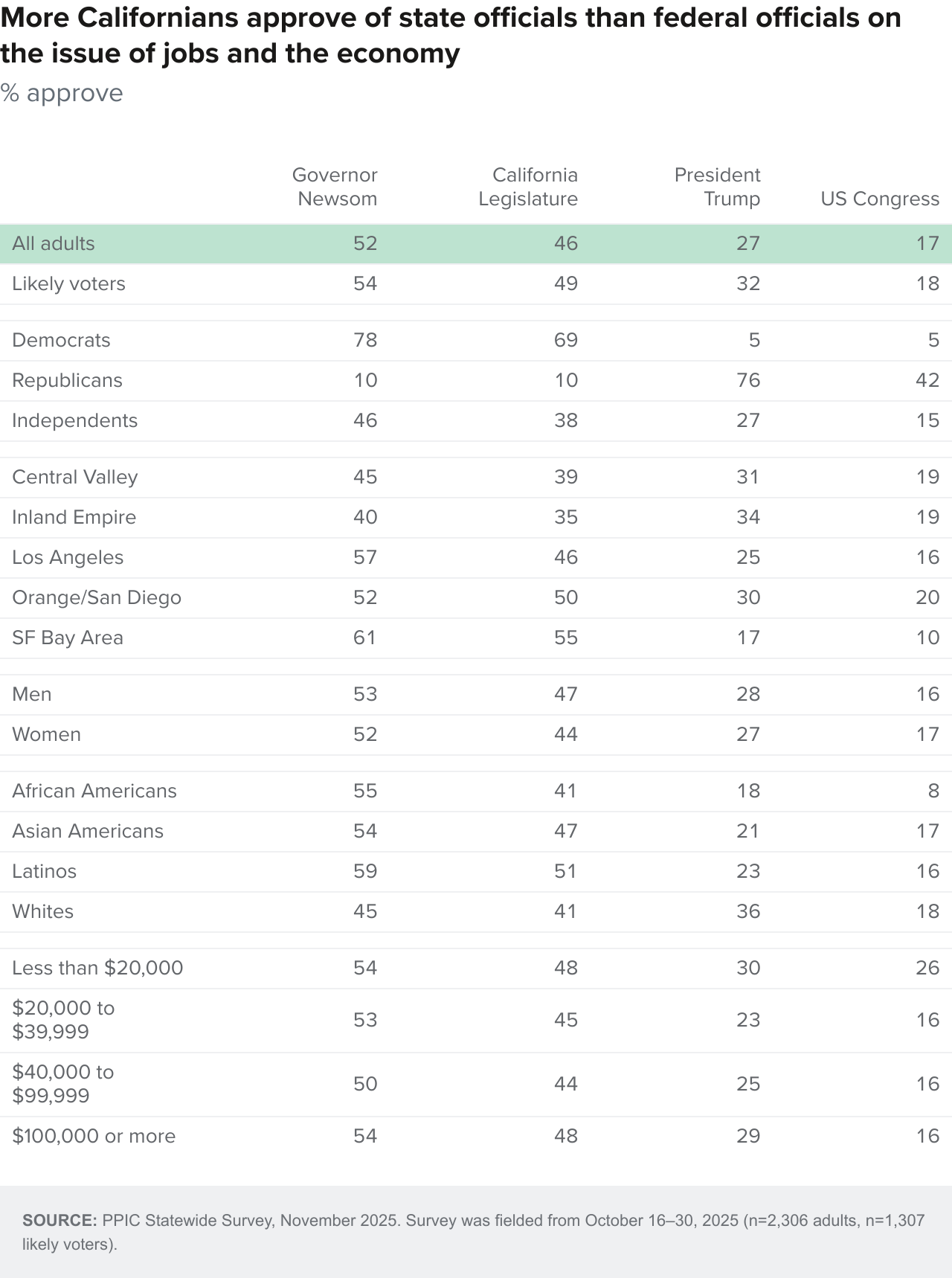
In the current political context, how are Californians feeling about the way their state and federal elected officials are handling jobs and the economy? At the state level, 52 percent of California adults approve of Governor Gavin Newsom and 46 percent approve of the state legislature for their handling of jobs and the economy. At the federal level, 27 percent of California adults approve of President Donald Trump and 17 percent approve of the US Congress for their handling of jobs and the economy. Partisans are deeply divided in their approval of the governor, legislature, and the president, while majorities disapprove of Congress for their handling of jobs and the economy. Majorities believe they can trust their state (53%) and the federal government (77%) to do what is right “only some of the time” when it comes to handling jobs and the economy.
Economic Insecurities and Worries
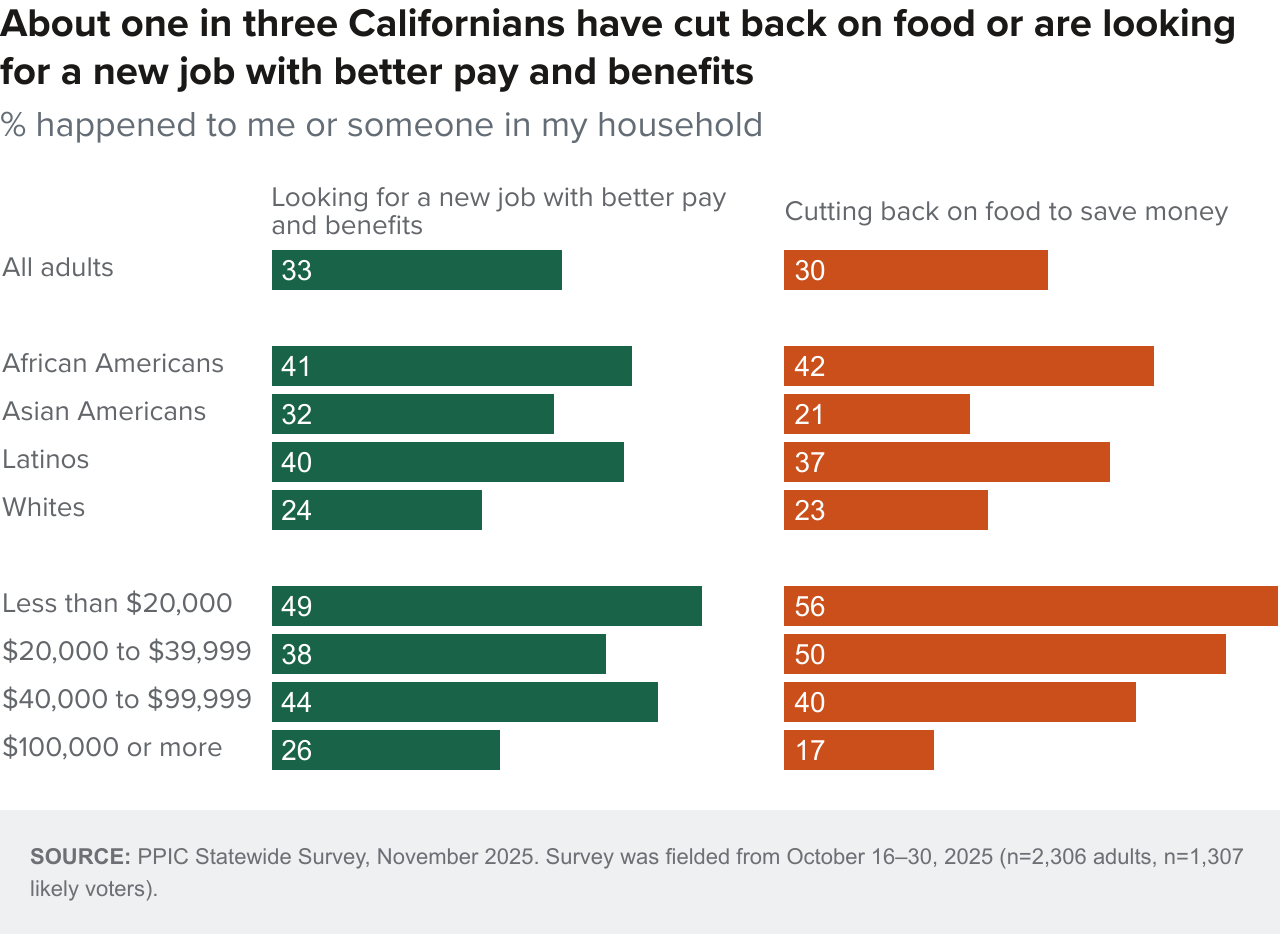
Amid rising prices and growing pessimism about California’s economy, we asked residents about several financial difficulties, experiences, and worries their households may have faced over the past year. One in three Californians say they have been searching for a new job with better pay and benefits. Three in ten report having to cut back on food to save money. More than two in ten say they have experienced reduced hours or pay (23%), put off receiving medical care (22%), or been unable to pay a monthly bill (21%). Two in ten or fewer report having difficulty paying rent or a mortgage (20%), working a second job to cover monthly bills (18%), receiving food stamps (17%), or losing their job (17%). These findings are similar to results from a year ago (aside from job seeking and holding a second job, which were new questions added this year).
The prevalence of financial difficulties generally declines as household income increases, with the exception of residents looking for a job with better pay and benefits. One in three or more Californians earning under $40,000 report experiencing most of these challenges (25% report working a second job). Among those earning less than $40,000, about half say they have had to cut back on food (52%) or have received food stamps (51%). Furthermore, about half of residents earning less than $20,000 report being unable to pay a monthly bill. In contrast, among households making $100,000 or more, one in ten or fewer report receiving food stamps (6%), being unable to pay a monthly bill (8%), having difficulty paying for housing (9%), working a second job (11%), or losing their job (11%).
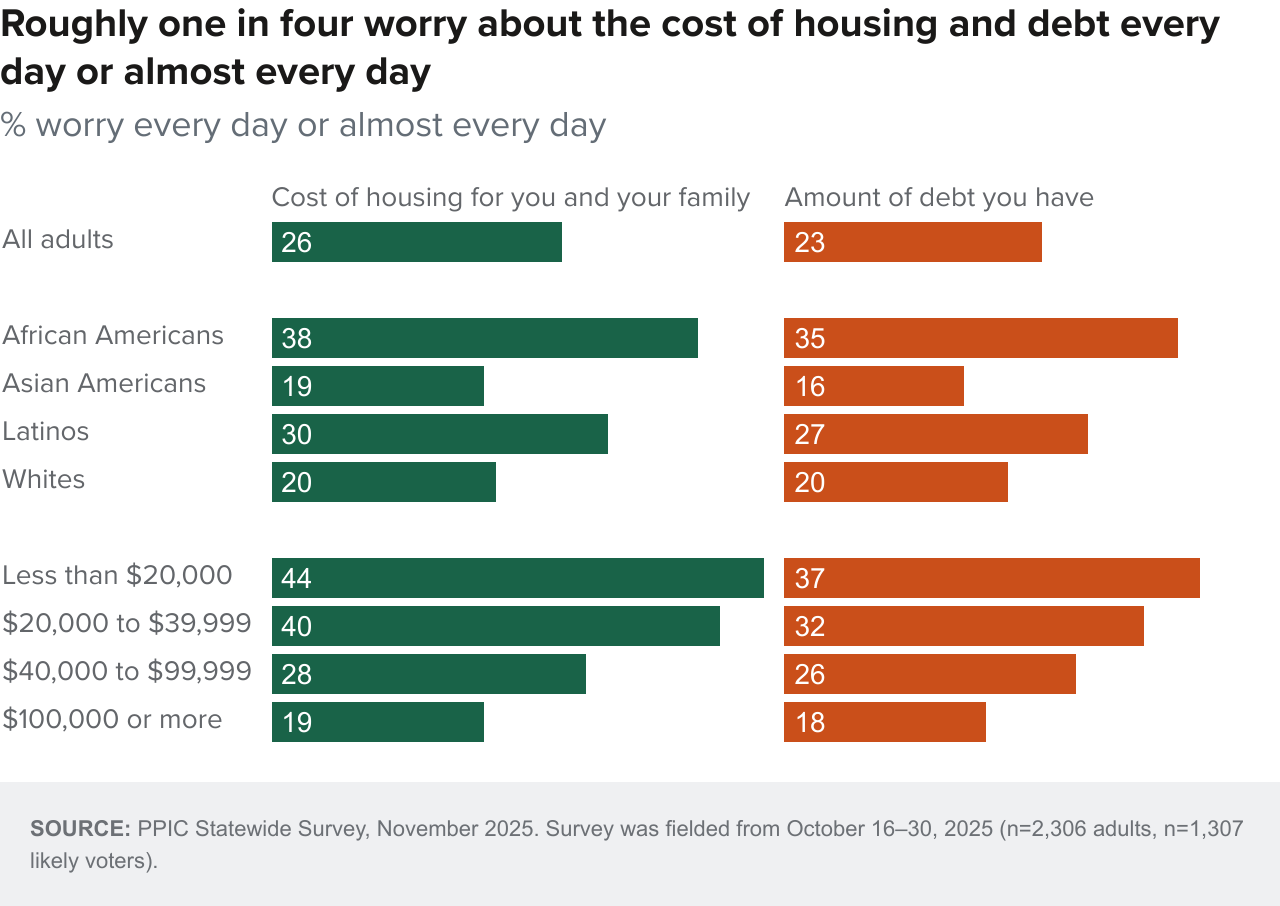
About a quarter of Californians say they worry every day or almost every day about housing costs for themselves and their families, as well as about the amount of debt they carry. These shares are similar to last year’s findings. Currently, about two in ten Californians worry often about paying their bills, while somewhat fewer worry about being able to afford an unexpected medical expense (16%) or losing their job (14%). African Americans and Latinos are generally more likely than Asian Americans and whites to express frequent worry about all these financial concerns. Overall, the frequency of worry declines as income rises.
More than four in ten lower-income residents report worrying every day or almost every day about housing costs, compared to about two in ten among those making $100,000 or more. Renters (40%) are more than twice as likely as homeowners (17%) to worry about housing costs at least almost every day. Inland Empire residents (32%) are more likely than residents in other major regions to worry often about housing costs.
Among parents of children 18 or under, nearly two in ten (18%) say they worry very often about the cost of child care. Younger parents (ages 18–34) are far more likely (31%) to worry about this daily or almost daily than parents ages 35–54 (15%). Men (21%) are also slightly more likely than women (16%) to express frequent concern about child care costs.
In recent years, the economic and personal consequences of artificial intelligence (AI) have drawn considerable attention. Overall, 14 percent of employed Californians say they use AI to complete work tasks at least once a day, while about one in ten (9%) use it several times a week, one in four (25%) use it less often, and about half (52%) say they never use it. Across regions, employees in the San Francisco Bay Area (57%) are the most likely to report using AI at work, while those in the Central Valley are the least likely (40%). AI use at work increases with education and income while declining with age. Nearly half of employed Californians (49%) believe AI will decrease the number of jobs available in their industry, while one in ten think it will increase jobs, and four in ten expect no effect. African Americans (61%), Los Angeles residents (56%), those with more than a high school education (54%), and adults ages 18–54 (50%) are among the most likely to believe AI will reduce job opportunities. This perception varies across income groups.
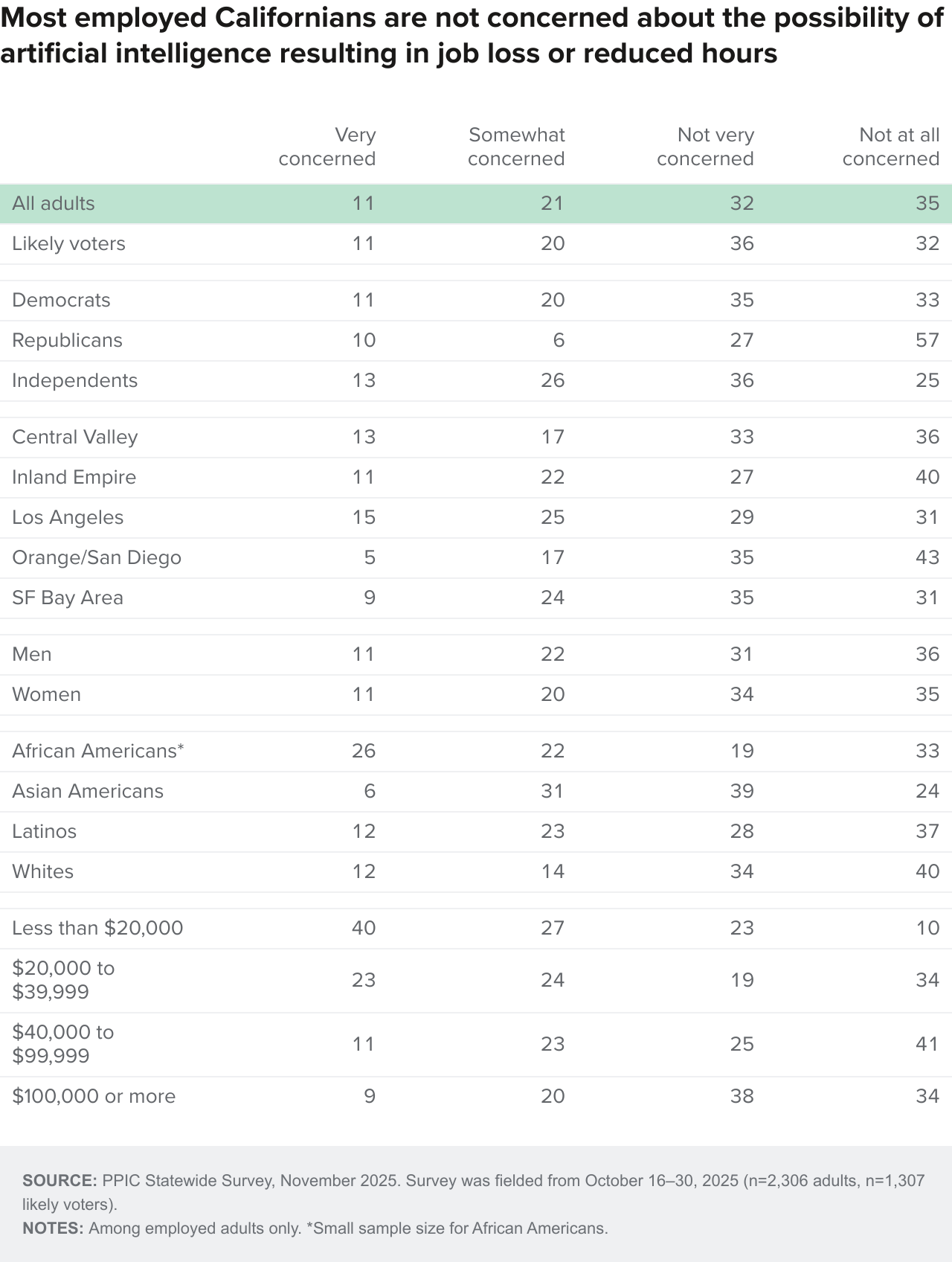
About one in three employed Californians are very (11%) or somewhat (21%) concerned that AI could cause them to lose their job or have their hours reduced. Employed residents in Los Angeles (40%) are more likely than those elsewhere to express this concern, while residents in Orange County and San Diego (22%) are the least likely to hold this view. Across racial/ethnic groups, nearly half of African Americans (48%) express concern about losing their job or hours due to AI, compared to smaller shares of Asian Americans (37%), Latinos (35%), and whites (26%). Levels of concern are generally similar across other demographic groups. Across income groups, two in three Californians earning less than $20,000 express concern over AI-related job loss, compared to about three in ten of those earning $100,000 or more.
Job Conditions and Worker Power
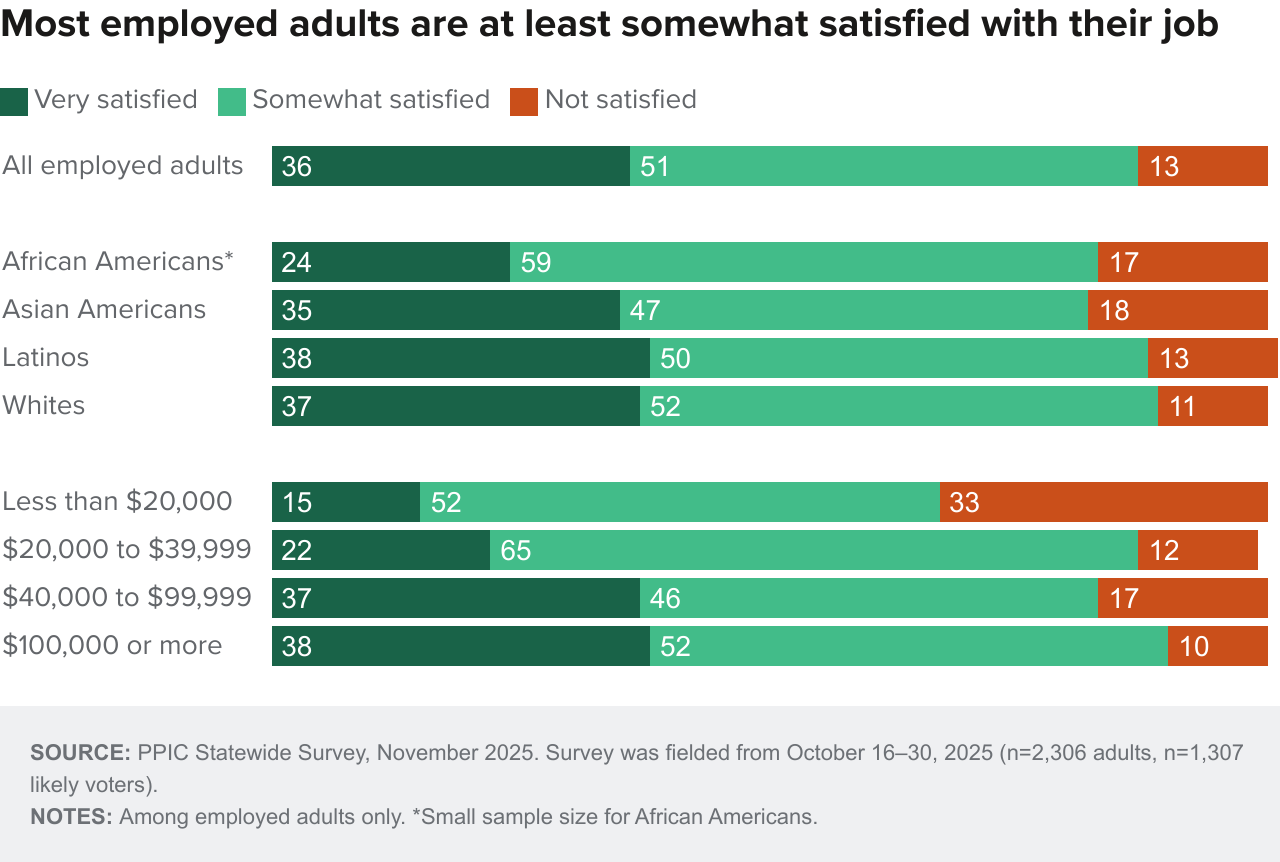
Most employed adults across California are very or somewhat satisfied with their job, including most full- and part-time employed adults. The overall share is similar to a year ago. Today, African Americans, adults earning less than $40,000, and adults with only some college education (28%) are the least likely across demographic groups to say they are very satisfied. The share saying they are very satisfied rises as age and income increases. Across regions, workers in the Inland Empire (46%) are the most likely to say they are very satisfied with their job.
Overwhelming majorities of employed Californians say their job offers stable pay (88%), predictable work hours (83%), paid sick leave (82%), health care coverage (78%), and retirement savings (75%). Employed adults who work part time or have incomes under $40,000 are among the least likely across demographic groups to say their job has these features.
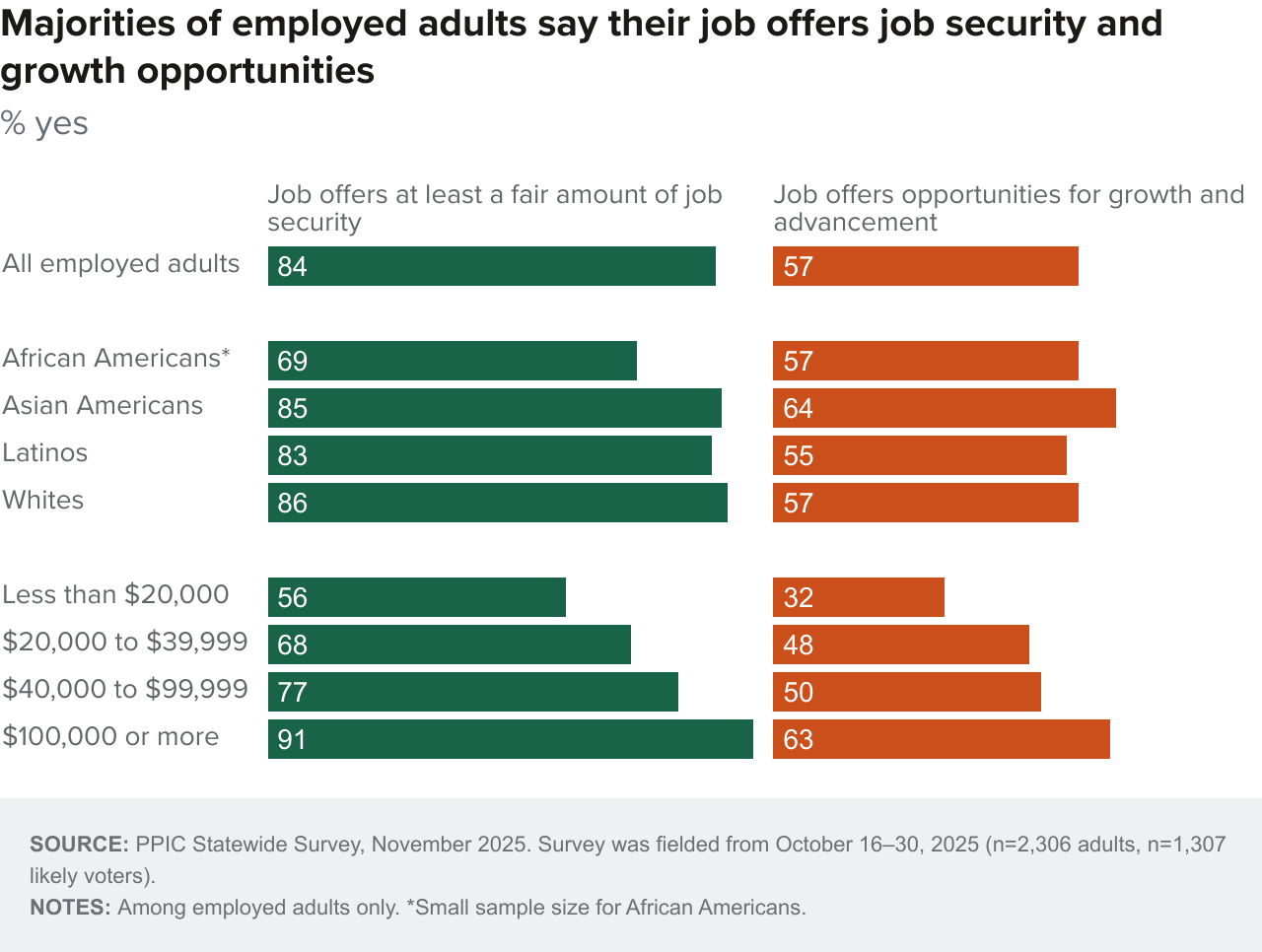
Over eight in ten employed adults say their job has at least a fair amount of job security, including most adults who are employed full time (88%) and part time (70%). A majority of employed adults (57%) say their job provides opportunities for growth and advancement, with full-time employed adults (62%) more likely to say this than those who have part-time jobs (40%). A majority of employed adults (58%) also say their current job provides educational or training assistance, with a similar disparity between full-time (64%) and part-time employed adults (36%). Majorities across racial/ethnic groups say their workplace provides job security, opportunities for growth, or training assistance. Shares saying their workplace provides these features increase as incomes rise.
When it comes to voicing concerns in the workplace, about seven in ten employed adults (72%) say they can speak up without fear of negative consequences; about a quarter (27%) say they cannot. And most (63%) say that decisions at work take into account their views and concerns; nearly four in ten (37%) say their workplace does not take their views and concerns into account.
Six in ten employed adults (61%) say that their current company or organization offers diversity, equity, and inclusion (DEI) training or meetings at work. Majorities across parties, regions, and demographic groups hold this view. When asked if they think that it is a good thing for companies to adopt DEI programs, 64 percent of Californians say it is a good thing. Most Democrats (87%) and independents (64%) say this, compared to just one in four Republicans (24%). Majorities across regions and demographic groups say these DEI programs are a good thing.
Overwhelming majorities of adults (70%) and likely voters (72%) approve of labor unions; a quarter disapprove (28% adults, 27% likely voters). The shares approving are the same as a year ago, and seven in ten have supported labor unions since PPIC began asking this question in 2023. Most approve across demographic, partisan, and regional groups, with the exception of Republicans (48%). Three in four adults (74%) and likely voters (75%) say labor unions are mostly a good thing for workers; majorities across partisan, demographic, and regional groups say this. Three in ten employed adults (31%) say their workplace offers membership or affiliation with a union, occupation association, worker center, or other type of group that represents workers. A similar share of California workers say they or a family member are in a union (30%; 31% full-time workers, 26% part-time workers).
Most Californians at least somewhat agree that it is important for workers to organize so that employers do not take advantage of them (44% completely agree, 39% somewhat agree). The share saying they completely agree varies across regions and demographic groups, and declines with rising age. When it comes to the idea that voting gives people like them a say in what the government does, most adults completely (34%) or somewhat (47%) agree, with three in ten or more across demographic and regional groups saying they completely agree.
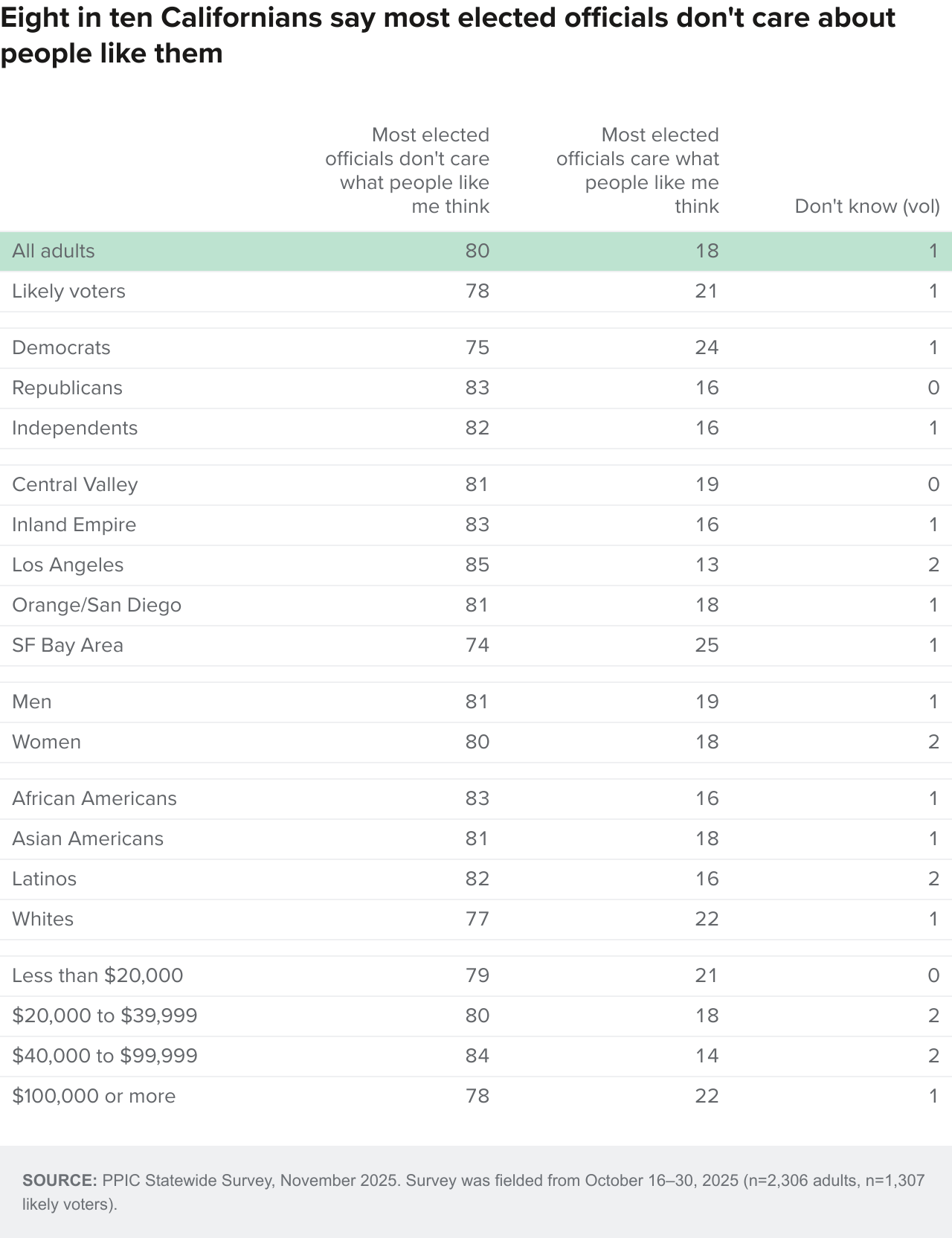
Californians are pessimistic about elected officials taking into account the opinions of their constituents. Eight in ten adults and likely voters say that elected officials don’t care what people like them think; about two in ten say most elected officials do care (18% adults, 21% likely voters). The pessimistic view is shared widely across demographic and regional groups, and the share saying most elected officials do not care declines with rising age and education.
Worker Policies
When asked about ways to improve the economic well-being of Californians, there is overwhelming support for a variety of policies. Nearly eight in ten Californians (79%) and likely voters (77%) are in favor of the government offering a health insurance plan, similar to Medicare, that Americans can choose to purchase instead of private insurance. More than three in four Californians have been in favor of this policy since our first Californians and Their Economic Well-Being survey in 2020. There is bipartisan support for a government-offered public health care option, with nine in ten Democrats (91%), eight in ten independents (81%), and half of Republicans (53%) in favor. More than seven in ten across regions and demographic groups favor a public health care option.
Nearly eight in ten adults and likely voters (78% each) are in favor of increasing government funding for job training programs. About eight in ten Californians have supported this policy each of the six times we have asked this question since 2020. Increased spending on job training continues to see bipartisan support, with nine in ten Democrats (89%), eight in ten independents (79%), and six in ten Republicans (59%) in favor. Support is widespread, with seven in ten or more across regions and demographic groups supporting this policy.

More than seven in ten adults and likely voters (73% each) support increasing government funding for child care programs. About three in four Californians have supported this policy since we first asked this question in 2020. Nine in ten Democrats (89%) and three in four independents (74%) support increased funding for child care programs, compared to fewer than half of Republicans (44%). Support is highest in the San Francisco Bay Area (82%), followed by Los Angeles and Orange/San Diego (75% each), the Central Valley (70%), and the Inland Empire (65%). Two in three or more across demographic groups are in favor; support declines with increasing household income. Support is similar among those with (74%) and without (73%) children 18 or under in the house.
About seven in ten adults (72%) and likely voters (70%) support expanding the Earned Income Tax Credit (EITC) for lower-income families. Overwhelming shares of Californians have supported this policy since we first asked this question in December 2020. Most Democrats (85%) and independents (70%) are in favor, while Republicans are divided (49% favor, 50% oppose). About two in three or more across regions and demographic groups support expanding the EITC.

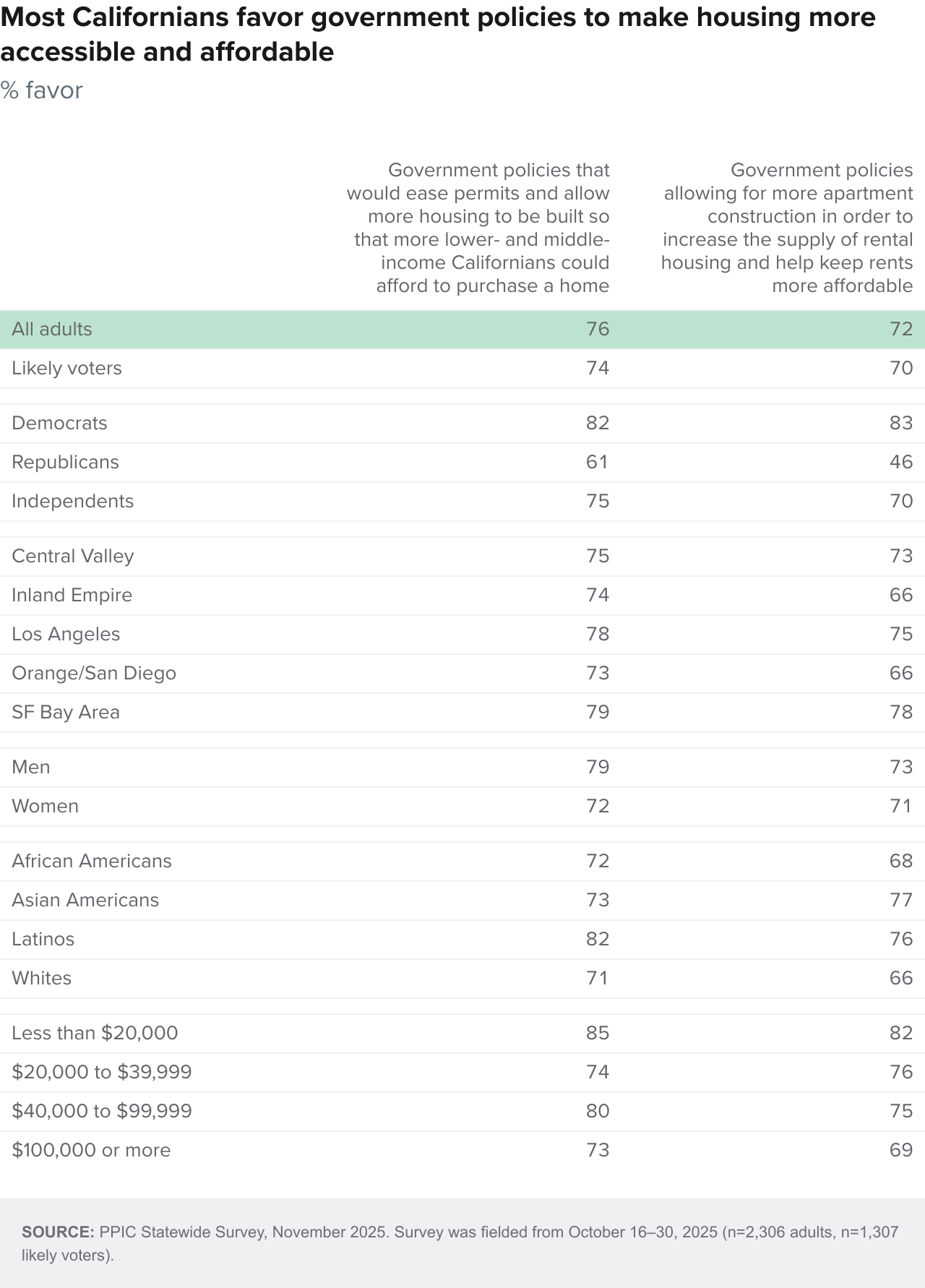
Housing costs and availability have been a top issue for Californians for many years. When asked about government policies that would ease permitting and allow more housing to be built so that more lower- and middle-income Californians could afford to purchase a home, three in four adults (76%) and likely voters (74%) are in favor. Support was similar among adults the only other time we asked this question in November 2022 (73%). There is bipartisan support for this policy, with six in ten or more across parties in favor. Seven in ten or more across regions and demographic groups support this policy. Notably, renters (83%) are more likely than homeowners (72%) to be in favor.
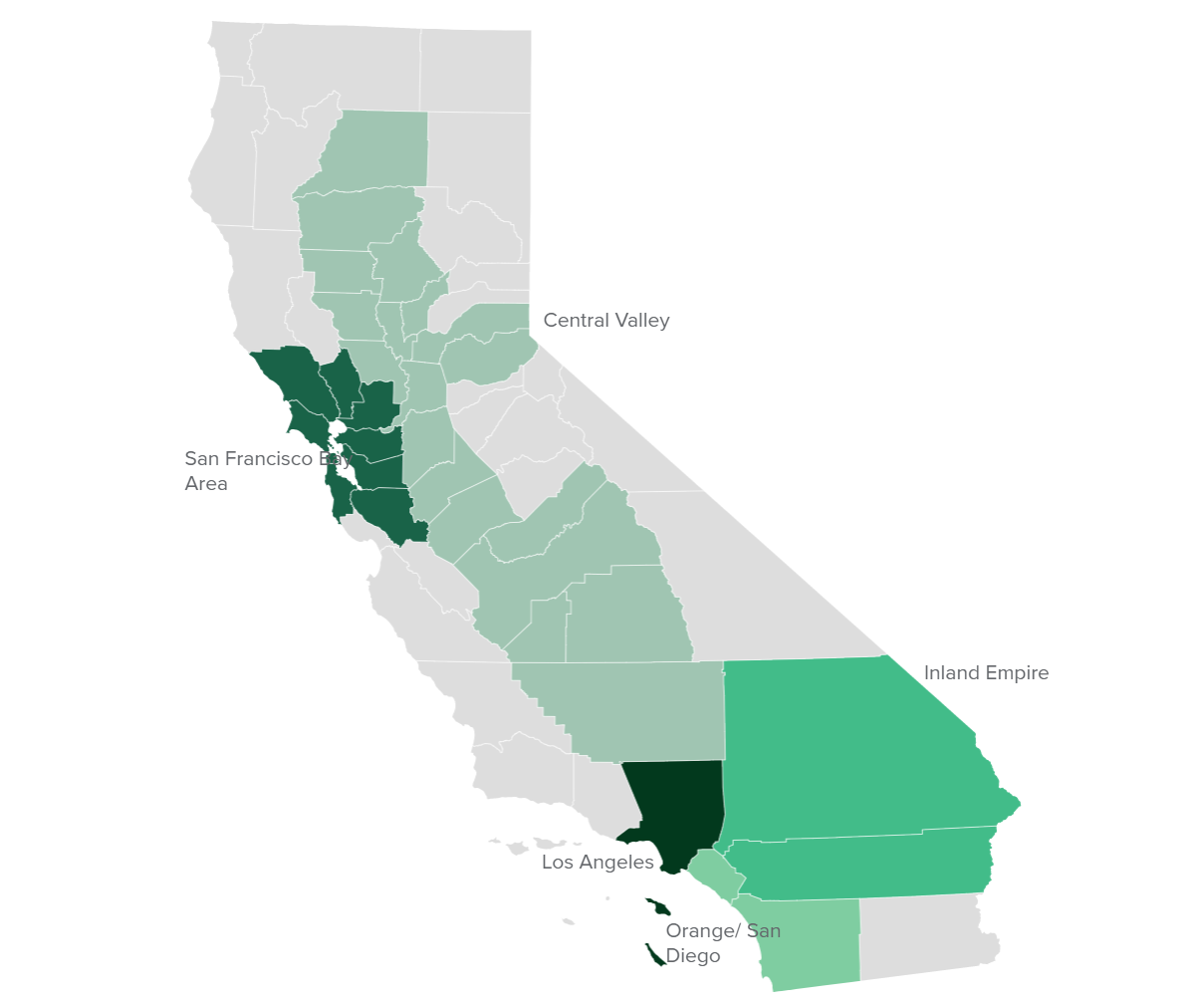
There is also overwhelming support among adults (72%) and likely voters (70%) for government policies allowing for more apartment construction to increase the supply of rental housing and help keep rents more affordable. Democrats (83%) and independents (70%) are more likely than Republicans (46%) to favor this policy. About three in four voters in the San Francisco Bay Area, Los Angeles, and the Central Valley are in favor, while two in three in the Inland Empire and Orange/San Diego hold this view. Six in ten or more across demographic groups favor more apartment construction to increase supply and help keep rents more affordable.
Two in three Californians (67%) and likely voters (64%) support increasing the current minimum wage from $16.50 per hour to $17 on January 1, 2026, and to $18 on January 1, 2027. Majorities of Democrats (84%) and independents (59%) are in favor, while fewer than four in ten Republicans (36%) hold this view. There is majority support across regions and demographic groups for raising the minimum wage.
When asked about a “universal basic income” of $1,000 for all adult citizens, fewer than half of adults (46%) and likely voters (40%) are in favor. Support for this policy reaches a majority among Democrats (58%), Los Angeles residents (54%), African Americans (65%), Latinos (56%), those ages 18–54 (53%), those making less than $40,000 (63%), and those with at most a high school education (52%).
Topics
Economic Growth Economic Mobility Economic Trends Economy Health & Safety Net Jobs and Employment Political Landscape Population Statewide Survey Workforce and TrainingLearn More

Concern over Health Care Affordability Is Widespread

California’s Legislative Analyst Talks Shop about a Tough State Budget

Work and Economic Insecurity in California

Californians’ Economic Outlook? Gloomy