
Key Findings
The economic well-being of Americans was a key issue in the presidential election. National economic indicators pointed to steady employment growth and lower inflation rates in 2024, but many voters were unhappy with the status quo. For Californians, the outcome of the election raises questions about the potential impact of the next president and Congress on economic conditions—and their jobs and financial situations. While financial markets are signaling optimism, many working Californians continue to struggle with relatively low wages, given the state’s high cost of living.
These are among the key findings of the Californians and Their Economic Well-Being survey that was conducted from November 6 to November 22:
 Fifty-two percent say that “getting costs and inflation under control” and 45 percent say that “building an economy that gives every American a chance to succeed” should be very high economic priorities for the next president. A majority of Californians are expecting bad times for the state economy in the next 12 months. Most residents are “somewhat” satisfied with their own finances, while almost half of lower-income residents are not satisfied. One in three believe that the “American Dream” of working hard and getting ahead still holds true, while seven in ten say that children growing up in California today will be financially worse off than their parents.
- Twenty-nine percent of Californians, and half of lower-income adults, say they or someone in their household has cut back on food to save money. Twenty-six percent of residents, and about four in ten lower-income adults, worry every day or almost every day about their cost of housing.
 Fifty-two percent of Californians have an unfavorable opinion of artificial intelligence (AI), and part-time employees have the most unfavorable views. Half of employed adults think that AI will decrease the number of jobs in their industry. One in three workers express concerns about AI resulting in their jobs or their hours being cut, including four in ten of those with lower incomes.
- Most employed residents say they are at least somewhat satisfied with their jobs; younger and lower-income workers are less likely than others to be very satisfied. Sixty-one percent say their job offers opportunities for growth and advancement, and 56 percent say it offers education and training assistance; however, fewer than half of lower-income workers have jobs that offer these opportunities. Sixty-six percent of employed adults say that the company or organization they work for offers diversity, equity, and inclusion (DEI) training or meetings. Sixty-three percent of Californians think that it is a good thing for companies to have DEI programs.
- Seven in ten Californians approve of labor unions, including majorities across partisan and income groups. One in three residents would like to see labor unions have more influence than they have today; partisans are divided. About eight in ten residents agree that it is important for workers to organize so that employers do not take advantage of them, and that voting gives people like themselves some say in what government does. Most Californians agree that the wealthy and the poor should have an equal amount of influence on government policymaking.
 Seventy-six percent of Californians favor increasing government funding so that child care programs are available for more lower-income working parents. Overwhelming majorities also favor increasing government funding for job training programs so that more workers can gain the skills they need for today’s jobs. Three in four favor the government expanding eligibility for and increasing the Earned Income Tax Credit for lower-income working families and individuals. Partisans are divided on policies that would make two-year and four-year college tuition free, eliminate college debt, and give first-time home buyers $25,000 to put toward a down payment.
 Fifty-two percent of Californians have an unfavorable opinion of artificial intelligence (AI), and part-time employees have the most unfavorable views. Half of employed adults think that AI will decrease the number of jobs in their industry. One in three workers express concerns about AI resulting in their jobs or their hours being cut, including four in ten of those with lower incomes.
 Seventy-six percent of Californians favor increasing government funding so that child care programs are available for more lower-income working parents. Overwhelming majorities also favor increasing government funding for job training programs so that more workers can gain the skills they need for today’s jobs. Three in four favor the government expanding eligibility for and increasing the Earned Income Tax Credit for lower-income working families and individuals. Partisans are divided on policies that would make two-year and four-year college tuition free, eliminate college debt, and give first-time home buyers $25,000 to put toward a down payment.
Economic Conditions
The economy was the top issue in our pre-election polling. With the election in the rearview mirror, how are Californians thinking about the economic priorities of the next president? Fifty-two percent of adult residents say that “getting costs and inflation under control” and 45 percent say that “building an economy that gives every American a chance to succeed” should be “very high” economic priorities for the next president. Overwhelming majorities across partisan and income groups and regions of the state believe that the two economic goals should be “very high or high” priorities of the next president.
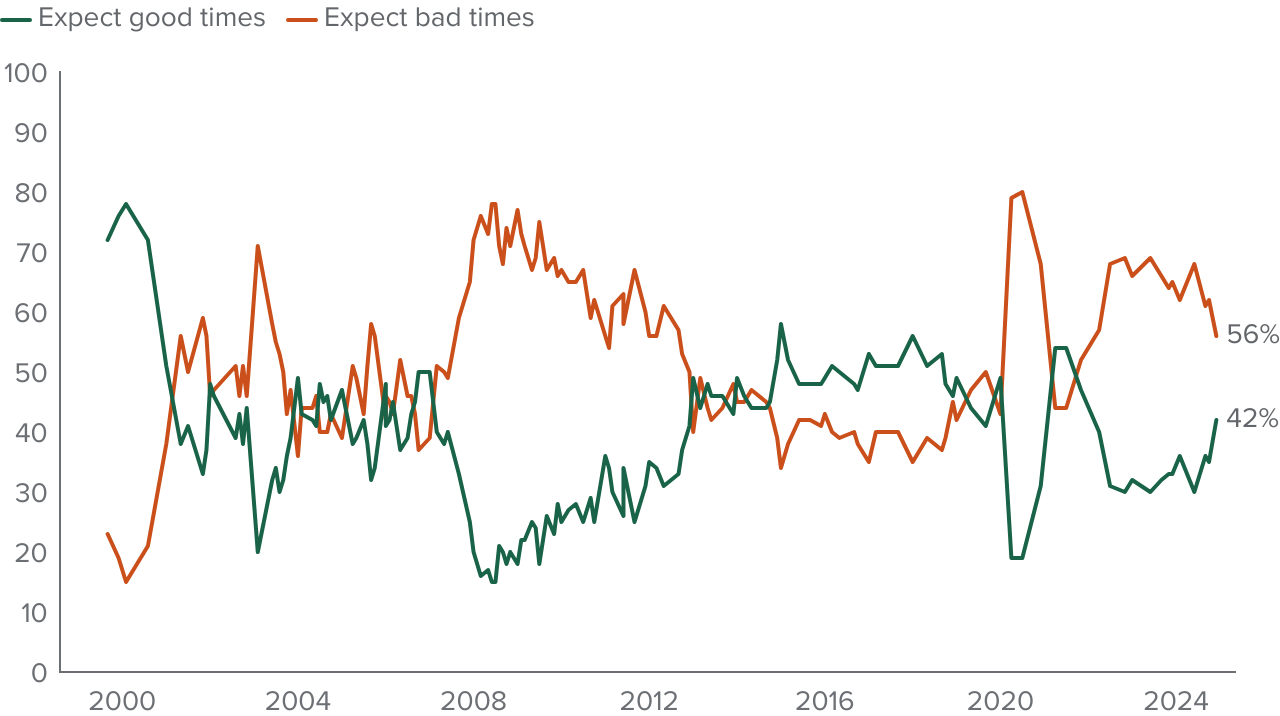
Over the next 12 months, 56 percent of adult residents expect bad times financially in California. Sixty-two percent expected bad times in our October survey. Today, solid majorities of Republicans (60%) and independents (65%) are pessimistic, compared to 47 percent of Democrats. And majorities across income groups and state regions expect bad times financially in the next 12 months.
Most Californians expect bad economic times in the next year
SOURCES: PPIC Statewide Surveys 1999–2024.
When asked about the availability of well-paying jobs in their part of California, more than eight in ten view this as a big problem (20%) or somewhat of a problem (64%). The availability of well-paying jobs is more likely to be perceived as a big problem for those with household incomes under $40,000 (28%) than for those with household incomes of $80,000 or more (18%), and for those with a high school education or less (21%) or some college education (24%) than for college graduates (16%). Orange/San Diego (12%) and San Francisco Bay Area (15%) residents are less likely than Los Angeles (20%), Central Valley (22%), or Inland Empire (27%) residents to say this is a big problem in their region.
Twenty-six percent of adults say the lack of well-paying jobs has made them consider moving away from the part of California they live in now (note: 21% say they would move outside of the state). Thirty-nine percent of adults with children in their household, 31 percent of renters, and 30 percent of 18-to-34-year-olds have considered moving from their part of California for this reason.
In terms of their personal financial situation today, 52 percent say that it is about the same as a year ago, while three in ten say they are worse off and one in five are better off than they were a year ago. Those earning under $40,000 a year are much more likely than those with household incomes of $80,000 or more to say they are worse off today than a year ago (40% to 25%). Republicans (47%) are more likely than Democrats (17%) and independents (31%) to say they are financially worse off today.
Three in four Californians say they are very (18%) or somewhat (57%) satisfied with their financial situation, while one in four are not satisfied (25%). Satisfaction with personal finances was similar a year ago. Today, about half or more across demographic groups and regions are at least somewhat satisfied with their financial situation. Republicans (29%) and independents (25%) are somewhat more likely than Democrats (18%) to say they are not satisfied. Renters are more likely than homeowners to say they are not satisfied (32% to 20%). Half of adults with annual incomes under $20,000 are not satisfied with their financial situation, compared to 18 percent of those making $80,000 or more.
Most Californians are satisfied with their personal finances although relatively few are very satisfied

SOURCE: PPIC Statewide Survey, December 2024. Survey was fielded from November 6–22, 2024 (n=2,344 adults, n=1,449 likely voters).
How many Californians are struggling financially? Based on their current financial situation, about one in five adults say it would be very difficult (11%) or nearly impossible (8%) to pay for a $1,000 emergency expense. About half of lower-income residents, three in ten renters, and one in four younger adults say that paying for this emergency expense would be very difficult or nearly impossible.
Looking a year ahead at their personal financial situation, 52 percent expect it to be the same as they are today, while 21 percent expect to be worse off, and 27 percent expect to be better off than they are today. Republicans (37%) are more likely than Democrats (25%) and independents (24%) to say they will be financially better off a year from now than they are today. Adults ages 18 to 34 are more likely than those 55 and older to think they will be financially better off (33% to 20%). Those earning under $40,000 a year are more likely than those with household incomes of $80,000 or more to say they will be worse off a year from now than they are today (30% to 18%).
Only one in three Californians think that the American Dream—the notion that if you work hard, you’ll get ahead—holds true. About half or more across partisan and demographic groups and state regions think the American Dream once held true, while 15 percent think it never held true. Just 25 percent of 18-to-34-year-olds and 26 percent of renters think that the American Dream still holds true. In addition, six in ten adults and majorities across partisan and income groups and state regions think the American Dream is harder to achieve in California than elsewhere in the US (12% easier, 26% same).
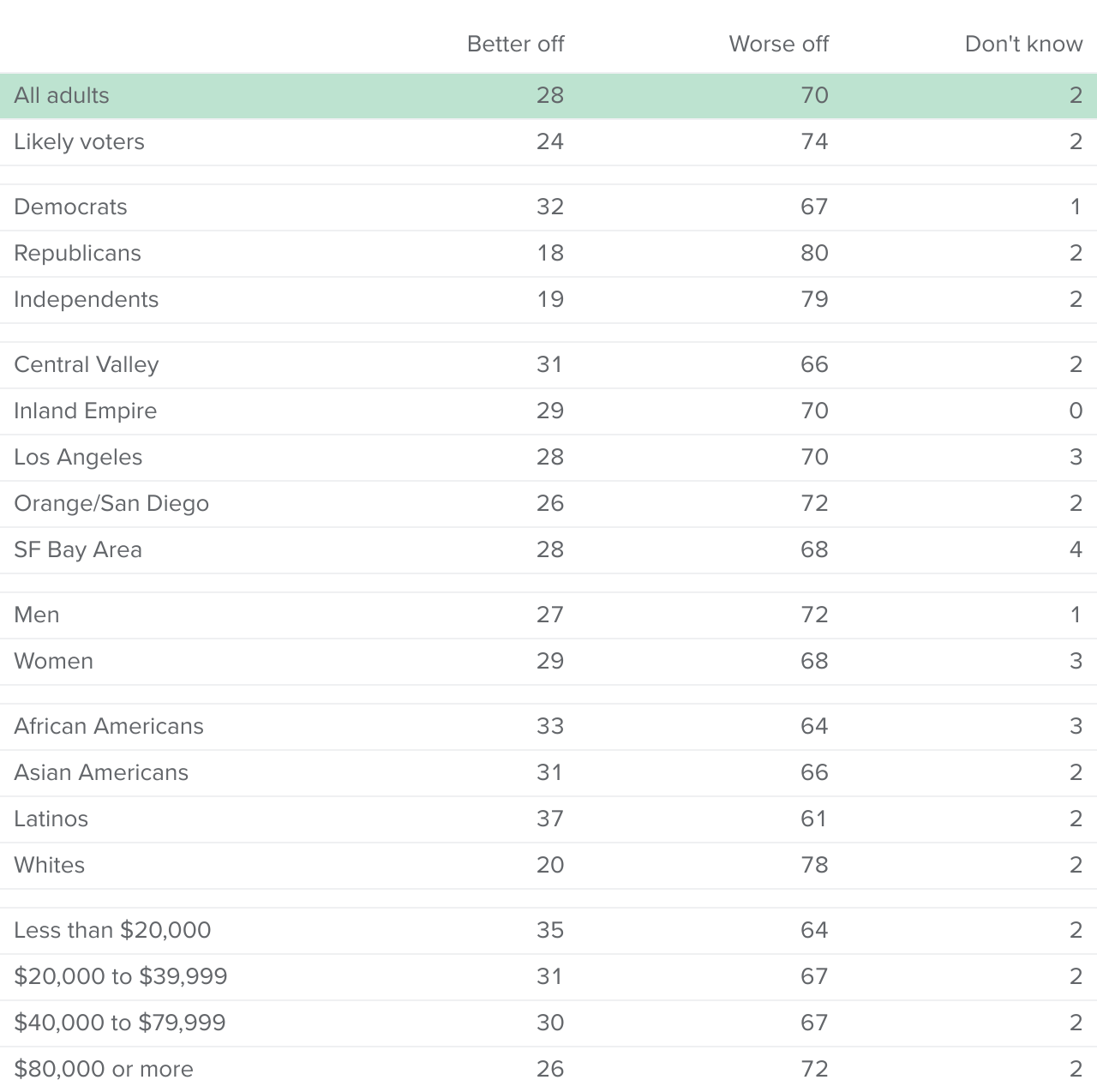
Moreover, 70 percent of Californians think that when children in California today grow up, they will be worse off financially than their parents (28% better off). Solid majorities across regions and partisan and demographic groups—including 63 percent of adults with children in their household—believe that when children in California today grow up, they will be financially worse off than their parents.
Most Californians think children today will be worse off financially than their parents
SOURCE: PPIC Statewide Survey, December 2024. Survey was fielded from November 6–22, 2024 (n=2,344 adults, n=1,449 likely voters).
Economic Security and Worries
Rising prices and inflation have impacted many Californians. We asked Californians about their experiences with various financial difficulties in the past year. Three in ten Californians (29%)—including half of lower-income adults—say they have reduced meals or cut back on food to save money; slightly fewer have had their hours cut at work (23%), had difficulty paying rent or their mortgage (22%), or been unable to pay a monthly bill (21%). Californians also report that they or someone in their household have put off going to see a doctor or purchasing medication (20%), received CalFresh benefits (17%) or food from a food bank or pantry (17%), been laid off (16%), or received unemployment benefits (12%). Notably, these findings are mostly similar to results a year ago.
Californians in households with incomes under $20,000 are especially likely to report cutting back on food, being unable to pay a bill, or having difficulty paying for housing. Notably, renters are nearly three times more likely than homeowners to say they had difficulty paying for housing (34% to 12%). African Americans and Latinos are more likely than Asian Americans and whites to report hardship across all of these areas.
Among the oversample of lower-income Californians with incomes less than $40,000, those who are younger, less educated, and making less than $20,000 a year are generally more likely than others to report experiences of these hardships.
About one in four have been unable to pay monthly bill, had difficulty paying mortgage, or put off a doctor visit
% happened to me or someone in my household

SOURCE: PPIC Statewide Survey, December 2024. Survey was fielded from November 6–22, 2024 (n=2,344 adults, n=1,449 likely voters).
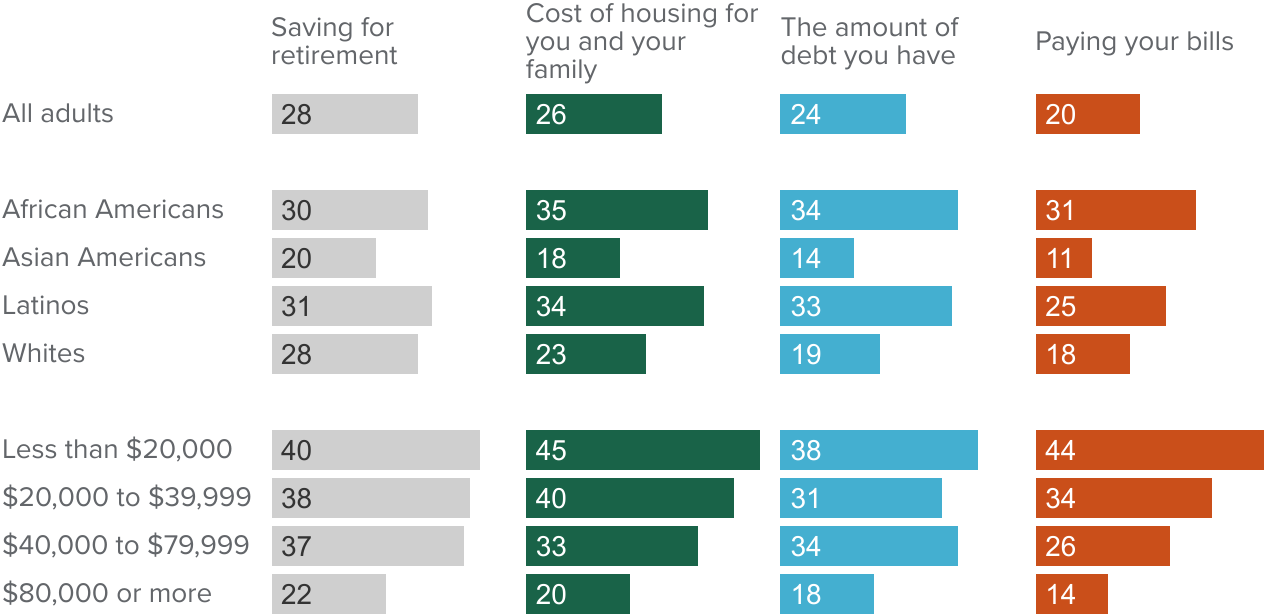
We also asked Californians how often they worry about a variety of economic issues. About one in four Californians worry every day or almost every day about saving for retirement (28%), the cost of housing (26%), and the amount of debt they have (24%). Slightly fewer worry every day or almost every day about paying bills (20%), the cost of health care (19%), and job loss in their household (15%). Among parents, one-third worry daily or almost every day about being able to save enough for their children’s college education (32%) and one in ten worry about the cost of child care (12%). Overall, these findings are similar to last November.
African Americans and Latinos are generally more likely than Asian Americans and whites to worry about these issues, while concern decreases with rising income. Additionally, older Californians and homeowners are less likely than younger adults and renters to worry frequently about most of these issues.
Among the oversample of lower-income Californians, those who are especially likely to be worried about most of these issues are women, younger Californians, and those without a college degree.
Californians are most worried about saving for retirement and the cost of housing
% worry every day or almost every day
SOURCE: PPIC Statewide Survey, December 2024. Survey was fielded from November 6–22, 2024 (n=2,344 adults, n=1,449 likely voters).
Over the past few years, artificial intelligence (AI) and its impact have attracted a lot of attention. Nine in ten (91%) adults have heard or read at least a little about AI, and 52 percent have an unfavorable view. However, most employed Californians are not concerned about the possibility that AI will result in them losing their job or having their hours or salary cut.
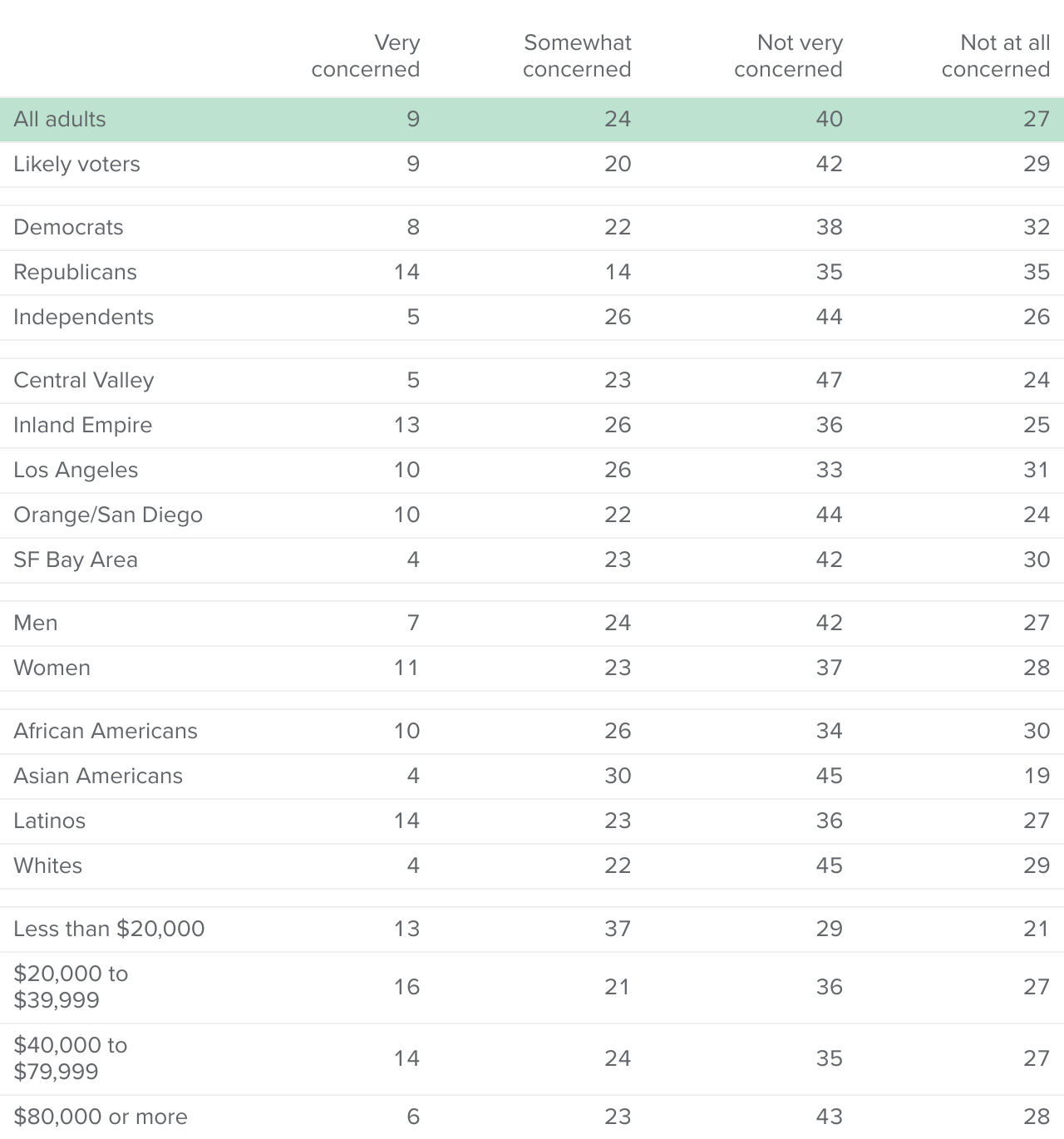
A third of employed adults report being very (9%) or somewhat concerned (24%) about job impacts from AI, while two in three are not very concerned (40%) or not at all concerned (27%). Across regions, concern is highest in the Inland Empire (39%) and Los Angeles (36%), followed by Orange/San Diego (32%), the Central Valley (28%), and the San Francisco Bay Area (27%). Latinos (37%), African Americans (36%), and Asian Americans (34%) are more likely than whites (26%) to be concerned. Concern is lower among older workers and those who attended college, and it decreases with rising income. Among the lower-income oversample, Latinos are especially likely to be concerned (44%).
It is noteworthy that when asked about what impact advances in AI would have on the number of jobs in their industry, half of employed adults say these advances would decrease the number of jobs (50%), four in ten say it would not impact the number of jobs (39%), and one in ten say it would increase the number of jobs (10%).
Most Californians are not concerned about the possibility that artificial intelligence will result in their jobs or hours being cut
SOURCE: PPIC Statewide Survey, December 2024. Survey was fielded from November 6–22, 2024 (n=2,344 adults, n=1,449 likely voters).
Job Conditions
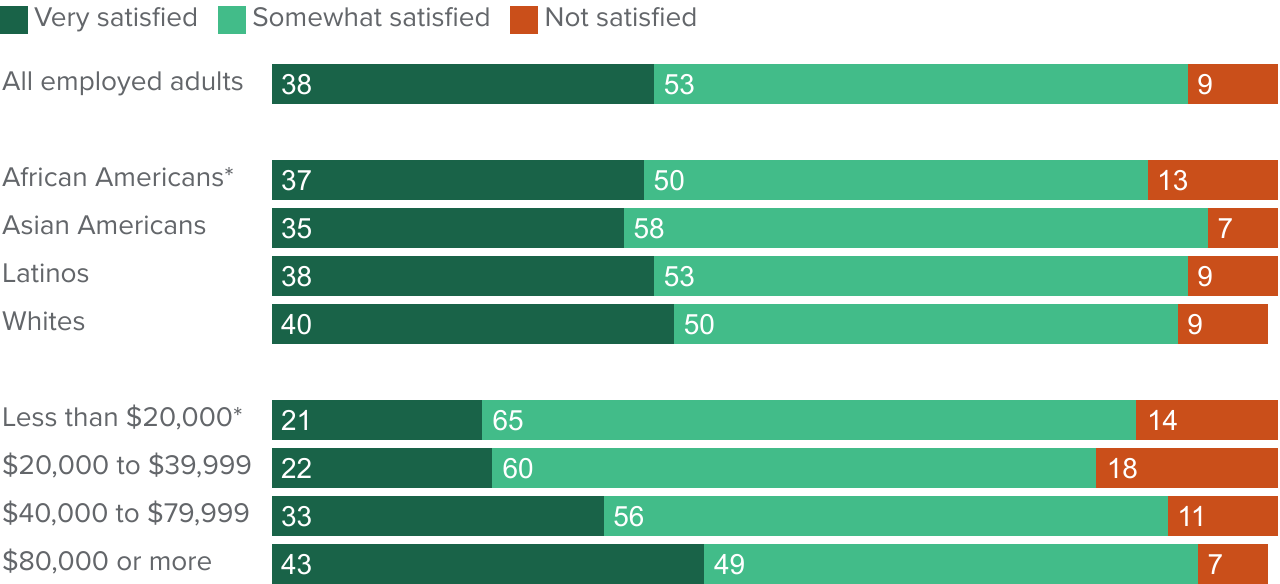
Most employed adults across the state are very (38%) or somewhat satisfied (53%) with their jobs; about one in ten say they are not satisfied (9%). Shares saying they are very satisfied vary across regions and some demographic groups. About six in ten Inland Empire workers (59%) say they are very satisfied, compared to four in ten or fewer in other regions of the state (40% Orange/San Diego, 37% Central Valley, 36% San Francisco Bay Area, 32% Los Angeles). Views are similar across racial/ethnic and gender groups. Adults 55 and older (46%) are more likely to be very satisfied with their jobs than adults ages 18 to 34 (33%). Only about two in ten adults with incomes under $40,000 hold this view, compared to a third of adults earning $40,000 to $79,999 and more than four in ten who earn $80,000 or more.
Most employed adults are at least somewhat satisfied with their job
SOURCE: PPIC Statewide Survey, December 2024. Survey was fielded from November 6–22, 2024 (n=2,344 adults, n=1,449 likely voters).
NOTES: Among employed adults only. *Small sample size for African Americans and those with incomes less than $20,000.
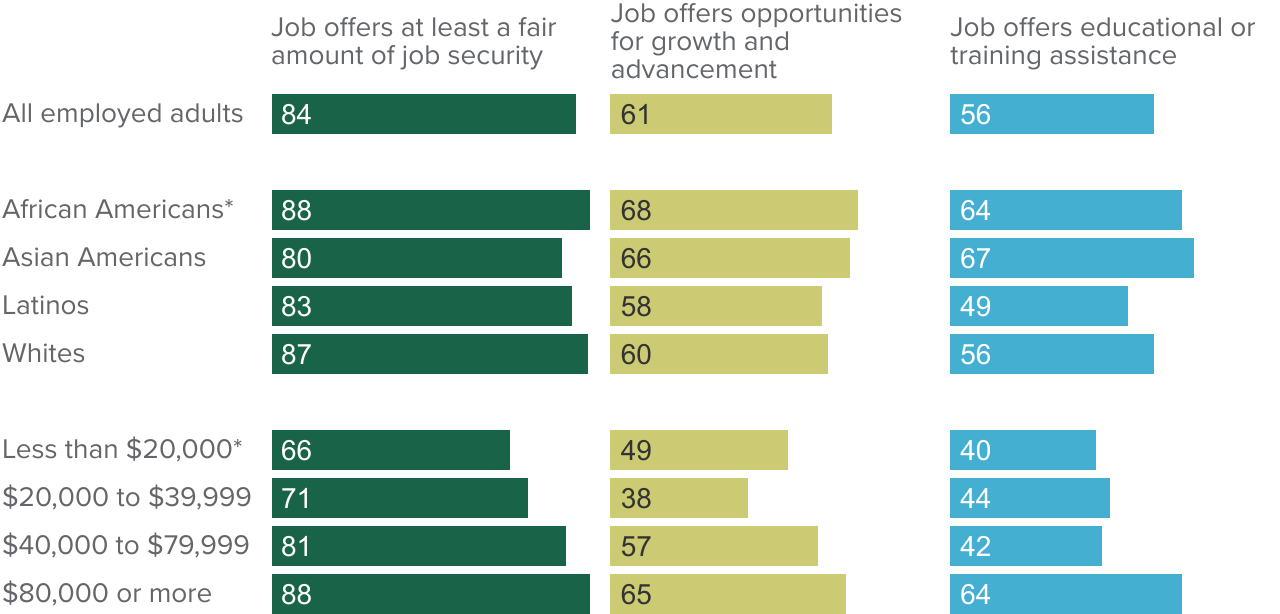
More than eight in ten employed Californians say they have at least a fair amount of job security, including overwhelming majorities across regional, partisan, and demographic groups. Adults earning less than $40,000 (70%) are less likely to say they have job security compared to other income groups (81% $40,000-$79,999, 88% $80,000 or more). Full-time workers (89%) are far more likely than part-time workers (69%) to report job security. Relatedly, more than eight in ten employed adults say they have stable and predictable hours (81%) and pay (85%), while part-time workers are far less likely to have stable hours (60%) and pay (68%). Majorities of adults making less than $40,000 say they do not have predictable hours (60%) or pay (64%) at work.
A solid majority (61%) of working adults say their job offers opportunities for growth and advancement, while about four in ten say their job does not. Men (65%) are more likely than women (56%) to report that their job offers these opportunities. Lower-income Californians are much less likely than those with higher incomes to say their job offers opportunities for growth and advancement. Notably, two-thirds of full-time workers say this, compared to about four in ten part-time workers.
A majority (56%) of California workers say their jobs offer educational or training assistance; shares vary across demographic and regional groups. Majorities of African Americans, Asian Americans, and whites say their jobs offer this type of assistance, compared to about half of Latinos. Less-educated adults are less likely than college graduates to say this, and residents earning less than $80,000 are less likely than those earning more to report this. While majorities across regions say their jobs offer educational or training assistance, Inland Empire workers (61%) are most likely—and workers in the Central Valley (52%) are the least likely—to say this.
Most employed adults say their job provides health insurance coverage (78%), paid sick leave (83%), and a retirement savings plan (72%). A majority of Californians earning under $20,000 say their job does not provide health insurance coverage (62%) or a retirement savings plan (61%). A majority do say their job provides paid sick leave (56%). (Note: The sample size for employed Californians earning less than $20,000 is less than 100).
Most employed adults say their job offers job security; majorities say their job offers growth opportunities and educational or training assistance
% yes
SOURCE: PPIC Statewide Survey, December 2024. Survey was fielded from November 6–22, 2024 (n=2,344 adults, n=1,449 likely voters).
NOTES: Among employed adults only. *Small sample size for African Americans and those with incomes less than $20,000.
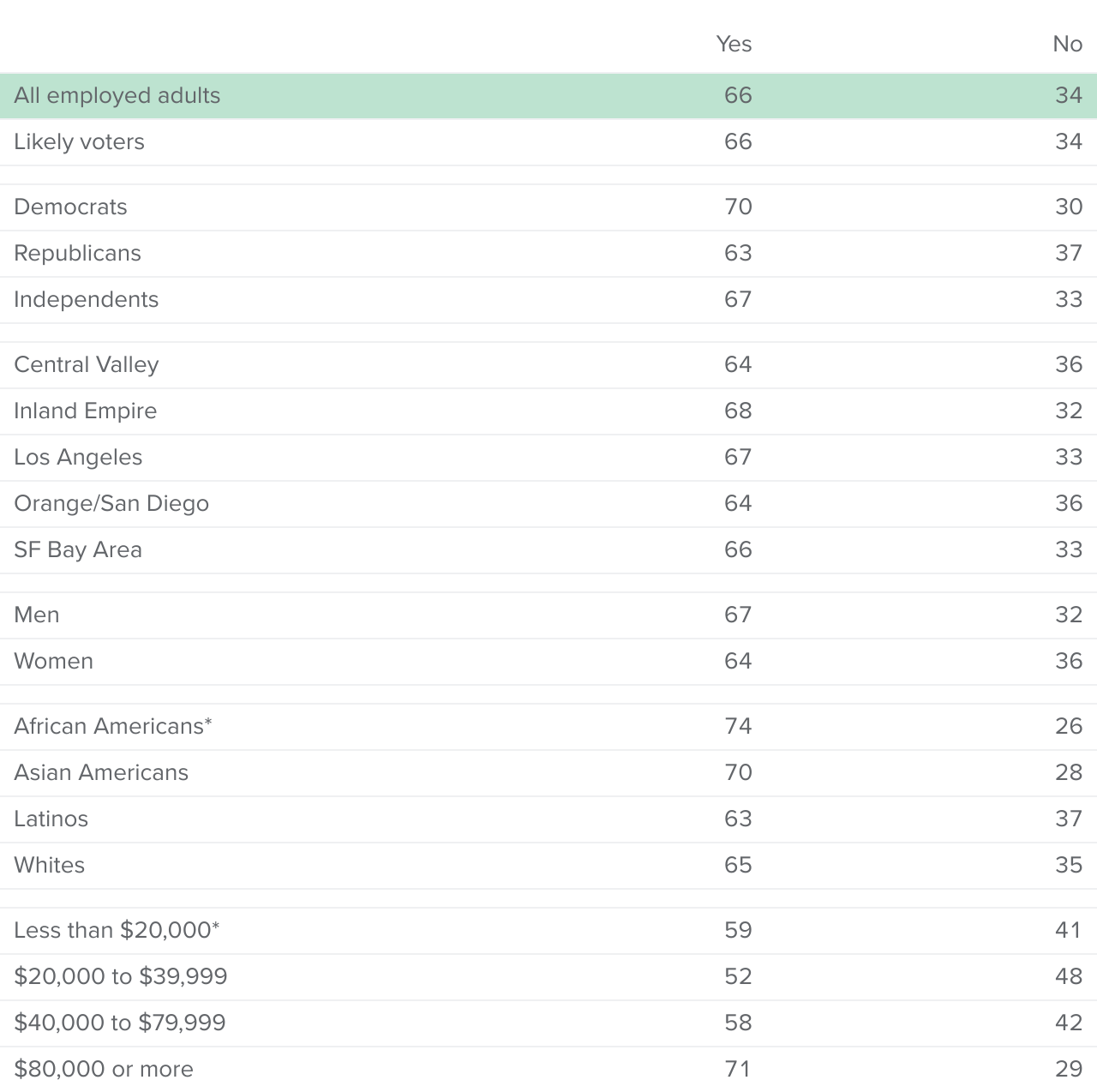
Two-thirds of adult workers say their company or organization provides training or meetings on diversity, equity, and inclusion. Solid majorities across partisan, regional, and most demographic groups say this. Lower-income adults are less likely to report this than those earning more than $80,000. Seven in ten full-time workers (71%) say this, compared to only half of part-time workers (50%).
A solid majority (63%) of California adults say companies adopting diversity, equity, and inclusion programs is a good thing, while about a third say it is a bad thing. Majorities across partisan, regional and demographic groups say it is a good thing, with the exception of Republicans (31%). The share saying it is a good thing is highest among Democrats (86%), African Americans (76%), women (70%), and Latinos (69%).
Strong majorities of employed adults say their company or organization provides trainings or meetings on diversity, equity, and inclusion
SOURCE: PPIC Statewide Survey, December 2024. Survey was fielded from November 6–22, 2024 (n=2,344 adults, n=1,449 likely voters).
NOTES: Among employed adults only. *Small sample size for African Americans and those with incomes less than $20,000.
Worker Power
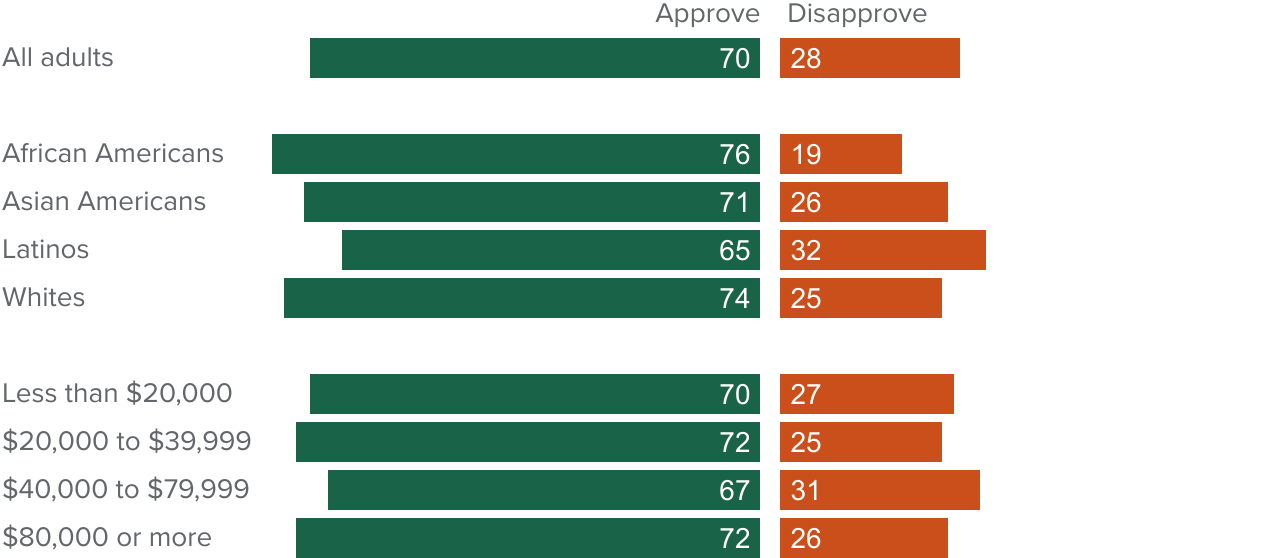
Overwhelming majorities of adults (70%) and likely voters (75%) approve of labor unions, while about a quarter disapprove (28% adults, 24% likely voters). Shares were similar in November 2023 (70% approve, 26% disapprove). Majorities of Democrats (87%), independents (68%), and Republicans (57%) express approval. Solid majorities across demographic groups approve, including overwhelming majorities of full- and part-time working adults. Solid majorities across the state’s regions approve of labor unions. Compared to Californians, adults nationwide (70%) are equally as likely to approve of labor unions, according to an August Gallup poll.
An overwhelming share of Californians approve of labor unions
SOURCE: PPIC Statewide Survey, December 2024. Survey was fielded from November 6–22, 2024 (n=2,344 adults, n=1,449 likely voters).
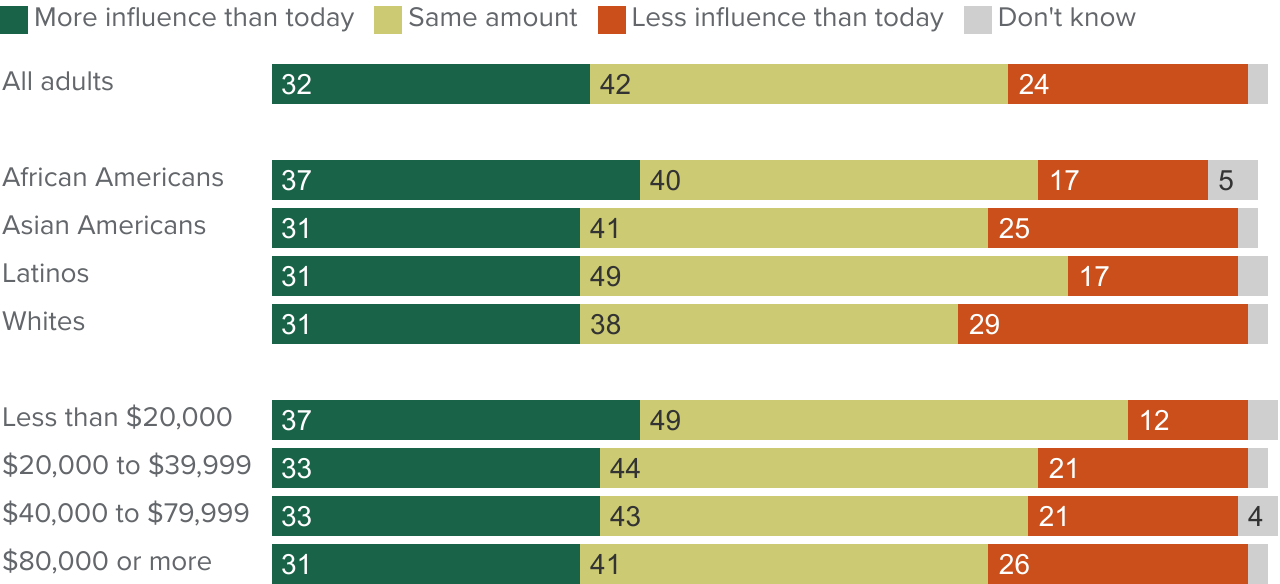
Roughly four in ten adults (42%) say unions should have the same amount of influence in the United States as they have today. About one in three say they should have more influence, and about a quarter say unions should have less influence. These shares were similar last November. Today, about four in ten Democrats (43%), Republicans (42%), and independents (39%) say unions should have the same amount of influence, but Republicans are most likely to say they should have less (44%), and Democrats are most likely to say they should have more (42%). Roughly four in ten or more across demographic and regional groups say unions should have the same amount of influence they have today. San Francisco Bay Area residents (41%), African Americans (37%), and adults with incomes under $20,000 (37%) are among the most likely to say labor unions should have more influence. Adults ages 18 to 34 (36%) are slightly more likely than older adults (30%) to say this.
Roughly four in ten Californians want labor unions to have the save amount of influence as they have today
SOURCE: PPIC Statewide Survey, December 2024. Survey was fielded from November 6–22, 2024 (n=2,344 adults, n=1,449 likely voters).
About nine in ten (88%) adults agree that the wealthy and the poor should have equal influence on government policymaking. More than eight in ten across partisan, demographic, and regional groups agree, including half or more across these groups who completely agree with this statement.
Eighty-one percent of adults agree that voting gives people like them some say in what the government does (36% completely agree, 45% somewhat agree). Across partisan, demographic, and regional groups, most hold this view, including over three in ten among these groups who completely agree with this statement. Complete agreement is highest among Inland Empire residents (45%), Democrats (42%), Asian Americans (41%), and adults ages 55 or older (41%).
About eight in ten adults somewhat (38%) or completely agree (45%) that it is important for workers to organize so that employers do not take advantage of them. These shares were similar about a year ago. Today, strong majorities across partisan, demographic, and regional groups agree that it is important for workers to organize. However, there is some nuance: shares in complete agreement reach a majority only among Democrats (60%), African Americans (59%), Latinos (53%), adults earning less than $20,000 (51%), and adults ages 18 to 34 (51%).
While labor unions have overwhelming support and many say it is important for workers to organize, few Californians report being offered union membership at work. Fewer than three in ten adults (28%) say their workplace offers membership in or affiliation with a union, occupation association, worker center, or other group that represents workers; 71 percent say their workplace does not offer this. One in three California adults (33%) say they or someone in their family is a union member.
Most Californians agree that the wealthy and the poor should have equal influence in policymaking and that it is important for workers to organize so employers do not take advantage of them
% completely/somewhat agree

SOURCE: PPIC Statewide Survey, December 2024. Survey was fielded from November 6–22, 2024 (n=2,344 adults, n=1,449 likely voters).
Worker Policies
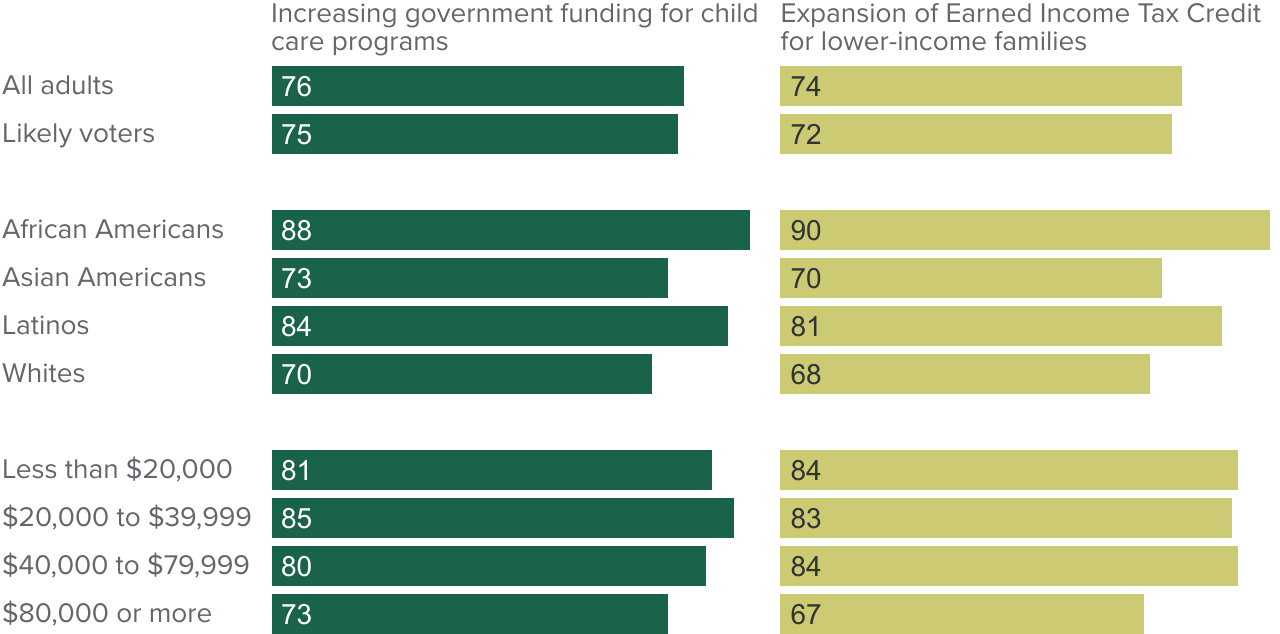
There is solid support for policies that could improve the economic well-being of Californians. About three in four adults and likely voters favor increased government funding to make child care programs available to more lower-income working parents, while about a quarter are opposed. Most Democrats (89%) and independents (73%) are in favor, while Republicans are divided (49% favor, 50% oppose). Seven in ten or more across demographic and regional groups are in favor. More than eight in ten African Americans and Latinos are in favor, compared to about seven in ten or more whites and Asian Americans. Across regions, support is highest in the San Francisco Bay Area (81%) and lowest in Orange/San Diego and the Inland Empire (73% each). Lower-income adults are more likely to be in favor than those earning $80,000 or more.
Overwhelming majorities of adults (74%) and likely voters (72%) support expanding eligibility for and increasing the Earned Income Tax Credit for lower-income working Californians (oppose: 24% adults, 27% likely voters). Most Democrats (89%) and a strong majority of independents (69%) are in favor, while a majority of Republicans are opposed (54%). Strong majorities across demographic and regional groups are in favor. Across racial/ethnic groups, African Americans (90%) are most likely and whites (68%) are least likely to express support. More than eight in ten residents earning less than $80,000 are in favor of expanding the earned income tax credit, compared to fewer who make $80,000 or more.
Overwhelming majorities favor increasing government funding for child care programs and expanding the Earned Income Tax Credit
% favor
SOURCE: PPIC Statewide Survey, December 2024. Survey was fielded from November 6–22, 2024 (n=2,344 adults, n=1,449 likely voters).
Two in three adults and more than six in ten likely voters (63%) favor a government policy to make tuition free at both public two-year and four-year colleges; about a third of adults and four in ten likely voters (37%) oppose this idea. An overwhelming majority of Democrats support free tuition, compared to a smaller majority of independents (58%). Meanwhile, two-thirds of Republicans are opposed (67%). Solid majorities across regions are in favor, with support highest in the San Francisco Bay Area (71%). Among racial/ethnic groups, overwhelming majorities of African Americans (87%) and Latinos (75%) and about six in ten Asian Americans say they are in favor of free tuition (whites: 56% favor). Support decreases as income increases.
When asked whether they would favor or oppose a government policy to eliminate college debt, a majority of adults (58%) express support, while likely voters are more divided (53% favor, 47% oppose). Support was similar last November (57%) but has declined since December 2020, when 65 percent were in favor. Today, partisans are divided on this issue: nearly eight in ten Democrats (78%) favor eliminating college debt, while eight in ten Republicans (79%) are opposed, and independents are divided (51% favor, 48% oppose).
Support for eliminating college debt varies across demographic groups, with adults under 55 more likely than older adults to express support. Support for this policy increases as income declines. Majorities of African Americans (78%), Latinos (69%), and Asian Americans (53%) are in favor of eliminating college debt, while a majority of whites are opposed (52%). Half or more across most regions are in favor.
Majorities favor government policies to reduce higher education costs
% favor

SOURCE: PPIC Statewide Survey, December 2024. Survey was fielded from November 6–22, 2024 (n=2,344 adults, n=1,449 likely voters).
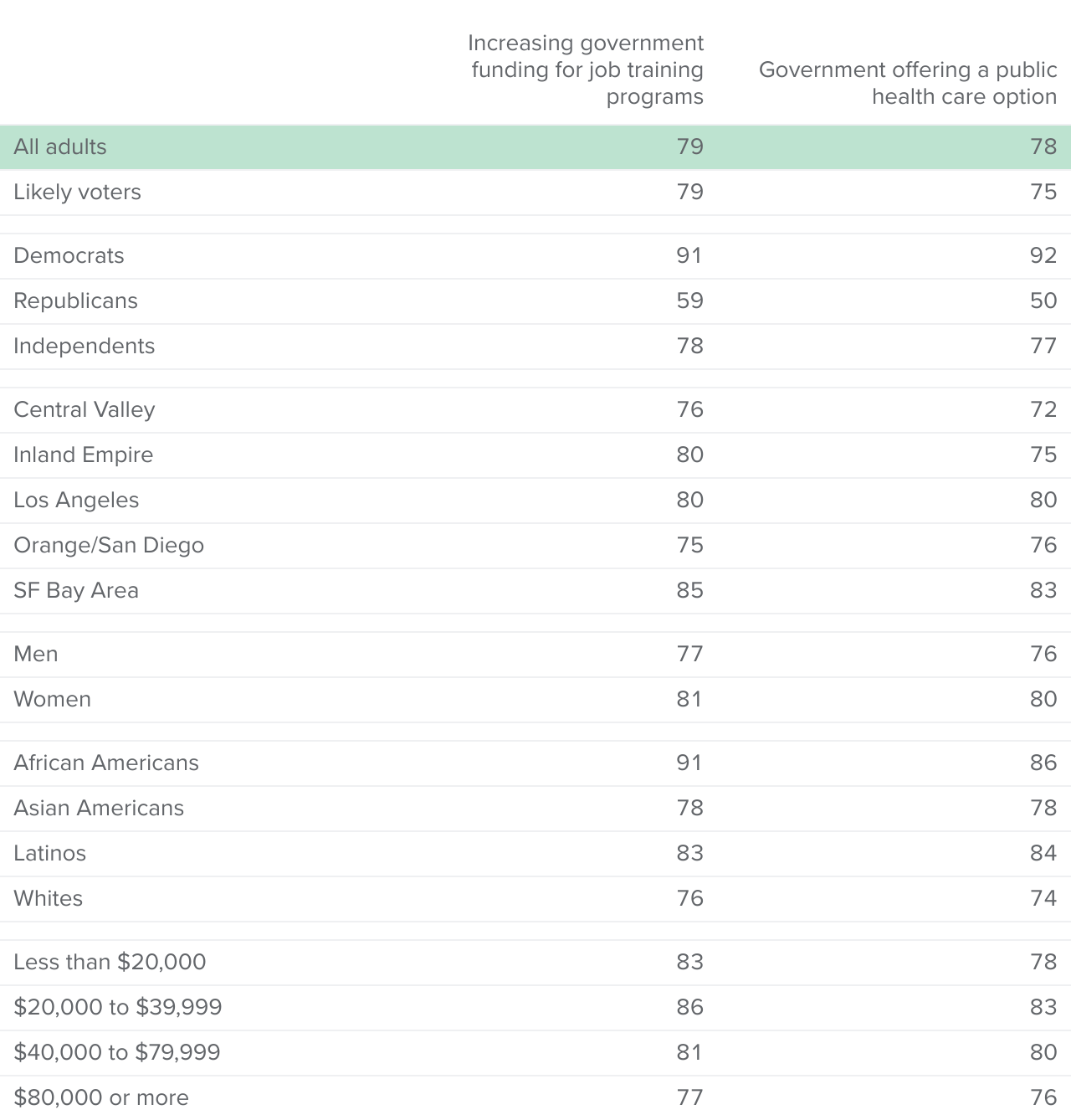
About eight in ten adults and likely voters favor increased government funding for job training programs so that more workers have the skills they need for today’s jobs; two in ten are opposed. Nine in ten Democrats and about eight in ten independents support this, compared to a smaller majority of Republicans (59%). More than three in four or more across regions and demographic groups are in favor of increased funding for job training.
Overwhelming majorities of adults (78%) and likely voters (75%) favor the government offering a health insurance plan similar to Medicare that adults can purchase instead of private insurance (21% adults and 24% likely voters are opposed). Nine in ten Democrats and about three in four independents are in favor, while Republicans are divided (50% favor, 49% oppose). Roughly seven in ten or more across demographic and regional groups favor a public health care option.
Overwhelming majorities favor increased funding for job training and a public health care option
% favor
SOURCE: PPIC Statewide Survey, December 2024. Survey was fielded from November 6–22, 2024 (n=2,344 adults, n=1,449 likely voters).

Topics
Economic Growth Economic Mobility Economic Trends Economy Housing Jobs and Employment Political Landscape Poverty & Inequality Statewide Survey