
Table of Contents
- Key Takeaways
- Introduction
- Economic Security Feels Out of Reach for Many Workers
- Affordability Is a Huge Issue for California’s Workers
- Why Is Work Falling Short?
- Why Are Workers Hesitant about Making Career Changes?
- Takeaways from Listening to California Workers
- Notes and References
- Authors and Acknowledgments
- PPIC Board of Directors
- Copyright
Key Takeaways
California is one of the largest economies in the world, but many working Californians do not feel economically secure—they struggle to pay their bills, save for the future, and balance the demands of work and daily life. PPIC Statewide Survey data indicate that pessimism about future economic opportunity has become even more pervasive amid recent economic volatility. In this report, we analyze statewide data and draw from focus groups about economic security with working Californians from diverse demographic, geographic, and political backgrounds. Several key insights emerge:
- Affordability is a challenge, particularly in recent years. The cost of basic necessities—which make up a large share of spending by lower- and middle-income workers—has increased substantially since 2020; food and rent are up 25 percent on average, and utilities and gas are up 40 percent. Lower- and middle-income workers also struggle with out-of-pocket health care costs.
- Coping with the cost of living can feel like walking a tightrope. Taking on debt can help cover costs in the near-term, but many workers feel overwhelmed by the amount of debt they hold; student loan delinquencies in particular are rising. Many workers participate in safety net programs that defray the costs of basic necessities, but some focus group participants said their earnings are slightly too high to qualify and others felt that the process of getting and keeping benefits is too onerous.
- Family, health, and other personal needs impact work choices. Many focus group participants talked about making employment and financial decisions that allow them to care for household members or deal with their own health issues. Many have considered work opportunities in lower-cost areas in California and elsewhere but have opted to stay put because of family and community support—fully understanding that they would continue struggling to make ends meet.
- The struggle to make ends meet reflects long-term labor market changes. Over the long term, California has added high- and low- but not middle-wage jobs; meanwhile, earnings levels have grown dramatically for those near the top but stagnated for those at or below the median. Overall, the state’s economic output has grown more sharply than have family incomes.
- Changing careers or employers to make more money carries risk for workers in precarious financial situations. Investing in additional education—or making any financial move—is particularly challenging for workers who are already struggling to make ends meet. This difficulty is compounded by uncertainty about California’s economy, which has been disrupted by the pandemic, technological change, and federal policy shifts.
Workers in our focus groups feel that the time and energy it takes to make ends meet and a system they perceive as stacked against them are barriers to political engagement—but they want decision makers to understand what makes their lives so difficult. This report aims to elevate their voices.
Introduction
Many workers in California feel economically insecure—they may not be classified as living in poverty, but they do not earn enough to cover monthly bills and weather financial shocks. Their challenges have intensified in recent years, with disruptions from the pandemic, structural changes in the economy, and technological change. At the same time, costs have risen sharply for items that are necessary to survive. All told, 71 percent of Californians do not believe that the American Dream—if you work hard, you will get ahead—holds true (Baldassare et al. 2025d).
Why do so many workers in California struggle to achieve economic security? Some of the current challenges are long in the making. Because economic growth has not been evenly distributed across industries or regions, opportunities have been unevenly distributed across California’s workforce. A majority of Californians (56%) believe that the American Dream is harder to achieve in the Golden State than elsewhere in the US (Baldassare et al. 2025d)—making the issue especially urgent for state leaders.
One evidence-based pillar of national efforts to improve upward mobility involves expanding access to rewarding jobs (Ellwood and Patel 2018; Urban Institute 2025). However, economic mobility is intertwined with systemic factors such as lifelong access to education, neighborhood characteristics, health and access to care, and political environment.
In this report, we synthesize the economic challenges California workers are facing and highlight perspectives that could inform policies to address these challenges. In addition to our analysis of big-picture economic data, we draw on the observations of 137 working Californians in focus groups conducted in the summer of 2025. While our analysis aims to understand the realities of California workers writ large, our focus groups were limited to workers who self-identified as economically insecure, and our conversations with these workers shed light on issues and nuances not fully captured by other sources.
Almost half of California’s 12 million prime-age workers earn less than $51,500 per year (see text box below); we refer to this group as “lower-earning workers.” Some are working part-time, but about 60 percent have full-time, year-round jobs. Those in the “middle-earning workers” group (earning between $51,600 and $97,800 per year) also struggle with economic stability. Our report focuses on these two groups. The Californians who participated in our focus groups were selected with an eye toward capturing the diverse perspectives of lower- and middle-wage workers across the state. We heard from a mix of part-time, full-time, and self-employed workers with varying demographic, educational, and political backgrounds (see text box). However, all of the participants feel economically insecure and do not see many avenues to advance financially.

Economic Security Feels Out of Reach for Many Workers
“Economic security just translates more to freedom to me. Not worrying about everyday expenses and being able to think a little bit more broadly about life and helping my daughter and things like that.” – Los Angeles worker
“Financial security means that I can retire comfortably. I’m secure. The word security carries meaning to me… knowing that I can pay all of my bills and tuck some away and have savings.” – Coastal county worker
The most straightforward definition of economic security is the ability to control finances month to month and the capacity to absorb a financial shock (CFPB 2015). Many of our focus group discussions focused on the ability to pay monthly bills without worry and have some left over. Additionally, many expressed the desire to have sufficient resources for small luxuries, nice-to-haves for their families like gifts or vacation, or investments for the future—hallmarks of financial freedom or well-being.
Based on their current financial situation, two in ten California adults say that it would be “nearly impossible” (8%) or “very difficult” (11%) to pay for a $1,000 emergency expense, according to the PPIC Statewide Survey. Almost half of those in lower-income households say this kind of expense would be nearly impossible (24%) or very difficult (22%) to cover (Baldassare et al. 2025d).
A worker in the San Francisco Bay Area summed up these struggles: “I feel like I’m swimming, and it’s harder and harder to stay afloat. We have enough to pay the bills but there’s nothing left over for emergencies if something comes up. I don’t foresee it getting better. It’s just getting more and more expensive and harder to stay afloat.”
Overall, 9.8 percent of California’s workers are in poor households, without enough resources from earnings and government support to cover basic housing, food, clothing, and utility needs (on average, a family of four would need $44,000 to cover these basic needs as of 2023). A larger share (14.7%) may be at risk of poverty because their resources amount to no more than one-and-a-half times the amount needed to cover basic needs.
Our focus group participants cited numerous examples of living without income while job hunting, sick, or caring for friends or family; these gaps in earnings led to economic insecurity, as savings were drained or they had to rely on other means to meet monthly needs. About two-thirds of California households have enough liquid assets to cover basic needs for a month without income (Appendix Table C1; Thorman and McConville 2025); fewer households would be able to maintain their current standard of living for that long. Older, more highly educated, and white and Asian households are more likely than others to have enough savings to get them through a month without income.
One in five Californians worry about paying their bills every day or almost every day, including 37 percent of lower-income Californians (Baldassare et al. 2025d). Feeling economically insecure has a negative effect on mental health (Ridley et al. 2020), and this makes it harder to gain security. Economic stressors can create a “scarcity mindset” that makes it difficult to focus on solutions and has substantial impacts on the ability to make decisions. One worker from the Inland Empire conveyed the stress of meeting basic needs as follows: “It’s like, when the water’s on, I see money coming out of the faucet. It’s very stressful. It’s hard to sleep.”
Affordability Is a Huge Issue for California’s Workers
“I work full time, and I can’t afford to live. I’m not saying I want to be rich and live this lavish lifestyle. I just feel like if I’m working 60 hours a week, I should be able to go to the doctor.” – San Diego worker
On top of already high prices in the state, inflation accelerated in 2021 and peaked in 2022 at levels not seen in over 30 years. Prices in August 2025 were 25 percent higher than in January 2020, double the rate of growth experienced in recent history (Bohn 2025). Although some level of inflation is expected over time, higher-than-expected rates can lead to acute feelings of loss (Dräger et al. 2014). Further, the negative impact of inflation on multiple dimensions of well-being—including uncertainty, affordability, and fairness—is stronger for those with lower incomes (Stantcheva 2024), even for those whose wages have generally been keeping pace with inflation since the pandemic. Not all Californian workers are making more than they did before the pandemic (Duan and Payares-Montoya 2023), and lower-income households are less able to adjust spending away from major expenditures that are driving higher costs (Bohn and Duan 2024).
The Cost of Basic Necessities Is High and Rising
Workers in our focus groups talked about feeling affordability pressures across a range of areas—and made frequent comparisons to costs before the pandemic.
Rent
“I know I’m never gonna have a house. I’ve accepted that at this point. But the rent is too damn high.” – Los Angeles worker
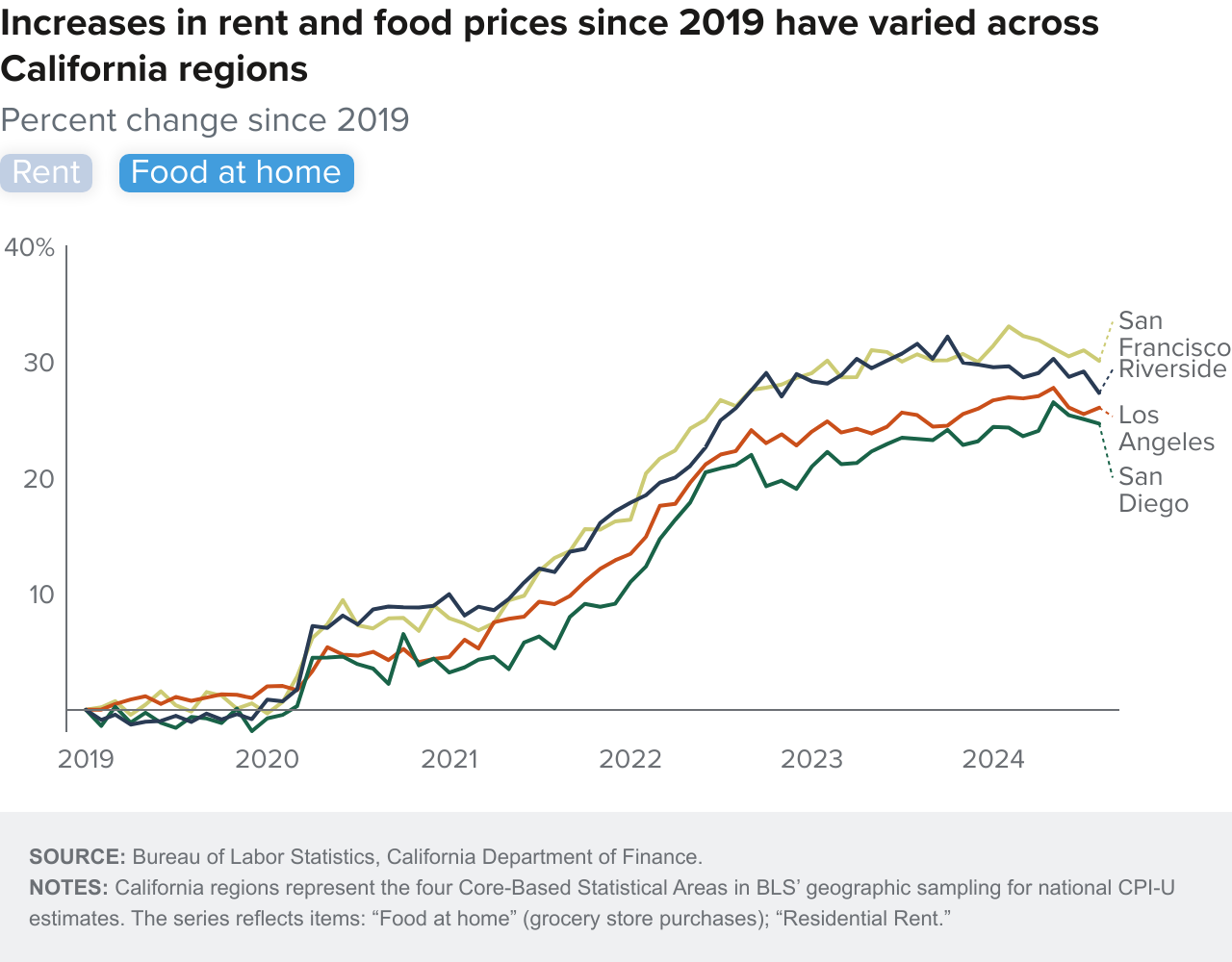
Food and shelter are basic needs. Inflation for rent in California was typically higher than overall inflation between 2019 and 2025 (which averaged 25%), with variation across regions (Figure 1). Housing is the largest expense for Californians overall, and it is a relatively larger expense for those with lower incomes (Johnson and McGhee 2023). Forty-two percent of California residents with lower incomes worry every day or almost every day about the cost of housing (Baldassare et al. 2025d). Focus group participants mentioned several challenging features of the rental market, including:
- Constant rent increases: “The rents are going up. They always increase it.” – Los Angeles worker
- Renting insecurity: “When you rent, you can’t view your housing as permanent because the landlord can always decide to make a change. I worry about that for my family.” – San Francisco worker
- Limited mobility: “I have a rent-controlled apartment that was great when I was single, but now I have a wife and kid. We’re going to have to move at some point, and it’s a huge risk.” – San Francisco worker
- Corporate control of the housing market: “You have 80,000 empty units because they’re not willing to drop the prices, but private equity firms will never let the rent go down.” – Coastal county worker
Increases in rent are one of the largest drivers of inflation across California. Rental costs varied meaningfully across the state before the pandemic, with the Bay Area experiencing median rental costs approximately 30 to 200 percent higher than other large metropolitan areas in 2019 (Johnson and McGhee 2023). However, rent increases since the pandemic have also varied meaningfully: rent in the Riverside area (the Inland Empire) has increased almost 40 percent since 2019, compared to around 13 percent in the Bay Area (Figure 1).
It is important to note that rents were relatively flat from 2020 through 2021—perhaps due to state and local policies during the early part of the pandemic—but rose quickly along with other prices after 2021. These rapid increases of the largest household expense are difficult to adjust to.


Focus group participants most frequently cited government intervention on housing costs when asked what policies would help their financial situations most. Californians overall have mixed policy preferences on specific housing solutions. Some focus group participants specifically brought up rent control; Californians overall are divided on the policy (and a measure on the 2024 ballot failed). Others said that increasing the supply of housing or affordable housing programs would support homeownership, especially for middle-income workers who don’t qualify for assistance.
Food
“My dream policy would be lowering food prices. Grocery prices are extremely high. Can’t buy eggs for less than 10 bucks. Just lowering grocery prices in general would help out a lot of people, because we are barely affording rent in California. And now we gotta deal with high prices on eggs, groceries, every single thing, and it’s hard for all of us.” – Bay Area worker
Food prices increased by 25 to 30 percent across California from 2019 to 2024. After increasing sharply in the early months of the pandemic (related to surging demand and supply chain issues), prices did not decline but did stabilize before inflation took off economy-wide in 2022. Food is the third-largest category of spending for California families (after housing and transportation; see Bohn 2025), and the pain of rising food prices is felt day in and day out. Our focus group participants articulated a desire for the government to control prices, even though they acknowledged it is not clear how this could be done and that “prices always go up.” Indeed, while the Federal Reserve’s policies were effective at slowing the growth in prices, its objective is not to reverse price growth (Najjar and Shapiro 2025). At the end of the day, the cost of certain staples feels especially onerous to many in our focus groups.
Energy
“Make utilities stop increasing the rates. It increases like 20 percent every year—that’s unnecessary.” – Coastal county worker
Among the other expenses central to household budgets, energy costs—for utilities and gasoline—have increased the most in California since the pandemic. In 2023, household utility prices were 75 percent higher than 2019 prices in three of the four regions where inflation is measured in California (Figure 2). As of August 2024, utility prices remained more than 40 percent higher than 2019 prices and were 60 percent higher in San Francisco. The cost of gas has shown much greater volatility over the past few years. Within-year swings of over 20 percent are common, which makes it difficult to plan for gas expenditures—and is particularly challenging in places where workers rely on their cars. Gas prices were 80 to 90 percent higher than 2019 prices across regions in 2022 and 40 percent higher as of August 2024.
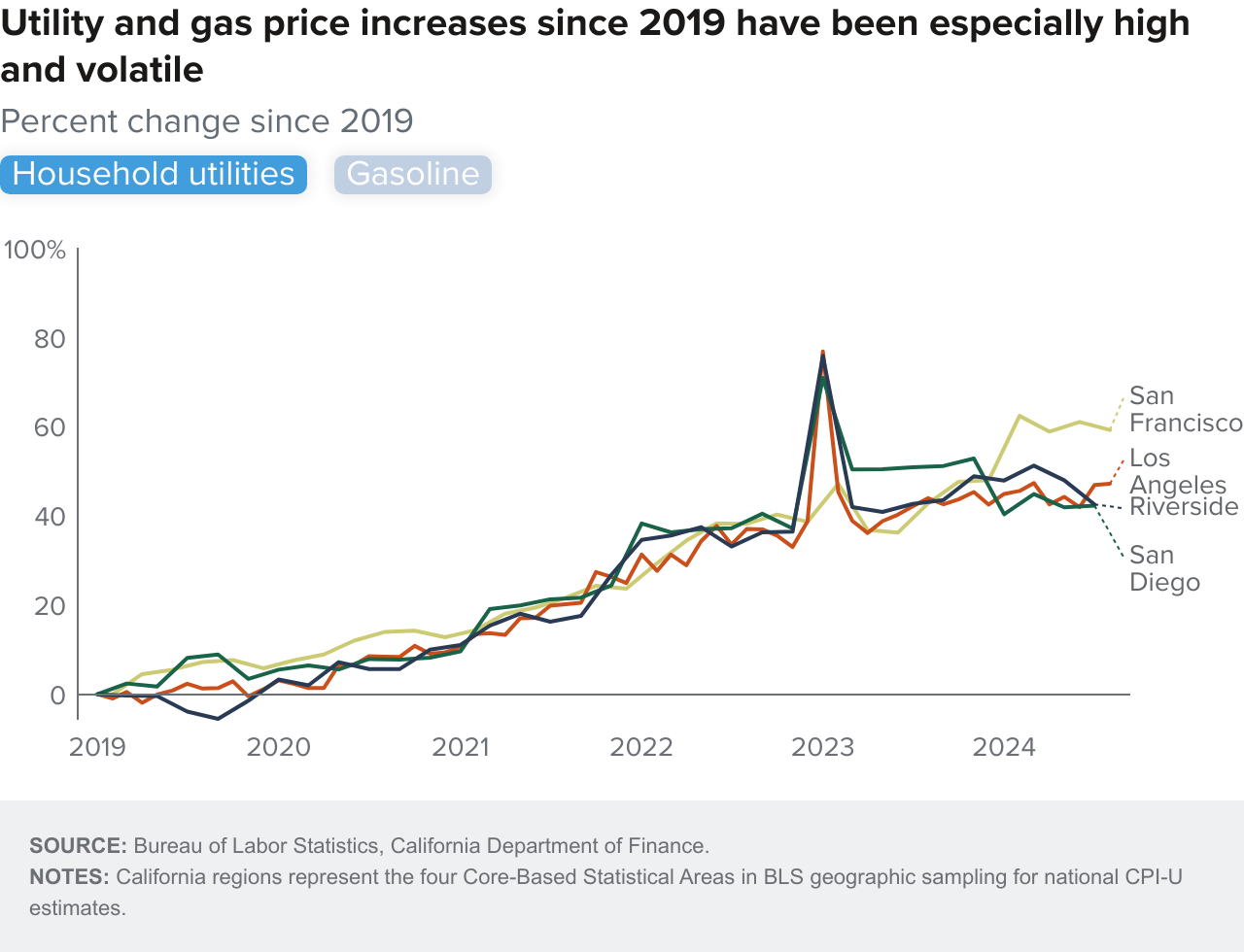

Californians’ concerns about rising energy prices post-COVID are reflected in survey and focus group responses. For example, 52 percent (including 58% and 63% of lower- and middle-income households) said that the price of gasoline at the pump is a “major problem” (and perspectives are similar when asked about natural gas and electric utility bills; Baldassare et al. 2025c). As with food prices, focus group participants expressed a desire for government intervention in lowering the cost of utilities.
Some participants attributed higher electricity costs to the private ownership of their utilities and said they would like to see more publicly or independently owned utilities. Others pointed to new charges for things like wildfire prevention or expressed concern that widespread use of AI was playing a role in rising costs and would need to be managed in the future.
Debt
“I do have a pretty good job now and I live in a low-cost area, so that’s helpful, but I have a lot of debt from college and from getting my teeth fixed. I’m living paycheck to paycheck. All that debt is holding me back even though I have a pretty good job.” – Coastal county worker
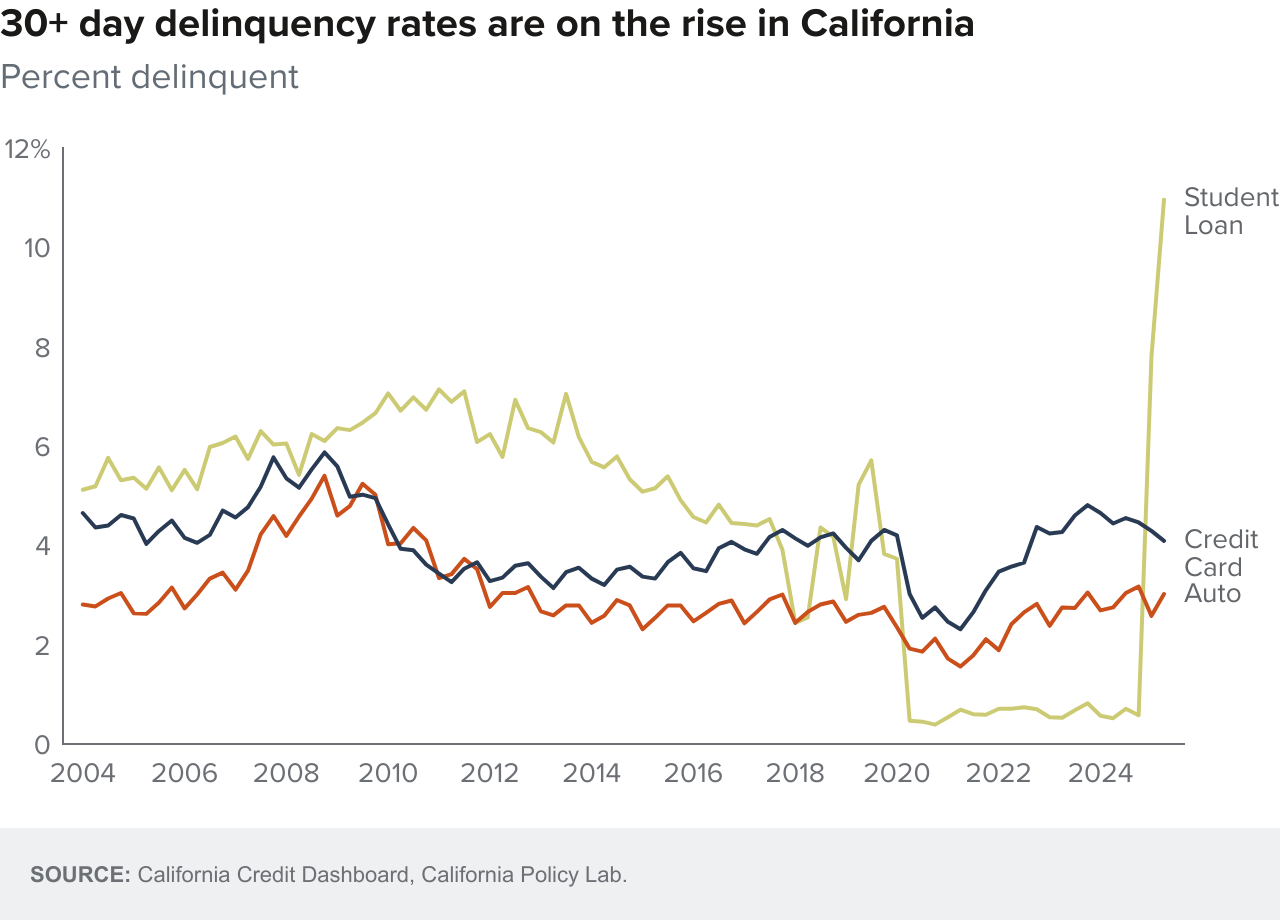
One of the ways affordability challenges reveal themselves is through debt, and Californians are starting to show signs of struggle in this area. Trends in overall debt can reflect complicated dynamics between economic conditions and supply-side responses by creditors. However, not paying back debt is a signal that borrowers are struggling to meet their commitments. Figure 3 shows quarterly 30+ day delinquency rates for auto loans, credit cards, and student loans. The trends are presented starting with the earliest year of available data, 2003, to provide a comparison to other large changes in the economy. Delinquency rates for both credit card debt and auto loans spiked during the Great Recession, declined during the recovery, and dipped after the onset of the pandemic. Both are now on an upward trajectory that appears higher than before the pandemic.
Student loan delinquency trends were affected by pandemic-related payment pauses. However, many of these payments were expected by September 2024, and the federal government restarted the collection of delinquent loans in May 2025. Since these changes, student delinquency rates measured by credit agencies have spiked to 11 percent in California as of the second quarter of 2025.
Health
“I can be responsible with groceries, but health and dental? Things like that are scary. I’ve got a tooth that’s been bugging me for a month, and I’m afraid to go in because I don’t know how much my insurance will cover.” – Inland Empire worker
While employer-provided health insurance, Medi-Cal public health insurance, and Covered California subsidized insurance support the health needs of many lower- and middle-income workers, many nonetheless struggle with access and/or out-of-pocket costs. One in six Californians (16%) worry about being able to afford an unexpected medical expense every day or almost every day, including 24 percent and 26 percent of middle- and lower-income households (Baldassare et al. 2025d). In our focus groups, many workers described unexpected medical shocks in their household that put them on a downward economic spiral. Some of these workers are now dragged down by medical debt.
Others with chronic health issues identified a tension with advancing with work and access to public benefits: “If I work more than a certain amount, I won’t qualify for Medi-Cal. Otherwise, I can’t pay for my medications,” said one Central Valley worker. Even though there are additional healthcare supports—like Covered California, which currently helps people with incomes up to 600 percent of the federal poverty limit (although federal subsidies that help keep premiums affordable are set to expire in 2025)—some workers hesitate to get care because of a lack of transparency in costs. For workers who are already burdened by financial stress, physical pain and discomfort only adds to their challenges.
Californians overwhelmingly support a government health insurance plan (similar to Medicare) for individual purchase—79 percent of adults favor this, including 83 percent and 79 percent of lower- and middle-income adults (Baldassare et al. 2025d). Our focus group participants often brought up “universal health care” as an aspirational policy to improve access to care, reduce the cost of care, and eliminate medical debt.
Coping with Affordability Involves Difficult Tradeoffs
“Rent, rent, rent. I make enough to pay my rent, but not enough to pay my groceries and bills.” – San Francisco worker
California’s affordability challenges are forcing workers to make trade-offs in how they spend their money and the opportunities they seek. For example, 30 percent of Californians—and half of those living in households with annual incomes under $40,000—report that they or someone in their household has reduced meals or cut back on food to save money (Baldassare et al. 2025d).
Childcare costs eat away at the benefit of working full time. Care for young children is expensive for families who can’t access government subsidies or receive support from family and friends. The cost of preschool care ranges from 6 to 18 percent of median income, depending on where you live in California—and infant care costs up to 28 percent of median income (Danielson et al. 2025). Many workers mentioned the limitations imposed by childcare costs; as one worker living in Los Angeles put it, “I have a lot of schooling, that’s not the problem. But I don’t have money to spend on child care, and so I can’t work more to make more money.” In addition to caring for children, some workers felt hemmed in by their responsibility for adult dependents.
Moving to less expensive areas means leaving support networks. Many Californians have considered moving because of the high cost of housing—34 percent have thought about leaving the state and 11 percent have considered moving elsewhere in California (Baldassare et al. 2023), including most of our focus group participants. However, there are trade-offs to this strategy. When asked about what keeps them in California, many participants highlighted their local support systems and their attachment to family, friends, and community. “I already moved out of LA once, and I came back because I needed family to help with child care, and then also the emptiness of not being around all my friends and family,” said one Los Angeles worker.
Safety net benefits help but are not sufficient. Although many working Californians are eligible for and participate in safety net programs, gaps remain. First, 70 percent of low-income workers and 37 percent of middle-income workers receive cash or in-kind (food or housing) benefits. We estimate an additional 514,000 workers would be poor if these programs did not exist. However, some workers felt left out, including some in our focus groups who said they were just above eligibility thresholds and hoped those thresholds could be adjusted to account for the cost of living, such as one San Diego worker who said, “I’m in that awful group where I barely make enough to survive, yet I still don’t qualify for any type of help.” Others who thought they might be eligible felt that the administrative burden of program enrollment was not worth it: “Half the time you’re doing a bunch of waiting when you could be working. Honestly, the amount of time you give is not worth the amount,” said one San Diego worker. Even small administrative burdens can deter eligible people from claiming safety net benefits (Martin et al. 2023; Herd and Moynihan 2025). Finally, some focus group conversations demonstrated mixed feelings of entitlement for programs, as captured by the exchange between two San Diego participants:
Worker 1: “At times, I do feel guilty for utilizing it. Someone’s worse off than I am, and my using the resource is taking away from someone else.”
Worker 2: “Most of my wages have been taxed, so this is something I deserve.”
These mixed feelings and awareness were reflected in the focus group members’ experiences. For example, 43 percent of those who participated in the groups reported using food banks in the previous 12 months. For awareness around local resources, some group members referenced 211 as a way to identify valuable resources. Overall, however, many participants cope with costs not with the public safety net, but by leaning on friends and family. This raises the question of why so many workers are not earning enough from their jobs to feel economically secure. We examine this question next.
Why Is Work Falling Short?
“The cost of living is going up, but what we get paid at work is not. We have to pick up different jobs and have no time to recharge or do the basic things to balance out our lives. If I have to push the boulder up the hill, I will, but I don’t think any of us should have to live like that. I don’t think the meaning of life is to just work and work and work.” – Los Angeles worker
Most employed Californians say that they are satisfied (36% very, 51% somewhat) with their current jobs (Baldassare et al. 2025d). Workers in lower-income households (i.e., $40,000 or less) are less likely to be very satisfied with their jobs (20%), while 61% are somewhat satisfied. While most lower-income workers say that their jobs offer at least a fair amount of security (64%), stable and predictable pay (66%), and stable and predictable hours (65%), fewer than half say that their jobs offer opportunities for growth and advancement (43%), education and training assistance (39%), and retirement savings (46%).
Limitations of Work
Our focus group participants generally expressed a similar overall positive sentiment about their jobs—but they were also keenly aware that their jobs do not allow them to improve their economic circumstances.
Earnings fall short. Lower-wage workers are not making a lot of money—and rising prices make their earnings feel even lower. “Employers aren’t necessarily raising wages, but your landlord’s certainly raising your rent. The cost of gas and everything else goes up, but not what you’re bringing home,” said one Los Angeles worker.
Workers across our focus groups said it would be nice to have higher wages, and many expressed especially strong frustration that their wages were not keeping pace with inflation. As we will see below, trends in the job market validate concerns about earnings being outpaced by inflation for many Californians.
In our focus groups, many participants acknowledged that boosting wages would help them cover rising costs. For some, this brought up ideas about the role of government: some suggested tying minimum wages to local costs of living, setting minimum wages to increase with inflation, or compelling private employers to peg wage increases to inflation. At the same time, some worried that raising the wage floor could raise prices. A statewide ballot measure in 2024 to increase the minimum wage failed, even though 67 percent of all Californians and 78 percent of lower-income residents say they favor increasing the minimum wage (Baldassare et al. 2025d). Some also pointed to what is often called universal basic income (UBI) as a policy that could provide lower-wage workers with a sense of stability. While Californians overall are divided on UBI (46% favor, 52% oppose), 63 percent of those in lower-income households and 50 percent of middle-income Californians support it (Baldassare et al. 2025d).
For the 15 percent of California’s workforce who are unionized, wage-setting is often negotiated by labor unions (US Bureau of Labor Statistics 2025). Overwhelming majorities of Californians across income groups agree that “it is important for workers to organize so that employers do not take advantage of them” (Baldassare et al. 2025d). Our focus group participants cited benefits from union wage negotiations (and other supports) but some workers who were union members recoiled at paying dues from already constrained paychecks and a few questioned union political priorities.
Part-time and erratic work schedules can limit earnings potential. Lower-wage workers are more likely to have unpredictable or unstable work schedules. They are also more likely to work part time. “I work part time and my hours are always changing,” said a Los Angeles worker. “I don’t really have a set amount that I can expect to make every month. So it feels like a surprise—one month I might be okay, but the next month, I might not make enough.”
Volatility in work hours and earnings is more prevalent among lower-wage jobs and workers at the lower end of the earnings distribution (Bauer et al. 2025). Unpredictable or variable work schedules can create uncertainty about monthly earnings, making it difficult for workers to plan ahead. In the latest California data, we also find that workers with lower annual earnings are much more likely to work part time (38%) than middle- (10%) or higher-earning workers (8%) (Technical Appendix Figure C1).
Wage growth opportunities can be limited. Certain industries and occupations in California have disproportionate shares of lower-wage workers—and some face decreasing opportunities or uncertain prospects given technological and other changes. As one Los Angeles worker put it: “The industry I work in is kind of slowly dying. There are just not as many opportunities. The pay is less than it used to be in food and beverage and trying to drum up opportunities is the biggest challenge.”
Almost half of lower-wage workers are in four sectors: health care and social assistance, retail trade, accommodation and food services, and educational services (Technical Appendix Figure C2). One bright spot is that health care and social assistance has grown more than any other sector since 2022 (Bohn et al. 2025b). However, job availability and economic security are not one and the same, as we explore below. Some occupations are predominantly held by lower-wage workers (Thorman et al. 2024), including farming, fishing and forestry, food preparation and services, building and grounds cleaning, personal care and services, and health care support (Technical Appendix Figure C3).
Balancing multiple jobs is hard. Working multiple jobs can boost earnings for lower-wage workers, but it can also lead to additional stress or frustration, especially if it still doesn’t make ends meet. “I work really hard—I work two jobs, but for as hard as I work, I feel like I should have a lot more to show for it,” said a Central Valley worker. A coastal county worker saw this challenge as part of what it takes to live in California: “I also know that me and all my friends, we buy into the ‘California hustle.’ If you don’t have a California hustle, you can’t live here. You have to have some kind of hustle on the side, like it’s just a thing.”
As earnings from one job may not be enough to make ends meet, workers mentioned finding additional part-time or full-time opportunities and picking up “side hustles” or gig work. Only 4.7 percent of California’s prime-age workers held multiple jobs in 2024, a slight increase from before the pandemic (4.4%). Rates are higher among women than men (5% compared to 4.4%) and are particularly high among Black women (8%). In our focus groups, some participants felt the need for additional income from a second job, while others indicated that working a second job was not worth it, citing lost time with family (especially children), increased burnout, and incurring expenses that could cancel out the money earned.
Gig work—such as ride-sharing and home delivery—was frequently mentioned as a way to make ends meet. Although some focus group participants said they enjoyed the flexibility it offered, most spoke about it as a way to “scramble” or “hustle” to survive. The actual size of the gig economy in California is hard to estimate because it is inconsistently defined and falls outside of many government systems that measure work—such as the Unemployment Insurance system or nationally representative surveys capturing employment. However, one study was able to use tax data from 2012 through 2017 in California and found that 18 percent of workers receive income as independent contractors, and half of these workers also receive income from a traditional employer (Bernhardt et al. 2022).
Anecdotally, however, gig work has grown meaningfully since the pandemic. Recent studies estimate that 25 to 43 percent of US workers have received income from “gig or non-standard work.” The true number today is hard to pin down in California but based on these estimates it is likely that one- to two-fifths of California workers gain some supplementary income through gig work. Although gig work may provide flexibility, workers must pay self-employment taxes, are not afforded protections or benefits, and must assume a range of risks and costs. As one San Diego worker put it, “I do gig work, and the more I work, the more I’m going to have to spend because my car breaks down.”
Job characteristics can make it difficult to pursue other opportunities. Despite their struggles with low salaries, workers we heard from cited several factors that influence their workplace satisfaction, including flexibility and autonomy, employer support and healthy workplace culture, and career advancement opportunities. Others do not want to give up health care or union benefits even if other jobs could offer higher earnings.
A Los Angeles worker is optimistic about growth opportunities: “[My employer] supports me by providing opportunities. I know as hard as I’m willing to work, there’s going to be an opportunity for me to grow.”
A Central Valley worker is willing to forego higher pay for a healthy work culture: “I’ve been with my employer for about seven years…and I love my managers. We work really well together. So, although I’m not getting paid what I would love to get paid, I stay for the culture.”
Another Central Valley worker values the ability to work at home: “I work from home. I get to take my six-year-old to school every morning and pick them up every afternoon. I get to take care of my three-year-old too. I feel like I got lucky with the work-from-home situation. And I don’t want to lose that.”
Work can be incompatible with family demands. California’s lower-wage workers face difficult tradeoffs when it comes to work and home life. In California, lower-wage workers are more likely to be in larger households (3.6 individuals vs. 3 in households of higher-wage earners) and have more children in their homes. Many focus group participants shed light on the difficult balance they try to strike between caretaking responsibilities and work.
“I could go make more money, but it comes at a sacrifice of not being able to spend time with my kids and also having child care for them,” said one Los Angeles worker. “If I work longer hours, it takes time away from my kids. I’m not willing to do that at this point.”
A worker in the Inland Empire talked about working less to care for an adult relative: “I care for my brother-in-law who has vascular dementia, so he can’t be left home alone. I cannot work as often as I was before, which is not of my own choice. I mean, yes, if I put him in a facility, then sure I can go back to work full-time, but is that what we really want to do? No.”
While elder care, family leave policies, and child care all factor into the puzzle that many workers face in balancing work and family demands, we know the most about the policy preferences of Californians regarding child care. Overwhelming majorities of Californians are in favor of increasing government funding so that child care programs are available for more lower-income working parents (73%), according to the November 2025 PPIC Survey. Californians also support government funding for voluntary preschool programs, like Transitional Kindergarten, to a high degree (68% overall and up to 72% for lower-income individuals; Baldassare et al. 2025a).
Job Growth Has Been Concentrated in High- and Low-Wage Occupations
“I used to be in retail, and I feel the industry is just failing. I had a higher position before I had my daughter. And now they’re trying to turn that into a more basic position by cutting it below full time, etc. I don’t see that as a sustainable industry anymore.” – San Diego worker
Over the past 25 years, job growth has become increasingly polarized: the number of jobs in high-wage occupations in California has grown 60 percent, while middle-wage jobs have not grown at all and lower-wage occupations have grown 25 percent (Figure 4). These categories are defined by median annual earnings of an occupational category, so that we can understand how the structure of job opportunity has shifted over time; low-, middle-, and high-wage jobs line up similarly to the categories used throughout this report for worker earnings. It is clear that even as California’s economy has grown, job opportunities have not grown evenly across the board.
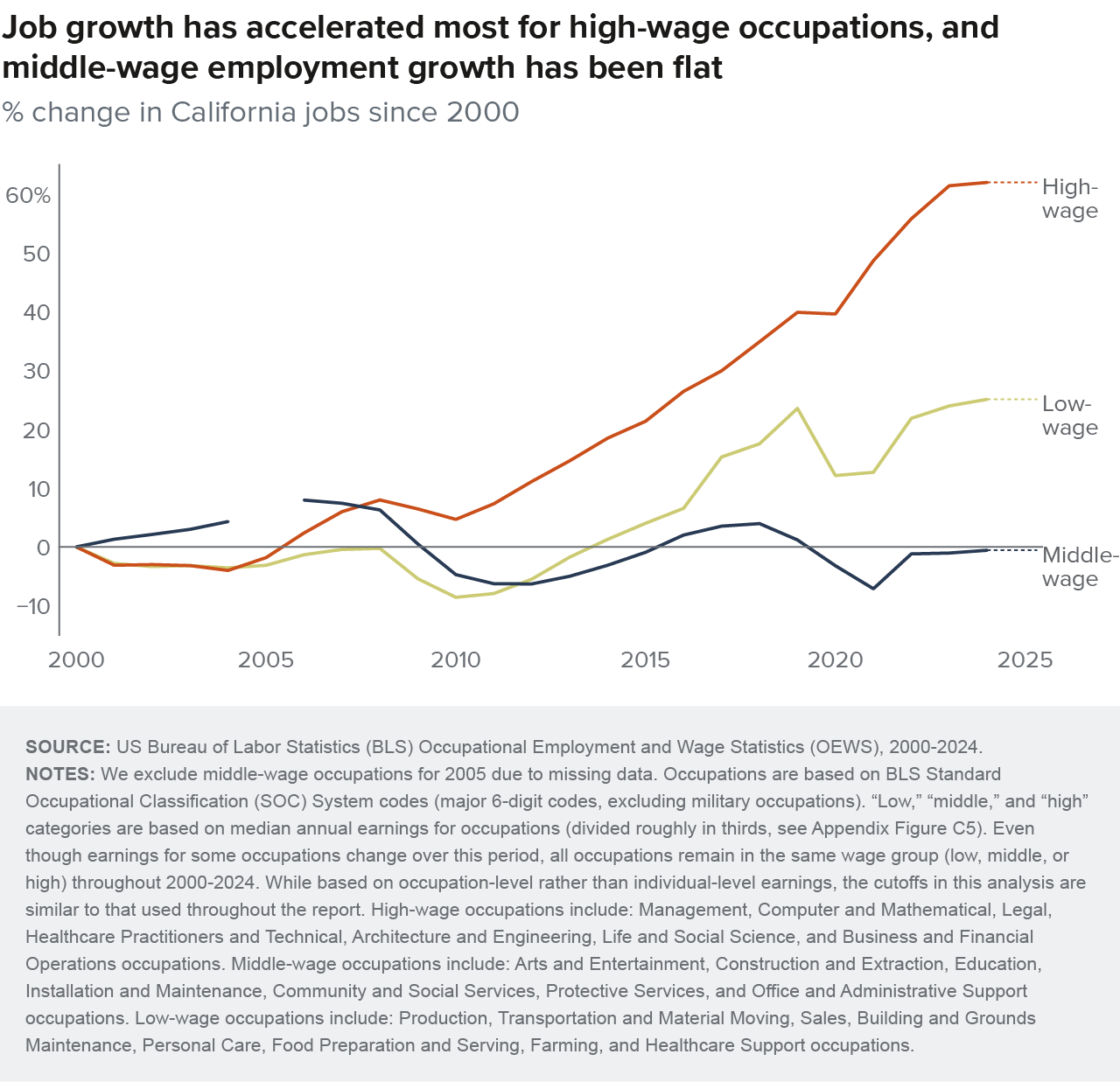
High-wage jobs in business and finance, health care practitioners, and computer and mathematical occupations have grown particularly fast, even as the share of higher-wage jobs altogether makes up just over a quarter of all jobs (up to 27% in 2024 compared to 21% in 2000; see Technical Appendix Figure C6). Low-wage occupations that have grown the most in California over the past 25 years include health care support and personal care, transportation and material moving, and food preparation and serving; together, low-wage occupations comprise 43 percent of California’s total jobs. Finally, while growth among middle-wage occupations overall has stagnated, there has been variation across job types: office and administrative jobs contracted significantly while jobs in education and social services increased slightly.
Job openings—even in lower-wage occupations—are a route to opportunity through work. However, lower-tier earnings may not sustain an individual as they age, start a family, and/or seek homeownership—and stagnating job growth in middle-wage occupations makes it challenging to move up the career ladder.
Indeed, many workers remain in lower-wage jobs over the long haul. Nationwide, only 43 percent of workers in low-wage jobs moved into higher-paying roles within a 10-year period—and the longer workers remain in low-wage jobs, the lower their chances of moving upward (Escobari et al. 2021, based on data through 2019). Given the growth in low-wage and high-wage jobs, with no growth in the middle, stepping stones are becoming less available in many careers. Moving up from low-wage jobs in hospitality, arts and entertainment, agriculture, retail, and administrative jobs is particularly rare. For those who are going to school or balancing family demands, these jobs may be temporary and part time; but full-time workers in these sectors are unlikely to move up the ladder—and in California, most job changers stay within the same sector.
In addition, even as lower-wage jobs have grown, earning levels have barely changed. Inflation-adjusted earnings growth in California was only 4 percent for the lowest-paid segment (the 10th percentile) of the workforce since 1980, and in 2023, a full-time, year-round worker getting a median wage (at the 50th percentile) earned just 7 percent more than a similar worker in 1980 (Figure 5). Meanwhile, wages for workers with the highest earnings (90th percentile) increased 50 percent over many years of consistent growth.
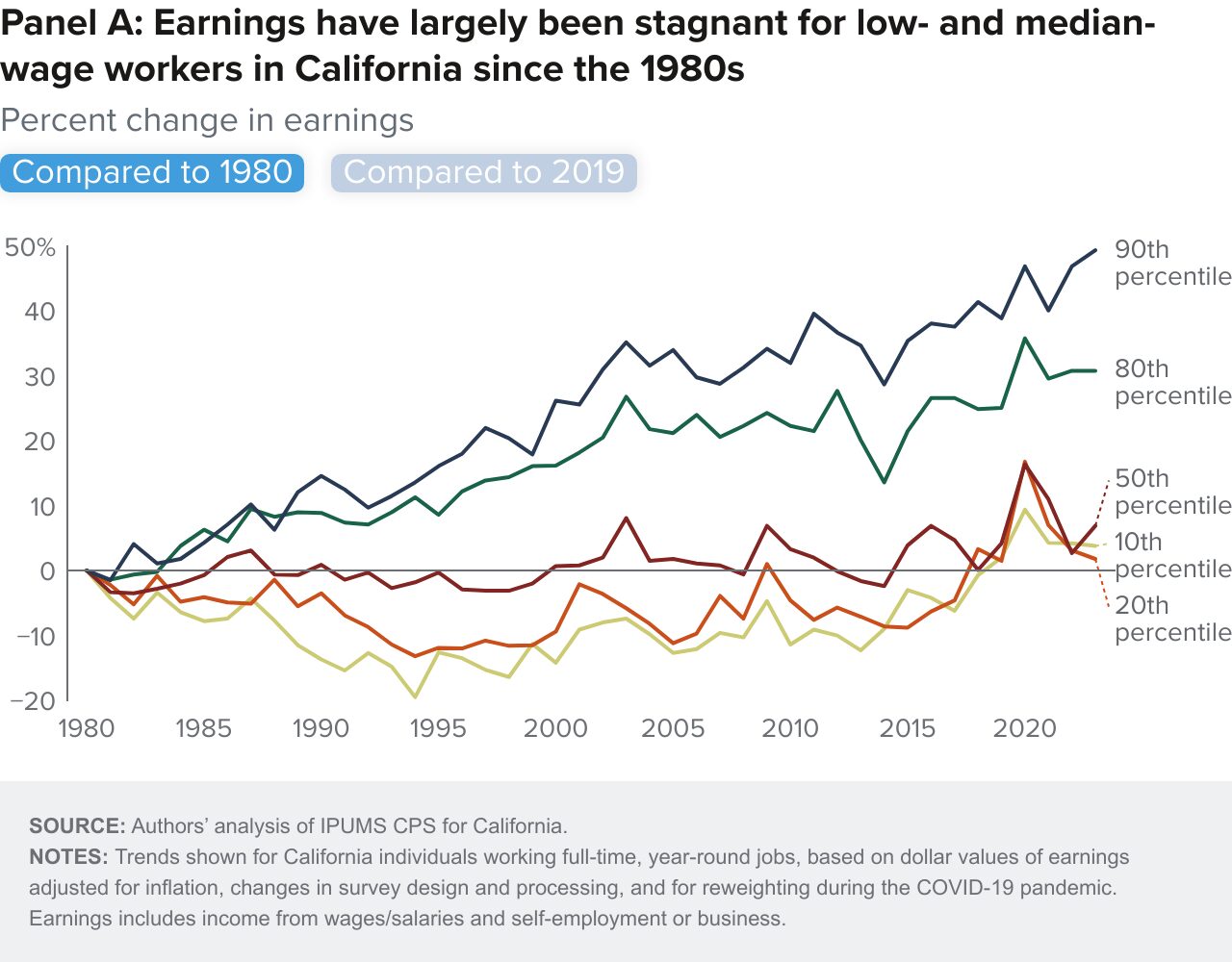


Early in the pandemic, full-time workers saw earnings rise across the board (Figure 5, Panel B). These increases were short-lived for middle- and low-wage workers, however. By 2023, median earnings and below were at most 3 percent higher than in 2019, while top earnings were 5 to 8 percent higher.
Even as the gap has widened between high earners and others, so has the gap between economy-wide returns and those for families. Since the start of the Great Recession (2007), California’s GDP has increased 38 percent, while the fastest-growing family incomes—those at the 90th percentile—have increased only 17 percent (Technical Appendix Figure C7). Middle incomes have grown just 13 percent and low incomes have grown 7 percent over the same period.
Why Are Workers Hesitant about Making Career Changes?
“I’m kind of burnt out after putting so much time in and not really going anywhere, so the idea of adding another thing or to switch a new thing in feels so dangerous. If I drop a ball, the whole thing could fall apart. Everything’s held together with sticks and gum.” – Los Angeles worker
“Things are uncertain. I want a better paying job, but I’m hesitant to look for new employment. Right now I’m stable, and so I’m going to keep with it. It’s the best for now,” – Los Angeles worker
When asked about how they might improve their economic prospects, many workers in our focus groups said they had considered changing jobs, changing careers, starting businesses, and/or going back to school. Yet few felt confident that they could afford to pursue these strategies or that they would pay off. Their perspectives seem to reflect not only the high stakes for individuals trying to come up with a strong plan—especially risky for those who don’t feel economically secure now—but also a broader shift in the economy that makes it particularly difficult to prepare for the future.
Growth Could Require Switching Employers or Careers
“Last week, I had a conversation with my boss about my growth trajectory. I want to grow. I think I’ve made it obvious that I want to grow, and my boss literally had no answer. To me, that speaks volumes to the fact that there’s no path forward. They just want me to do what I’m doing currently and that’s it.” – Central Valley worker
Employers play a critical role in creating jobs, as well as in worker advancement. As noted previously, lower-wage workers in California find fewer opportunities for growth and advancement (43%) than do middle or higher-wage workers (50% and 63%, respectively). According to the PPIC Statewide Survey, lower- and middle-wage workers also report less education and training assistance from employers (39% and 47%, vs. 66% of higher-wage workers). An overwhelming majority of Californians (78%) favor increased funding for job training programs so that more workers can gain the skills they need for today’s jobs (Baldassare et al. 2025d).
Large firms have historically afforded more education and training opportunities to workers as well as internal job ladders or relocation (Black et al. 1999; Carballo et al. 2024; DeVaro et al. 2012). In other words, for workers looking to advance, the size of their employer can play an important role in their chances of moving up. However, most employers in California are small, and the majority of workers are employed by small firms (less than 100 employees; Cremin and McConville 2025). Moreover, working at a large company is not a certain path to career growth, as wage gains at large firms have increasingly accrued to higher-wage workers; further, worker skills and the industry in which they are employed are also critical to earnings potential (Song et al. 2019; Card et al. 2024).
Many workers advance by switching employers, industries, or jobs. For workers seeking to move to higher-paying positions, they will be unlucky and less able to do so if the economy is sluggish or in a recession (Haltiwanger et al. 2018a). In periods of economic growth, more workers are able to move up the ladder; this is particularly important for younger workers, less-educated workers, and workers in successful firms (Haltiwanger et al. 2018b). Data from payroll provider ADP shows that earnings gains since 2021 have been larger for workers who changed jobs—this was especially true after the pandemic lockdowns: annual earnings for job changers increased 16 percent in summer 2022, compared to 8 percent for those who did not change jobs. In 2025, job changers saw 7 percent growth in earnings, compared to 4.4 percent among job stayers.
Although many workers in our focus groups said they wanted to improve their circumstances, many had doubts about making a change.
Workers Are Unsure If or When Investments in Training Would Pay Off
“I’ve been thinking about making a career shift and getting more training, but when you go to school you have to sacrifice a lot of your time, and your ability to work a normal job… it takes money to make money.” – Los Angeles worker
Many workers are reluctant to make changes or investments in the future without certainty that they will pay off and would like to have economic security before introducing more uncertainty in their lives—which puts them in a bind. Others feel especially risk averse from having invested time and money in options that have left them with debt.
This uncertainty is fueled by perceived changes in the return on educational investments. For example, one worker in the San Francisco Bay Area said, “I’ve thought about going back to school, but what’s stopping a robot from doing the job that I would want after I paid hundreds of thousands of dollars to get through school?” This question highlights doubt about making an upskilling investment but also points to uncertainty about a changing world. For individuals from lower-income households, an understanding of how advancing in education will result in improved employment outcomes is an important motivator for pursuing education (Shaefer et al. 2025). However, the workers we spoke to questioned the certainty of this connection. While the cost of education—including time outside the workforce—clearly feels like a barrier, workers may also be responding to a perceived decline in job opportunities, which we discuss next.
A Volatile Labor Market Exacerbates Risk
“Every single extra penny I get, I try to put away so that there is something in case something happens, or I lose my job, or somebody dies. I’m always scared to be in that boat, so I’m trying to do my best, but it’s hard to live right now when you’re so scared of what might happen.” – Bay Area worker
Workers are hesitant to pursue paths that might lead to economic security not only because those paths require personal risks, but also because the current economy is uncertain. The pandemic shook up California’s labor market, erasing jobs and shifting millions of workers to remote work. While the recovery was quick by historical standards, a severe inflation crisis came along with it, putting intense pressure on household budgets. Today, employers are rethinking their workforce plans amid the development of AI. And for most of 2025, employers have been confronting uncertainty caused by international tariffs, shifting federal investments, and global tensions. In sum, economy-wide uncertainty is compounding the challenges workers face in making long-term plans.
The period of ample job openings per unemployed worker and a high rate of quits following the pandemic, where more workers were making changes to better their job circumstances (coined the “Great Resignation”) turned out to be relatively short-lived (Figure 6). Unemployed workers began to outnumber open positions again in March 2023, and quit rates started trending downward—stabilizing near pre-pandemic levels. Employers are also making changes. As of 2024, 75 percent of workers with jobs that could be done remotely were being asked to return to the office, a 12-percentage point increase from a year and a half earlier. Despite this new demand on workers’ personal time and resources, workers are not quitting at a higher rate. These perceived changes in both job opportunities and worker behavior have led to what is being called “job hugging”—sticking with a job for the sake of stability.

According to the PPIC Statewide Survey, Californians are pessimistic about the economy. Three in four believed that California would experience bad financial times in the next 12 months, and one in three said they were financially worse off than they were a year ago (Baldassare et al. 2025b). While those in lower-income households were about as likely to expect bad financial times for California (76%), this group was more likely to report being financially worse off than a year ago (40%).
Job Hunting Feels Increasingly Challenging
For many workers, the challenge of getting a job offer stems from employers, increased competition, and AI. “AI is everywhere,” said one San Diego worker. “If you apply to a job online, they use AI, and your resume doesn’t even get pulled.”
Some workers in our focus groups complained about applying for “ghost jobs”—seemingly open positions—and never getting any response. Research on this phenomenon is thin, but a 2024 employer survey found that 30 percent of companies intentionally post fake positions. For all positions, however, there is evidence that competition is increasing. Through 2019, research from the Federal Reserve has documented increases in the number of job applications submitted by unemployed workers over time. We also heard examples of this from the focus groups. For example, one worker from the Inland Empire said she applies to 50 positions per week.
As employers adopt AI tools to help them screen job candidates, human screeners may find themselves out of work. For example, a Bay Area worker who had been a recruiter in a human resources department reported seeing these positions replaced by AI. The increasing prevalence of AI screening tools is being widely discussed in online platforms and has spurred growth in services that offer to supply job applicants with resume optimization tools.
Amid all of this technological noise, job-search exhaustion has increased, and many workers express a desire to return to a simpler time. Many of our focus group participants mentioned that most of the job-search success they have experienced or seen has been achieved through personal connections. What we heard from many workers is that they wanted to go back to meeting prospective employers in person, and many expressed strong interest in job fairs.
Takeaways from Listening to California Workers
“Stability stands as a problem for me, because not only is it taking up all my time and mental space, worrying and stressing about what’s tomorrow, what we’re going to do moving forward, but it just makes it difficult to kind of get grounded or root yourself in anything and focus on progress forward when you’re so worried about the here and now always.” – Central Valley worker
Perhaps the most significant insight to come out of our focus groups is that many workers who lack economic security are stuck in survival mode. Many Californians we talked to said they were doing whatever it took to make their day-to-day lives work. “What it took” didn’t look the same for everyone. Most reported cutting back on spending, even on necessary household expenses. Some are working multiple jobs and/or doing informal gigs to make ends meet. Some have sought support from family and community or government programs, and those who have sought social safety net assistance—for health insurance, in particular—described careful planning to ensure they wouldn’t lose income eligibility for key resources.
Having trouble consistently meeting basic needs can lead to paralysis and feeling trapped. Sticking with what you know—whether that involves staying in a rent-controlled apartment that the family has outgrown or keeping a job that is stable but doesn’t fully cover household needs—seems like a safer option than reaching for more and landing in a worse position. Many workers in our focus groups are not sure if they can rely on family, friends, or the government to ensure their basic needs are met. And when macroeconomic prospects are also uncertain, economic security feels fleeting and advancement seems completely out of reach. “I feel lucky right now, but if anything goes wrong, I have nothing to fall back on. I can pay my bills and mortgage, but if I lose my jobs or my kids get sick then I would be in trouble,” said one Inland Empire worker. “Maybe I said my financial situation was steady earlier since I was trying to be positive, but it’s not really steady.”
Policymakers can—and in many cases, already do—try to address the set of challenges facing lower-income Californians. For example, safety net programs lifted over 500,000 workers out of poverty in 2023, and California is one of a few states offering paid family leave that can help workers balance caregiving and work in times of need. Yet when we asked workers in our focus groups where they turned for support, few named specific government programs or resources without prompting, and many noted that these programs were helpful when available but did not fully cover their needs.
When asked for a single policy that could best help their financial situations, workers in our focus groups most often emphasized how meaningful it would be for government to control their cost of living and prevent it from increasing rapidly, especially their housing costs. As we have seen, these workers might not have been able to name specific policy solutions; they simply feel that costs have gotten out of control. This was accompanied by a broader feeling among participants that as people struggling to make ends meet, they had been left behind. As one Bay Area worker put it, “It’s getting to the point where it feels like the world is not designed for us anymore. It’s designed for the CEOs and the people who are able to pay to have the laws written the way they want them.”
Californians across political parties and demographic groups agree that “voting gives people like me a say in what the government does” (81%; Baldassare et al. 2025d). However, when asked about the citizens’ initiative process and about having more of a voice in policymaking, focus group participants described feeling overwhelmed by making ends meet and lacking the capacity to engage politically. This suggests that elected leaders will need to proactively engage with Californians who are short on time or energy if they want to include their voices in the process of understanding and responding to their fundamental economic challenges. Tools like Engaged California, which aims to generate discussion among residents to inform policy, may be one option for this type of outreach.
Our conversations with workers suggest that Californians struggling to make ends meet want policymakers to better understand their lives. When we asked what advice they would like to give to policymakers, almost all participants said that they feel misunderstood by government leaders. One worker in the Central Valley summed up the desire for decisionmakers to understand their struggle: “Live like we do, and just see if you can make it work, and see what it feels like. Because until you know how hard it is to live on like $2,000 a month, when rent is like $1,200–$1,800 and you have kids or dependents, then you can’t really conceptualize what people need.”
None of the policy issues raised in this report have easy answers—indeed, California’s leaders have been grappling with many of them for some time. However, the urgency of finding solutions is heightened now. Californians have weathered five years of economic volatility, from the pandemic to an inflation crisis to major political and policy swings to accelerating technological change. All of this is pushing many workers to the brink.
While the workers who participated in our focus groups in the summer of 2025 expressed a deep appreciation for California, they are clearly engaged in a profound struggle for economic well-being for themselves and their families. For these Californians, the challenge feels bigger than it did before the pandemic, and survey data reflects a persistent pessimism about future economic opportunity—both in the near term and for the next generation—among Californians writ large.
Topics
Economic Mobility Economic Trends Economy Health & Safety Net Jobs and Employment Poverty & Inequality Statewide Survey Workforce and TrainingLearn More

Most Californians Expect Little Change to Their Finances Despite Economic Uncertainty

Who Are California’s Workers?
A Year in Neutral for California’s Job Market

Why Do So Many California Workers Feel Economically Insecure?

Five Fast Facts on the Cost of Living in California

Testimony: Cost Pressures and Affordability for Californians in Today’s Economy