Key Findings
California voters signaled their funding priorities by passing a $10 billion state bond for education facilities last November. California’s K–12 public schools are expanding their reach with universal transitional kindergarten and dual enrollment in high schools. But K–12 schools face many challenges, including lagging student test scores, declining school enrollment and chronic absenteeism. Meanwhile, a series of executive orders by the Trump administration is creating uncertainty about education policies and funding, as well as concern about the impact of increased immigration enforcement on students and their families.
These are the key findings of the Californians and Education survey on state policy direction, local public schools, K–12 funding, and early childhood education that was conducted on March 27 to April 4, 2025.
- Seventy-one percent of California adults and 74 percent of public school parents are opposed to the executive order by President Trump to close down the US Department of Education. Sixty-five percent of Californians and 71 percent of public school parents say that they support the executive order requiring that transgender athletes compete on teams that match the sex they were assigned at birth, not the gender they identify with. Sixty-six percent of adults and 74 percent of public school parents are very or somewhat concerned about increased federal immigration enforcement efforts on undocumented students in their local public schools, and majorities are in favor of their local school district designating itself as a sanctuary “safe zone.”
- Forty-five percent of Californians think that the state’s K–12 public education system is headed in the right direction. Half of adults believe that major changes are needed in the state’s K–12 system, and that the quality of education has gotten worse in the past few years. Californians rank five goals as very high or high priorities for K–12 public schools: teaching students the basics (91%), teaching life skills (79%), preparing students to be engaged citizens (67%), preparing students for the workforce (66%), and preparing students for college (57%). About half approve of the way that Governor Newsom, the state legislature, and superintendent of public instruction Tony Thurmond are handling the state’s K–12 public education system.
 Most Californians and public school parents give their local public schools passing grades. Majorities say that their local public schools are doing an excellent or good job in preparing students for college, jobs and the workforce, and engaged citizenship. Almost half think that teachers’ salaries as compared to their cost of living are a big problem. About one in three say they are very concerned about the threat of mass shootings at their local public schools.
 Forty-eight percent of adults think that there is not enough state funding for their local public schools. Majorities of likely voters would vote “yes” on state and local school bond measures. Two-thirds of adults are in favor of the Local Control Funding Formula, which provides additional funding for school districts with more English language learners and lower-income students. About six in ten are very or somewhat concerned about declining student enrollment affecting their local public schools’ funding. A majority of likely voters are opposed to providing parents with tax-funded vouchers to send their children to their choice of a public, private, or parochial school.
- About two in three Californians think that the state government should fund voluntary preschool programs, such as transitional kindergarten, for all four-year-olds in California. Seven in ten are very concerned or somewhat concerned that children in lower-income areas are less likely than others to be ready for kindergarten. Four in ten think that the affordability of preschool education is a big problem, compared to 15 percent who say that the quality of preschool education is a big problem. Forty-five percent of adults and 56 percent of public school parents say that attending preschool is very important to a student’s success in kindergarten through grade 12.
 Forty-eight percent of adults think that there is not enough state funding for their local public schools. Majorities of likely voters would vote “yes” on state and local school bond measures. Two-thirds of adults are in favor of the Local Control Funding Formula, which provides additional funding for school districts with more English language learners and lower-income students. About six in ten are very or somewhat concerned about declining student enrollment affecting their local public schools’ funding. A majority of likely voters are opposed to providing parents with tax-funded vouchers to send their children to their choice of a public, private, or parochial school.
K–12 Policy Direction and State Approval Ratings
We gauged the perceptions of California adults and public school parents regarding the state’s K–12 policy direction and their approval of the way that the state’s elected officials are handling the state’s K–12 public education system. We also examined Californians’ concerns and levels of support for three recent executive orders that have consequences for state education policy and public school students.
Changing Federal Landscape. President Trump issued an executive order to close the US Department of Education. Seventy-one percent of adults and 74 percent of public school parents oppose closing down the department; majorities across state regions and demographic groups are opposed, while partisans are divided (91% Democrats, 31% Republicans, 72% independents). President Trump also issued an executive order to ban transgender participation in sports in educational institutions. Sixty-five percent of adults and 71 percent of public school parents support requiring transgender athletes to compete on teams that match the sex they were assigned at birth, not the gender they identify with; majorities across the state’s regions and demographic groups are in support, while partisans are divided (49% Democrats, 91% Republicans, 71% independents).
President Trump issued an executive order to step up federal immigration enforcement that has implications for undocumented residents, including public school students and their families. Sixty-six percent of adults and 74 percent of public school parents are very concerned or somewhat concerned about the impact of increased immigration enforcement on undocumented students in their local public schools as well as on the families of these students. Sixty-three percent of adults and 72 percent of public school parents are in favor of their local public school district designating itself as a sanctuary “safe zone” to indicate that it will protect undocumented students and their families from immigration enforcement, and 69 percent of adults and 74 percent of public school parents are in favor of their local public schools requiring staff to keep information about the immigration status of students and their families confidential. Majorities across the state’s regions and demographic groups hold these views, while partisans are divided.
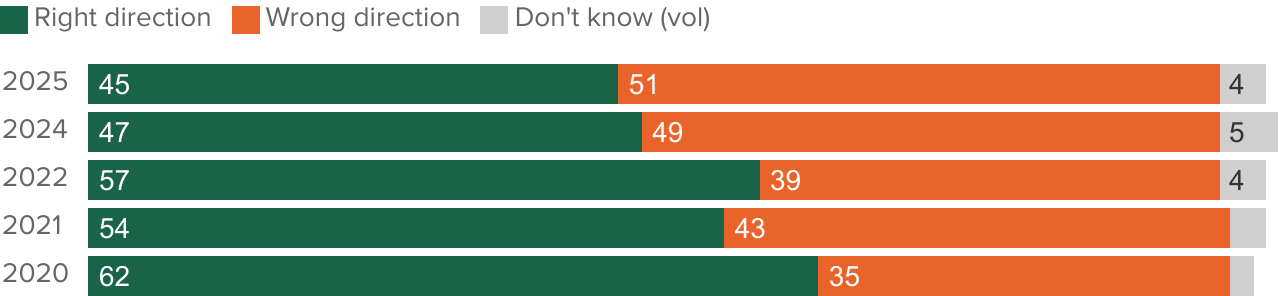
California K–12 Public Education System. Fewer than half of adults (45%) and likely voters (46%)— compared to 56 percent of public school parents—think that the state’s K–12 public education system is generally going in the right direction today. The perception that the system is generally going in the right direction is below 50 percent across state regions and age and income groups, but it varies across racial/ethnic groups (50% Asian Americans, 49% Latinos, 45% African Americans, 39% whites). There is also a partisan divide: 65 percent of Democrats think the K–12 public education system is generally going in the right direction today, compared to 16 percent of Republicans and 38 percent of independents. A similar share of adults said that the state’s K–12 public education system was generally headed in the right direction last year, while majorities said the state’s K–12 system was headed in the right direction in 2020, 2021, and 2022.
Less than a majority say California's K–12 public education system is headed in the right direction
SOURCE: PPIC Statewide Surveys, 2020-2025.
Half of adults and 44 percent of public school parents think that “major changes” are needed in the state’s K–12 public education system. About four in ten are very concerned that schools in lower-income areas have a shortage of good teachers compared to wealthier areas; somewhat similar shares are very concerned that public school students in lower-income areas are less likely than others to be ready for college.
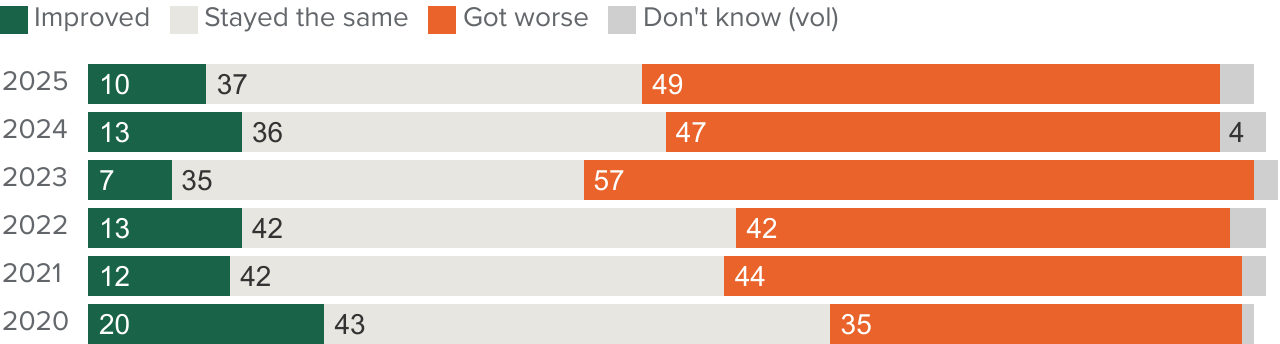
About one in three adults and 25 percent of public school parents view the quality of education in California’s K–12 public schools today as a big problem. Half of adults and 41 percent of public school parents think that the quality of education has gotten worse over the last few years. Pluralities hold this view across the state’s regions and demographic groups. Partisan perceptions vary: 75 percent of Republicans think educational quality has worsened, compared to 50 percent of independents and 35 percent of Democrats. Over the past several years, pluralities have said that education quality has gotten worse.
Nearly half of adults think the quality of education in California's K–12 public schools has gotten worse
SOURCE: PPIC Statewide Surveys, 2020-2025.
Just 19 percent of adults and 23 percent of public school parents say that California ranks “near the top” or “above average” in student test scores compared to other states. Thirty-nine percent of adults and 49 percent of public school parents view the state as “average” in this domain. Thirty-eight percent of adults and 28 percent of public school parents say the state is “below average” or “near the bottom.” Partisans vary in their perceptions of the state’s ranking in student test scores. Lagging student test scores compared to national averages have been found in recent reports.
Most Important Goals. What is the most important goal for California’s K–12 public schools? California adults most often choose teaching students the basics (40%), followed by teaching life skills (21%), preparing them for college (16%), preparing them to be engaged citizens (11%), and preparing them for the workforce (8%). Importantly, public school parents most often choose preparing for college (32%), followed by teaching the basics (25%) and teaching life skills (23%) as the top goal. Majorities of adults rate all five goals as “very high” or “high” priorities for California’s K–12 public schools: teaching the basics (91%), teaching life skills (79%), preparing students to be engaged citizens (67%), preparing students for the workforce (66%), and preparing students for college (57%). Public school parents (72%) are more likely than adults to say that preparing students for college is a very high or high priority.
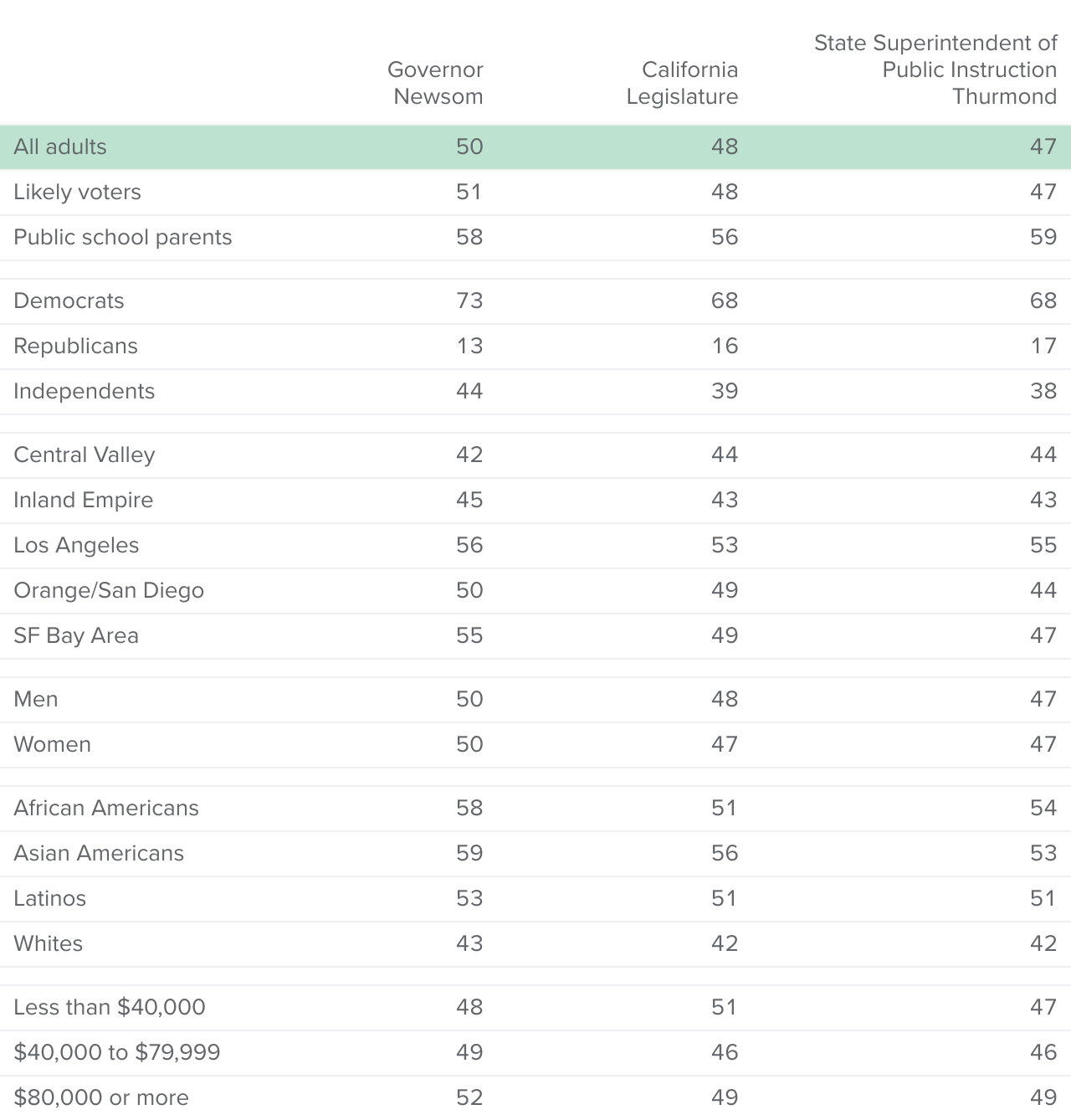
State Approval Ratings. Approval levels of the way state elected officials are handling K–12 public education are aligned with divided views about the direction of the state K–12 public education system. Fifty percent of adults and 51 percent of likely voters approve of Governor Newsom’s handling of the state’s K–12 public education system. Similarly, 48 percent of adults and likely voters approve of the California legislature’s handling of the system. California Superintendent of Public Instruction Thurmond receives a 47 percent approval rating from both adults and likely voters for his handling of the K–12 public education system. Partisans are divided. Public school parents give higher approval ratings than adults to the governor (58%), state legislature (56%), and superintendent of public instruction (59%). Approval ratings were similar a year ago.
Half of Californians approve of the way Newsom, state legislature, and Tony Thurmond are handling the K–12 public education system
% approve
SOURCE: PPIC Statewide Survey, April 2025. Survey was fielded from March 27-April 4, 2025 (n=1,591 adults, n=1,094 likely voters, and n=279 public school parents).
Local Public Schools
Californians give passing grades to the quality of their local public schools; most give grades of B (36% adults, 37% public school parents) or C (33% adults, 29% public school parents), while relatively few give an A (12% adults, 17% public school parents). Most say their grade is primarily based on their own experience (41% adults, 62% public school parents), their family or friends (27% adults, 23% public school parents), or their consumption of news media (20% adults, 9% public school parents).
Majorities of adults and public school parents say their local public schools are doing an excellent or good job of preparing students for college (adults: 9% excellent, 56% good; public school parents: 11% excellent, 64% good). Adults and public school parents held similar views last April. Today, majorities across parties, regions, and demographic groups hold a positive view—with the exception of African Americans (46%). More than half of adults (6% excellent, 48% good) and two-thirds of public school parents (10% excellent, 56% good) say their local schools are doing well at preparing students for jobs and the workforce. About half or more across demographic groups and regions hold this positive view, while partisans are divided.
A majority of adults (55%) and public school parents (70%) also say that their local schools are doing an excellent or a good job in preparing students to be engaged citizens. Democrats (62%) are more likely than independents (50%) and Republicans (47%) to say this.
Majorities say local schools are doing well at preparing students for college and preparing students for the workforce
% excellent/good job at . . .

SOURCE: PPIC Statewide Survey, April 2025. Survey was fielded from March 27-April 4, 2025 (n=1,591 adults, n=1,094 likely voters, and n=279 public school parents).
Most Californians express concern about issues related to English language learners. About seven in ten adults and public school parents express concern about improving outcomes for English language learners; nearly all (85% adults, 86% public school parents) say it is important for California’s future economic well-being to improve outcomes for these students. Two-thirds favor providing extra assistance to English language learners. Californians are more divided on whether districts with more English language learners should receive more funding from the state or not (adults: 52% should, 46% should not; public school parents: 58% should, 41% should not).
An overwhelming majority of adults and public school parents are very concerned or somewhat concerned about the threat of mass shootings in local schools. Seven in ten or more Democrats and independents are concerned, compared to about half of Republicans. Solid majorities across regions and demographic groups express concern. Overwhelming majorities of adults and public school parents support having one or more armed police officers on duty when school is in session (adults: 35% strongly, 36% somewhat; public school parents: 47% strongly, 29% somewhat). Solid majorities across parties, regions, and most demographic groups support this.
A majority of adults (55%) and close to half of public school parents (47%) are very concerned or somewhat concerned about chronic absenteeism (defined as absence on 10% or more of school days). Similarly, about half of adults (48%) and most public school parents (54%) are concerned about the threat posed by wildfires to their local schools.
Overwhelming majorities of adults are concerned about the threat of a mass shooting in their local schools
SOURCE: PPIC Statewide Survey, April 2025. Survey was fielded from March 27-April 4, 2025 (n=1,591 adults, n=1,094 likely voters, and n=279 public school parents).
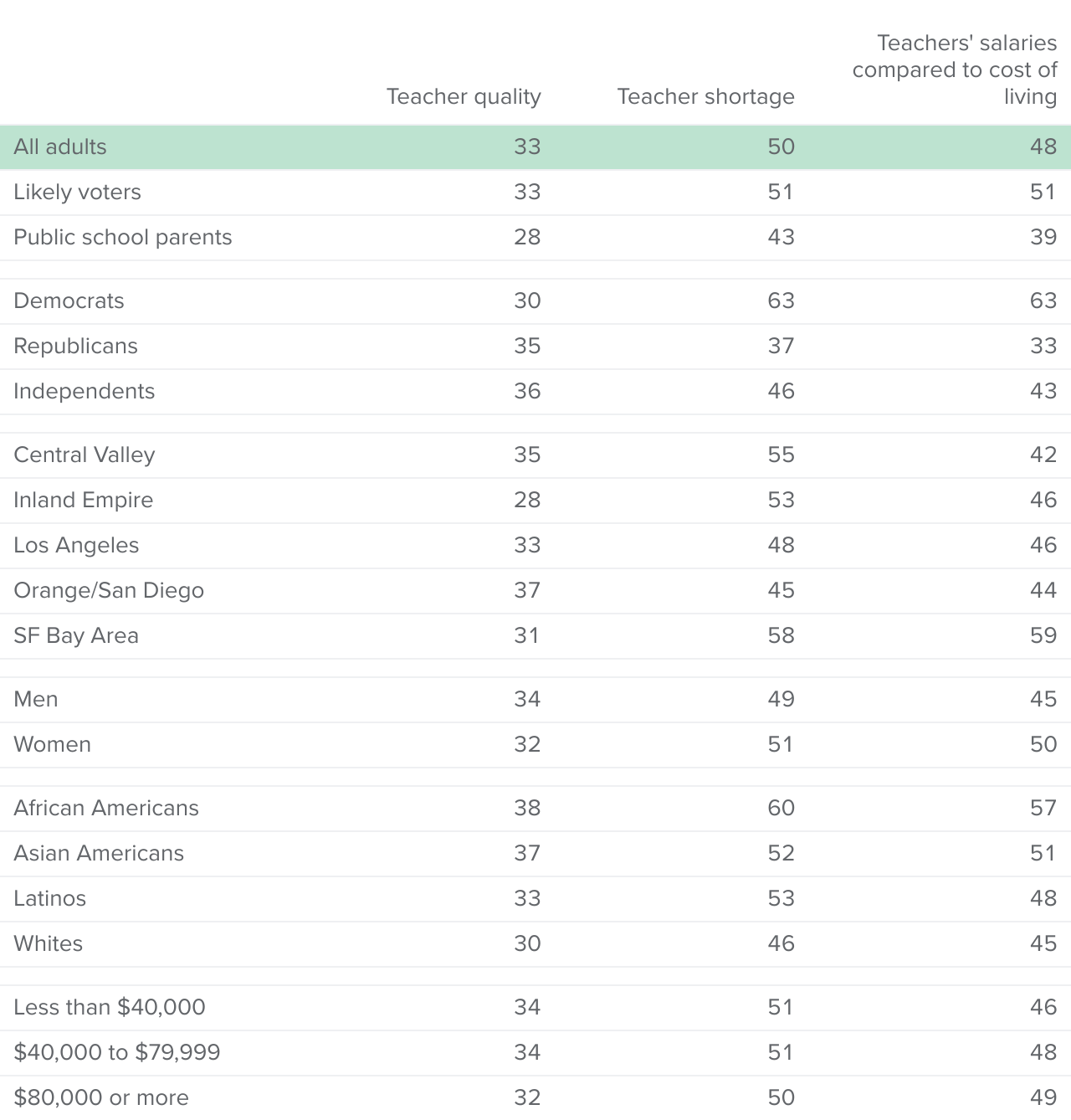
Nearly all adults and public school parents say teacher shortages are at least somewhat of a problem (adults: 50% big, 37% somewhat; public school parents: 43% big, 45% somewhat). Fewer than half of residents in Los Angeles and Orange/San Diego say teacher shortages are a big problem, compared to majorities in other regions. Across parties and demographic groups, Democrats and African Americans are most likely to think this is a big problem.
Nearly all Californians say teacher salaries compared to the cost of living are a problem in the state (adults: 48% big, 38% somewhat; public school parents: 39% big, 49% somewhat). More than four in ten across parties, regions, and demographic groups see this as a big problem, with the exception of Republicans (33%). Far fewer say that teacher quality is a big problem (33% adults, 28% public school parents), while almost half say it is somewhat of a problem (46% adults and public school parents). Fewer than four in ten across parties, regions, and demographic groups say teacher quality is a big problem in the state.
Strong majorities of adults (66%) and public school parents (69%) approve of teachers’ unions. With the exception of Republicans (37%), six in ten or more across parties, regions, and demographic groups approve of teachers’ unions.
Half say a teacher shortage and teachers' salaries are a big problem in the state; a third say the same of teacher quality
% big problem
SOURCE: PPIC Statewide Survey, April 2025. Survey was fielded from March 27-April 4, 2025 (n=1,591 adults, n=1,094 likely voters, and n=279 public school parents).
K–12 Education Funding
About half of adults (48%) and public school parents (50%) say the current level of funding for their local public schools is not enough, while a third or more (34% adults, 40% public school parents) say it is just enough, and about one in ten (13% adults, 9% public school parents) say it is more than enough. California ranked 17th out of the 50 states in per student expenditures for public K–12 education, according to the National Education Association’s Ranking and Estimates report. Asked where they think California currently ranks in per pupil spending for K–12 public schools, adults are most likely to say it has an average ranking (36%). Nearly four in ten say it is near the top (14%) or above average (24%), and fewer than a quarter say it is below average (18%) or near the bottom (5%). About half have said the state has an average ranking since 2020, while a majority expressed this view in 2019.
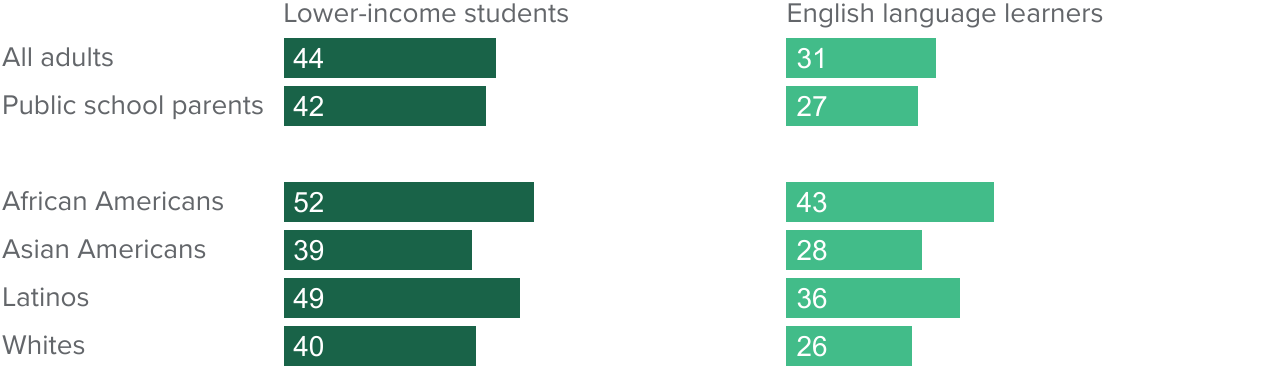
When it comes to the current level of resources for lower-income students in their local public schools, about four in ten adults (44%) and public school parents (42%) say it is not enough. Similar shares say it is just enough (39% adults, 46% public school parents) and one in ten say it is more than enough (12% adults, 11% public school parents). Overall views were similar a year ago. Across regions and demographic groups today, African Americans (52%), adults 18 to 34 (52%), and those with incomes under $40,000 are the most likely to say that the resource level for lower-income students is not enough.
About three in ten Californians say the current level of resources for English language learners is not enough (31% adults, 27% public school parents). Half of adults (50%) and six in ten public school parents (60%) say there are just enough resources, and fewer say the level is more than enough (14% adults, 11% public school parents). Views overall were similar a year ago. Today, about four in ten or more across parties, demographic, and regional groups say resource levels for English language learners are just enough.
Four in ten or fewer say the current level of resources is not enough for students with lower incomes or whose first language is not English
% not enough
SOURCE: PPIC Statewide Survey, April 2025. Survey was fielded from March 27-April 4, 2025 (n=1,591 adults, n=1,094 likely voters, and n=279 public school parents).
After reading a brief description of the Local Control Funding Formula (LCFF)—which provides additional funding to school districts that have more English language learners and lower-income students and gives local school districts more flexibility in spending state funding—strong majorities of adults (66%) and public school parents (73%) are in favor. Support for the LCFF was similar a year ago, and majorities have supported this since PPIC first asked about it in April 2014. Still, most say they have heard nothing at all about the LCFF (78% adults, 67% public school parents).
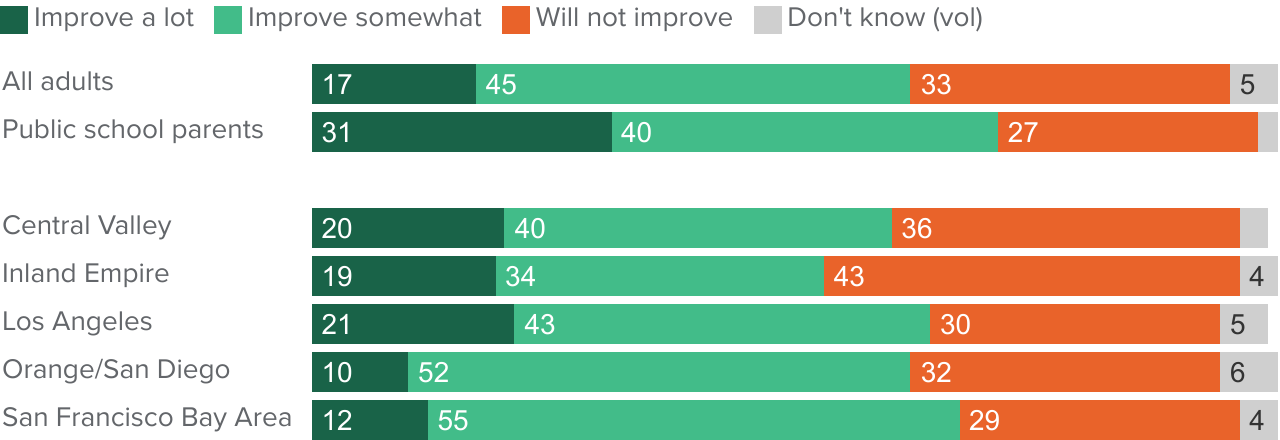
Most adults and public school parents say the LCFF will improve academic achievement of English language learners and lower-income students either a lot (17% adults, 31% public school parents) or somewhat (45% adults, 40% public school parents. Similar shares expressed these views a year ago. Today, most Democrats and independents say it will help improve academic achievement, while most Republicans say it will not. Majorities across demographic and regional groups say the LCFF will improve academic outcomes.
A solid majority think the Local Control Funding Formula will improve academic achievement of English language learners and lower-income students
SOURCE: PPIC Statewide Survey, April 2025. Survey was fielded from March 27-April 4, 2025 (n=1,591 adults, n=1,094 likely voters, and n=279 public school parents).
Nearly two in three public school parents (64%) say their school district has not provided them with information about how to become involved with developing and revising the accountability plans for allocating resources that is required by the LCFF.
In November 2024, California voters passed Proposition 2 (58.7% yes), a $10 billion initiative aimed at supporting construction projects by public schools and community colleges). Today, majorities of adults (58%), likely voters (55%), and public school parents (74%) say they would vote yes on a state ballot measure to pay for school construction projects. Majorities of adults (57%), likely voters (52%)—and two in three public school parents (68%)—would support a local school construction bond, which would require 55 percent support to pass. Asked about a local parcel tax increase to create more funds for local public schools—which would require two-thirds support to pass—majorities of adults (52%) and likely voters (53%) say they would vote no, and fewer than two-thirds of public school parents (57%) express support.
Half of adults (50%) and a solid majority of public school parents (62%) would favor tax-funded vouchers that would allow them to send their children to any public, private, or parochial school they choose; however, a majority of likely voters are opposed (54%). Most Republicans support vouchers, while most Democrats and independents are opposed.
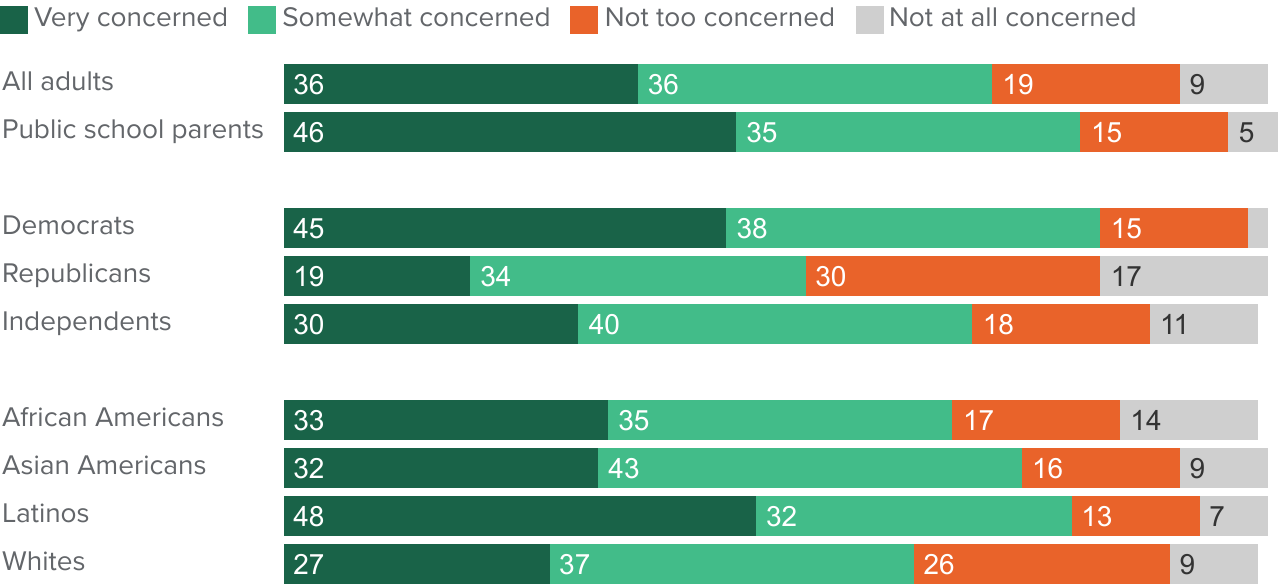
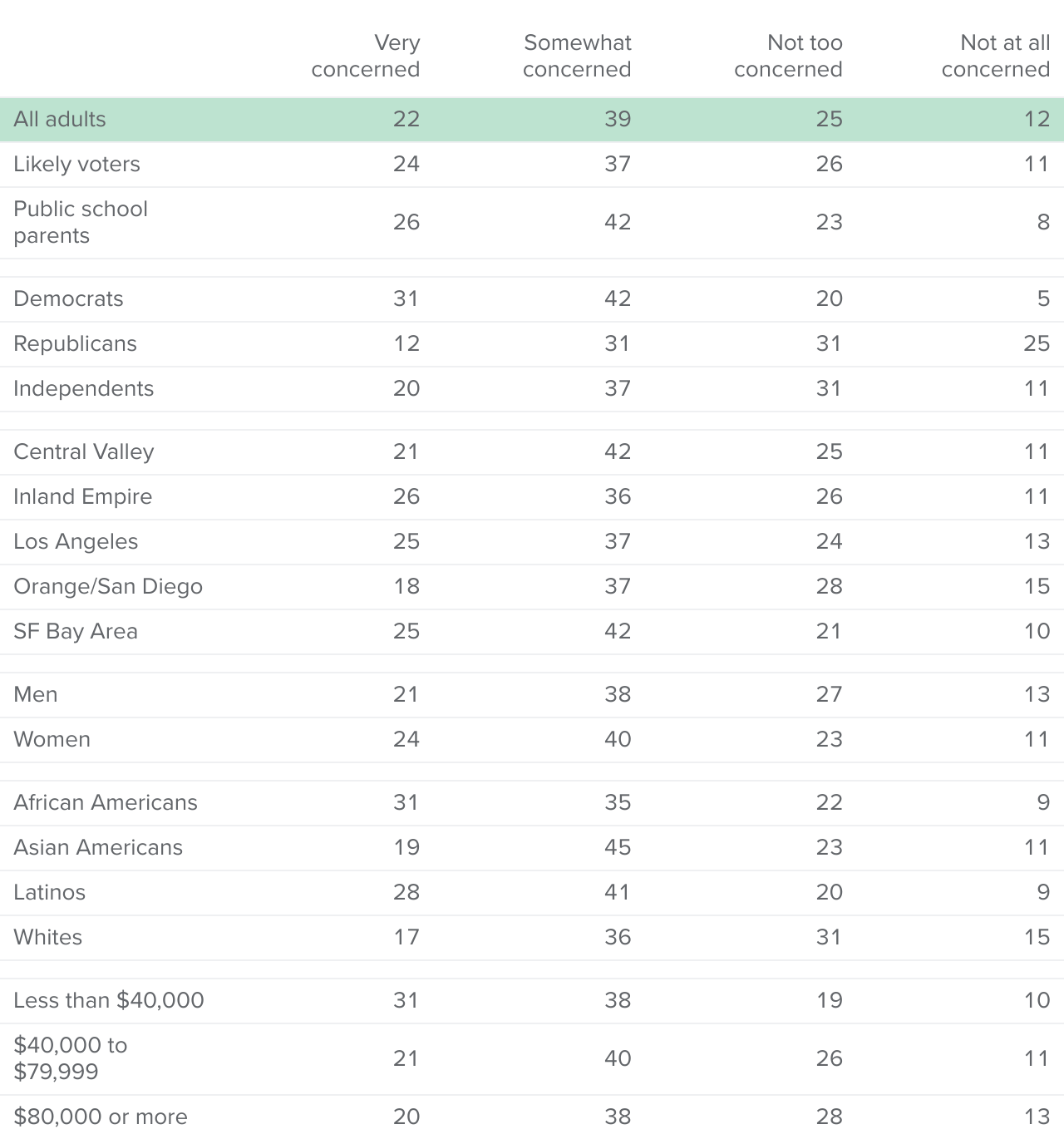
Sixty-one percent of adults and 68 percent of public school parents say they are very concerned or somewhat concerned that declining school enrollment will affect funding for their local public schools. Majorities of Democrats and independents say this, while a majority of Republicans say they are not too concerned or not at all concerned. Majorities across demographic, regional, and partisan groups express concern, including two in ten or more who are very concerned.
About six in ten Californians are concerned about declining enrollment affecting funding for their local public schools
SOURCE: PPIC Statewide Survey, April 2025. Survey was fielded from March 27-April 4, 2025 (n=1,591 adults, n=1,094 likely voters, and n=279 public school parents).
Early Childhood Education
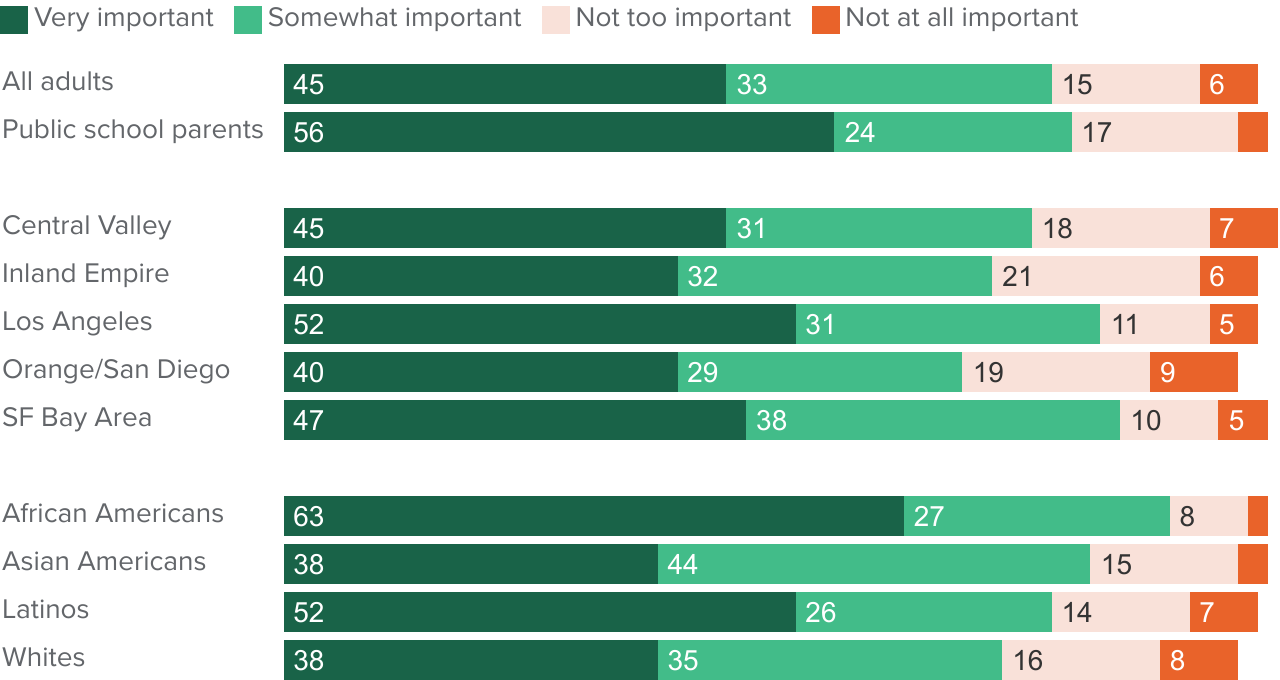
As part of a multiyear plan under AB 130, transitional kindergarten in California’s public schools will be available to all four-year-olds for the 2025–26 school year. As they have in surveys dating back to 2006, more than three in four Californians continue to say that preschool is important to a student’s success in kindergarten through grade 12. Today, one in five Californians say it is not too or not at all important. Notably, public school parents are more likely than adults overall to say attending preschool is very important. About seven in ten or more across parties, regions, and demographic groups view preschool as important, but there are some subgroup differences. Democrats (54%) are much more likely than independents (40%) or Republicans (33%) to say preschool is very important. African Americans and Latinos are more likely than Asian Americans and whites to hold this view. Interestingly, those with a high school diploma or less (53%) are more likely than those with some college (43%) and college graduates (39%) to say attending preschool is very important.
Most Californians think attending preschool is important
SOURCE: PPIC Statewide Survey, April 2025. Survey was fielded from March 27-April 4, 2025 (n=1,591 adults, n=1,094 likely voters, and n=279 public school parents).
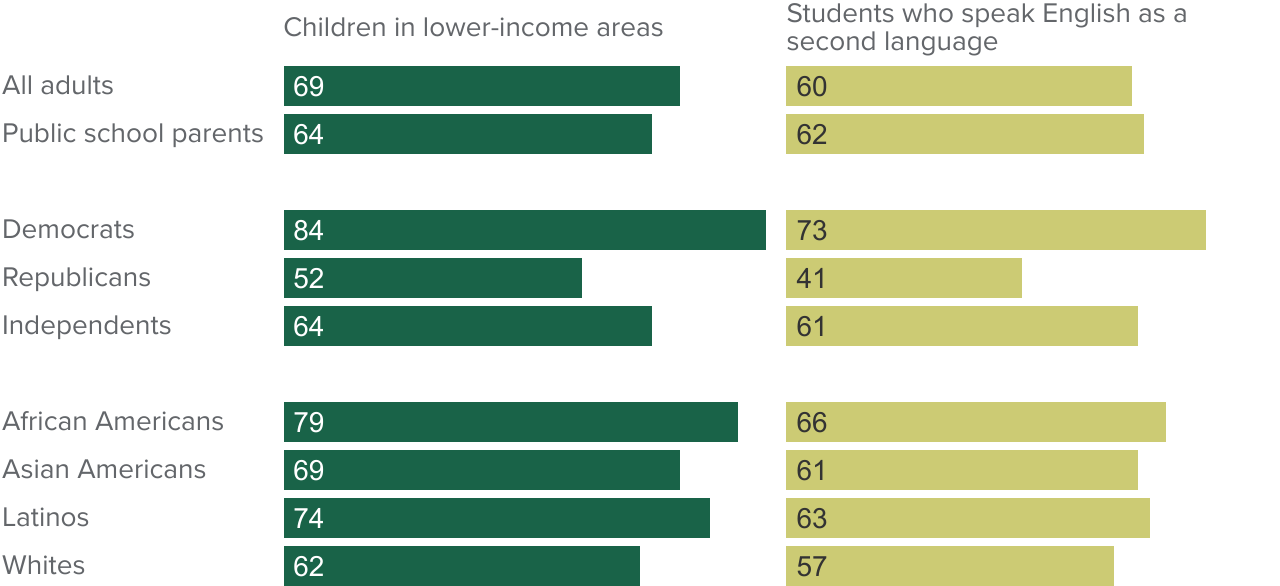
As California expands transitional kindergarten as part of the state’s early childhood education system, how do Californians perceive the readiness for kindergarten of students in lower-income areas and those who speak English as a second language? Most are concerned about both groups, but concern about students in lower-income areas is somewhat higher. And while partisans are divided, solid majorities of Californians across regions and demographic groups are at least somewhat concerned about the kindergarten readiness of students in lower-income areas. Six in ten adults—with partisans divided—and majorities across regions and demographic groups are concerned about students who are English language learners being ready for kindergarten. Concern about the readiness of both groups of students has held steady in recent years.
Most Californians worry whether students in lower-income areas and students who are English language learners are ready for kindergarten
% very or somewhat concerned
SOURCE: PPIC Statewide Survey, April 2025. Survey was fielded from March 27-April 4, 2025 (n=1,591 adults, n=1,094 likely voters, and n=279 public school parents).
While universal transitional kindergarten is likely to help address the affordability of a preschool education, eight in ten Californians today say that affordability is a big problem (39%) or somewhat of a problem (41%). Public school parents hold similar views (36% big problem, 47% somewhat of a problem). At least three in four across parties, regions, and demographic groups view the affordability of preschool education as at least somewhat of a problem. Concern about the quality of preschool education is less prevalent among all adults (15% big problem, 49% somewhat of a problem) and public school parents (14% big problem, 52% somewhat of a problem). But majorities across parties, regions, and demographic groups say the quality of preschool is a problem. On both questions, perceptions today are similar to findings from recent years.
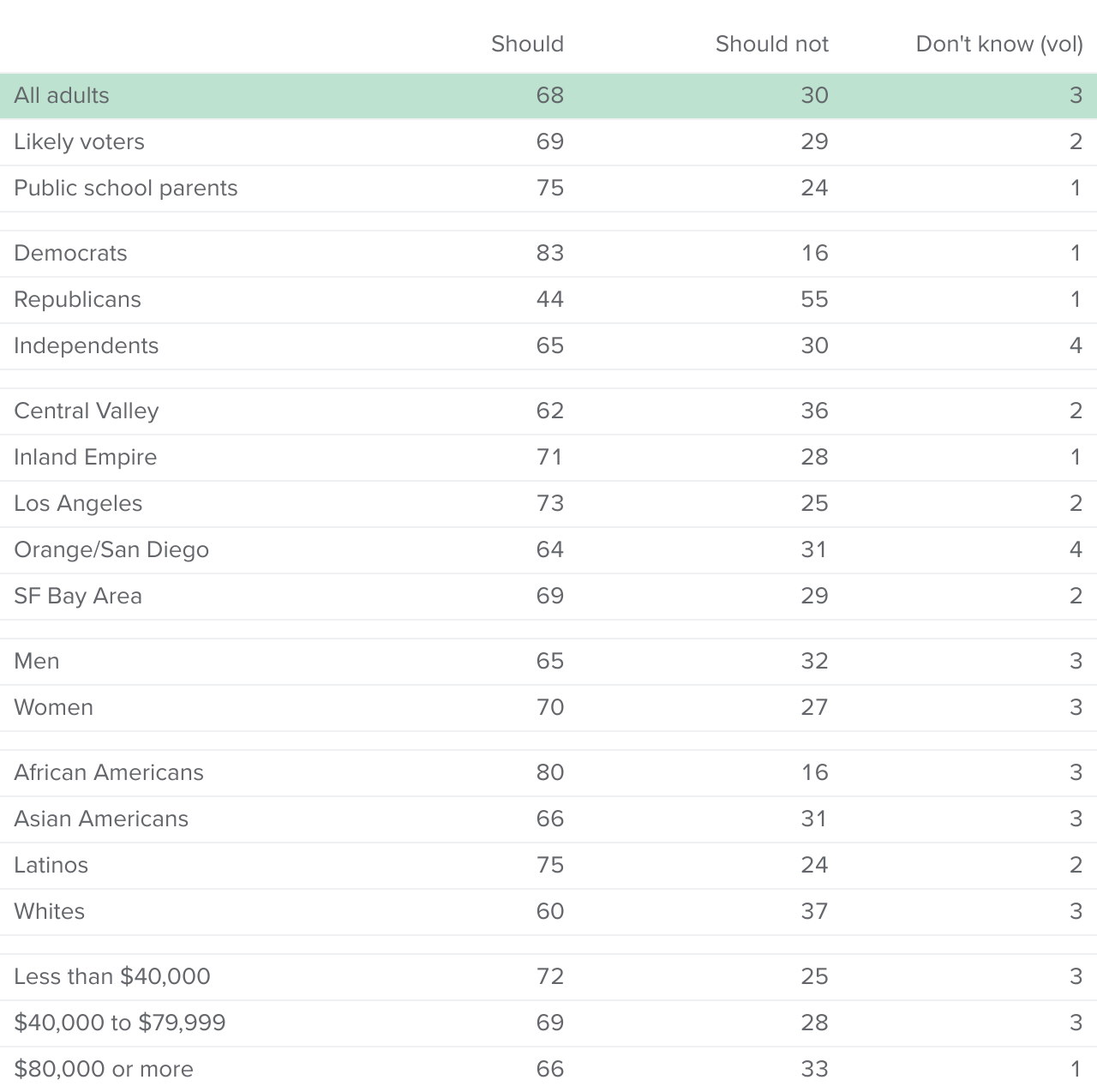
How do Californians feel about the state funding preschool programs such as transitional kindergarten? Two-thirds or more of adults, likely voters, and public school parents think the state should fund voluntary preschool programs for all four-year-olds in California. Notably, more than six in ten have held this view since we first asked this question in April 2014. Today, solid majorities across parties, regions, and demographic groups—with the exception of Republicans—support state funding for preschool. Democrats and independents are far more likely than Republicans to think the state should fund preschool programs. Across racial/ethnic groups, African Americans and Latinos are more likely than Asian Americans and whites to hold this view; those with varying levels of education are similarly likely to express support (69% high school or less, 66% some college, 67% college graduate).
A strong majority of Californians think the state should fund voluntary preschool programs for all four-year-olds in California
SOURCE: PPIC Statewide Survey, April 2025. Survey was fielded from March 27-April 4, 2025 (n=1,591 adults, n=1,094 likely voters, and n=279 public school parents).

Topics
K–12 Education Political Landscape Statewide Survey