

Key Takeaways
Coursework in civics teaches collaboration—an indispensable skill in a democracy—as well as critical thinking. And it provides fundamental knowledge about the world around us, helping students understand how to engage constructively with key systems that shape our experience: the law, the policymaking process, elections, and how to improve the lives of all.
Majorities of Californians say:
- Civic education is a very high or high priority for K–12 education. But for adults and public school parents, civics is competing with many other important education goals.
- California schools are doing at least a good job teaching civics; public school parents are slightly more likely to hold this view.
- The top priority for civic education is learning about the US Constitution, with broad consensus across regions, political parties, and demographic groups.
Knowledge about and understanding of civics is especially important in California, where voters regularly make major policy decisions through the initiative process. California needs informed and engaged residents who understand and take an active role in their government.
Introduction
Today’s students are tomorrow’s voters, leaders, and problem solvers. It’s essential for them to understand how our government works, how to engage in the political process, and what their rights and responsibilities are as members of a democratic society. They must also grapple with how to effect change and how to engage—in a collegial and civil manner—those who have a different point of view.
The influence of civics extends far beyond the election season. Put simply, it is woven through the fabric of our daily lives—from establishing policy and infrastructure that determine access to clean water, to refining programs that support the availability of school lunches, to making government investments that further our ability to connect to the internet. To some extent, it is the everyday nature of civics that makes its significance so hard to see.
Learning How Californians View Civics
To understand how the public thinks about civics issues we asked a series of questions in our April PPIC education survey. Although there is some recent national polling about the importance of civic education, little public opinion data exists to help us understand how Californians view civics and its role in K–12 education.
This report explores responses from California adults—and public school parents in particular—to a range of questions, from the relative and absolute importance of civic education to perceptions of how the local public schools are performing in this realm to the topics and activities that should be the focus of a civic education. We then offer reflections and recommendations for moving forward.
Civic Education as a Priority
While most adults do not view preparing students to be engaged citizens as the top goal for K–12 education, for majorities of Californians and public school parents civic education is still a priority.
Californians Place Civics among the Top Five Goals for Public Schools
In our survey, we asked participants to name the most important among five top goals for California’s K–12 public schools. Adults mentioned three other topics ahead of civic education. They largely prioritize
- teaching students the basics (40%),
- teaching students life skills (21%), and
- preparing students for college (16%).
After these top three goals, Californians then turn to civics and career readiness as the most important priorities for schools:
- preparing students to be engaged citizens (11%) and
- preparing students for the workforce (8%).
Four percent of adults give other responses and only 1 percent are not sure.
Parents take a slightly different perspective from that of all California adults on the areas they would like their K–12 schools to prioritize. Public school parents choose as top goals:
- preparing for college (32%),
- teaching the basics (25%), and
- teaching life skills (23%).
Similar to all adults, however, 11 percent of parents say the top goal is teaching students to be engaged citizens.
When we break down views by California’s political groups and by the state’s regions, contrasting opinions emerge on the matter of educating students to be engaged citizens.
- Among partisans, Democrats (13%) and independents (10%) place greater emphasis on civic education than do Republicans (5%).
- Across regions, residents in the San Francisco Bay Area (15%) and in Los Angeles (12%) give more weight to civic education as a top goal than do other regions; levels fall thereafter, with 10 percent in the Inland Empire, 8 percent in Orange/San Diego counties, and 7 percent in the Central Valley.
Views on the importance of teaching civics vary to a lesser degree across educational levels (14% college graduate, 9% some college, 9% high school or less)—and views vary little across age, gender, income, and racial/ethnic groups.
Californians Rank All Top Educational Goals as High Priorities
Next, we asked our survey respondents to separately rank each of these five goals for California’s K–12 public schools on a five-point scale ranging from “very high priority” to “very low priority.”
Every goal earns a rating of “very high” or “high” priority from majorities of adults:
- teaching students the basics (91%),
- teaching students life skills (79%),
- preparing students to be engaged citizens (67%),
- preparing students for the workforce (66%), and
- preparing students for college (57%).
Fewer than one in ten adults give “very low” or “low” priority ratings to any of these goals.
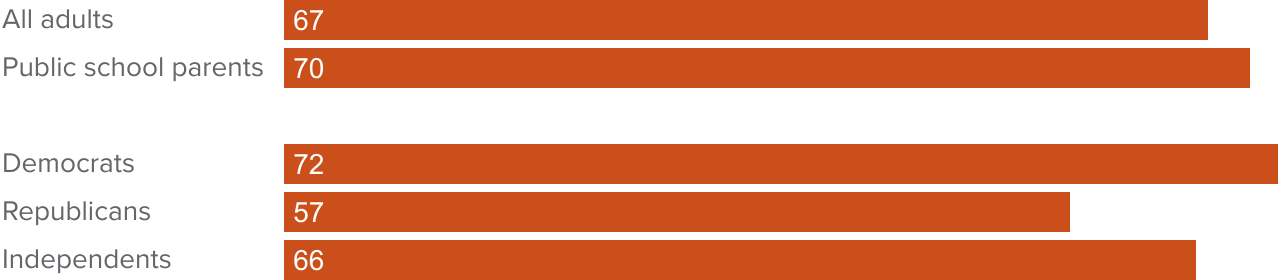
Public school parents rate each goal as a “very high” or “high” priority for schools in similar shares as all adults do. On the specific goal of preparing students to be engaged citizens, 70 percent of parents think it should be a very high or high priority, while 25 percent say medium, and only 5 percent say it should be a low or very low priority (Figure 1).
Most Californians and public school parents prioritize preparing students to be engaged citizens
% very high/high priority
SOURCE: PPIC Statewide Survey, April 2025. Survey was fielded from March 27-April 4, 2025 (n=1,591 adults, n=1,094 likely voters, and n=279 public school parents).
Across political groups, demographic groups, and state regions, majorities agree on giving very high or high priority to preparing students to be engaged citizens.
- Partisans vary in how they rate this topic (72% Democrats, 57% Republicans, 66% independents).
- Residents in Los Angeles (75%) and the San Francisco Bay Area (70%) are more likely to consider civic education at least a high priority than are residents in the Inland Empire (64%), Central Valley (63%), and Orange/San Diego counties (61%).
- A slight gender gap exists: 70 percent of women compared to 63 percent of men feel civic education should be highly prioritized.
- Across racial/ethnic groups, opinions also differ somewhat on giving the topic high priority (72% Latinos, 70% Asian Americans, 68% African Americans, 60% whites).
There is little variation in these priority ratings across age, education, and income groups.
Public Schools Are Preparing Students to Be Engaged Citizens
Schools earn passing grades from Californians when we asked residents to choose a letter grade to rate the quality of public schools in their neighborhoods (12% A, 36% B, 33% C, 11% D, 6% F). Public school parents give about the same grades.
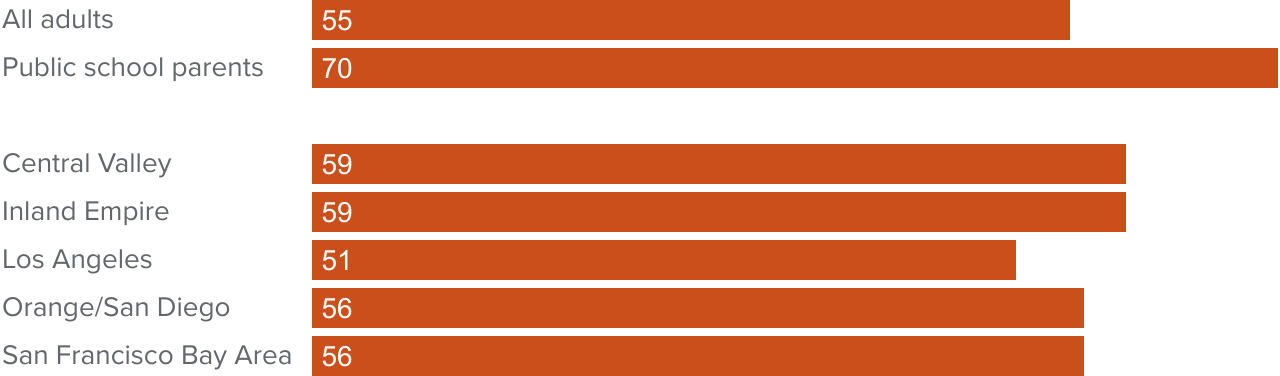
In terms of the job that schools are doing to prepare students to be engaged citizens, majorities of adults rate their local public schools well (6% excellent, 49% good), while four in ten think that they are doing a not so good (35%) or a poor job (6%) (Figure 2). Their views on how well schools prepare students for jobs and the workforce are similar (6% excellent, 48% good). By comparison, larger majorities of adults think their local public schools are doing an excellent (9%) or good job (56%) of preparing students for college.
Public school parents, however, are somewhat more generous with their ratings than all adults: parents tend to say their local public schools are doing a good or excellent job of preparing students to be engaged citizens (70%), for college (75%), and for jobs and the workforce (66%).
Majorities of Californians think their local schools are doing an excellent or good job at preparing students to be engaged citizens
% excellent/good
SOURCE: PPIC Statewide Survey, April 2025. Survey was fielded from March 27-April 4, 2025 (n=1,591 adults, n=1,094 likely voters, and n=279 public school parents).
Ratings on how well schools prepare students to be engaged citizens vary by political party (62% Democrats, 47% Republicans, 50% independents), across racial/ethnic groups (63% Asian Americans, 59% Latinos, 51% whites, 45% African Americans), and across state regions (59% Central Valley, 59% Inland Empire, 56% Orange/San Diego counties, 56% San Francisco Bay Area, 51% Los Angeles) while school ratings in this domain are similar across gender, education, and income groups.
The Most Important Elements of Civic Education
We asked our survey respondents how important it should be for public school students to learn about seven elements of civic education. Overwhelming majorities say that all of the elements mentioned are “very” important or “somewhat” important for students to learn:
- US Constitution (92%),
- California elections and voter registration (87%),
- how to find information and detect disinformation about elections (86%),
- US leadership role in the world (85%),
- California Constitution (84%),
- how to evaluate and discuss different political viewpoints (82%), and
- doing community service outside of the classroom (77%).
Fewer than 10 percent of adults think these elements of civic education are “not at all important.”
The views of public school parents are similar to those of all adults; that is, overwhelming majorities think that it is important for students to learn about
- California elections and voter registration (91%),
- how to find information and detect disinformation about elections (90%),
- US Constitution (89%),
- California Constitution (86%),
- how to evaluate and discuss different political viewpoints (84%),
- US leadership role in the world (82%), and
- doing community service outside of the classroom (76%).
Fewer than 5 percent of public school parents think that these aspects of civic education are “not at all important.”
Californians want students to learn about the Constitution
The US Constitution receives the highest ratings when Californians consider what is “very important” for students to learn about civics (Figure 3).
- Among all adults, 67 percent say that it is “very important” for students to learn about the US Constitution (25% somewhat, 5% not too, and 2% not at all important).
- Among public school parents, 59 percent say this element of civic education is “very important” (30% somewhat, 7% not too, 4% not at all important).
Majorities across political and demographic groups and across state regions agree on the high importance of public school students learning about the US Constitution.
- Partisans differ somewhat on the importance of this issue (69% Democrats, 81% Republicans, 69% independents).
- Across racial/ethnic groups, opinions also vary (75% whites, 63% Latinos, 59% African Americans, 58% Asian Americans).
The very high value placed on learning about the US Constitution also increases with age, education, and income. Few across any group dismiss its value and say that learning about the US Constitution is “not important at all.”
Students should learn how to find election information and detect disinformation
Activities around participation in elections stand out as “very important” topics that Californians feel should be covered in civics classes. Majorities of adults believe that public school students should learn how to find election information and how to detect disinformation (54%, very important). They also think that students should learn about California elections and voter registration (53%, very important).
Public school parents largely agree that their local school should put great emphasis on teaching students how to find election information and detect disinformation (54%, very important) and teach them about California elections and voter registration (51%, very important).
Most Californians think it is important for students in their local schools to . . .

SOURCE: PPIC Statewide Survey, April 2025. Survey was fielded from March 27-April 4, 2025 (n=1,591 adults, n=1,094 likely voters, and n=279 public school parents).
Majorities across partisan groups think that learning about California elections and voter registration is very important (63% Democrats, 53% Republicans, 52% independents). However, they differ in the strength of their responses on learning to find election information and detect disinformation (67% Democrats, 42% Republicans, 56% independents).
College graduates, those 55 and older, and higher-income residents favor students learning about California elections and voter registration. Larger shares of college graduates, those 55 and older, and coastal residents also want students to learn how to find election information and detect disinformation.
Californians place less emphasis on evaluating different political views
The participants in our survey feel less strongly about the other elements of civic education. Fewer than half say that it is “very important” for students in their local public schools to learn about:
- how to evaluate and discuss the pros and cons of different political viewpoints (49% adults, 45% public school parents),
- the California Constitution (47% adults, 45% public school parents), and
- the US leadership role in the world (44% adults, 46% public school parents).
However, when we break down participants by education, income, and region, we see that majorities in some groups place high value on teaching students how to evaluate and discuss the pros and cons of different political viewpoints: college graduates (56%), higher-income residents (54%), and the the coastal regions (55% Los Angeles, 52% Orange/San Diego counties, 52% San Francisco Bay Area).
Opinions about this topic vary across partisan groups (57% Democrats, 47% Republicans, 51% independents).
The California Constitution is important to some while the US leadership role is a lesser priority
Half or more believe it is very important to learn about the California Constitution among those 55 and older (53%), Republicans (53%), adults with some college education (52%), Los Angeles residents (51%), women (51%), and Latinos (50%).
Fewer than half of Californians say it is very important for students to learn about the US leadership role in the world; this opinion holds across political and demographic groups and state regions—except for adults 55 and older (51%).
Few prioritize taking civic education beyond the classroom
Only about three in ten adults (31%) and public school parents (33%) think it is very important for students in their local public schools to do community service outside of the classroom. Fewer than four in ten hold this view across political and demographic groups and regions, except for African Americans (41%).
Promoting Civic Education
California adults and public school parents alike rate civic education as a high priority for K–12 public schools. But they acknowledge that schools have other key responsibilities, such as teaching the basics and preparing students for college.
When we asked Californians about the central elements of civic education, overwhelming majorities favor the study of the US Constitution and election-related information. While some differences emerge among regional, partisan, and demographic groups around ranking the key elements of civic education, California adults and public school parents generally support and see the value of civic education in K–12 public schools.
Still, given everything we ask of our public schools, raising the profile of civic education remains a challenge. Promoting and growing participation in the State Seal of Civic Engagement should be a top priority.
Statewide education entities—from the California Department of Education to the State Board of Education to the California School Boards Association—could share information about successful local and regional civics programs and how to scale them. Moreover, including youth voices in the state’s new Engaged California initiative and other public forums—including citizens’ assemblies and deliberative polling—should be a priority and could help students get ready for a more engaged future.
Improving Current Efforts around Civic Education
Most California adults and public school parents give positive reviews to their local public schools for the job they are doing teaching students to be engaged citizens, but there is room for further improvement in these grades. Future public opinion research needs to include the students’ perspectives on civic education.
At PPIC, we envision a state where public policy substantially improves well-being across all regions and communities. To fulfill that vision, California needs informed and engaged residents who understand and take an active role in their government. This is especially critical in California, where voters make important policy decisions at the ballot box.
It is important that emerging adult Californians become civically engaged—including in their political participation. Without civic education as a priority in high schools, young people may lack broad knowledge about the role and structure of government at the local, state, and national levels. If this is the case, young people would be left with very little information about how to create change or solve problems in their communities. And this lack of knowledge breeds distrust and disengagement.
We believe this challenge can be addressed with good information—a sharp contrast to the misinformation and disinformation readily available online today—and with programs that actively teach the skills of civility and working across differences. PPIC’s CalCivics program seeks to engage students and educators directly, providing accessible, fact-based information and opportunities to sharpen critical thinking skills through participation in events and workshops.
We live in a time of deep polarization, but the importance of understanding basic facts about our government and our democracy can and should unite us all. We join with many other organizations across the state seeking to elevate civic education and engagement activities for California’s young people. Together, we aim to build a brighter future for our state.
Topics
Higher Education K–12 Education Political Landscape Statewide SurveyLearn More

Our Nation’s Founding Documents Matter to Californians

As Elections Approach, Californians See Value in Civic Education

Commentary: Why Civic Education Matters Now More than Ever
The Importance of Civic Education Today

Experts Discuss Civic Education in California
PPIC Statewide Survey: Californians and Education

Inspiring California’s Youth through Civic Education

Civic Education Is Essential to California’s Future
Inspiring Civic Engagement