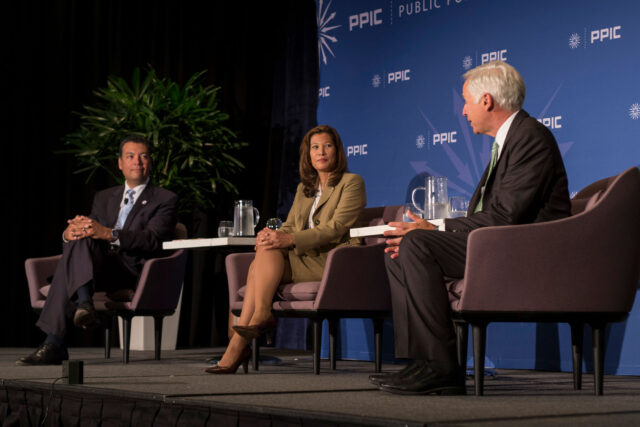

Civic education helps people understand how government works and gives them a sense of their power, potential, and responsibilities as citizens. But many observers are concerned about low levels of civic engagement in California and across the country. At a recent event in Sacramento, PPIC’s Tani Cantil-Sakauye talked with a panel of leaders and experts about how we can work together to advance civic knowledge among Californians.
Jeff Gonzalez, who represents District 36 in the California State Assembly, noted that “civic knowledge is important because it’s the basis of advocating for yourself, your family, and most importantly your community.” In an era of “fast-food knowledge,” it is especially important to educate young people about how civic engagement can empower them. “Someone used to say that knowledge is power,” he added. “It’s not power that you can lord over someone else, but power that is within you, that allows you to advocate for you and those around you.”
Shirley Weber, California secretary of state, noted that civic engagement is more important than ever. “We have so many folks who don’t know what it is,” she said. “When I talk to young people today about civic engagement,” she added, “they don’t really understand why we’re so concerned about it, and how it defines who they are and what they going to do—what their future looks like.”
Judith McConnell, administrative presiding justice for the Court of Appeal, outlined a state judiciary’s civic learning initiative that includes a range of programs to educate young people about the three branches of government—and, in particular, the courts. “We want to teach our youth about the role of the courts in our democracy,” she said. “We’re not majoritarian; we don’t base our decisions on the prevailing winds.”
Mark Baldassare, director of the PPIC Statewide Survey, talked about some of the key findings of a recent survey that focused on civic engagement. “Californians ranked the US Constitution as the most important thing we ought to be teaching in schools—the share was about 90%, there was virtually no disagreement,” he said. Justice McConnell noted that one way to implement these findings is to incorporate the Constitution into basic skills curricula: “What we need to do is put the Constitution into reading classes, into math classes,” she said.
Another key survey finding underlines the importance of fostering people’s ability to talk about political differences but also find common ground. “It’s something that has unfortunately been lost in this moment,” Baldassare said. “Can our schools help give people the skills to express their views as well as take in the views of others?”
***
PPIC’s Speaker Series on California’s Future invites thought leaders and changemakers with diverse perspectives to participate critically, constructively, and collaboratively in public conversations. The purpose is to give Californians a better understanding of how our leaders are addressing the challenges facing our state.
PPIC is a nonpartisan, nonprofit organization. PPIC does not take or support positions on any ballot measure or on any local, state, or federal legislation, nor does it support, endorse, or oppose any political parties or candidates for public office. Any opinions expressed by event participants are theirs alone and do not necessarily reflect any position of the Public Policy Institute of California.
Topics
civic education civic engagement Higher Education K–12 Education Political Landscape Statewide Survey US ConstitutionLearn More
Our Nation’s Founding Documents Matter to Californians

As Elections Approach, Californians See Value in Civic Education

Commentary: Why Civic Education Matters Now More than Ever
The Importance of Civic Education Today

Californians and Civic Education

Inspiring California’s Youth through Civic Education

Civic Education Is Essential to California’s Future