Key Findings
The spring quarter has been a time of heightened economic insecurity and fiscal uncertainty in the US. This is in the context of executive actions on new tariffs that may raise consumer prices, a federal budget bill that includes tax cuts and spending changes, and potential fiscal consequences of federal immigration enforcement for residents, businesses, and universities. In California, the governor’s May budget revision includes spending cuts and lower-than-expected revenues. Local governments are also dealing with budget deficits—most notably Los Angeles, as it takes steps toward recovering from the January wildfires. The US economy continues to create more jobs, inflation has been held in check, and interest rates are stable; however, the bond market has been jittery about tariffs and the US debt level.
These are the key findings of the Californians and Their Government survey on the federal policy landscape, national issues, state issues, and the state budget that was conducted May 22 to May 29, 2025.
- Twenty-nine percent of Californians and 34 percent of likely voters approve of the job performance of President Donald Trump. Four in ten or fewer support new tariffs on imports from Canada, Mexico, and China. Majorities support downsizing the federal government, half support cutting US aid to foreign countries, and four in ten support cutting back environmental regulations on oil and gas drilling. One in five adults and likely voters approve of the way the US Congress is handling its job. About three in ten adults and likely voters approve of the way that the US Supreme Court is handling its job. Strong majorities are in favor of abortion being legal, allowing same-sex marriages, and anti-discrimination protections for transgender individuals.
 When asked to identify the most important problem facing the US today, Californians are most likely to choose political extremism or threats to democracy, followed by economic conditions. Seven in ten think the US economy will have bad times financially during the next 12 months, including majorities across state regions and demographic groups. Seven in ten say that things in the US are generally going in the wrong direction, with partisans divided on this issue. Eight in ten believe that we can trust the federal government to do what is right “only some of the time” and that the federal government is “pretty much run for the benefit of a few big interests looking out for themselves.” Majorities say the federal government “wastes a lot of the money we pay in taxes.”
 Californians are most likely to choose economic conditions, followed by housing costs and availability, when asked to name the most important issue facing people in California today. Three in four say the California economy will have bad times financially during the next 12 months, including majorities across state regions and demographic groups. Majorities think that California is going in the wrong direction, with partisans divided on this view. Forty-four percent of adults and 46 percent of likely voters approve of the job performance of Governor Gavin Newsom. Forty-one percent of adults and 45 percent of likely voters approve of the way that the California Legislature is handling its job. Half say that recent price increases cause financial hardships, four in ten say that housing costs are a financial strain, and one in three are financially worse off today than a year ago.
- Forty-three percent of Californians think that the state budget situation is a big problem. Most Californians name health and human services and K–12 public education as their top two priorities for state government spending. After reading a brief description of the budget, 43 percent of adults and 42 percent of likely voters favor the governor’s proposed plan. Majorities think that the mix of spending cuts, loans, and funding shifts in the budget are a good idea, but fewer than half think that that using reserve funds to balance the budget is a good idea, while four in ten are in favor of providing health care coverage for undocumented immigrants in California. Fifty-five percent say they would prefer to pay lower taxes and have a state government that provides fewer services.
 Californians are most likely to choose economic conditions, followed by housing costs and availability, when asked to name the most important issue facing people in California today. Three in four say the California economy will have bad times financially during the next 12 months, including majorities across state regions and demographic groups. Majorities think that California is going in the wrong direction, with partisans divided on this view. Forty-four percent of adults and 46 percent of likely voters approve of the job performance of Governor Gavin Newsom. Forty-one percent of adults and 45 percent of likely voters approve of the way that the California Legislature is handling its job. Half say that recent price increases cause financial hardships, four in ten say that housing costs are a financial strain, and one in three are financially worse off today than a year ago.
Federal Policy Landscape
The three branches of the federal government and their interconnectedness have been center stage this year. The US House of Representatives passed the “big” federal budget bill that was sent to them by the president. The president continues to issue executive orders that impact domestic policies and international relations. The US Supreme Court is ruling on lawsuits that query the alignment of executive orders with the US Constitution and federal statutes. In California, the federal policy landscape has major implications for state and local governments, businesses, and residents.
US President. Donald Trump’s approval rating stands at 29 percent among California adults and 34 percent among likely voters today. A similar 30 percent of adults and 33 percent of likely voters approved of the president at the start of his second term. The president’s approval rating is much higher in national polls. Donald Trump won 38 percent of the California vote in the November presidential election. Today, 82 percent of Republicans, 6 percent of Democrats, and 31 percent of independent voters approve of the president. Approval of the president varies across racial/ethnic groups (16% African Americans, 20% Latinos, 27% Asian Americans, 39% whites). Fewer than four in ten Californians across age, education, gender, and income groups and the state’s regions approve of the president.
Three in ten Californians approve of President Trump
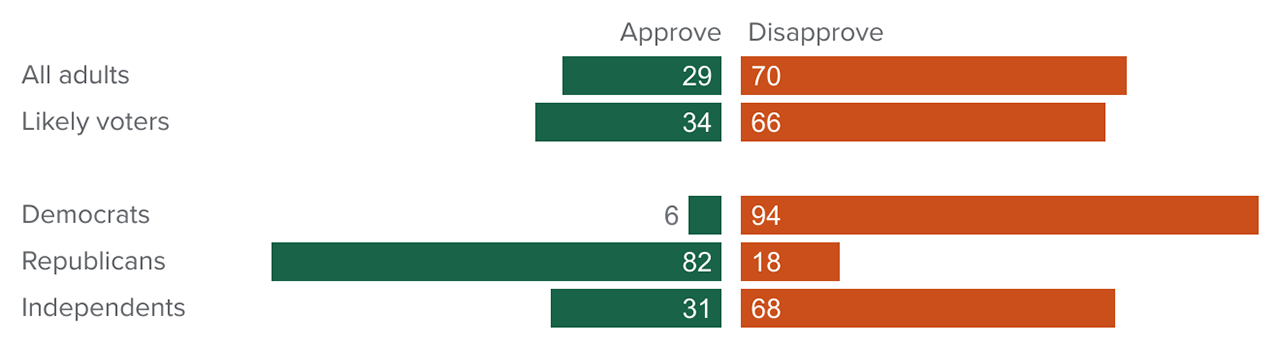
SOURCE: PPIC Statewide Survey, June 2025. Survey was fielded from May 22–29, 2025 (n=1,591 adults and n=1,080 likely voters).
Federal Cuts in Spending and Regulations. Majorities of Californians support the downsizing of the federal government (57% adults, 57% likely voters), and about half support cutting US aid to foreign countries (53% adults, 49% likely voters), while about four in ten say they support cutting back on environmental regulations on gas and oil drilling (40% adults, 39% likely voters). Partisans are deeply divided in their support for downsizing the federal government (36% Democrats, 91% Republicans, 64% independents), cutting US aid to foreign countries (33% Democrats, 84% Republicans, 54% independents), and cutting back environmental regulations on oil and gas drilling (20% Democrats, 72% Republicans, 37% independents).
New Tariffs. Fewer than one in three Californians support new tariffs on imported goods from Canada (27% adults, 30% likely voters) and Mexico (29% adults, 32% likely voters), while about four in ten support new tariffs on imported goods from China (36% adults, 40% likely voters). Fewer than half across age, education, income, and racial/ethnic groups and across regions support new tariffs on these nations, while partisans are deeply divided on new tariffs for Canada, Mexico, and China.
US Congress. Twenty percent of California adults and likely voters approve of the way the US Congress is handling its job. Americans’ approval rating of the US Congress is higher in national polls. The approval rating for Congress was similar in our February survey (20% adults, 18% likely voters) and our June 2024 survey (19% adults, 15% likely voters). Fewer than 30 percent of adults have approved of Congress since 2023. Today, fewer than three in ten Californians across age, education, gender, income, and racial/ethnic groups and state regions approve of the way that Congress is handling its job. Forty-six percent of Republicans approve of the way that Congress is handling its job, compared to 8 percent of Democrats and 17 percent of independents.
Two in Ten Californians Approve of Congress
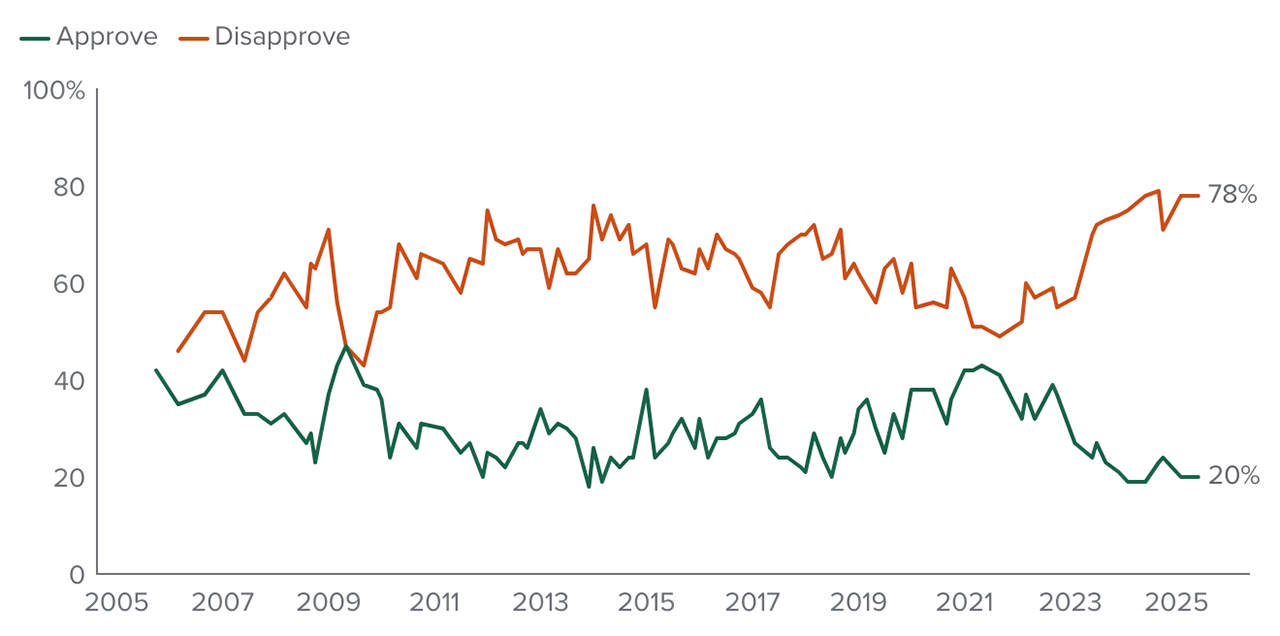
SOURCE: PPIC Statewide Surveys, 2005-2025.
US Supreme Court. Thirty-one percent of California adults and 32 percent of likely voters approve of the way that the US Supreme Court is handling its job. The approval rating of the US Supreme Court is much higher among Americans in national polls. Californians’ approval was similar in our September 2024 survey (31% adults, 31% likely voters). By comparison, approval was higher in our January 2017 survey, when 57 percent of California adults and 53 percent of likely voters approved of the Supreme Court. Today, fewer than four in ten across age, education, gender, income, and racial/ethnic groups approve of the way that the Supreme Court is handling its job. Partisans are divided in their approval of the Supreme Court (56% Republicans, 18% Democrats, 31% independents).
Social Policies. Most Californians think that abortion should be legal in all or most cases (72% adults, 75% likely voters), and they are in favor of same-sex marriage (73% adults, 79% likely voters) as well as anti-discrimination protections for transgender individuals (66% adults, 69% likely voters). Support for these issues was similar in our September 2023 survey. Today, majorities across demographic groups and state regions support legal abortions and same-sex marriage, as well as anti-discrimination protections for transgender individuals. Majorities across partisan groups support legal abortions (89% Democrats, 52% Republicans, 72% independents) and same-sex marriages (90% Democrats, 52% Republicans, 80% independents), while partisans are more divided when asked if they are in favor of anti-discrimination protections for transgender individuals (87% Democrats, 38% Republicans, 69% independents).
One in three or fewer approve of President Trump, Congress, and the US Supreme Court
% approve

SOURCE: PPIC Statewide Survey, June 2025. Survey was fielded from May 22–29, 2025 (n=1,591 adults and n=1,080 likely voters).
National Issues
About seven in ten adults (73%) and likely voters (70%) in the state say the United States is headed in the wrong direction; far fewer say the country is headed in the right direction (26% adults, 30% likely voters). The share saying wrong direction is similar to a year ago, and partisan views today are divided. According to a May Reuters/Ipsos poll, adults nationwide (51%) are far less pessimistic than Californians overall (73%) about the direction of the country, though this is still a slim majority.
Asked to identify the most important problem facing the US today, Californians are most likely to choose political extremism or threats to democracy (35%), followed by the economy and jobs (21%) and immigration (11%). Likely voters are somewhat more likely than adults overall to say the biggest problem is political extremism (44% likely voters). Californians’ top three issues mirror views nationwide; however, Californians are more likely than adults nationwide (21%) to say the most important issue is political extremism, according to the Reuters/Ipsos poll.
An overwhelming majority of adults (73%) and likely voters (72%) say the US will have bad financial times over the next 12 months. Seven in ten or more have said this since the beginning of 2025 (72% February 2025); however, majorities have said this since February 2022. Today, most Democrats (92%) and independents (72%) say bad times are ahead, while about six in ten Republicans (63%) say good times are ahead. More than six in ten across demographic groups and regions anticipate bad economic times during the next 12 months.
Nearly three in four think the US will have bad financial times over the next year
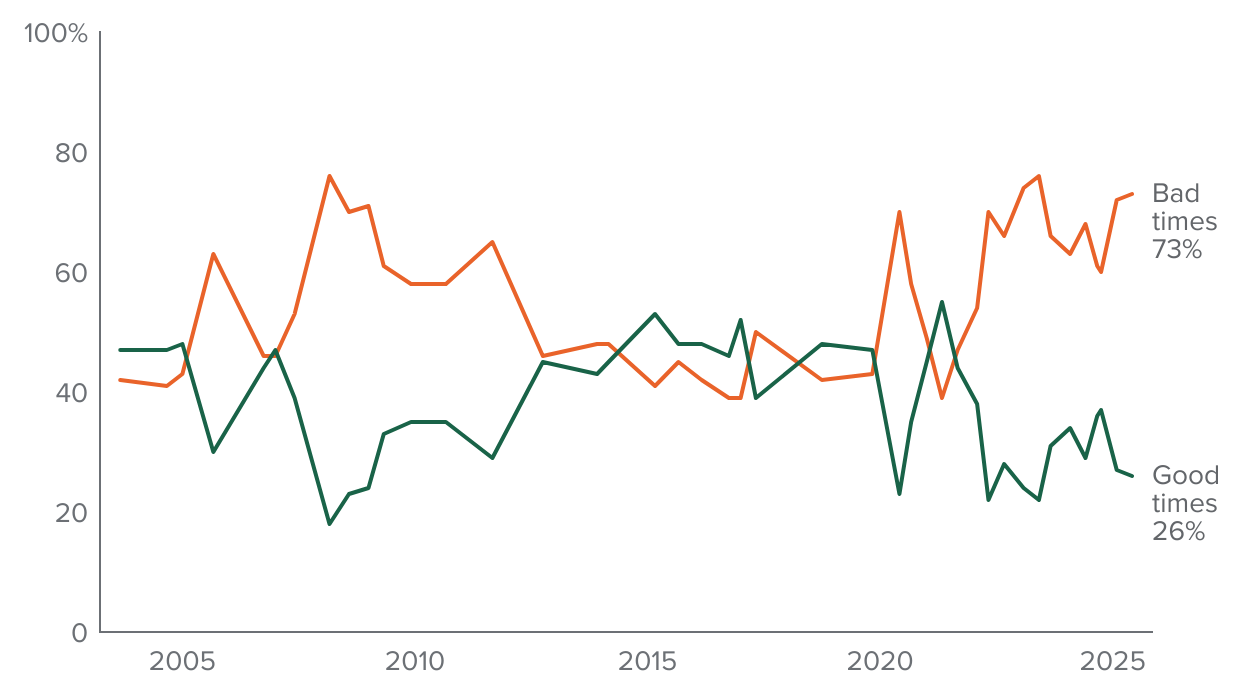
SOURCE: PPIC Statewide Surveys, 2003–2025.
Over eight in ten adults (84%) and likely voters (86%) say the federal government is run by a few big interests; far fewer say it is run for the benefit of all people (15% adults, 14% likely voters). The share saying a few big interests has seen a steady increase since May 2022, but majorities have said this since 1998, the first time PPIC asked this question.
When asked about their level of trust in the federal government, eight in ten California adults (79%, 82% likely voters) say they can trust it to do what is right only some of the time. In comparison, far fewer trust the federal government just about always (3% adults, 2% likely voters) or most of the time (18% adults, 15% likely voters). The overall share saying they trust the federal government only some of the time has increased since last year (67% September 2024); however, majorities of adults overall have expressed distrust since PPIC first asked this question in 1998. Today, most partisans say they only trust the federal government some of the time.
Most California adults and likely voters say the federal government wastes a lot or some of the money we pay in taxes; few say the federal government doesn’t waste very much. Overwhelming majorities have said there is at least some waste since PPIC first asked this question in 1998. Among partisans today, Republicans are most likely to say the federal government wastes a lot, followed by about two in three independents and about half of Democrats. Majorities across demographic groups and regions say there is a lot of waste, with the exception of Asian Americans (47%).
Nine in ten Californians say the federal government wastes the money we pay in taxes
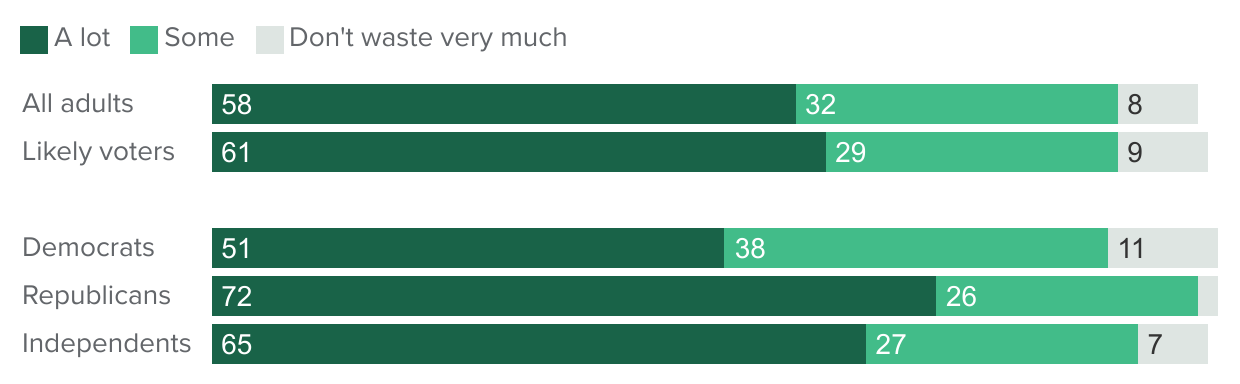
SOURCE: PPIC Statewide Survey, June 2025. Survey was fielded from May 22–29, 2025 (n=1,591 adults and n=1,080 likely voters).
Relatively few have positive impressions of the Democratic and Republican Parties. About six in ten adults (58%) and likely voters (61%) have an unfavorable impression of the Democratic Party, and seven in ten adults (71%) and likely voters (70%) have an unfavorable impression of the Republican Party. Democrats and Republicans hold favorable views of their own parties, while about seven in ten independents hold unfavorable impressions of the Democratic (72%) and Republican (73%) Parties. Three in four adults (74%) and likely voters (76%) say a third major party is needed— including majorities of independents (85%), Democrats (79%), and Republicans (58%).
Forty-one percent of adults and 50 percent of likely voters approve of the way Alex Padilla is doing his job as US senator. Thirty-seven percent of adults and 46 percent of likely voters approve of the way Adam Schiff is handling his job as US senator. Forty percent of adults and 47 percent of likely voters approve of the way their own representative to the US House of Representatives is handling their job, similar to a year ago. Today, there is majority approval for all three only among Democrats, but a slim majority of San Francisco Bay Area residents approve of Senator Padilla.
Four in ten or fewer approve of Senator Padilla, Senator Schiff, or their own US House representative
% approve
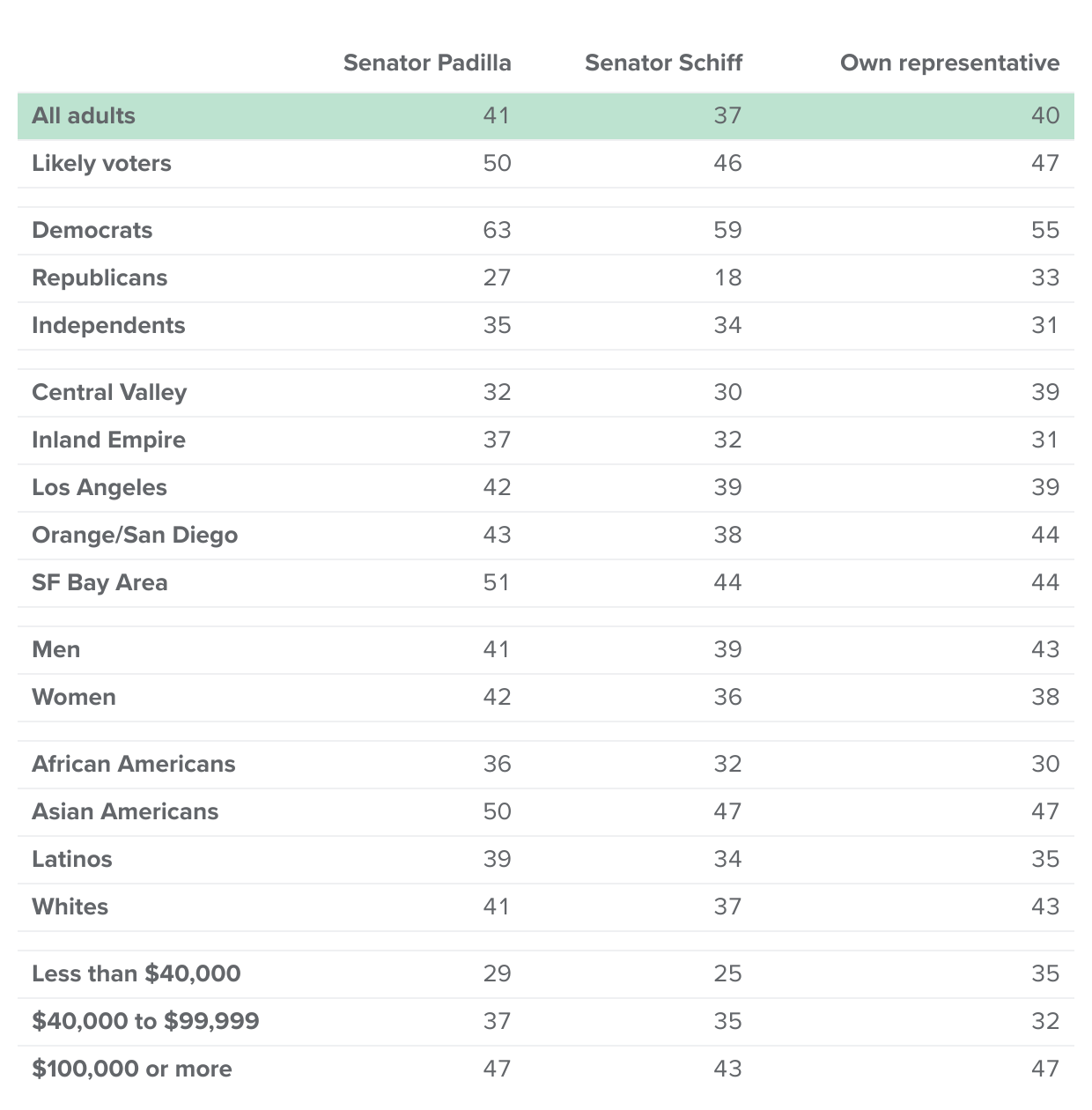
SOURCE: PPIC Statewide Survey, June 2025. Survey was fielded from May 22–29, 2025 (n=1,591 adults and n=1,080 likely voters).
State Issues
Over a third of Californians see the cost of living, the economy, and inflation (37%) as the most important issue facing California today. This is the top issue chosen across parties, regions, and demographic groups. Fifteen percent see housing costs and availability as the most important issue. This comes at a time when most Californians hold pessimistic views of the state’s economy and many report financial hardships related to recent price increases and housing costs.
Three in four Californians expect bad economic times in the state over the next year. This share has increased significantly since before last year’s election (62% October 2024). Moreover, the share of Californians holding this pessimistic economic view has not been this high since the start of the COVID-19 pandemic (79% April 2020). Today, overwhelming majorities across parties expect bad economic times (82% Republicans, 77% independents, 72% Democrats). Two-thirds or more across regions and demographic groups have this pessimistic view.
On a related note, majorities of adults (60%) and likely voters (56%) say the state is generally going in the wrong direction. Majorities have held this view over the past two years (54% June 2023). Today, about six in ten Democrats (59%) say things in the state are headed in the right direction, down from 70 percent just a few months ago in February. Shares among Republicans (89% wrong direction) and independents (62% wrong direction) are unchanged since then. Majorities across state regions and demographic groups hold a pessimistic view of the state’s direction, with the exception of Asian Americans (49% wrong direction).
Most expect bad economic times in California over the next year
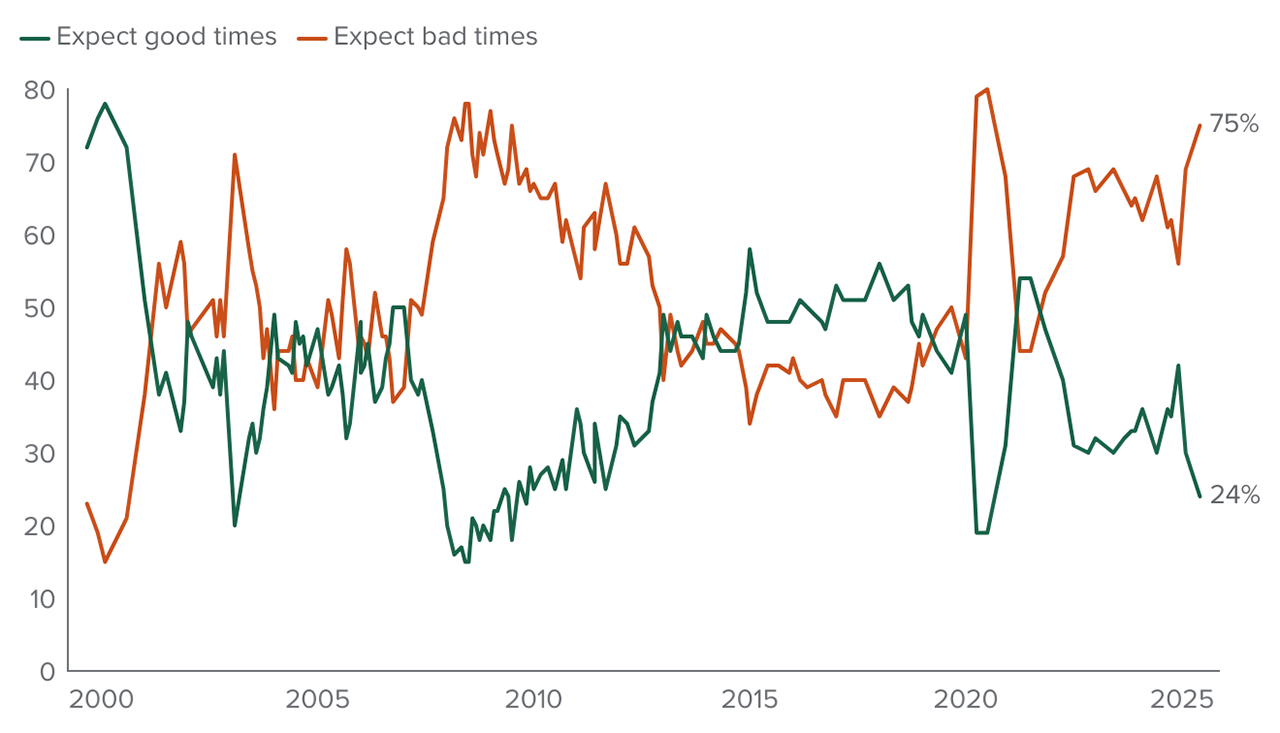
SOURCE: PPIC Statewide Surveys 1999–2025.
A third of Californians (33%) say they and their family are financially worse off than they were a year ago, while 54 percent say they are about the same and 13 percent say they are better off. Republicans (38%) and independents (36%) are more likely than Democrats (26%) to say they are worse off financially. Residents with incomes under $40,000 are more likely to say their personal financial situation is worse than a year ago (40%) than residents earning $100,000 or more (29%). Across regions, residents in the Inland Empire (48%) are more likely than those elsewhere to say they are worse off (37% Central Valley, 33% Los Angeles, 28% Orange/San Diego, 26% San Francisco Bay Area).
Half of Californians say recent price increases have caused financial hardship for them or their household, including 16 percent saying serious hardship. Latinos (64%) and African Americans (57%) are much more likely than whites (43%) and Asian Americans (33%) to report financial hardship due to recent price increases. This includes about a quarter of Latinos and African Americans who say it has caused serious hardship. Eight in ten lower-income residents (earning less than $40,000) say recent price increases have caused hardship, including 37 percent who say they face serious hardship. Reports of financial hardship decrease as income increases (64% $40,000 to $99,999, 38% $100,000 or more). Reports of hardship also decrease as age and educational attainment increase.
About four in ten Californians say the cost of housing places a financial strain on them and their families (23% a lot, 18% a little). This sense of strain is higher among residents in the Inland Empire (48%), the Central Valley (45%), and Los Angeles (45%) than in the San Francisco Bay Area (33%) and Orange/San Diego (33%). Renters (63%) are more than twice as likely than homeowners (28%) to say the cost of housing places financial strain on them. Nearly three in four earning less than $40,000 say housing costs create strain, including about half who say a lot of strain. This perception decreases as income increases. Latinos (53%) and African Americans (50%) are much more likely than whites and Asian Americans (31% each) to say housing costs put a financial strain on them or their families.
Half say recent price increases have caused financial hardship for them or their household
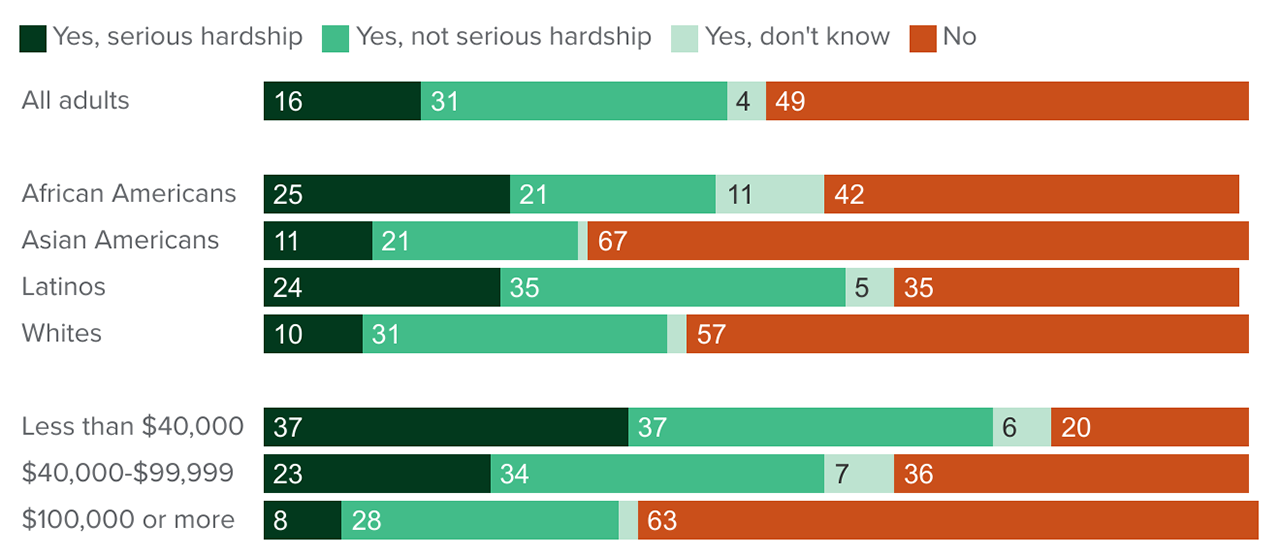
SOURCE: PPIC Statewide Survey, June 2025. Survey was fielded from May 22–29, 2025 (n=1,591 adults and n=1,080 likely voters).
Fewer than half of adults (44%) and likely voters (46%) approve of the way Gavin Newsom is handling his job as governor, while majorities disapprove (54% adults and 53% likely voters). Two-thirds of Democrats approve (67%), while nine in ten Republicans (91%) and about six in ten independents (63%) disapprove. Fewer than half across regions of the state and demographic groups approve of how the governor is handling his job, with the exception of African Americans (56% approve), Latinos (52% approve), and residents earning less than $40,000 (50% approve).
About four in ten or more adults (41%) and likely voters (45%) also approve of the job the state legislature is doing. A solid majority of Democrats approve (67%), while nearly nine in ten Republicans (87%) and six in ten independents (62%) disapprove. Half of residents in the San Francisco Bay Area approve, while majorities in other regions disapprove. Less than half across demographic groups approve of the state legislature.
California adults feel similarly toward the legislators representing their own state assembly and senate districts (43% approve, 54% disapprove). Likely voters are slightly more split in their opinion (48% approve, 50% disapprove). Across regions, fewer than half approve of their state legislators, except for San Francisco Bay Area residents (53% approve). Most Democrats approve (66%), while most Republicans (79%) and independents (59%) disapprove. Less than half across demographic groups approve, except for college graduates (53% approve) and Asian Americans (51% approve).
Less than half of Californians approve of their state elected officials
% approve

SOURCE: PPIC Statewide Survey, June 2025. Survey was fielded from May 22–29, 2025 (n=1,591 adults and n=1,080 likely voters).
State Budget
Last month, Governor Newsom released a revision to his January budget proposal that includes $321.9 billion in total spending—including $226.4 billion in General Fund spending—and an estimated $11.9 billion budget shortfall. Most Californians and likely voters say the state budget situation is at least somewhat of a problem; more than four in ten adults (43%) and likely voters (46%) say it is a big problem (somewhat of a problem: 49% adults, 47% likely voters; not a problem: 7% adults and likely voters). The share saying the budget situation is a big problem was similar in February (38% adults, 44% likely voters). Today, most partisans say it is at least somewhat of a problem, but Republicans (75%) are much more likely than independents (47%) and Democrats (26%) to say it is a big problem. Half or fewer across regions say the state budget is a big problem, with this perception highest in the Inland Empire (50%) and lowest in the San Francisco Bay Area (35%). Views also vary across racial/ethnic groups, with whites (51%) most likely to hold this view, followed by African Americans (44%), Asian Americans (39%), and Latinos (38%).
More than four in ten Californians say the state budget situation is a big problem
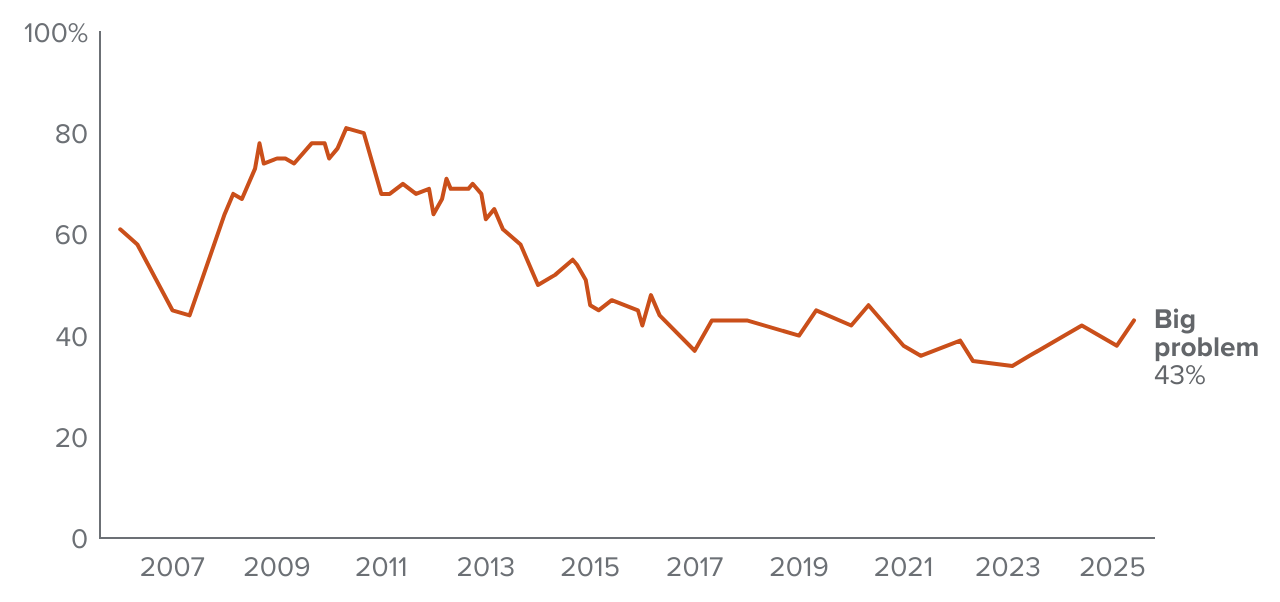
SOURCE: PPIC Statewide Surveys, 2006–2025.
After reading a brief summary of the governor’s May Revision, about four in ten Californians (43%) and likely voters (42%) are in favor—while majorities are opposed (55% adults, 56% likely voters). The proposal makes investments in climate resiliency and higher education and K–12 resources; it fully funds transitional kindergarten but includes reductions in health and human services. Additionally, the plan pulls $7.1 billion from the state’s reserves. In our February survey, 59 percent were in favor and 39 percent were opposed to the governor’s January budget proposal. Six in ten Democrats favor the revised plan, while majorities of Republicans and independents are opposed. Fewer than half across demographic groups favor the plan, with the exception of Latinos (51%). Across regions, support is highest in the San Francisco Bay Area (49%), followed by the Inland Empire (45%), the Central Valley (43%), Orange/San Diego (41%), and Los Angeles (39%). Californians 55 and older (37%) are less likely than younger Californians (46%) to support the revised budget proposal.
A majority of Californians and likely voters oppose the governor's state budget for the next fiscal year
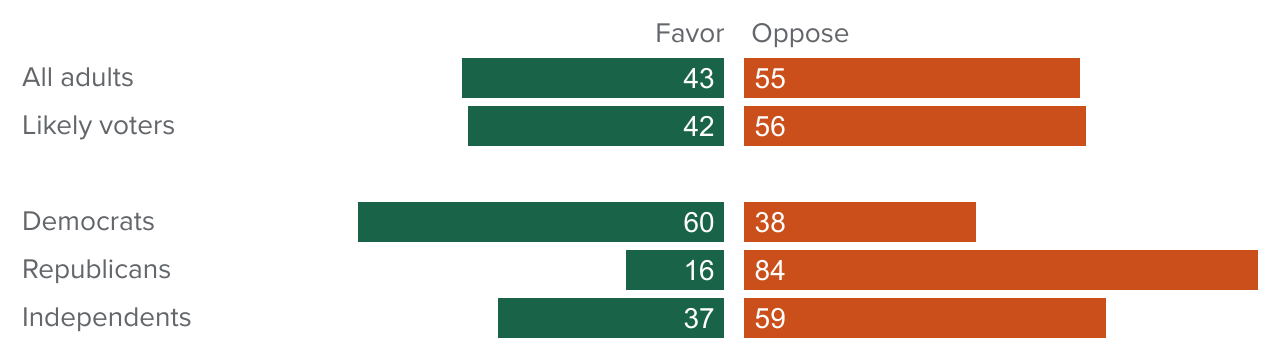
SOURCE: PPIC Statewide Survey, June 2025. Survey was fielded from May 22–29, 2025 (n=1,591 adults and n=1,080 likely voters).
When asked about the plan to use $7.1 billion from the Budget Stabilization Account, or “Rainy Day Fund,” to partially balance the current budget, adults are more likely to say this is a bad idea (56% adults) than a good idea (42% adults). Views were similar in February (52% bad idea; 44% good idea). Today, six in ten Democrats—compared to far fewer Republicans and independents—say this is a good idea. Fewer than half across regions and demographic groups say using these reserve funds is a good idea, with the exception of African Americans (55%).
The May Revision also uses a combination of reductions, revenue increases, borrowing, and shifts in funding sources to bridge the gap between spending and revenues. Most Californians (56%) say this is a good idea (41% bad idea). There is bipartisan agreement on this component of the budget, and majorities across the state’s regions say it is a good idea. Asian Americans are the most likely to say this is a good idea, while Latinos are the least likely. There are also differences across demographic groups, with positive views increasing with rising age (48% 18 to 34, 54% 35 to 54, 63% 55 and older), education (46% high school or less, 57% some college, 64% college graduates), and income.
The May Revision also proposes freezing Medi-Cal expansion for undocumented adults aged 19 and older. This proposal comes after years of movement toward covering immigrants that began with undocumented children in 2016, followed by adults up to age 25 in 2020, those 50 and older in 2022, and then adults aged 26 to 49 in 2024. In recent months, the state has had to borrow more than $3 billion to cover unexpected increases in Medi-Cal expenses—largely attributed to this expansion. When asked if they favor or oppose providing healthcare coverage for undocumented immigrants in California, 58 percent of adults oppose (41% favor). In surveys from 2015 to 2023, majorities favored this idea.
When asked what area should be the highest priority when it comes to state spending, most Californians choose health and human services (46%) or K–12 public education (39%), while far fewer say higher education (7%) or prisons and corrections (7%). Findings were nearly identical in February. In periodic surveys dating back to 2015, K–12 public education has been a top-two issue, while the share saying health and human services has risen to the top choice in recent years.
On the issue of size of government, a majority of Californians (55%) would rather pay lower taxes and have a state government that provides fewer services, while fewer (44%) would rather pay higher taxes and have a state government that provides more services. Findings were similar in February, although the gap was narrower (51% lower taxes/fewer services, 47% higher taxes/more services). While there has been a preference for lower taxes and fewer services in recent years, prior to 2023 Californians had a slight preference for higher taxes and more services in most surveys dating back to the first time we asked this question in 2003. Today, there is a wide partisan divide, with most Republicans (86%) and independents (62%) preferring lower taxes and fewer services, while two in three Democrats (65%) prefer higher taxes and more services.
Californians think key strategies to bridge the gap between spending and revenues are a good idea, but are more divided on use of Rainy Day Fund in the governor's budget plan
% good idea
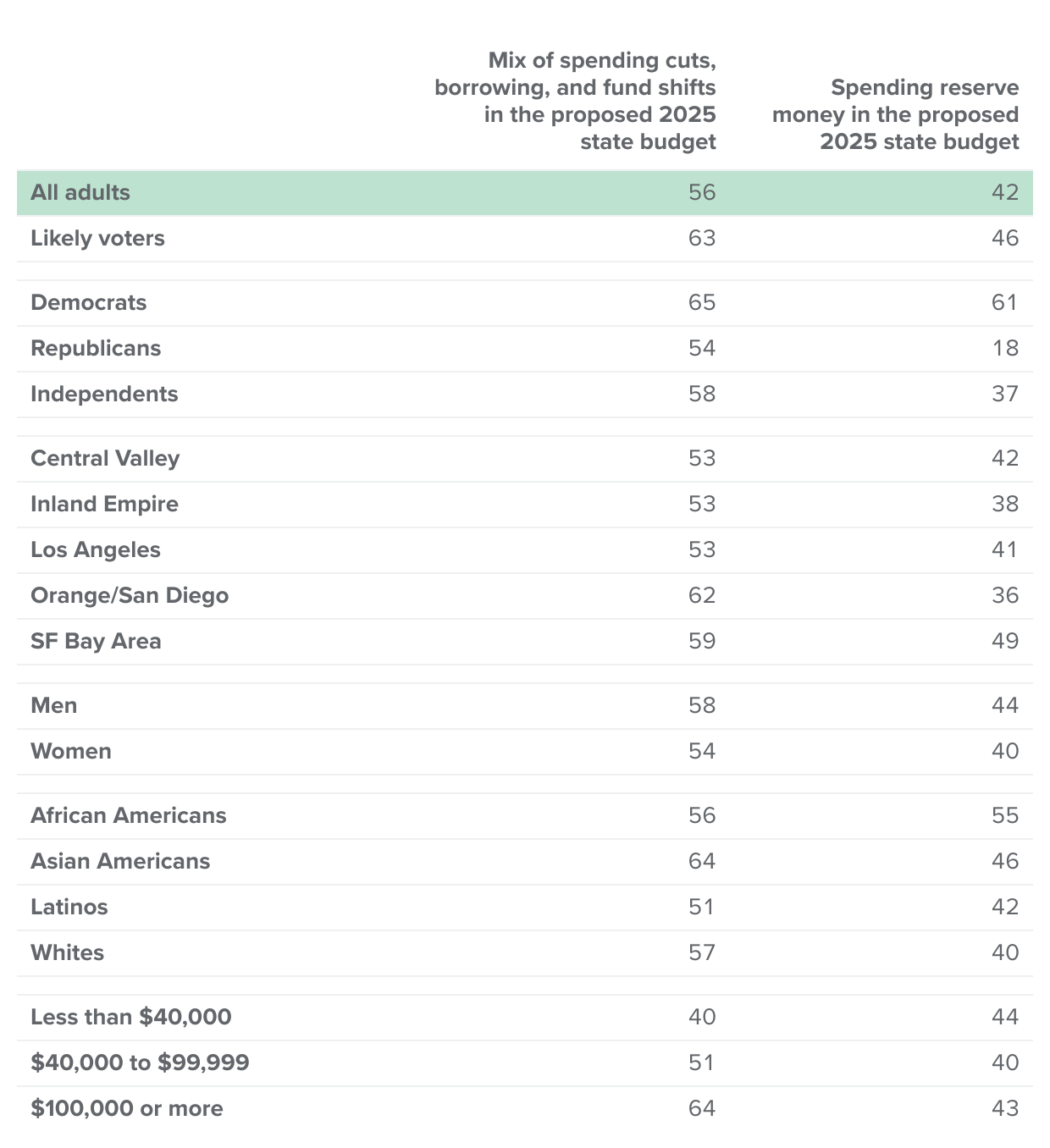
SOURCE: PPIC Statewide Survey, June 2025. Survey was fielded from May 22–29, 2025 (n=1,591 adults and n=1,080 likely voters).
Topics
Political Landscape Statewide Survey