Key Findings
Our first PPIC Statewide Survey of the year was conducted in the wake of significant local, state, and national events. Wildfires destroyed neighborhoods in California’s most populous county, and Los Angeles residents are now in the early stages of a long recovery process. Governor Gavin Newsom released the proposed 2025–2026 state budget, which includes a rosy outlook for tax revenues and spending from a new state bond and reserve funds. The second presidential term for Donald Trump began with a flurry of executive orders on immigration, climate change, tariffs, and other policies, and concerted efforts to reduce the size and scope of the federal government. The US and state economy continue to create more jobs, while lingering inflation has placed interest rate reductions on hold.
These are the key findings of the Californians and Their Government survey on the changing federal landscape, national issues, state issues, and the state budget that was conducted February 4–11, 2025:
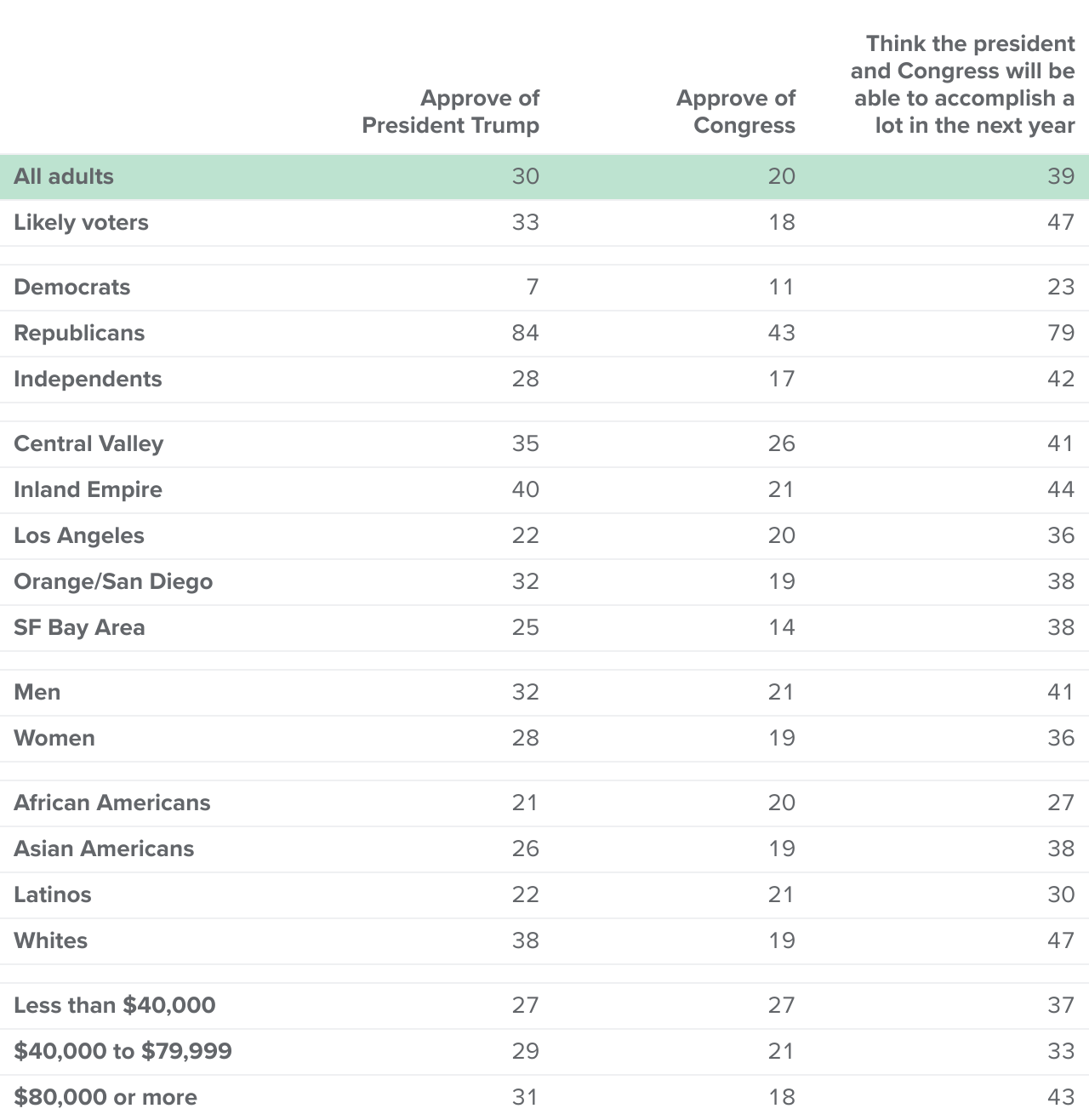
- Thirty percent of Californians and 33 percent of likely voters approve of the job performance of President Donald Trump. The share of adults who approve of the president was similar at the start of his first term in 2017. Today, about three in ten adults have a “great deal” or a “good amount” of confidence in President Trump making the right decisions for the country’s future. About one in five think the country will be able to unite behind Trump, and he will be able to accomplish a lot in the next four years. Twenty percent of Californians and 18 percent of likely voters approve of the way the US Congress is handling its job. Thirty-nine percent of adults and 47 percent of likely voters think that President Trump and Congress will be able to work together and accomplish a lot in the next year. Partisans are deeply divided in their views about the president and Congress.
 About two in three Californians choose political extremism or threats to democracy, economic conditions, and immigration when naming the most important problems facing the US today. About three in four think that the US is generally going in the wrong direction, and that the US will have bad times financially during the next 12 months, with majorities across regions holding these views. Close to six in ten Californians believe that global climate change is a major threat to the well-being of the US and most oppose the US withdrawal from the Paris Agreement. Seven in ten think that immigrants today are a benefit to California, and most favor a way for undocumented immigrants living in the US to stay in the country if certain requirements are met.
- About half of Californians name the cost of living and inflation, housing costs and availability, and the environment as the most important issues for the governor and legislature to work on in 2025. A majority think that things in California are going in the wrong direction. Seven in ten expect that California will have bad times financially during the next 12 months, including majorities across state regions. Fifty-two percent of adults and 55 percent of likely voters approve of the job performance of Governor Gavin Newsom. Forty-six percent of Californians, and 53 percent of those living in Los Angeles County, think the threat of wildfires is a big problem in their part of California. Twenty-nine percent of adults, and 27 percent of LA residents, have a “great deal” of confidence in the government’s readiness to respond to wildfires in their part of California.
 About four in ten Californians think the state budget situation is a big problem. Californians name health and human services and K–12 public education as their priorities for state spending. Fifty-one percent of adults and 50 percent of likely voters prefer to pay lower state taxes and have fewer state services. After reading a brief description of the budget, 58 percent of adults and 57 percent of likely voters favor the plan. Seven in ten favor spending $2.7 billion of the $10 billion in Proposition 4 state bond funds for water and wildfire projects. Fifty-two percent of adults and likely voters think that it is a bad idea to use state reserve funds to balance the budget.
 About four in ten Californians think the state budget situation is a big problem. Californians name health and human services and K–12 public education as their priorities for state spending. Fifty-one percent of adults and 50 percent of likely voters prefer to pay lower state taxes and have fewer state services. After reading a brief description of the budget, 58 percent of adults and 57 percent of likely voters favor the plan. Seven in ten favor spending $2.7 billion of the $10 billion in Proposition 4 state bond funds for water and wildfire projects. Fifty-two percent of adults and likely voters think that it is a bad idea to use state reserve funds to balance the budget.
Changing Federal Landscape
The American people have spoken, changing the federal landscape from divided government to Republican control of the executive branch, the US Senate, and the US House of Representatives. A flurry of executive orders and Senate confirmation hearings reflect the dramatic shift. In this new context, California’s elected officials are seeking federal support for the Los Angeles wildfires while grappling with the implications for immigration policy, climate change policy, and other key policy and fiscal domains.
US President. Donald Trump begins his second term with 30 percent of California adults and 33 percent of likely voters approving of his job performance as president. A similar 30 percent approved of the president at the start of his first term. The share approving at the start of other presidents’ terms was higher in the past 20 years. President Trump’s approval rating is higher in national polls. Donald Trump won 38 percent of the California vote in the November presidential election.
Today, 84 percent of Republicans, 7 percent of Democrats, and 28 percent of independent voters approve of the job performance of the president. Four in ten or fewer across age, education, gender, income, and racial/ethnic groups and the state’s major regions approve of the president.
President Trump begins his second term with three in ten Californians approving of his job performance
% approve
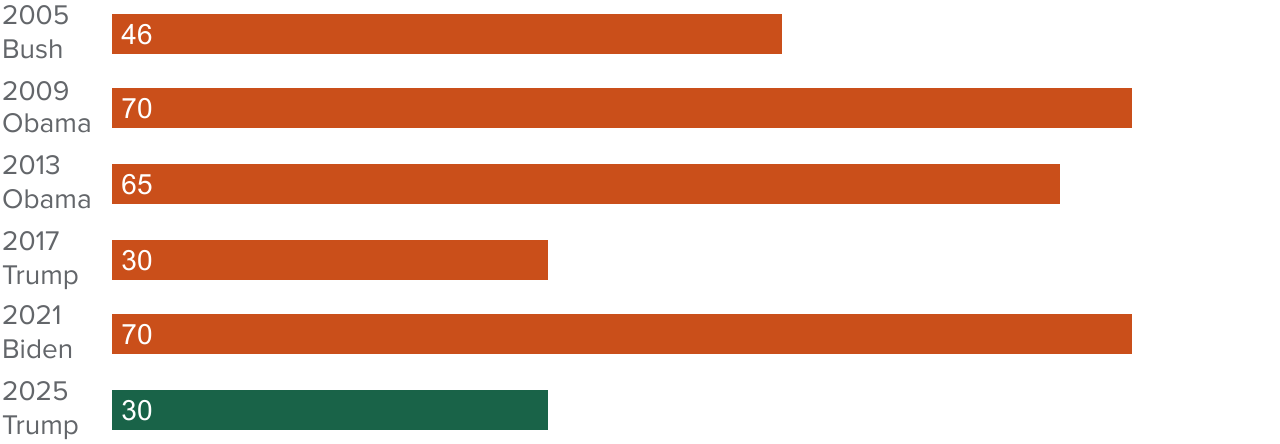
SOURCE: PPIC Statewide Surveys, 2005–2025.
NOTES: Initial job approval ratings of elected US presidents, 2005-2025.
Twenty-eight percent of California adults have a “great deal” or a “good amount” of confidence in President Trump to make the right decisions for the country’s future (17% just some, 55% none at all). Fewer than four in ten across the state’s regions and demographic groups say that they have this level of confidence. Eighty-three percent of Republicans say that they have a great deal or good amount of confidence, compared to 6 percent of Democrats and 27 percent of independents.
Twenty-one percent of California adults believe that the country will be able to unite behind Donald Trump and that he will be able to accomplish a lot in the next four years. Sixty-one percent of Republicans expect this outcome, compared to 4 percent of Democrats and 22 percent of independents. Fewer than three in ten across regions and demographic groups hold this view.
US Congress. Twenty percent of California adults and 18 percent of likely voters approve of the way that the US Congress is handling its job. Americans’ approval rating of the US Congress is higher in national polls. Californians’ approval rating of Congress was similar in the October 2024 PPIC Statewide Survey before the November election (24% adults, 18% likely voters). Fewer than 30 percent of adults have approved of Congress since 2023.
Today, fewer than three in ten Californians across the state’s major regions and across age, education, gender, income, and racial/ethnic groups approve of the way that Congress is handling its job. Forty-three percent of Republicans approve of the way that Congress is handling its job compared to 11 percent of Democrats and 17 percent of independents.
One in five Californians approve of Congress

SOURCE: PPIC Statewide Surveys, 2005-2025.
About three in ten California adults (28%) think it is a better situation when the president’s party also has a controlling majority in the US Congress, as it is today, while four in ten believe it is better when one party controls the White House and the other party controls Congress; about three in ten don’t think it matters too much. Thirty-five percent or fewer across regions and demographic groups believe that the better situation is when the president’s party controls Congress. Sixty-one percent of Republicans believe it is better when the president’s party controls Congress, compared to 17 percent of Democrats and 26 percent of independents.
Thirty-nine percent of adults and 47 percent of likely voters think that President Trump and the US Congress will be able to work together and accomplish a lot in the next year. Fewer than half across the state’s major regions and demographic groups hold this view. Seventy-nine percent of Republicans compared to 23 percent of Democrats and 42 percent of independents think that the president and Congress will be able to work together and accomplish a lot in the next year.
US democracy. Thirty-three percent of Californians and 34 percent of likely voters are “very satisfied” or “somewhat satisfied” with the way that democracy is working in the United States. Satisfaction has declined since the October pre-election survey (43% adults, 46% likely voters). The share who are satisfied among partisans today (68% Republicans, 18% Democrats, 32% independents) has changed since the October pre-election survey (35% Republicans, 54% Democrats, 34% independents). Thirty-eight percent of adults and 43 percent of likely voters have “a lot” or “some” confidence in the future of the US political system. This level of confidence falls below 50 percent across state regions and demographic groups and varies by party registration (78% Republicans, 24% Democrats, 37% independents).
About four in ten Californians say the president and Congress will be able to work together to accomplish a lot in the next year
SOURCE: PPIC Statewide Survey, February 2025. Survey was fielded from February 4–11, 2025 (n=1,589 adults and n=1,086 likely voters).
National Issues
In the early days of Trump’s second term as president, about two in three Californians choose political extremism or threats to democracy (31%), economic conditions (19%), and immigration (15%) as the most important problems facing the US today. About three in four adults (76%) and likely voters (74%) say the US is generally headed in the wrong direction (right direction: 23% adults, 26% likely voters). The overall share saying things are headed in the wrong direction has increased slightly from last October (69%). Adults in California are much more likely than adults nationwide (49%) to say this, according to a February YouGov poll.
An overwhelming majority of adults (72%) and likely voters (70%) expect bad economic times in the US during the next 12 months; three in ten or fewer say they expect good times (27% adults, 29% likely voters). Partisans today are divided on this issue, with an overwhelming majority of Republicans expecting good times ahead, while most Democrats and independents expect bad financial times. The share of adults expecting good times has declined since before the presidential election, in October 2024 (37%). And since then, partisan views have shifted dramatically.
Partisan views have shifted drastically when it comes to the economic outlook of the US over the next 12 months
% good times

SOURCE: PPIC Statewide Survey, February 2025. Survey was fielded from February 4–11, 2025 (n=1,589 adults and n=1,086 likely voters).
Shortly after coming into office, the Trump administration made the decision to withdraw, for the second time, from the Paris Agreement—the international agreement that tries to address climate change. A strong majority of Californians (69% adults, 68% likely voters) oppose the Trump administration’s decision. These shares are similar to July 2017, during President Trump’s previous term.
Most Californians think global climate change is a threat to the well-being of the United States, including 58 percent who say it is a major threat (28% minor threat); about one in ten say it is not a threat. Views are similar to January 2021, the last time we asked this question. Today, about half or more across partisan, demographic, and regional groups say climate change is a major threat, with the exception of 19 percent of Republicans.
Six in ten adults (60%) and likely voters (61%) say the federal government is not doing enough to address climate change. Most Democrats (85%) and independents (60%) say this, while Republicans are most likely to say it is doing more than enough (48%). Strong majorities of adults (62%) and likely voters (64%) favor the California state government making its own policies, separate from the federal government, to address the issue of climate change.
Overwhelming majorities of adults (71%) and likely voters (70%) say developing alternative energy sources such as wind, solar, and hydrogen technology should be the more important priority for addressing America’s energy supply; three in ten or fewer (27% adults, 29% likely voters) say the priority should be expanding exploration and production of oil, coal, and natural gas.
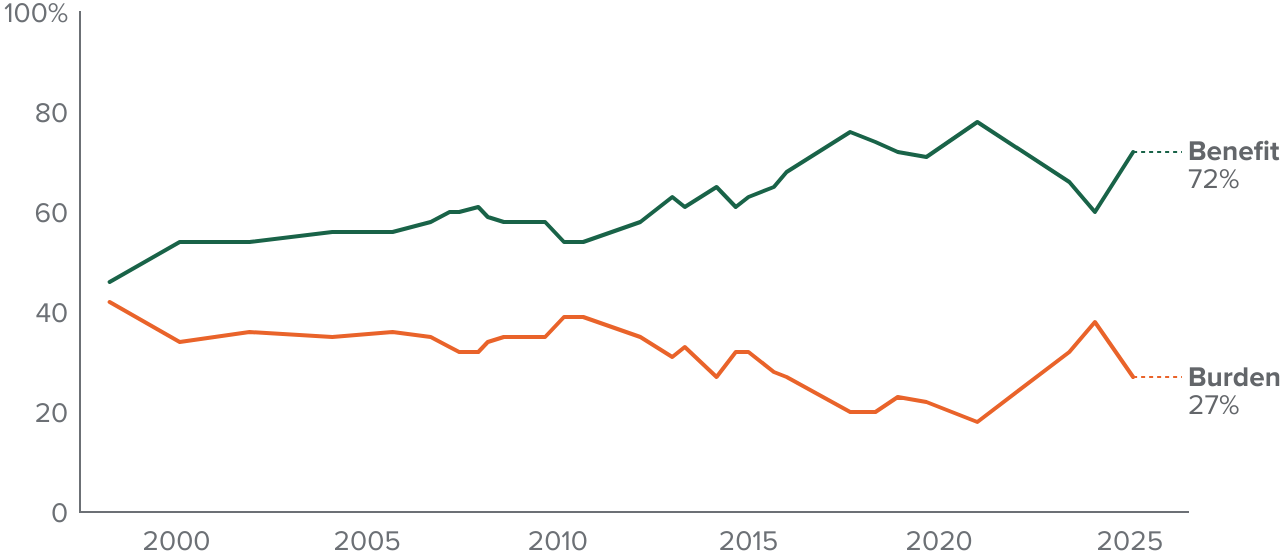
An overwhelming majority of adults (72%) and likely voters (70%) say that immigrants are a benefit to California because of their hard work and job skills; three in ten or fewer say that immigrants are a burden because they use public services (27% adults, 30% likely voters). The share of adults saying immigrants are a benefit has increased significantly from a year ago, when six in ten said this. Today, partisans are divided on the issue, with nine in ten Democrats and more than seven in ten independents saying they are a benefit, followed by just three in ten Republicans who say the same. Solid majorities across demographic groups and regions say that immigrants are a benefit to California.
An overwhelming majority of Californians say immigrants are a benefit to California because of their hard work and job skills
SOURCE: PPIC Statewide Surveys, 1998–2025.
When it comes to how to handle undocumented immigrants who are living in the US, overwhelming majorities of adults (73%) and likely voters (71%) in the state say that there should be a way for them to stay in the country legally, if certain requirements are met. In January 2021, a higher share of adults (87%) said undocumented immigrants should be allowed to stay legally. Today, partisans are divided on this issue (92% Democrats, 38% Republicans, 71% independents.)
Eight in ten adults (79%) and likely voters (80%) favor the protections given by DACA—Deferred Action for Childhood Arrivals—to undocumented immigrants brought into the US as children, including protection from deportation and the ability to hold a work permit, if they pass a background check. Overall, most adults have been in favor since September 2017.
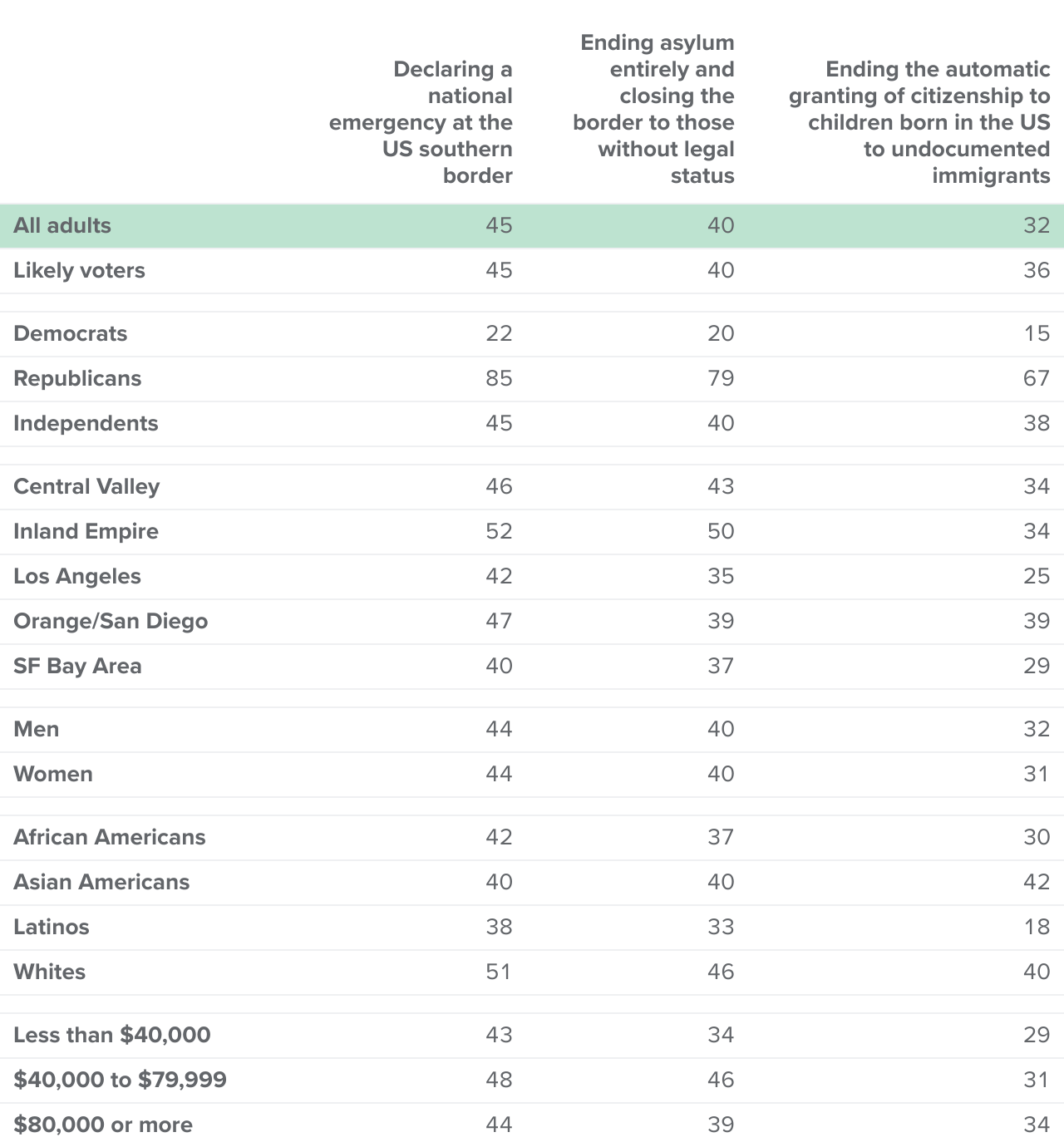
The Trump Administration has taken several actions to address immigration concerns in the US, though fewer than half of Californians express support for the policies we ask about. Forty-five percent of adults and likely voters each support declaring a national emergency at the US southern border, four in ten each support ending asylum entirely and closing the border, and about one in three each support ending the automatic granting of citizenship to children born in the US to undocumented immigrants. Partisans are divided on these three issues. Californians overall are about as likely as adults nationwide to support declaring a national emergency at the southern border (49%) but are less likely to support ending asylum (51%) and ending automatic citizenship (41%), according to a recent YouGov poll.
About six in ten adults (63%) and likely voters (62%) favor the California state and local governments making their own policies and taking actions, separate from the federal government, to protect the legal rights of undocumented immigrants in California.
About four in ten California adults worry some (23%) or a lot (20%) that someone they know could be deported. Latinos (64%), Californians who have a high school education only (56%), Democrats (54%), those age 35 or under (53%), and Los Angeles residents (53%) are most likely to worry about someone being deported.
Fewer than half of Californians support declaring a national emergency at the US-Mexico border, ending asylum, or ending birthright citizenship
% strongly/somewhat support
SOURCE: PPIC Statewide Survey, February 2025. Survey was fielded from February 4–11, 2025 (n=1,589 adults and n=1,086 likely voters).
State Issues
The most important issue mentioned by Californians for the state government to work on in 2025 is the cost of living, the economy, and inflation (24%). Fewer mention housing costs and availability (14%), environmental conditions including fires and water supply (13%), immigration (10%), and homelessness (10%). Likely voters are slightly more likely to mention problems with the government or elected officials (13%). Across partisan groups and most regions, economic conditions are the top issue named, with the exception of Orange/San Diego, where the most common issue mentioned is housing (21%).
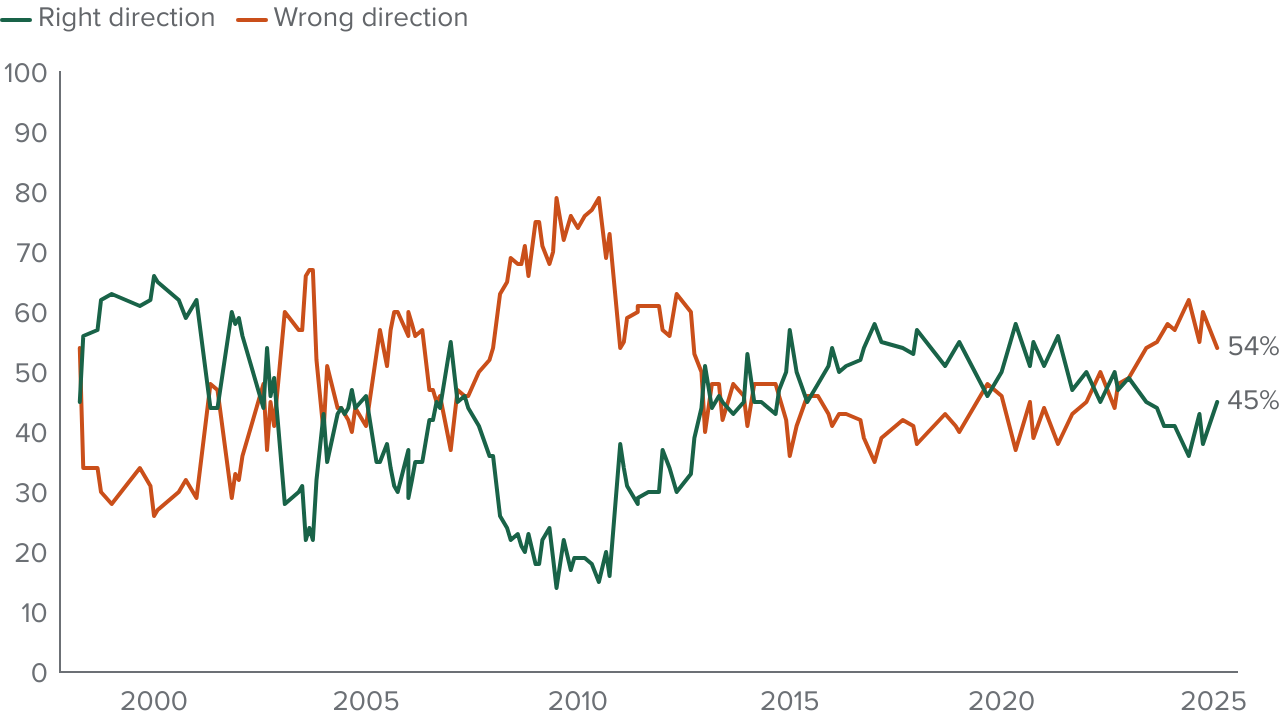
Majorities of California adults (54%) and likely voters (51%) continue to think that things in the state are headed in the wrong direction, though this share is down slightly from October (60% adults, 59% likely voters). Seven in ten Democrats (70%) say the state is going in the right direction while nine in ten Republicans (91%) and six in ten independents (61%) say wrong direction. Majorities of residents in the Central Valley (64%), Inland Empire (58%), and Orange/San Diego (53%) hold this view, compared to about half in Los Angeles (49%) and the San Francisco Bay Area (48%). Majorities across demographic groups say the state is going in the wrong direction, with the exception of Latinos (48%) and college graduates (49%). About seven in ten adults (69%) and likely voters (71%) think the state will see bad financial times in the next year. Solid majorities across parties, regions, and demographic groups hold this view. A majority of adults and likely voters have held this view since November 2021.
A narrowing majority say the state is going in the wrong direction
SOURCE: PPIC Statewide Surveys 1998–2025.
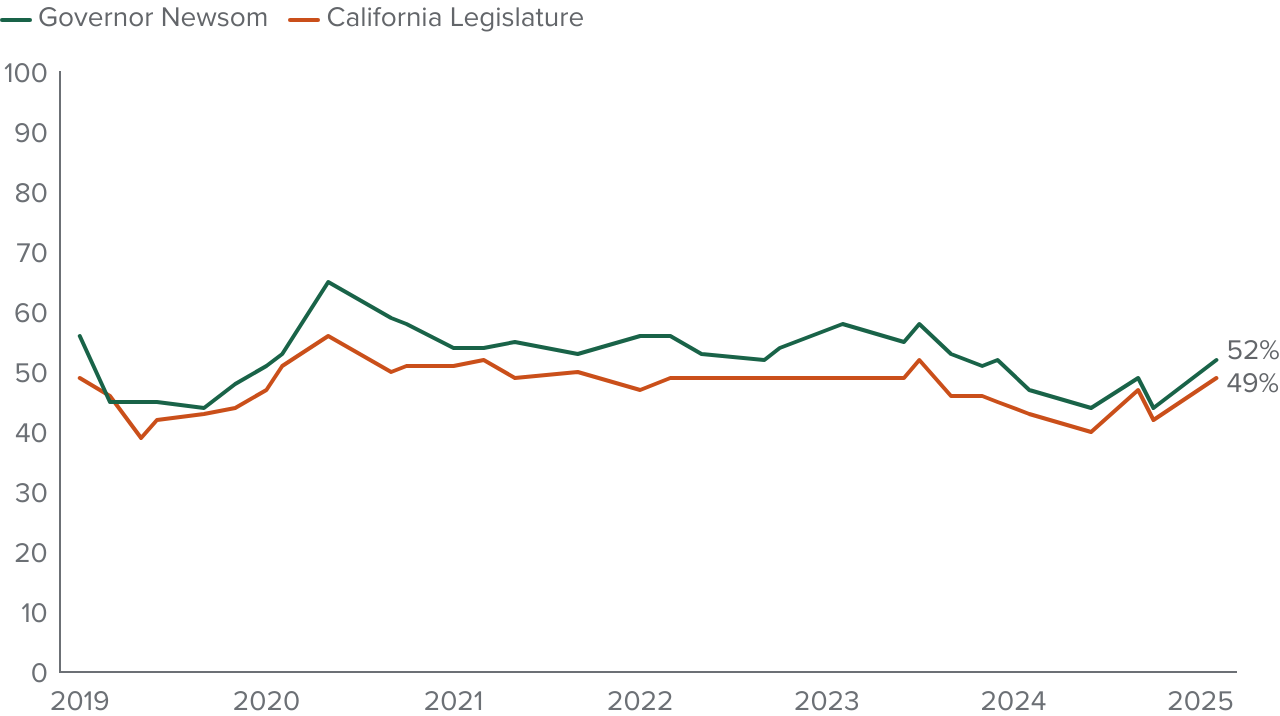
A majority of adults (52%) and likely voters (55%) approve of Governor Newsom’s job performance (disapprove: 47% adults, 45% likely voters). The governor’s approval rating was lower in our October pre-election survey (44% adults, 47% likely voters). An overwhelming share of Democrats (79%) approve, while a majority of independents (56%) and nine in ten Republicans (90%) disapprove. Approval is highest in Los Angeles (61%) followed by the San Francisco Bay Area (54%), while majorities in other regions disapprove. Half or more across most demographic groups approve of Newsom except for whites (45%), Asian Americans (48%), and residents with some college education (48%).
Californians are split on their approval of the state legislature (49% approve, 49% disapprove). Findings among likely voters are similar. Approval was lower among Californians for all of 2024. Approval varies among parties, regions, and demographic groups and is highest among Democrats (73%), African Americans (58%), San Francisco Bay Area residents (57%), and Latinos (55%). About six in ten or more adults (59%) and likely voters (63%) say Governor Newsom and the state legislature will be able to work together to accomplish a lot in the next year. Majorities of Democrats (78%) and independents (56%) agree, while seven in ten Republicans disagree (71%). More than half across regions and demographic groups hold this positive view.
Approval of Governor Newsom and the state legislature has increased since before the US election
SOURCE: PPIC Statewide Surveys, 2019–2025.
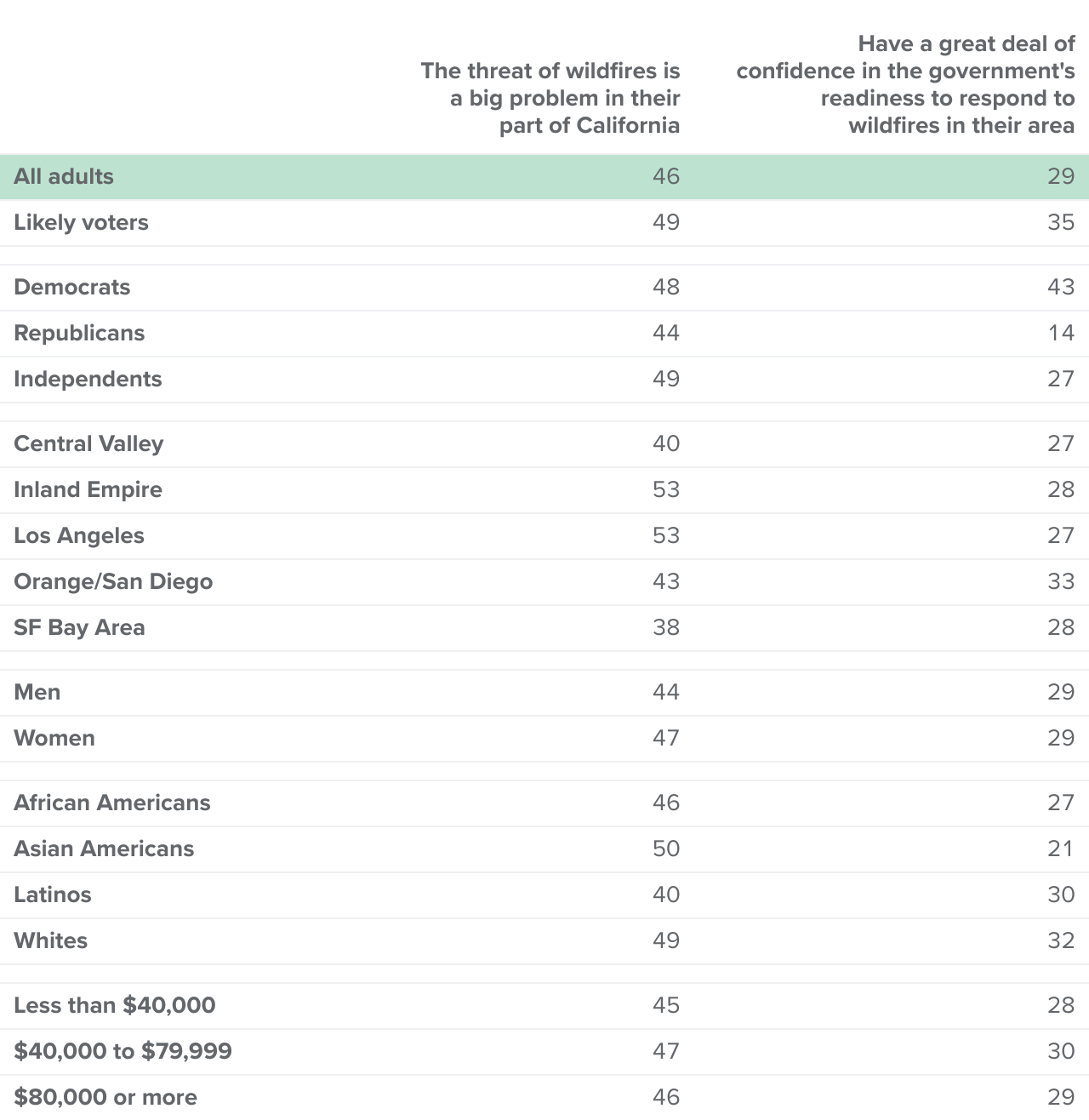
Earlier this year, Los Angeles County and surrounding areas suffered a series of wildfires, making wildfire resources a major discussion in the state. Today, 46 percent of Californians say wildfires are a big problem in their part of California (which is up from 39% in July 2024) and about third (36%) say they are somewhat of a problem. Seven in ten Californians say wildfires are either a very serious (30%) or somewhat serious (41%) threat to their personal and economic well-being. Three in four are very (46%) or somewhat concerned (32%) about climate change causing future fires that are more severe.
Across regions, larger shares of residents in Los Angeles and the Inland Empire say wildfires are a big problem in their area (53% each) than in other regions (Orange/San Diego: 43%, Central Valley: 40%, San Francisco Bay Area: 38%). Residents in the Inland Empire and Los Angeles (36% each) are also more likely to say wildfires are a very serious threat to their personal and economic well-being than in other regions (Orange/San Diego: 28%, Central Valley: 26%, San Francisco Bay Area: 23%).
Despite these levels of concern, Californians express relatively low levels of confidence in the government’s readiness to respond to wildfire in their part of California. Only three in ten (29%) say they have a “great deal” of confidence, while about half (49%) say “only some,” and one in five (22%) say “hardly any.” Across regions and demographic groups, a third or less say they have a great deal of confidence. Notably, 27 percent of Los Angeles residents have a great deal of confidence in the government’s readiness for wildfires in their area, down from 35 percent last July.
Almost half say wildfires are a big problem in their area but only three in ten have a great deal of confidence in the government's response
SOURCE: PPIC Statewide Survey, February 2025. Survey was fielded from February 4–11, 2025 (n=1,589 adults and n=1,086 likely voters).
State Budget
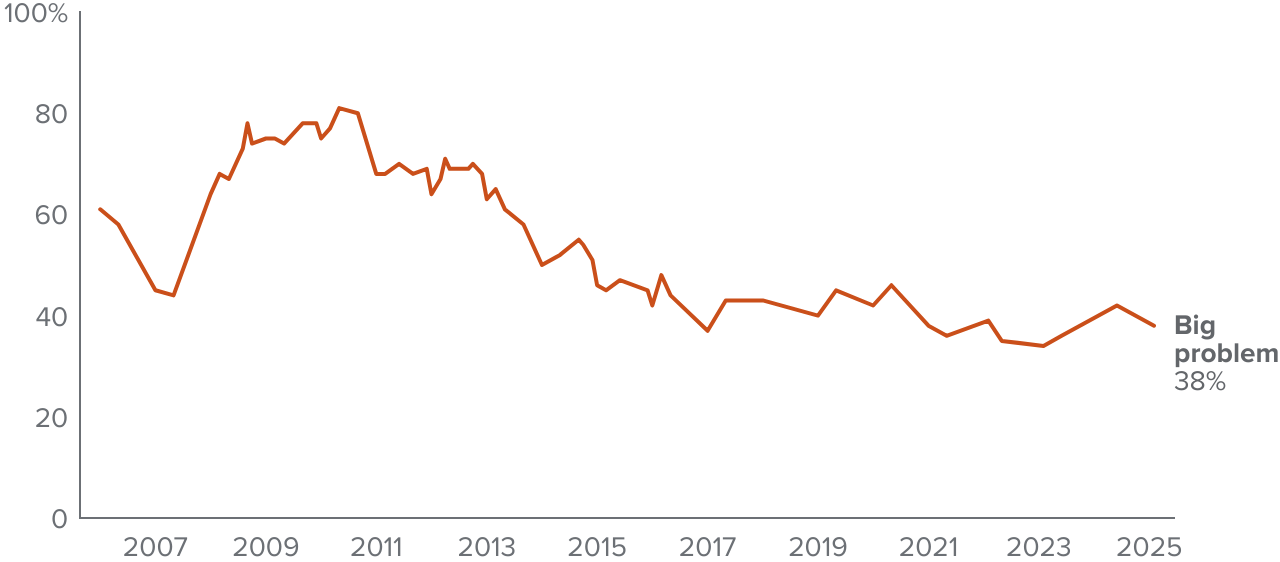
As the governor and legislature begin the budget process, Californians are feeling a great deal of uncertainty. In early January—just days after the destructive Los Angeles fires began—the governor introduced a $322.3 billion fiscal plan with $228.9 billion in general fund spending and a surplus of $363 million after pulling $7.1 billion from the state’s reserves. Still, when Californians are asked about the state budget situation, about four in ten say it is a big problem (38%), while a majority (53%) say it is somewhat of a problem, and very few say it is not a problem (7%). These views are mostly unchanged from last February (40% big problem, 48% somewhat of a problem) despite there being a projected deficit of $38 billion last January.
Views of the state budget are driven by partisan perceptions: fewer than one in four Democrats (23%) compared to three in four Republicans (76%) call the state budget situation a big problem. There are also regional differences, with those in the Inland Empire (50%) and the Central Valley (46%) being the most likely to hold this view (38% Orange/San Diego, 32% Los Angeles, 32% San Francisco Bay Area). Nearly half of whites (46%) compared to fewer in other racial/ethnic groups (38% Asian Americans, 35% African Americans, 31% Latinos) say the state budget situation is a big problem, while this perception increases with rising age (30% 18 to 34, 36% 35 to 54, 48% 55 and older).
About four in ten Californians say the state budget situation is a big problem
SOURCE: PPIC Statewide Surveys, 2006–2025.
After reading a short summary of Governor Newsom’s budget proposal, about six in ten Californians (59%) are in favor (39% oppose). A wide partisan divide exists on the budget, with eight in ten Democrats and half of independents in favor; most Republicans are opposed. Half or more across regions and nearly all demographic groups support the budget plan. Solid majorities of Latinos (67%), African Americans (65%), and Asian Americans (60%) are in favor, compared to 49 percent of whites. Support for the plan declines sharply as age increases (68% 18 to 34, 59% 35 to 54, 49% 55 and older).
A majority of Californians and likely voters favor the governor's state budget for the next fiscal year

SOURCE: PPIC Statewide Survey, February 2025. Survey was fielded from February 4–11, 2025 (n=1,589 adults and n=1,086 likely voters).
When asked about specific components of the governor’s proposal, Californians express mixed opinions. On the plan to use $7.1 billion from the Budget Stabilization Account or Rainy Day Fund, adults are more likely to say this is a bad idea (52%) than a good idea (44%). Democrats (63%) are far more likely than independents (37%) and Republicans (16%) to view this plan favorably. Fewer than half across regions and demographic groups say it is a good idea—with African Americans (62%), those making $40,000 to $80,000 (50%), and renters (50%) being the exceptions.
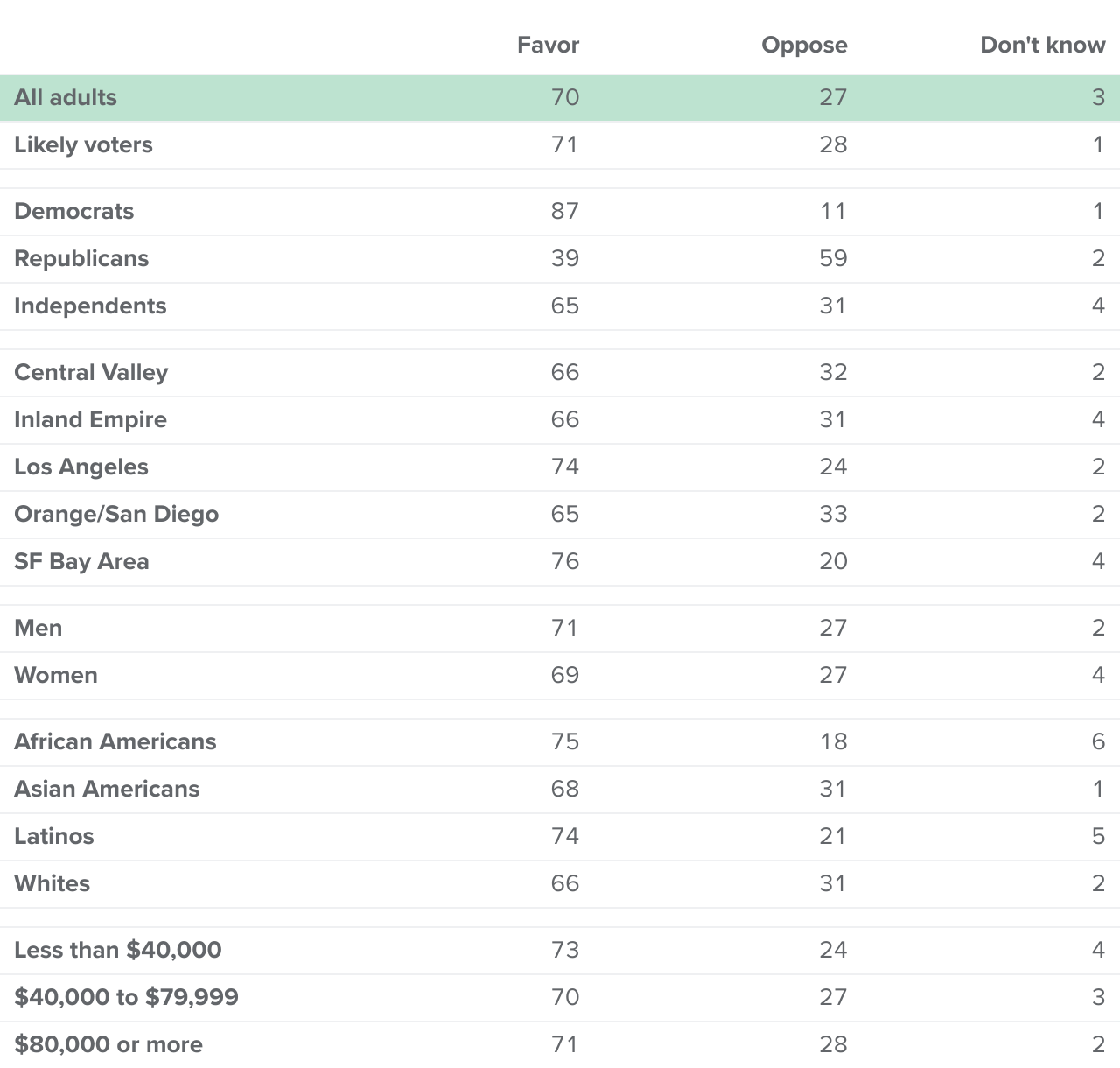
An overwhelming share of Californians favor the governor’s proposal to use $2.7 billion for the first year of a multi-year expenditure to implement Proposition 4—the $10 billion climate bond passed in November 2024. Support for this plan, which includes $1 billion for water-related programs as well as $325 million for wildfire and forest resilience, has strong majority support among Democrats (87%) and independents (65%), compared to about four in ten Republicans (39%). There is strong majority support across regions and demographic groups.
When asked what area of state spending should be the highest priority, Californians were most likely to choose health and human services (46%) or K–12 public education (40%), while far fewer say prisons and corrections (7%) or higher education (6%). Priorities have been similar in recent years. Health and human services and K–12 public education have been the top two issues nearly every time we asked this question, except the first time in January 2015 when higher education (20%) edged out health and human services (18%). Today, the top two spending areas are the same across parties, regions, and demographic groups; in most cases, people named health and human services as the highest priority.
When asked if they would rather pay lower taxes and have a state government that provides fewer services or if they would rather pay higher taxes and have a state government that provides more services, a slim majority (51%) would prefer lower taxes and a smaller government. This preference has been similar in recent years, although last June the gap between these preferences was wider (56% lower taxes/fewer services, 42% higher taxes/more services). Today, Democrats (68%) prefer a larger government, while Republicans (86%) and independents (59%) prefer a smaller government. The Central Valley and the Inland Empire prefer lower taxes and fewer services while other regions are more divided. Overall, smaller government is preferred across demographic groups; preference for a larger state government reaches a majority only among African Americans (55%), those making less than $40,000 (55%), renters (54%), and those 18 to 34 (53%).
Most Californians favor the governor's proposal to spend $2.7 billion for the first year of a multi-year expenditure to implement Proposition 4—the $10 billion climate bond passed in 2024
SOURCE: PPIC Statewide Survey, February 2025. Survey was fielded from February 4–11, 2025 (n=1,589 adults and n=1,086 likely voters).
Topics
Political Landscape Statewide Survey