Table of Contents
- Key Findings
- Federal and State Environmental Policy Directions
- Wildfires and Extreme Weather Events
- Climate Change Perceptions and Policies
- Ocean, Coast, and Marine Life
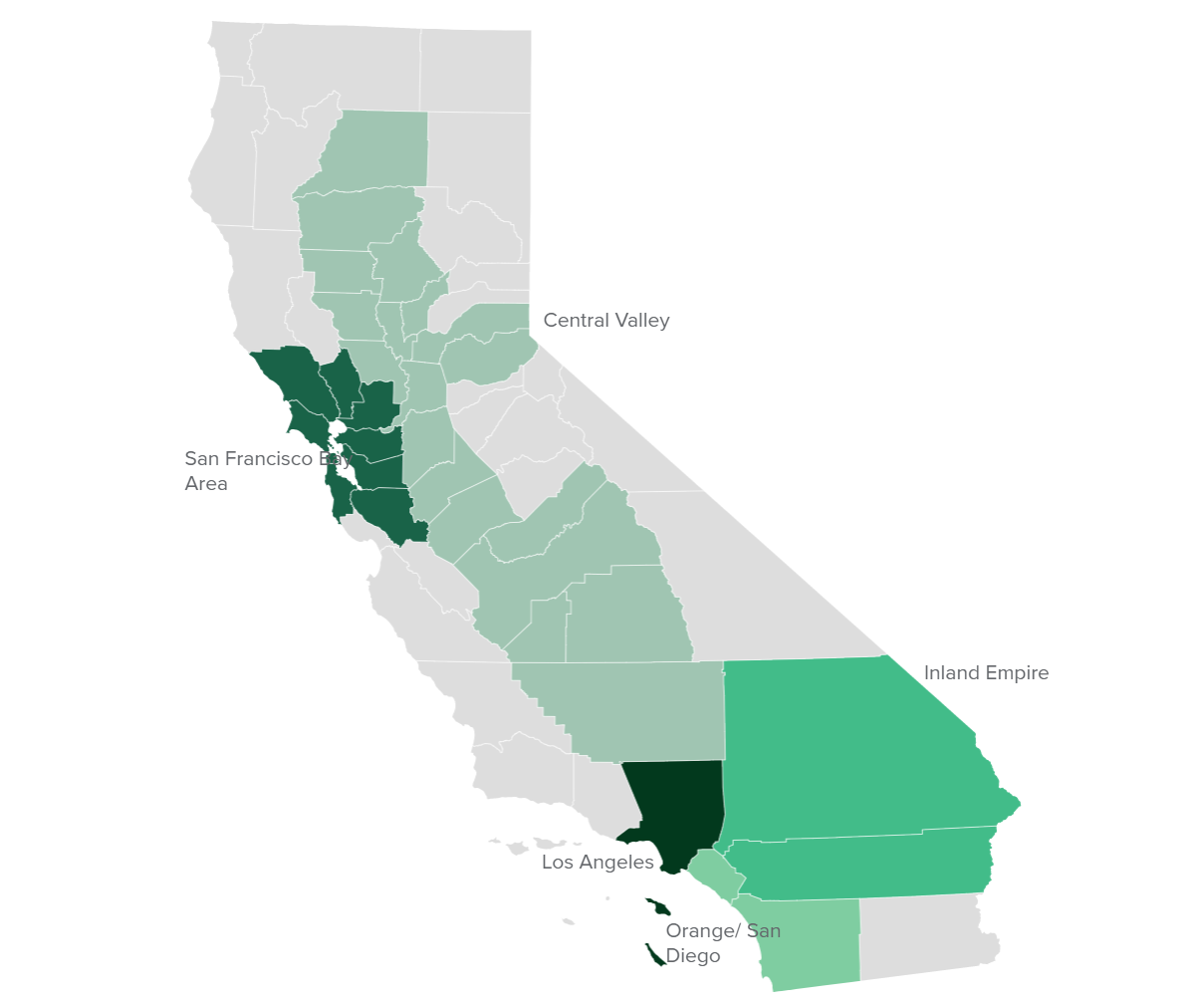
- Regional Map
- Methodology
- Questions and Responses
- Authors and Acknowledgments
- PPIC Statewide Advisory Committee
- PPIC Board of Directors
- Copyright
Key Findings
Californians reaffirmed their commitment to environmental protection in passing a $10 billion state climate bond with almost 60 percent support last November. The last election also led to federal environmental policy shifts that are at odds with the state’s policies to reduce greenhouse gas emissions and transition to renewable energy. The state government is at a crossroads in determining how much the taxpayers and consumers are willing and able to pay for these programs. Meanwhile, tragic events—starting with the Los Angeles wildfires in January and, most recently, the Texas floods in July—are wake-up calls about a lack of preparedness for the environmental changes underway.
These are the key findings of the Californians and the Environment survey on federal and state environmental policy directions, wildfires and extreme weather events, climate change and related policies, and ocean, coast, and marine life that was conducted July 1–July 7, 2025:
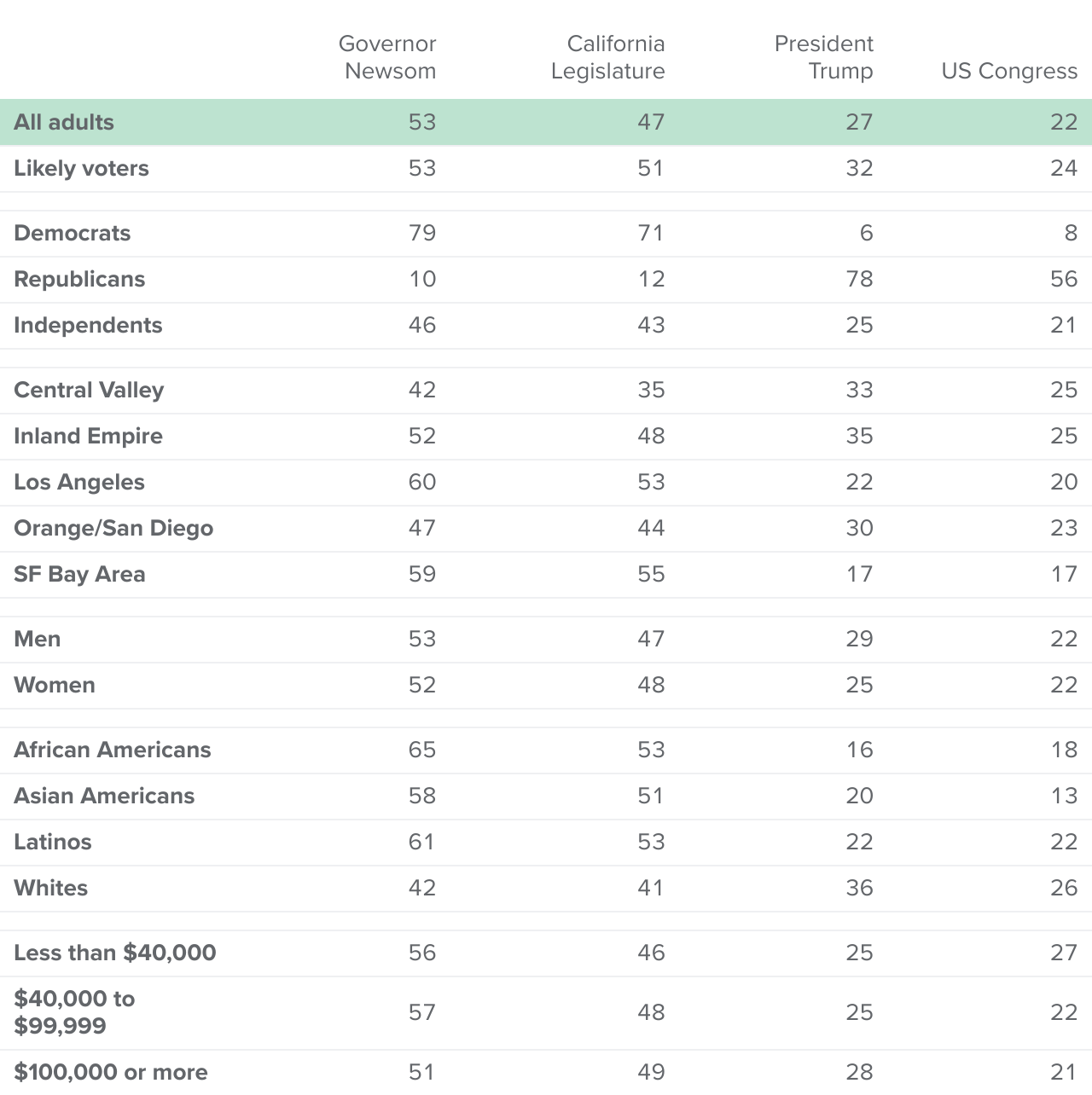
 Most Californians choose wildfires, global warming, government overregulation, and water supply when asked to identify the most important environmental issues facing the state today. Majorities believe that stricter environmental regulations in California are worth the cost and favor the state government making its own policies, separate from the federal government, on climate change. Six in ten believe that climate change is a major threat to the US and that the federal government is not doing enough to address global climate change. Seven in ten support the US participating in international efforts to help reduce the effects of global climate change. When it comes to the handling of environmental issues, 53 percent of adults approve of Governor Newsom, 47 percent approve of the legislature, 27 percent approve of President Trump, and 22 percent approve of Congress.
- Forty-six percent of Californians think that wildfires are a big problem in their part of California and 31 percent see them as a very serious threat to their personal and economic well-being. Six in ten think that state and local governments are not doing enough to address wildfires, including prevention and recovery. Majorities say that they have “only some” confidence in the government in terms of its readiness to respond to wildfires and extreme weather events in their region. Sixty percent say they are very concerned that home insurance will become more expensive, and 57 percent say that Californians will be unable to obtain home insurance due to climate-change risks.
 Most Californians think that the effects of climate change have already begun and view climate change as a serious threat to California’s future economy and quality of life. Six in ten are in favor of the state’s goals to achieve net zero greenhouse gas emissions and 100 percent renewable energy by 2045. Eighty-one percent favor building more solar power stations in California. Forty-seven percent say they have seriously considered getting or already have an electric vehicle. Forty percent are willing to pay more for electricity generated by renewable sources, such as solar and wind power, in order to help reduce climate change. Thirty-five percent favor banning the sale of all new gasoline-powered vehicles by 2035.
- Sixty percent of California adults and 66 percent of likely voters think the condition of oceans and beaches are very important to the state’s future economy and quality of life. Forty-four percent of adults are very concerned about ocean warming having an impact on marine and coastal life, while 31 percent are very concerned about the impact of rising sea levels on flooding and beach erosion. Sixty percent say plastics and marine debris are a big problem in the part of the California coast that is closest to them, and 44 percent say declining marine life is a big problem. Sixty percent say that marine protected areas (MPAs) are very important. Seven in ten Californians favor allowing wind power and wave energy projects off the California coast, while one in three support more oil drilling off the California coast.
 Most Californians think that the effects of climate change have already begun and view climate change as a serious threat to California’s future economy and quality of life. Six in ten are in favor of the state’s goals to achieve net zero greenhouse gas emissions and 100 percent renewable energy by 2045. Eighty-one percent favor building more solar power stations in California. Forty-seven percent say they have seriously considered getting or already have an electric vehicle. Forty percent are willing to pay more for electricity generated by renewable sources, such as solar and wind power, in order to help reduce climate change. Thirty-five percent favor banning the sale of all new gasoline-powered vehicles by 2035.
Federal and State Environmental Policy Directions
The devastating consequences of the urban wildfire in Los Angeles and extreme weather events outside the state have raised public awareness and concern about the environment. Meanwhile, executive orders and the Budget Act shifted the federal environmental policy landscape, while the California governor and legislature made changes to state environment policy (i.e., CEQA). What do Californians think about federal and state environmental policy directions in this new context?
Most Important Environmental Issue. Most Californians choose either wildfires, global warming, government overregulation, or water supply as the most important environmental issue facing California today. Partisans are divided on whether their top choice is global warming (31% Democrats, 3% Republicans, 16% independents) or government overregulation (8% Democrats, 42% Republicans, 14% independents). When asked to choose the level of government that they trust the most to handle California’s environmental issues, 45 percent of adults say the state government (32% local, 18% federal). However, partisans are divided on whether they trust the state government (68% Democrats, 11% Republicans, 43% independents) or the federal government (4% Democrats, 51% Republicans, 20% independents) when it comes to handling California’s environmental issues.
State Policies. Majorities of adults (55%) think that stricter environmental regulations in California are worth the cost, while 43 percent believe that they cost too many jobs and hurt the economy. Majorities across age and income groups think that stricter environmental regulations in California are worth the cost, while opinions vary across partisan, regional, and racial/ethnic groups.
Majorities of adults and likely voters say stricter environmental regulations are worth the cost

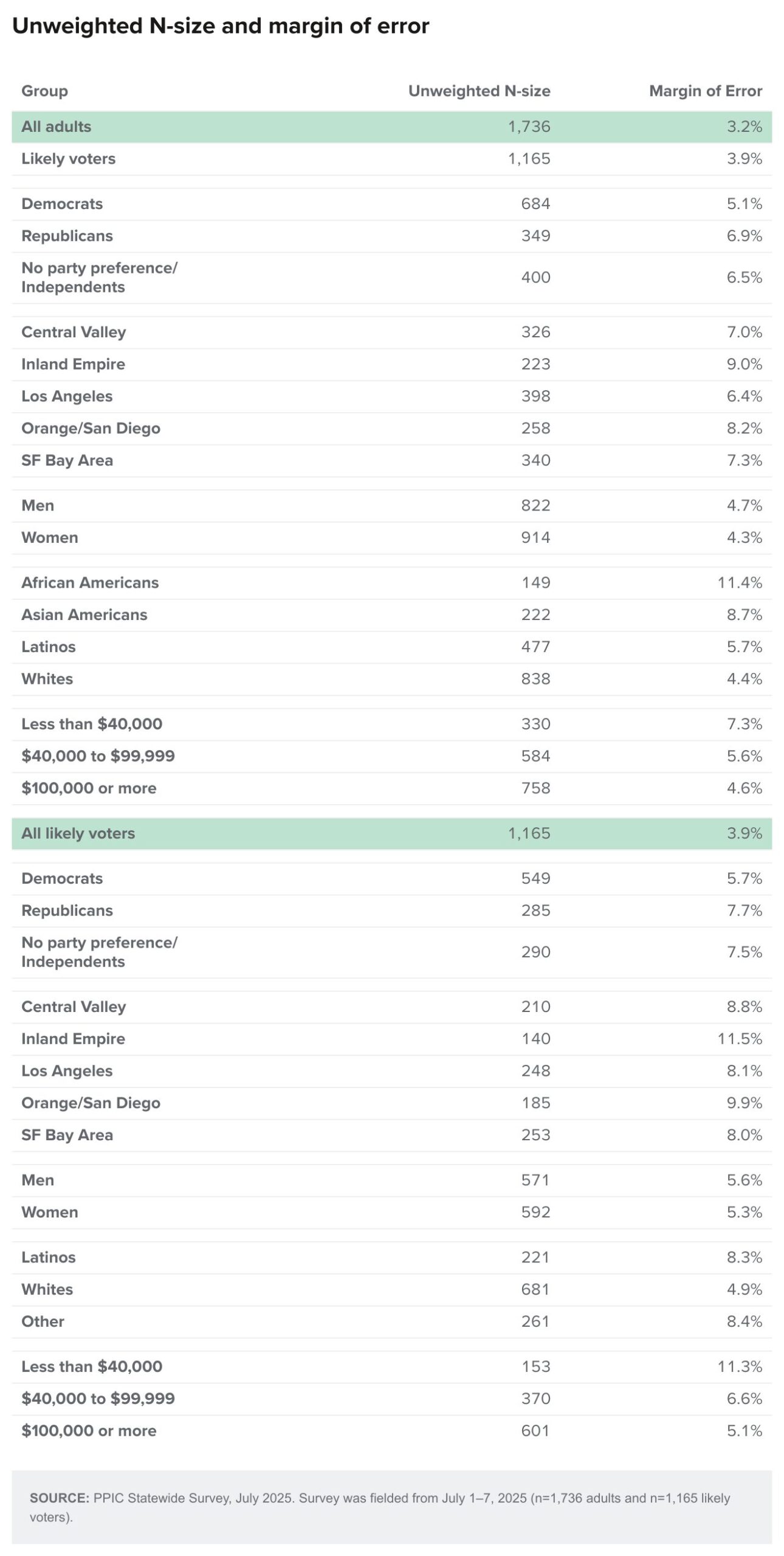
SOURCE: PPIC Statewide Survey, July 2025. Survey was fielded from July 1–7, 2025 (n=1,736 adults and n=1,165 likely voters).
Moreover, six in ten adults and likely voters say it is very or somewhat important that California acts as a leader around the world when it comes to efforts to fight climate change. Similar majorities favor the state government making its own policies, separate from the federal government, to address the issue of climate change. Majorities hold these two views across regions and demographic groups while partisans are divided.
Federal Policies. Majorities of adults (58%) and likely voters (60%) say that global climate change is a major threat to the well-being of the US. Similar shares say the federal government is not doing enough to address climate change. Half or more share these perspectives across demographic groups, while partisans differ on the view that climate change is a major threat (83% Democrats, 20% Republicans, 59% independents) and the perception that the federal government is not doing enough.
Six in ten think the federal government is not doing enough to address climate change

SOURCE: PPIC Statewide Survey, July 2025. Survey was fielded from July 1–7, 2025 (n=1,736 adults and n=1,165 likely voters).
Six in ten adults and likely voters think that protection of the environment should be given priority, even at the risk of curbing economic growth in the US. When asked about addressing the US energy supply, about seven in ten say the more important priority should be developing alternative energy sources, such as wind, solar, and hydrogen technology, and less than three in ten say it should be expanding exploration and production of oil, coal, and natural gas. Seventy-seven percent of adults and likely voters support the US participating in international efforts to help reduce the effects of global climate change. Partisans are divided on these policies.
Approval Ratings. About half or more of adults and likely voters approve of the way that Governor Newsom and the California Legislature are handling environmental issues in California. Opinions are similar across income groups and vary across regions; partisans are deeply divided. Similarly, 45 percent of adults say that they can trust the state government “just about always” or “most of the time” to do what is right when it comes to handling environmental issues in California.
By comparison, fewer than one in three California adults and likely voters approve of the way that President Trump and the US Congress are handling environmental issues in the US. Fewer than four in ten approve across demographic groups and regions while views are divided among partisans. President Trump had similarly low approval ratings among all adults eight years ago. Twenty-three percent of adults say they can trust the federal government “just about always” or “most of the time” to do what is right when it comes to handling environmental issues in the US.
For the handling of environmental issues, close to half or more approve of state officials and far fewer approve of federal officials
% approve
SOURCE: PPIC Statewide Survey, July 2025. Survey was fielded from July 1–7, 2025 (n=1,736 adults and n=1,165 likely voters).
Wildfires and Extreme Weather Events
Six months after the devastating fires in Southern California and as multiple fires burn across the state, eight in ten Californians (82%) say the threat of wildfires in their part of California is a problem, including 46 percent who say this is a big problem. Overall views were similar last July, but Californians today are more likely than a year ago to say wildfires are a big problem (46% today vs. 39% last July).
Most adults say that wildfires in their part of California are a very serious (31%) or somewhat serious threat (38%) to their personal and economic well-being; three in ten say the threat is not too serious (31%). Last July, a similar share viewed the threat as serious (26% very serious, 40% somewhat serious, 34% not too serious). Today, Californians in the Inland Empire and Los Angeles are more likely than those in Orange/San Diego, the Central Valley, and the San Francisco Bay Area to say wildfires are a very serious threat. Across parties, Democrats (36%) are much more likely than Republicans (26%) and independents (26%) to say the threat is very serious. Across racial/ethnic groups, Asian Americans and African Americans (37% each) are the most likely to think the threat is very serious, followed by Latinos (32%) and whites (26%).
Most Californians view wildfires in their part of California as a serious threat to their personal and economic well-being

SOURCE: PPIC Statewide Survey, July 2025. Survey was fielded from July 1–7, 2025 (n=1,736 adults and n=1,165 likely voters).
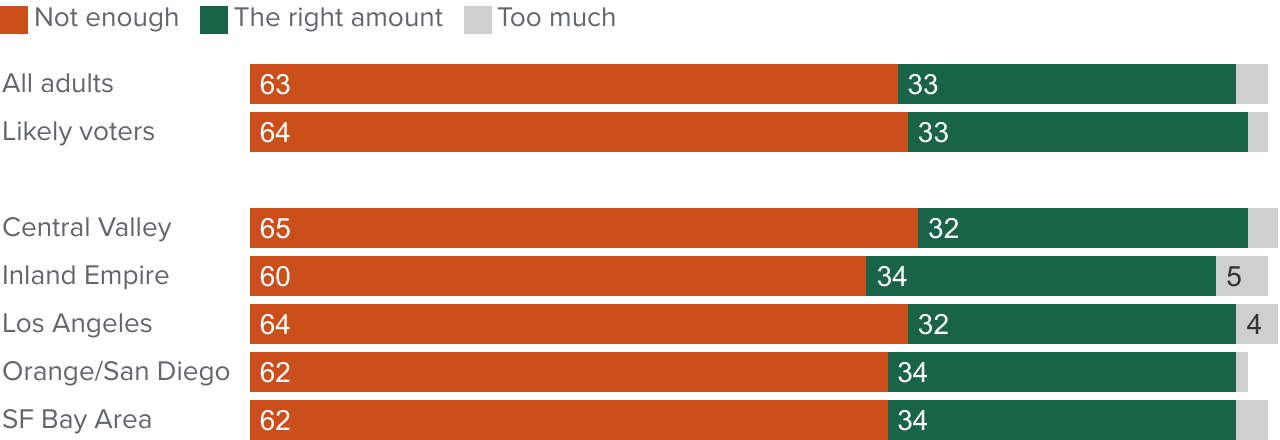
When asked about the state and local governments’ actions to address wildfires, including prevention and recovery, most California adults (63%) say state and local governments are not doing enough, while a third (33%) say they are doing the right amount and just 3 percent say they are doing too much. While views across regions are similar, partisan perceptions are more varied: 78 percent of Republicans, 64 percent of independents, and 58 percent of Democrats agree that not enough is being done. Across racial/ethnic groups, majorities of whites (69%), Asian Americans (64%), and Latinos (57%) think government is not doing enough, while African Americans are divided between not enough (47%) and the right amount (50%).
Most Californians think that the state and local governments are not doing enough to address wildfires
SOURCE: PPIC Statewide Survey, July 2025. Survey was fielded from July 1–7, 2025 (n=1,736 adults and n=1,165 likely voters).
Since many Californians say state and local governments are not doing enough, it is notable that just about one in four Californians (27%) say they have a great deal of confidence in the government in terms of its readiness to respond to wildfires in their part of the state. A majority of adults (52%) report having only some confidence, while one in five have hardly any confidence (20%). Views were similar last July (32% a great deal, 52% only some, 15% hardly any), and about one in three have said they have a great deal of confidence each July since 2020.
Overwhelming majorities of adults are very (54%) or somewhat concerned (33%) about rising electricity bills because of utilities’ responsibilities for the costs of wildfire damages; about one in seven are not too (10%) or not at all concerned (3%). In May 2019, following the devastating Camp Fire in late 2018, far fewer Californians were very concerned about rising electricity bills (41%).
Over the last year, California has experienced extreme weather events, including wildfires, heat waves, storms and flooding, and drought conditions in parts of the state. Many Californians see a connection between these events and a changing climate. Overwhelming majorities are concerned that climate change will cause heat waves (42% very, 36% somewhat), droughts (49% very, 35% somewhat), and wildfires (49% very, 37% somewhat) that are more severe.
Californians are also concerned about the impact due to climate-change risks on home insurance. Nearly nine in ten adults say they are concerned that home insurance will become more expensive (60% very, 27% somewhat) and that Californians will be unable to obtain home insurance (57% very, 31% somewhat).
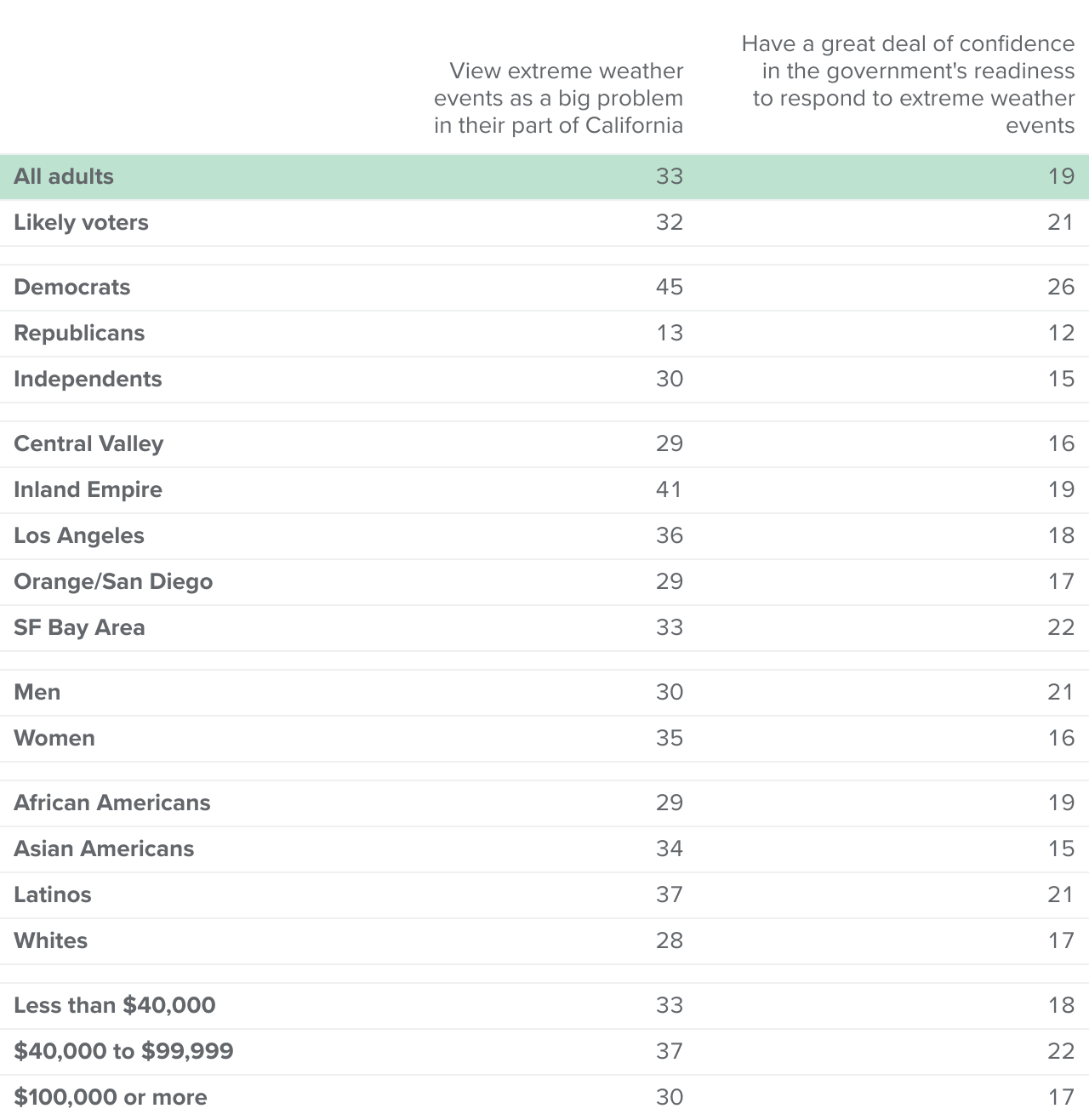
When asked about extreme weather events, three in four Californians say they are a big problem (33%) or somewhat of a problem (41%), while one in four view these as not much of a problem (26%). Views were similar in July 2023 (35% big problem, 41% somewhat of a problem, 24% not much of a problem). Today, Democrats are much more likely than Republicans and independents to call extreme weather a big problem. Regional differences emerge, with those in the Inland Empire the most likely to say this and those in the Central Valley and Orange/San Diego the least likely.
When it comes to the public perception of government’s readiness to respond to extreme weather events, just one in five (19%) say they have a great deal of confidence; about six in ten (58%) say they have only some confidence, and about one in four (23%) say they have hardly any confidence. Views were nearly identical last year (19% a great deal, 56% only some, 25% hardly any). Fewer than one in four across regions have a great deal of confidence. Democrats are much more likely than Republicans and independents to have a great deal of confidence.
One in three view extreme weather events as a big problem in their part of the state and one in five have a great deal of confidence in government's readiness to respond to these events
SOURCE: PPIC Statewide Survey, July 2025. Survey was fielded from July 1–7, 2025 (n=1,736 adults and n=1,165 likely voters).
Climate Change Perceptions and Policies
A solid majority of adults (62%) believe the effects of climate change have already begun while about one in five say the effects will begin happening within a few years (6%) or within their lifetime (13%). About one in ten think that these effects will not happen in their lifetime but will affect future generations (9%), and an identical share think they will never happen (9%). About three in four Californians say they worry a great deal (40%) or a fair amount (34%) about climate change. Across regions of the state, this share is highest among residents in Los Angeles (79%) and the San Francisco Bay Area (77%) and lowest in the Central Valley (65%, 70% Orange County/San Diego, 73% Inland Empire).
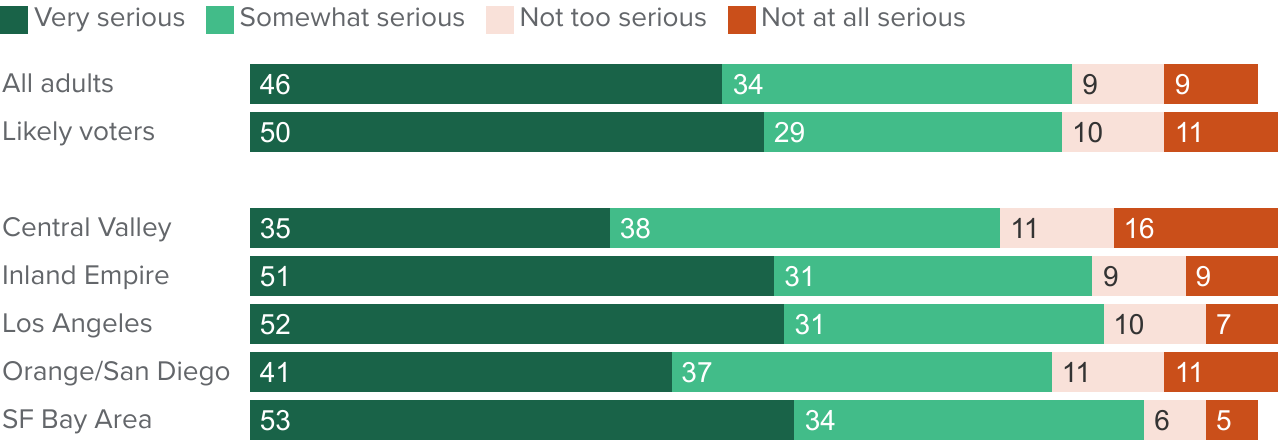
Eight in ten California adults say climate change is a very serious (46%) or somewhat serious (34%) threat to California’s future economy and quality life. About one in ten say this threat is not too serious or not at all serious. Seven in ten or more Californians have viewed climate change as a threat to the state since we first asked this question in 2005. Today, overwhelming majorities of Democrats (95%) and independents (82%) view climate change as a threat to the state, while Republicans are split in their views (52% very/somewhat serious threat, 48% not too/not at all serious threat). More than seven in ten across regions perceive climate change as a threat to the state; this share is highest in the San Francisco Bay Area (87%). Nearly three in four or more across demographic groups view climate change as a threat to the state’s well-being. About a quarter of Californians (24%) say they have considered moving to a different home to avoid the impacts of climate change.
Most Californians say climate change is a threat to the state's future economy and quality of life
SOURCE: PPIC Statewide Survey, July 2025. Survey was fielded from July 1–7, 2025 (n=1,736 adults and n=1,165 likely voters).
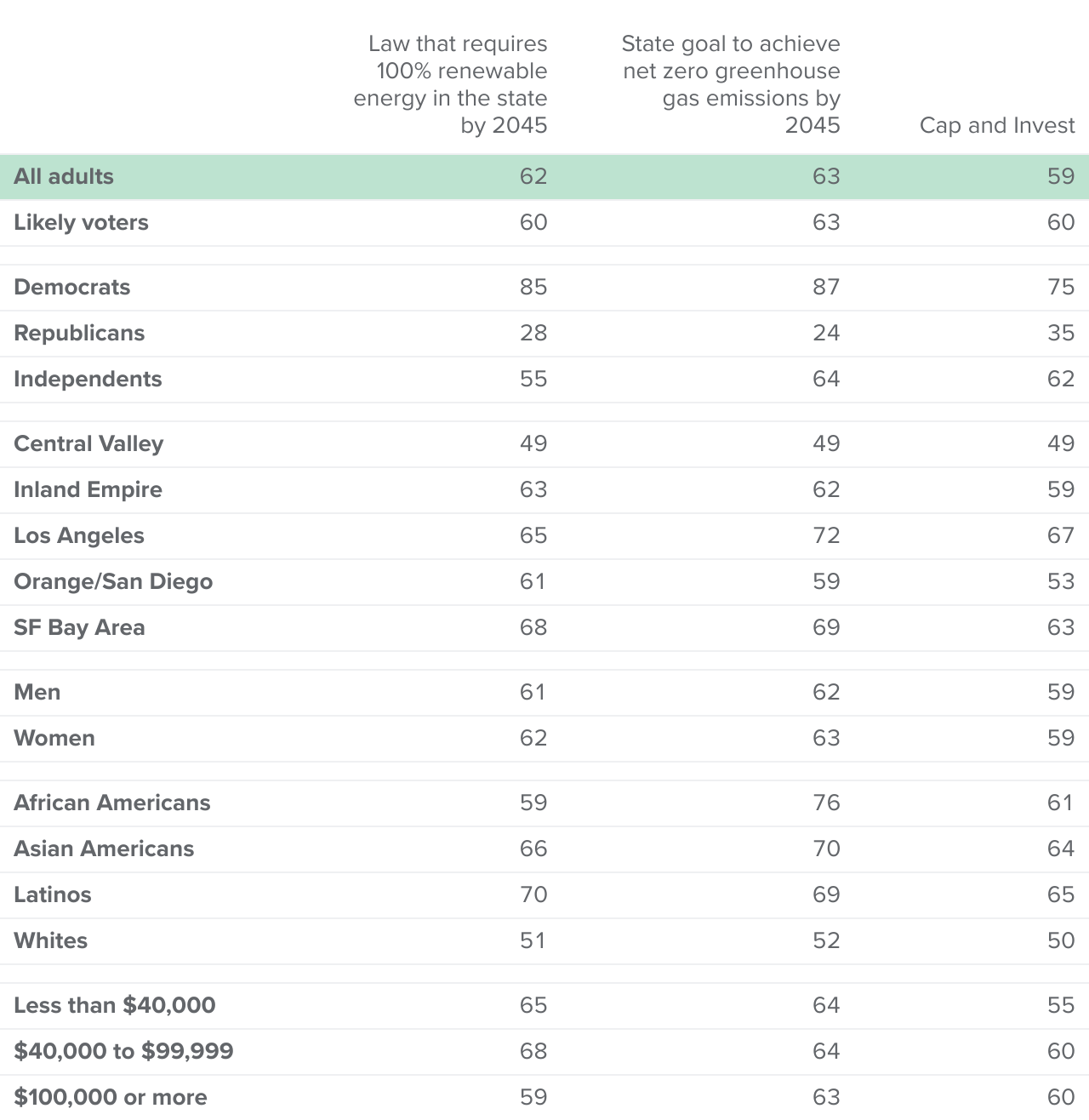
About six in ten adults (62%) and likely voters (60%) favor a state law that requires 100 percent of the state’s electricity to come from renewable sources by 2045. Democrats (85%) are far more likely than independents (55%) to be in favor, while most Republicans oppose (72%). Six in ten or more across most regions favor this law, except for the Central Valley, where residents are split.
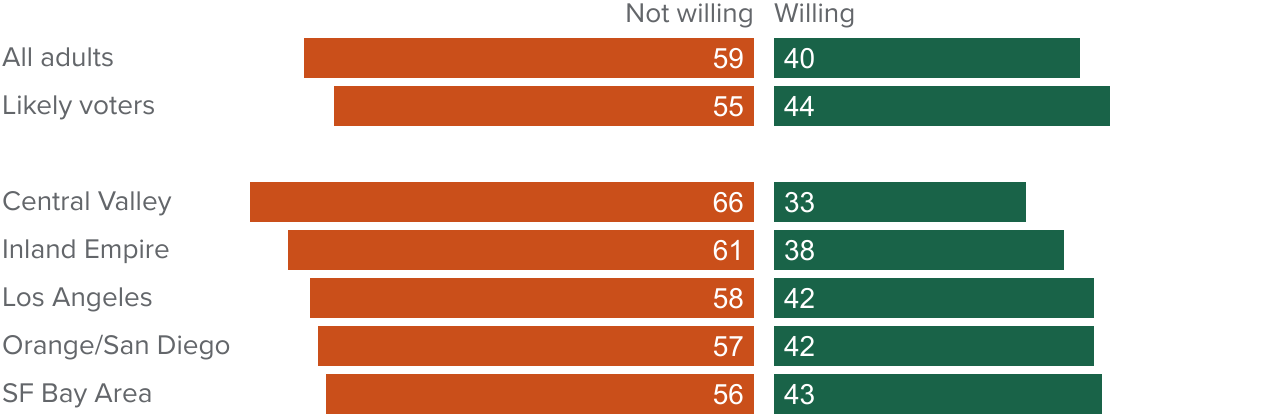
However, when asked if they would be willing to pay more for electricity generated by renewable sources, such as solar or wind energy, majorities of adults and likely voters say they would not be willing. The share willing to pay more for renewable energy sources (40%) has declined steadily since July 2016 (56% willing). Today, about six in ten Democrats (58%) say they are willing, while nearly all Republicans (86%) and six in ten independents (60%) say they are not willing. Majorities among regional groups and most demographic groups are unwilling. The only group with a majority who are willing to pay more is college graduates (51%).
About eight in ten adults (81%) and likely voters (83%) favor building more solar power stations in California, including more than six in ten across parties and about three in four or more across regional and demographic groups. About half of adults (48%) and a majority of likely voters (54%) favor building more nuclear plants in the state. A majority of Democrats (57%) oppose this, while half of independents (50%) and six in ten Republicans (62%) favor this proposal. Views are mixed and vary across regional and demographic groups. Notably, men (61%) are far more likely than women (36%) to support building more nuclear plants.
Majorities of Californians are not willing to pay more for electricity generated by renewable sources
SOURCE: PPIC Statewide Survey, July 2025. Survey was fielded from July 1–7, 2025 (n=1,736 adults and n=1,165 likely voters).
More than six in ten adults (63%) and likely voters (63%) support the state goal of achieving net zero greenhouse gas emissions no later than 2045. Nearly nine in ten Democrats and more than six in ten independents favor this goal, while about three in four Republicans oppose. About six in ten or more across most regions favor this law, except in the Central Valley, where residents are split (49% favor, 51% oppose). Majorities across demographic groups favor this goal for net zero emissions.
Californians have mixed views about electric vehicles. Forty-seven percent say they have seriously considered getting (36%) or already have (11%) an electric vehicle, while about half (52%) say they have not considered getting an electric vehicle. This share has actually gone down since July 2023, when 58 percent were considering or already had an electric vehicle. Today, solid majorities of Democrats (61%) have either considered purchasing an electric vehicle or already have one, while two in three Republicans (67%) and about half of independents (51%) have not considered buying an electric vehicle.
Six in ten adults (63%) and likely voters (61%) oppose Governor Newsom’s executive order banning the sale of all new gasoline-powered vehicles by 2035. This share has increased 11 points since July 2021, when 49 percent of Californians opposed the executive order. Today, most Republicans (92%) and independents (66%) are opposed, while a majority of Democrats (55%) are in support. Majorities across regions and demographic groups oppose this executive order. Californians are divided on the state banning the sale of all new diesel-powered heavy-duty and medium-duty trucks by 2036 (adults 47% favor, 51% oppose; likely voters 50% favor, 50% oppose). Two in three Democrats (67%) are in favor, while nearly nine in ten Republicans (87%) oppose; independents are divided (51% favor, 47% oppose).
Californians were asked about the state’s carbon emission trading program for companies, “Cap and Invest,” formally known as “Cap and Trade.” Six in ten adults and likely voters favor this program, including six in ten or more Democrats and independents. Conversely, six in ten Republicans oppose. Majorities across most regional and all demographic groups support the program, except for Central Valley residents.
When asked about spending Cap and Invest revenues, seven in ten adults and likely voters say it is at least somewhat important that revenues are spent on projects to improve environmental conditions in lower-income and disadvantaged communities. Aside from Republicans, majorities across parties, regions, and demographic groups say this is important.
Most Californians favor the state's goals for renewable energy and greenhouse gas emissions, as well as the Cap and Invest program
% favor
SOURCE: PPIC Statewide Survey, July 2025. Survey was fielded from July 1–7, 2025 (n=1,736 adults and n=1,165 likely voters).
Ocean, Coast, and Marine Life
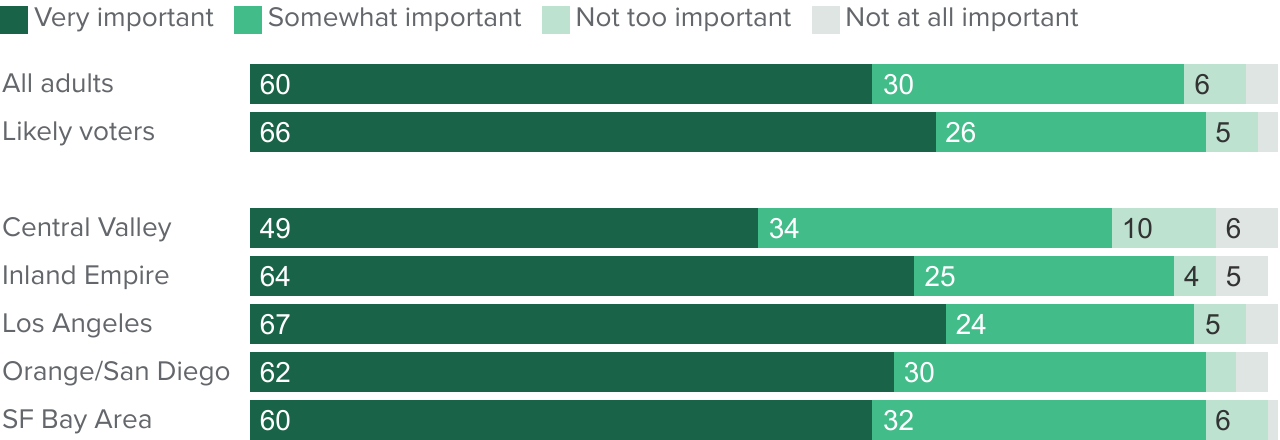
About nine in ten adults and likely voters say the condition of oceans and beaches is very important or somewhat important to California’s future economy and quality of life, including six in ten or more who say it is very important (60% adults, 66% likely voters). These shares are similar to last July. Today, partisans are divided on this issue, with most Democrats (74%) and independents (64%) saying it is very important, compared to far fewer Republicans (44%). Majorities across demographic groups hold this view, and coastal residents (63%) are more likely than inland residents (54%) to say the condition of oceans and beaches is very important. Majorities across the state’s major regions say it is very important, with the exception of Central Valley residents.
Most Californians say the condition of oceans and beaches is important to the state's future economy and quality of life
SOURCE: PPIC Statewide Survey, July 2025. Survey was fielded from July 1–7, 2025 (n=1,736 adults and n=1,165 likely voters).
About two in three adults say they are at least somewhat concerned about rising sea levels having an impact on flooding and beach erosion (31% very, 37% somewhat). Nearly half of Democrats (47%) say they are very concerned, compared to far fewer independents (29%) and Republicans (9%). One in four or more across demographic and regional groups say this.
When it comes to ocean warming having an impact on marine and coastal life, over three in four adults say they are at least somewhat concerned (44% very, 34% somewhat). Partisans are divided on this issue, with a solid majority of Democrats (64%), about four in ten independents (43%), and two in ten Republicans (20%) saying they are very concerned. While there is variation across demographic and regional groups, half or fewer across groups are very concerned.
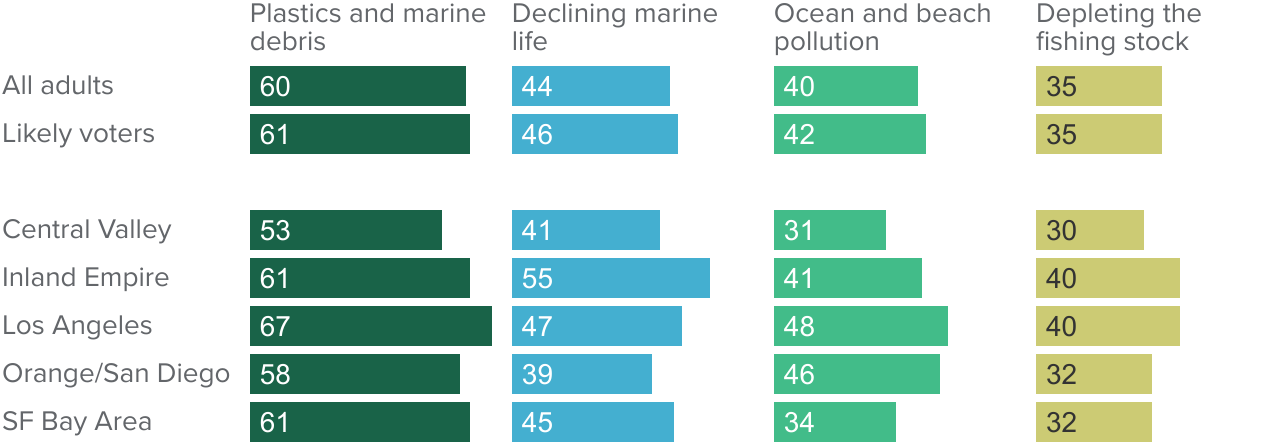
Most adults say plastic and marine debris (92%), ocean and beach pollution (89%), declining marine life (85%), and overfishing (79%) are at least somewhat of a problem in the part of the California coast closest to them, with a solid majority saying plastics and marine debris are a big problem. Fewer than half say declining marine life, ocean and beach pollution, and overfishing are big problems. These shares are similar to a year ago. Among partisans today, Democrats are most likely to say marine debris (74%) and declining marine life (57%) are big problems, and independents are most likely to say marine debris is a big problem (54%). Among Republicans, fewer than half say any of these issues are big problems. Across the state’s regions, the shares holding this view vary, with majorities reached among all major regions when it comes to plastics and marine debris. Residents in coastal regions are somewhat more likely to say ocean and beach pollution (43%; 34% inland) and marine debris (61%, 55% inland) are big problems on the part of the California coast closest to them.
A majority say plastics and marine debris are a big problem; fewer say this about declining marine life, beach pollution, and depleting the fishing stock
% big problem
SOURCE: PPIC Statewide Survey, July 2025. Survey was fielded from July 1–7, 2025 (n=1,736 adults and n=1,165 likely voters).
Roughly nine in ten adults say marine protected areas—or MPAs, which are managed by the California State Fish and Game Commission to protect fish, wildlife, and their habitat in coastal waters—are important, including six in ten who say it is very important (60%, 29% somewhat). Majorities across partisan, demographic, and regional groups say this, with the exception of Republicans (43%).
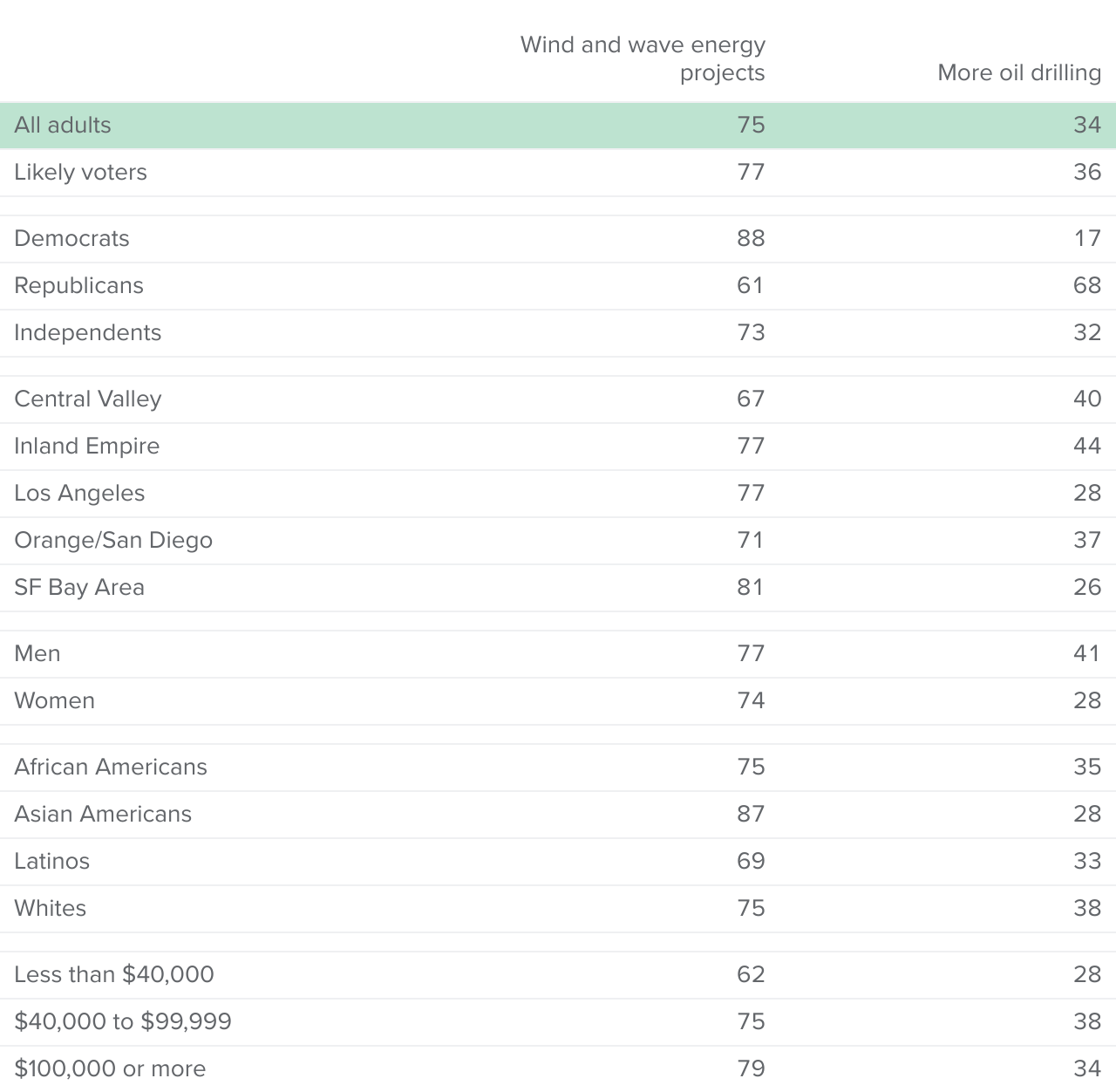
When it comes to allowing more oil drilling off the California coast, just one in three adults and likely voters are in favor, with a majority in opposition. These shares are similar to a year ago. Partisans today are divided on this issue, with most Republicans in favor, compared to about three in ten independents and fewer than two in ten Democrats. Across demographic and regional groups, the shares in favor are highest among men (41%) and residents in the Inland Empire (44%) and Central Valley (40%). The share in favor increases as age rises.
In contrast, about three in four adults and likely voters favor allowing wind power and wave energy projects off the California coast, including solid majorities across partisan groups. Today, overall shares are similar to a year ago. Six in ten or more across demographic and regional groups are in favor, including seven in ten or more among coastal (77%) and inland residents (71%).
Overwhelming majorities favor allowing wind and wave energy projects off the California coast; far fewer are in favor of allowing more oil drilling
% favor
SOURCE: PPIC Statewide Survey, July 2025. Survey was fielded from July 1–7, 2025 (n=1,736 adults and n=1,165 likely voters).
Topics
Political Landscape Statewide Survey Water, Land & AirLearn More

Californians Back Cap-and-Trade and Related Spending on Low-Income Communities

Californians and the Energy Transition

Californians Want Renewable Energy but Don’t Want to Pay Extra for It
A Deeper Look at California’s Homeowner Insurance Challenges

A Closer Look at California’s Surging Electricity Rates