
In a report and fact sheet released last month, we analyzed the development and current status of Tribal water rights in California. In this post, we use remote-sensing and other publicly available data to look at agricultural land and water use on Tribal reservations. Except where noted, this analysis does not capture Tribal agriculture located outside reservation boundaries, and it therefore likely underestimates Tribes’ total agricultural holdings. Additionally, we do not include land outside California for reservations that cross state boundaries.
Tribal agriculture in a nutshell
Of the 103 federally recognized Indian reservations in California, only about 20 consistently host irrigated agriculture, and most of these are relatively small-scale (less than 100 acres). In an average water year, about 15,800 acres are irrigated on Tribal reservations (about 0.2% of statewide irrigated acreage), including by non-Tribal residents. Irrigated acreage tends to decline slightly during drought years and rebounds during wet and normal water years. Water demands for this agriculture amount to about 60,000–70,000 acre-feet per year (about 0.2% of total statewide applied water).
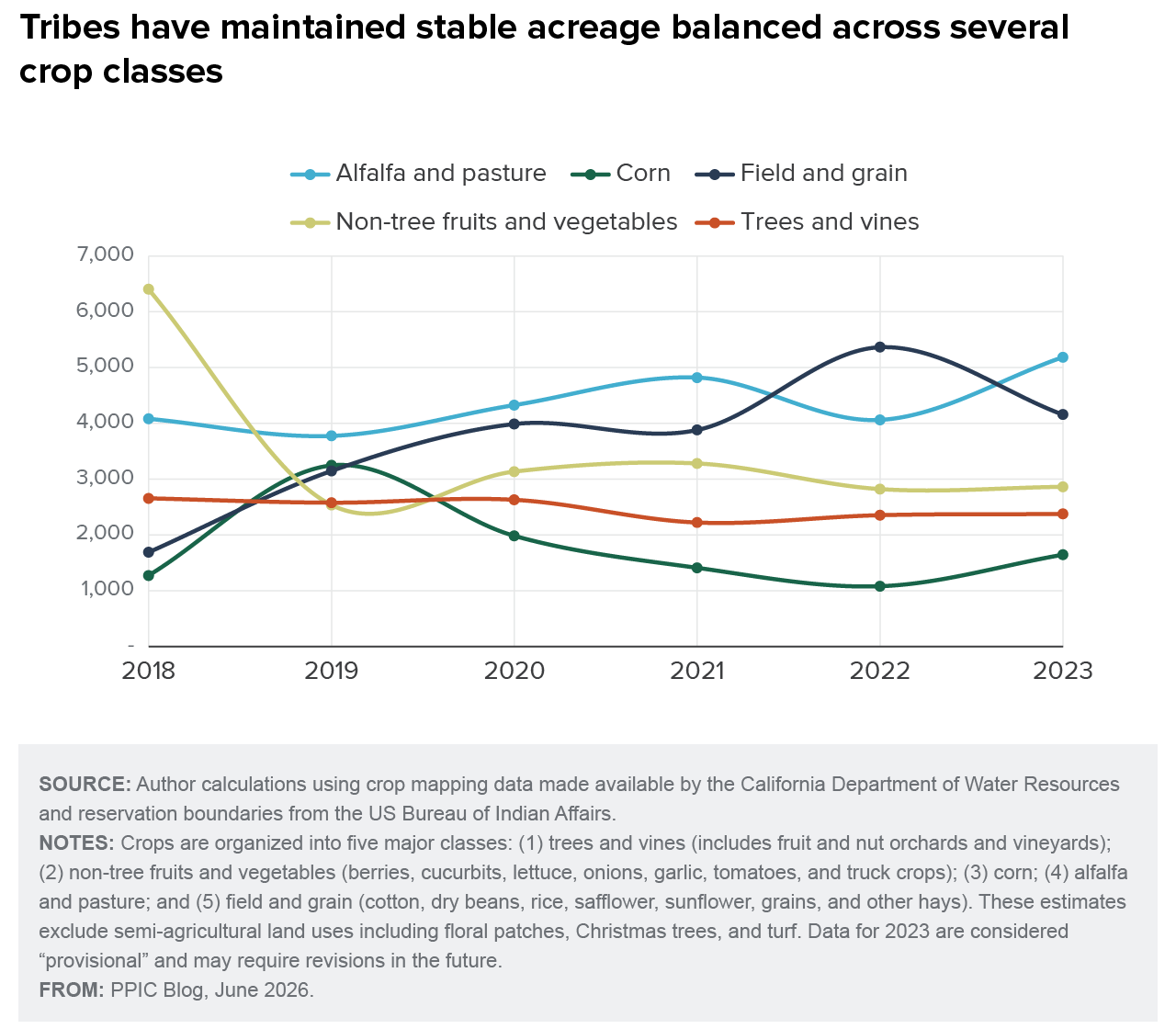
Agriculture on reservation lands features a more balanced portfolio of crops compared to the rest of the state. Perennial tree and vine crops, which live for many years, are much less prevalent on Tribal land (16% of crops) compared to statewide (48%), while major annual crop classes (alfalfa and pasture, corn, field and grain crops, and non-tree fruits and vegetables) are much more common. This high proportion of annual crops—those grown on yearly cycles—with fewer perennial crops likely reflects the hot, arid climate where most of these reservations are located.
Where is Tribal agriculture cultivated?
Nearly 90% of this cropland lies in the Colorado River Basin. By contrast, in the state overall, the Central Valley is the most intensively irrigated region.
- In an average year, about 14,000 acres are cultivated in the Colorado River Basin.
- Another 1,200 acres are cultivated on the North and South Coasts.
- Fewer than 100 acres are cultivated in the foothills of the Sierra Nevada Mountains.
- Finally, about 500 acres are cultivated on reservations in the Central Valley.
The bulk of Tribal water demand is driven by agriculture in the Colorado River Basin. In addition to containing the most acreage, evapotranspiration rates—the sum of evaporation and plant water use—are exceptionally high in this region, often reaching over 6.0 acre-feet per acre.
Who are the major players?
Three reservations—Fort Yuma Indian Reservation, Torres-Martinez Reservation, and Fort Mojave Reservation—account for about 85% of the irrigated acreage on Tribal reservations in California. These reservations host irrigated agriculture on about 7,000 acres, 3,600 acres, and 2,700 acres, respectively. While the Colorado River Indian Reservation holds substantial diversion rights on the Colorado River and irrigates about 650 acres in California, most of its lands are in Arizona.
There are numerous Tribes with larger agricultural holdings that do not fall within their reservation boundaries and thus are not captured in these summaries. For example, the Cachil DeHe Band of Wintun Indians of the Colusa Reservation grow about 4,000 acres of mostly rice in the Sacramento Valley. Another example—also in the Sacramento Valley— is the Yocha Dehe Wintun Nation of the Rumsey Rancheria, who manage a diverse 3,000-acre farming operation.
What’s next?
As the Western US grapples with dwindling water supplies, the Bureau of Reclamation is exploring a variety of strategies to more efficiently manage Colorado River supplies and stabilize water levels in Lake Mead. The bureau has suggested that Tribes in the Lower Colorado River Basin will likely have more opportunities to transfer water and participate in compensated water conservation programs to help meet these goals. These opportunities could significantly alter how the Tribes manage their water resources and provide new sources of income for Tribal members. In an upcoming post, we will explore these topics.