Table of Contents
Key Takeaways
Tribal water rights play an increasingly significant role in regional water management in California and on the Colorado River, benefiting both Tribal members and other water users. This report and accompanying appendix offer an overview and analysis of the Tribal water rights in California that have been quantified to date.
- The principal Tribal water rights in California are “federal reserved rights.” Federal reserved rights are associated with the creation of Indian reservations and may include both surface water and groundwater. They provide each Tribe with enough water to maintain a permanent home and to support Tribal economies and traditional practices. Of the 109 federally recognized Tribes in California, only 16 have water rights that have been quantified under federal law. →
- Quantification of Tribal water rights benefits both Tribes and overall water management. Quantification puts a precise number on the amount of water a water right holder is entitled to divert or pump from a specified source. It creates certainty for the Tribe that holds the water right and for other water users. Tribes without quantified rights can have difficulty attracting investment for water infrastructure and protecting water rights in times of shortage and in basins where water is fully allocated. Quantification can help integrate Tribal water rights and uses into regional water management. →
- Negotiated settlements have proven to be the most successful way to quantify Tribal water rights. Settlement agreements can address the specific circumstances of the watershed or groundwater basin in which a Tribe has reserved water rights. They also can tailor a Tribe’s rights to meet its contemporary demands and uses of water. Congressional approval and authorization of negotiated settlements can include funding for water infrastructure that may be essential for the Tribe to exercise its water rights. Ten Tribes in California have federal reserved water rights that were quantified by settlement agreement. Congress has approved eight of these agreements. →
- Some Tribes with quantified water rights have engaged in short-term transfers of water. These include forbearance agreements, transfers of conserved water, and transfers of water to help implement regional conservation goals. The Lower Colorado River basin Tribes are the most active participants in these types of programs. →
Introduction
Tribal water rights are an important—and often poorly understood—component of California’s water rights system. These rights are essential to the economy and well-being of California’s Tribes in the same way that water rights are critical for its cities and agriculture. Tribal water rights also play an increasingly significant role in regional water management in California and on the Colorado River.
General interest in Tribal water rights has increased as more Tribes have begun to participate in the co-management of rivers and coastal waters with all levels of government. State agencies have created Tribal liaison offices to work with Tribes and other parties to develop a common understanding of Tribal rights and to ensure that Tribal interests are well represented in public decision making. In addition, researchers, restoration practitioners, and state and federal agency staff are increasingly learning from the Tribes’ traditional ecological knowledge, which developed over thousands of years. Examples include Tribal designs for rearing winter-run salmon in the McCloud River, state-federal-Tribal co-management of the Chumash Heritage National Marine Sanctuary, Tribal leadership of the removal of dams on the Klamath River, and ongoing Tribal leadership of the subsequent habitat restoration and adaptive management of the river (Bardeen 2024; NOAA National Marine Sanctuaries 2024; Klamath River Renewal Corporation 2026).
Native Californians are the state’s original land and water managers. Tribal nations inhabit nearly every watershed across the state, with 109 federally recognized Tribes and more than 55 Tribes that are not currently recognized. These Tribes are diverse, each with their own unique history, culture, economy, and uses of water.
This report aims to shed light on Tribal water rights. To understand the current state of these rights, we provide an overview of their history, an analysis of the approaches that have helped Tribes succeed in quantifying their water rights, and a review of the contemporary exercise of these rights—including in basins where water is fully allocated. We conclude with a brief discussion of opportunities under federal and state law for other Tribes to quantify or otherwise protect their water resources. The accompanying appendix provides a much more detailed explanation and analysis of these topics and of Tribal water use.
Our overarching goals are to elucidate the differences between water rights associated with Indian reservations and state water rights; explain how the Tribal water rights settlement processes have benefitted other users of water within the same watershed or groundwater basin; suggest how other Tribes might learn from the successful quantifications of Tribal water rights; and recognize how challenging it can be for California’s Native American Tribes to secure and exercise their water rights. The authors hope this information will be useful to all who are interested in water in California.
The History that Underlies Tribal Water Rights in California
Tribal water rights developed differently across the state, mainly due to differences in the history of each region and Tribe. Understanding the history of Indigenous people and their lands in California is central to understanding Tribal water rights, because most Tribal water rights are associated with Indian reservations.
Before the arrival of the Spanish, California was the most densely populated and diverse region of what is now the United States (Figure 1). Like all people, Tribal communities used water for drinking, sanitation, hunting, transportation, materials, commerce, and spiritual practices. The Tribes relied on California’s extremely productive rivers, wetlands, and coasts for salmon, other wildlife, and plants that were central to their livelihoods and cultures. Some Tribes diverted water to irrigate crops (Anderson 2005).
California’s development happened in waves as the Spanish, Mexican, and US governments held sway in relatively rapid succession. Native Californians were displaced first from the most valuable lands near navigable waters—coastal plains, creeks, rivers, and wetlands—and pushed toward higher and drier areas inland. Each wave of settlers encroached into remote areas, and the Indigenous inhabitants were often forced onto ever more marginal land. During this process of dispossession, the colonial, federal, and state governments failed to honor their own laws that protected the Tribes’ rights to possess and use their ancestral lands (Wood 2008).
Ancestral Tribal groups in California
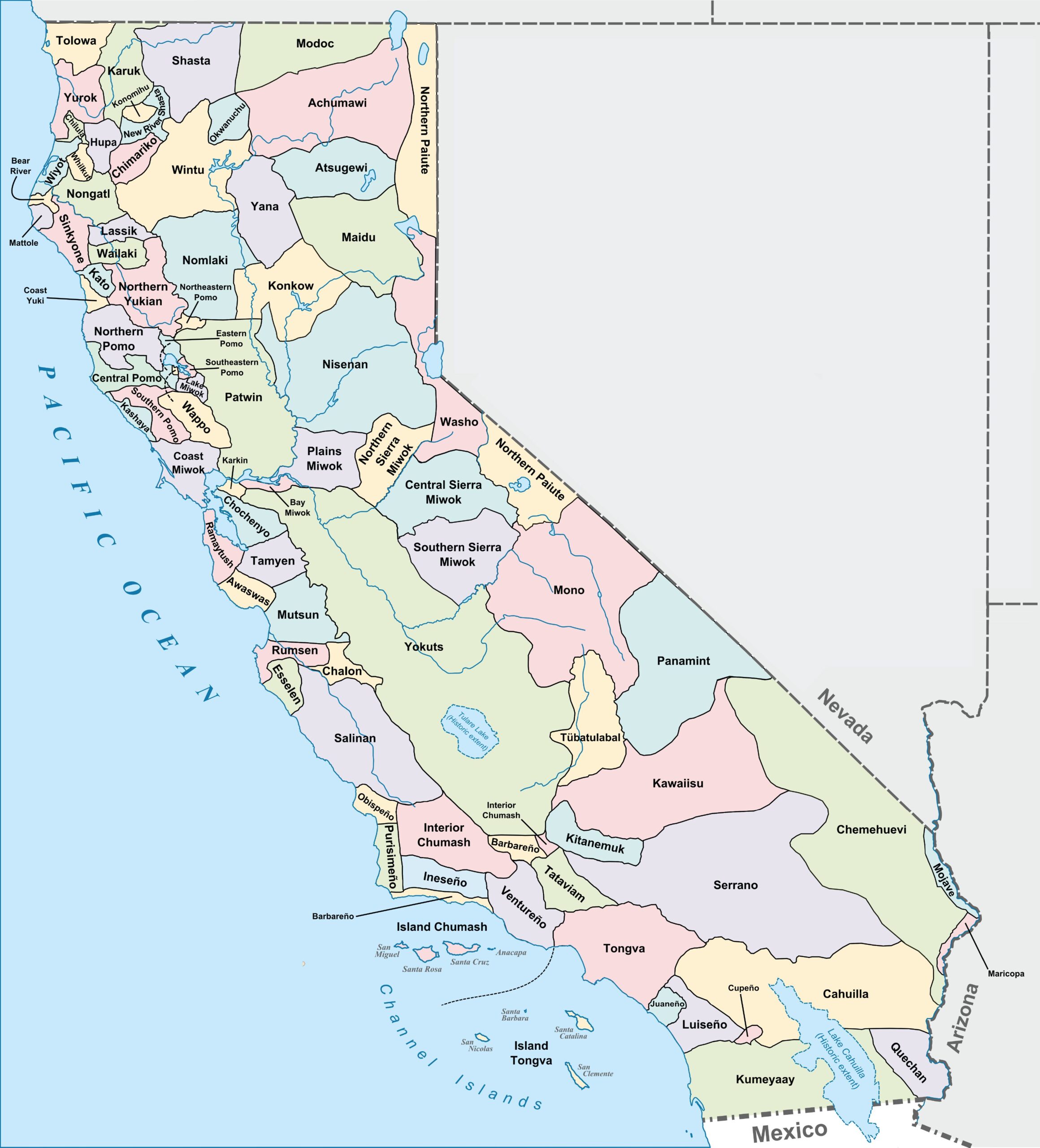
SOURCE: Adapted from “A map of California Tribal groups and languages at the time of European contact” by Concerto, Wikimedia Commons, licensed under CC BY-SA 3.0.
NOTE: The map shows geographic regions relating to Tribal language groups rather than Tribal groups or communities.
Spanish colonization, starting in 1769, dispossessed the Tribes of their lands along the coastal plain from Southern California to the Bay Area, and many Tribal members were forced to work at the missions or on Spanish land grants. The Mexican government, which governed Alta California from 1821–48, granted much of the Central Valley to private landowners, thus dispossessing a different set of Tribes (Jackson and Castillo 1995; California Native American Heritage Commission 2025).
By a coincidence of history, California became part of the United States just as gold was discovered. The non-Indigenous population skyrocketed to 25 times its previous size over just 12 years (Cook 1976). That rapid growth meant that entire industries had to be developed overnight to support so many new people. Tribes in the Klamath River basin, the Sierra Nevada, the Central Valley, the Lower Colorado River, and the inland mountains and valleys of Southern California—which had been relatively unaffected by Spanish and Mexican colonists—were displaced by mining, grazing, and logging (Anderson 2005; Madley 2016).
Shortly after California became a state in 1850, the United States Senate took an action that would change the course of history for Tribal lands, water rights, and sovereignty. Under intense pressure from California politicians and settlers who objected to setting aside land for Indigenous populations, the Senate rejected 18 treaties that federal officials had negotiated with more than 100 Tribal leaders throughout California. Under these agreements, the Tribes would have retained about 7.5 million acres (approximately 7% of the lands within state) as Indian reservations (Figure 2). Following the vote, the Senate classified the treaties as secret and had them locked in a vault, thus concealing the treaties’ acknowledgement of the Tribes’ rights to the land. The treaties were not made public until 1905. Today, less than 1 percent of the lands within the state are designated Indian reservations, and many of California’s Tribes are not federally recognized and do not have reservations or accompanying water rights (Wood 2008; Madley 2016).
Tribal lands that would have been protected by the 18 unratified treaties
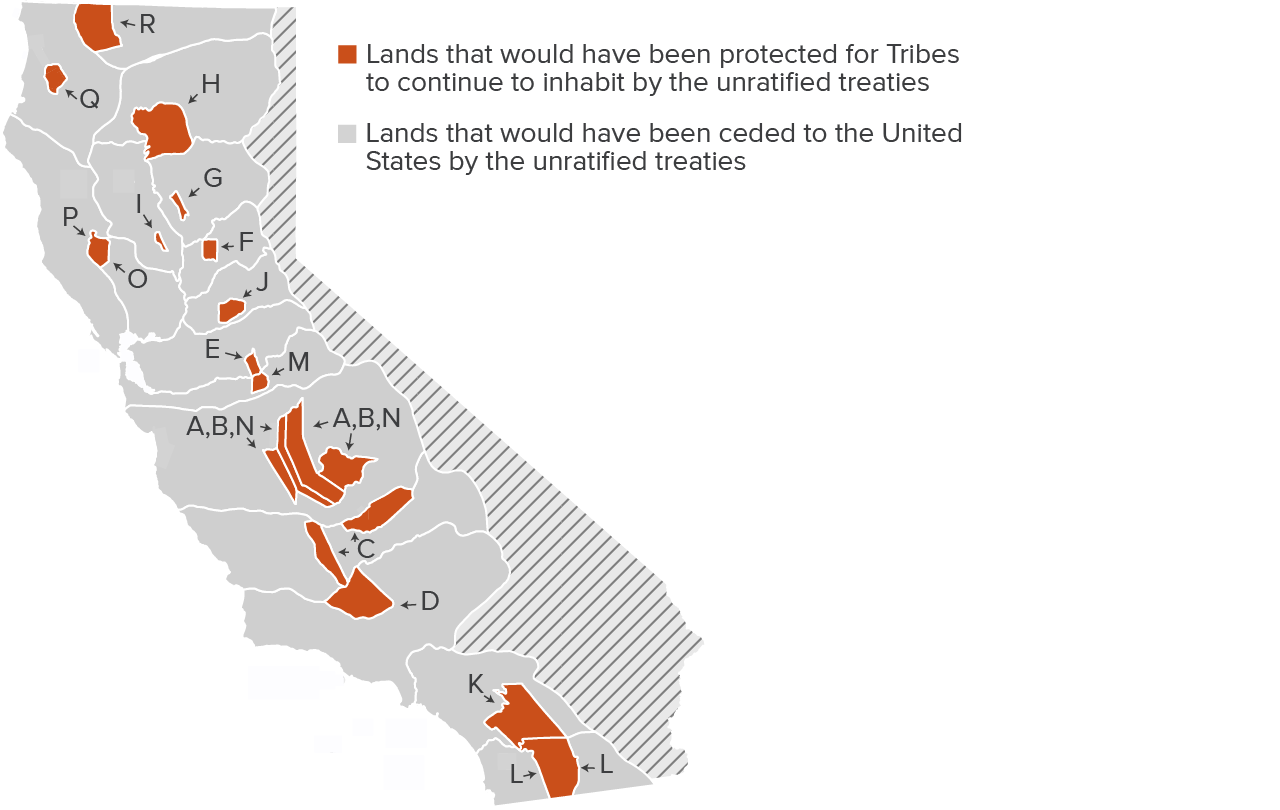
SOURCE: An adaptation of the original treaties map in Heizer (1972), reproduced using data from the Digital Atlas of California Native Americans.
NOTES: The 18 rejected treaties included some Tribes that were subsequently assigned to Indian reservations and now have quantified water rights. The vast majority of the Tribes that signed treaties with the United States, however, did not obtain reserved lands or accompanying water rights. The following Tribes signed the unratified treaties: A: Tache, Cahwia, Yokol, Tolumne, Wicchumne, Holcuma, Toeneche, Tuhucmach, Intimpeach, Choinuck, Welmilche, and Notonoto; B: Yolumne and Coyetie; C: Chunute, Wowol, Yowlumne, and Coyetie; D: Castake, Tejon, San Imiri, Uva, Carise, Buena Vista, Serahuow, Holoclame, Sohonut, Tocia, and Holmiuk; E: Chappasims, Cotoplammis, Louolumne, Sagewomnes, Sucaah, and Wechilla; F: Daspia, Yamado, Yollamer, Waidepacan, Onopoma, Moneda, Wannuck, Nemshaw, Benopi, and Yacumna; G: Michopda, Eskiun, Hololupi, Toto, Sunu, Cheno, Batsi, Yutduc, and Simsawa; H: Noemanoema, Ylacca, and Noimenoime; I: Colu, Willay, Cohama, Tatnah, Cha, Docduc, Chametko, and Tocde; J: Culee, Yassee, Loclumne, and Wopumne; K: San Luis Rey, Kahwea, and Cocomcahra; L: Dieguenos; M: Siyante, Potoyanti, Coconoon, Apangasse, Aplache, and Awallache; N: Howechee, Chookchanee, Chowchillie, Pohoneechee, Nookchoo, Pitcatchee, Casson, Toomna, Tallinchee, Paskesa, Wachaet, Itachee, Choenemnee, Chokimena, Wemalche, and Notonoto; O: Calanapo, Habinapo, Danohabo, Moalkai, Checom, Howkuma, Chanelkai, and Medamarec; P: Sainell, Yukias, Massutakaya, and Pomo; Q: Pohlik, Pehtuck, and Hoopah; R: Odeilah, Ikaruck, Kosetah, Idakariwakaha, Watsahewa, and Eeh.
In the decades following the Gold Rush, the United States began to create Indian reservations with a stated purpose of providing a home for Indigenous Californians to live under the “supervision and protection” of federal authorities. In practice, the establishment of reservations cleared the remaining ancestral lands so they could be exploited for mining, timber, commercial fishing, and settlement (Anderson 2005; California Indian Legal Services 2024).
The reservations were mainly remnants of the Tribes’ ancestral lands. Many were located in inhospitable landscapes where Tribes were allowed to remain while other settlers claimed richer lands near rivers and valleys. Nevertheless, these reservations were footholds where the Tribes could reconstitute themselves, preserve Tribal culture, and exercise sovereign authority. The reservations included water rights to allow these Tribal nations to secure enough water to sustain their members and create new Tribal economies (California Indian Legal Services 2024).
While critically important, these water rights were not a panacea. Most Tribes lacked resources to construct the infrastructure needed to take advantage of their water rights. In addition, the health of the state’s aquatic ecosystems declined as Californians engineered water systems and developed the lands upon which the Tribes depended. Around 90 percent of California’s wetlands were drained; rivers were leveed, dammed, and diverted; salmon and other wildlife populations began to plummet; and much of the landscape that had sustained Tribes for millennia was altered to an unrecognizable state. Large regional and inter-basin water development projects further depleted Tribal surface and groundwater and, in some cases, degraded water quality as well (Hundley 2001; Anderson 2005).
Tribal Water Rights Under Federal Law
In contrast to the vast majority of water rights in California, most Tribal rights are based on federal rather than state law. In this section, we describe the different pathways by which Tribes have quantified their water rights. As described above, quantification puts a precise number on the amount of water a water right holder is entitled to divert or pump from a specific source.
Federal Reserved Water Rights Predominate in California
Most Tribal water rights in California are associated with the creation of Indian reservations (see Figure 3). These rights are known as “federal reserved water rights.” They provide each Tribe with enough water to maintain a permanent home, including to support Tribal economies and traditional practices. For a Tribe to have federal reserved water rights, it must be federally recognized and have a reservation.
Of the 109 federally recognized Tribes in California, 16 have water rights that have been quantified under federal law (Congressional Research Service 2025a). As noted above, more than 55 Tribes currently lack federal recognition and do not have reservations with associated water rights.
Although the federal acknowledgment process is often lengthy and politically challenging, there are Tribes that have been federally recognized in contemporary times, which has enabled them to obtain reserved lands and accompanying water rights. For example, the US Bureau of Indian Affairs officially recognized the Timbisha Shoshone Tribe in 1983. Seventeen years later, Congress established the Timbisha Shoshone Reservation on small portions of the Tribe’s ancestral lands in Death Valley and adjacent areas (US Congress 2000). This was the first time that the United States returned land within a national park to its aboriginal inhabitants (Miller 2000, 2006; Martin 2024). Several other Tribes are currently seeking federal acknowledgment (see Appendix, Introduction).
Federal Indian reservations in California
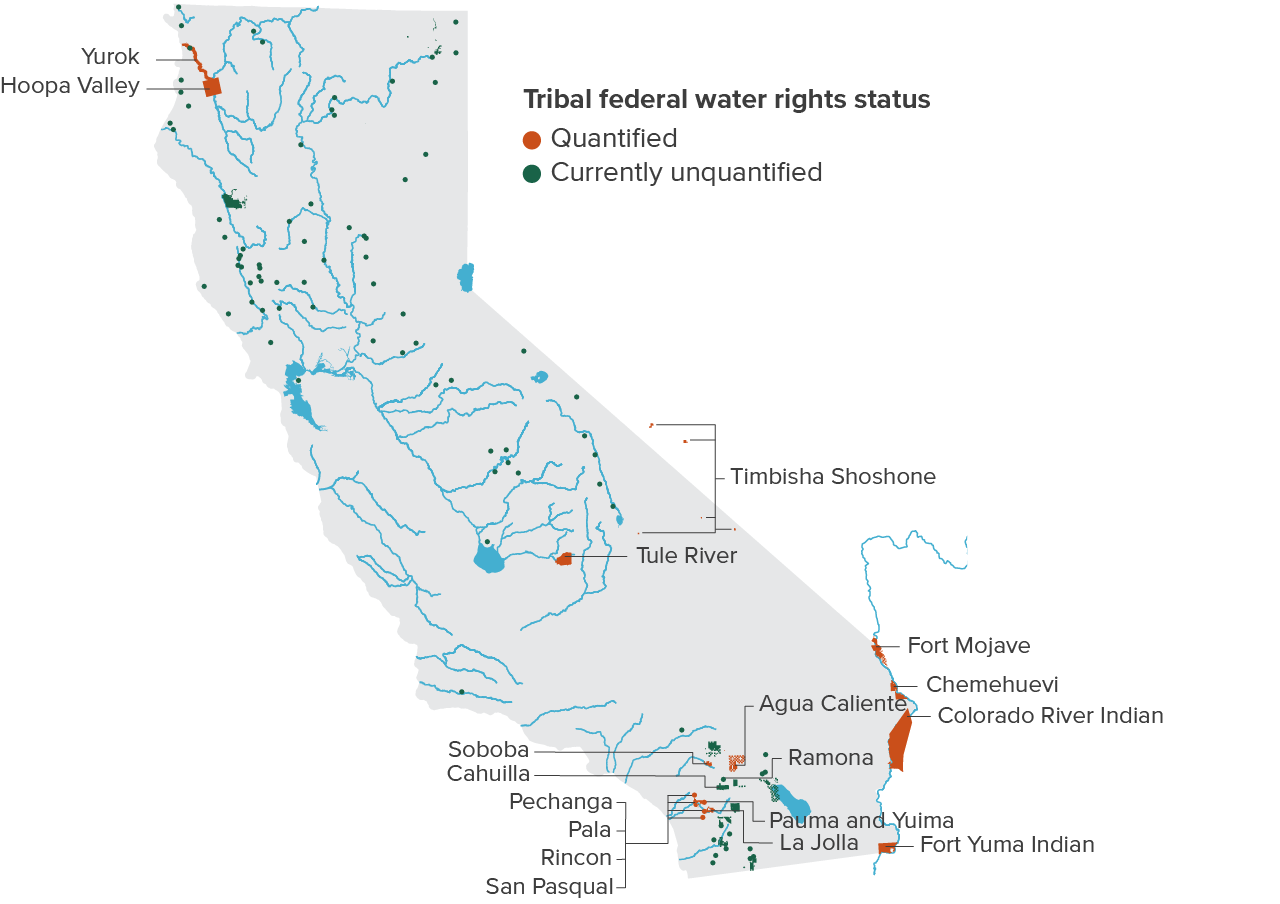
SOURCES: Reservation boundaries are obtained from the US Bureau of Indian Affairs. Lake, river, and stream boundaries are obtained from the USGS National Hydrography dataset and Lincoln Institute of Land Policy. Water features in the San Francisco Bay Area were obtained from the Metropolitan Transportation Commission.
NOTES: This map shows the locations of the federal Indian reservations wholly or partly within California, of which 16 have quantified federal water rights. Reservations occupying fewer than 7,500 acres of land are shown as point locations to improve visibility.
The federal reserved water rights doctrine—which was first articulated by the US Supreme Court in 1908—has been shaped by the federal courts, Congress, settlement agreements, and administrative practice. Key elements include:
- Water may be used for domestic uses, livestock, irrigated agriculture, commercial and industrial uses, and instream flows to enable fishing, hunting, and religious and ceremonial activities.
- Rights may include both surface water and groundwater.
- The date when a reservation was established determines the priority of Tribal reserved water rights relative to other water rights within the same river system or groundwater basin.
- Tribal reserved water rights include water that may be required for present and future uses within the reservation.
- Tribal reserved water rights exist largely independent of state law, and they may not be lost by abandonment, forfeiture, non-use, or unreasonable use (Newton and Washburn 2024).
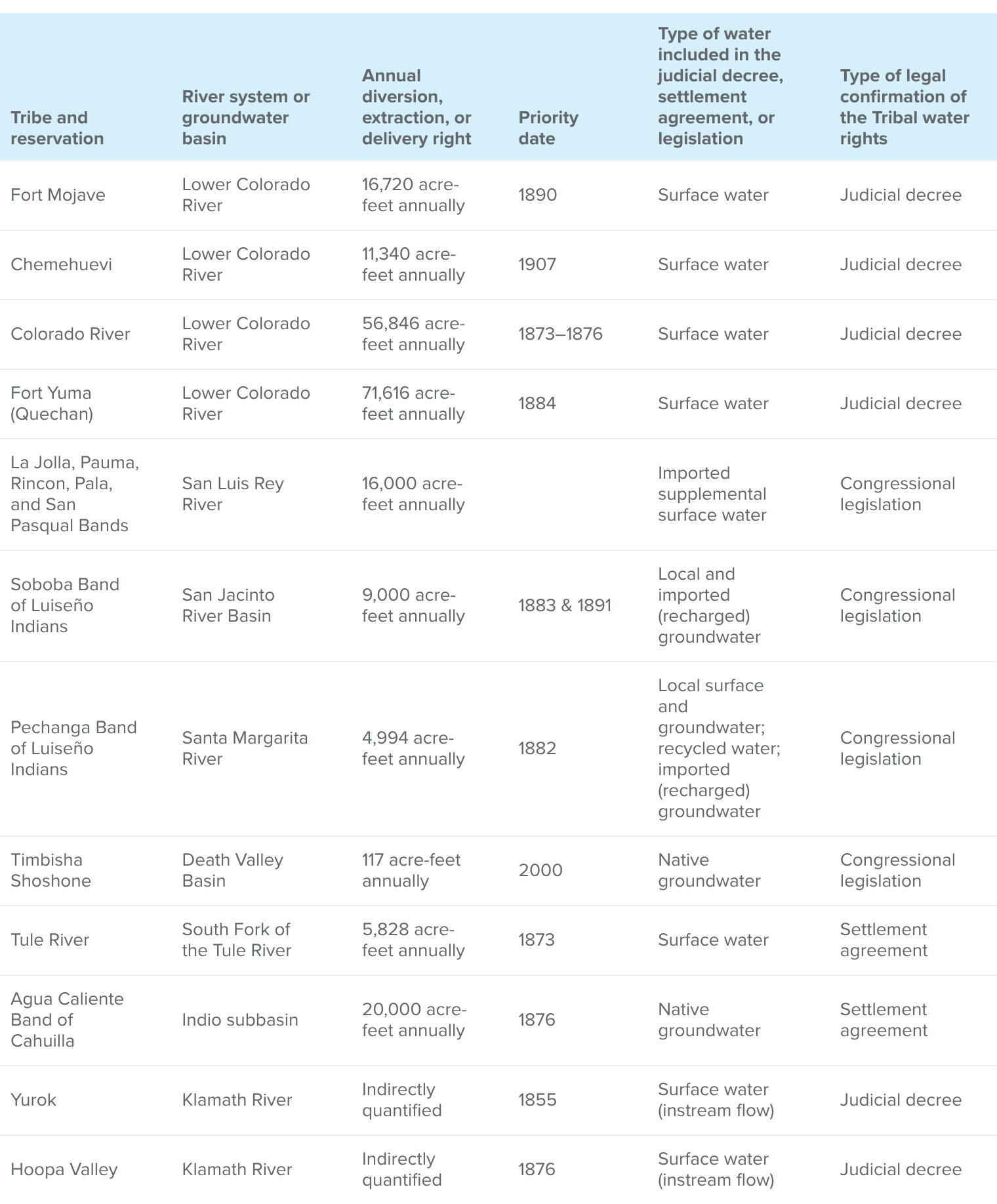
The 16 Tribes in California with quantified federal reserved water rights are listed in Table 1.
Quantified Tribal water rights in California
SOURCE: Appendix.
NOTES: (1) The Fort Mojave Indian Reservation extends into Arizona and Nevada, and the Colorado River and Fort Yuma Reservations extend into Arizona. These data include only the respective diversion rights for reservation lands in California. (2) The San Luis Rey River Indian Water Authority manages the “supplemental water” that is imported from the Colorado River for the La Jolla, Pauma, Rincon, Pala, and San Pasqual Reservations. The settlement agreements and legislation that confirm the Tribes’ rights to this supplemental water expressly preserve their federal reserved water rights to native surface water and groundwater, which remain unquantified. (3) The Agua Caliente and Timbisha Shoshone Tribes’ water rights include small quantities of surface water for ceremonial and traditional uses. (4) The Tule River Tribe and the Agua Caliente Band are currently seeking congressional approval and authorization of their respective water rights settlement agreements. (5) The term “Imported (recharged) groundwater” means imported surface water that is stored in local groundwater basins and is available for Tribal extraction and use. (6) The instream reserved rights of the Yurok and Hoopa Valley Tribes to support ancestral fishing rights and ceremonial practices are currently quantified in relation to regulatory streamflow requirements that protect federally listed endangered species.
Of the 16 tribes with quantified federal water rights, which aspects of those rights have proved most valuable? And what pathways to obtain them have been most successful? Below we analyze these issues, grouping the Tribes by similarities in their water rights.
Quantification Is an Important Aspect of Federal Reserved Rights
Quantification of a Tribe’s water rights offers many benefits. It puts Tribes on a level playing field with other water right holders. When Tribes know how much water they have, they have relative certainty, which allows them to make investment decisions. In some circumstances, they can engage in water trading.
In contrast, Tribes without quantified rights are unable to determine how much water they may lawfully use, which in turn deters investment—both for on-reservation development and for the water infrastructure needed to exercise their water rights. Tribes without quantified rights also have difficulty protecting their diversion or extraction rights in times of shortage and in basins that are fully allocated (see Appendix, Parts 4 & 6).
For example, the Agua Caliente Band of Cahuilla Indians has federal reserved groundwater rights in the Palm Springs area. Until its water rights were quantified, the Tribe was unable to develop its water resources and had to pay for groundwater supplied by local water agencies. The Tribal water right was quantified in 2025, and the Tribe now receives its 20,000 acre-feet allocation at no cost and can lease water for economic benefit (see Appendix, Part 6).
The experience of the Yurok and Hoopa Valley Tribes illustrates the risk of imprecisely quantified water rights. These Tribes have instream reserved water rights to flows needed to support the historically productive fishery of the lower Klamath River system, which is foundational to the Tribes’ sustenance and culture. Rather than defining a fixed quantity of water, the federal courts have held that—at a minimum—the Tribes are entitled to a flow in the Klamath River that ensures the survival of coho salmon, which are a threatened species (US Court of Appeals 2019). These flow levels currently are established by regulations from the National Marine Fisheries Service (NMFS) and can change based on science, fish populations, law, and politics.
The Klamath River is currently undergoing tremendous transformation. Recently four dams were removed, and other habitat and flow improvements are also underway. The Tribes of the Lower Klamath River basin have been stewards of the river since time immemorial (Yurok Tribe 2026). Precise quantification of the Tribal senior reserved water rights would ensure that sufficient water remains in the river to support the suite of native fishes and the river’s ecosystem. The Yurok Tribe is currently working with the Department of the Interior as a prelude to seeking precise quantification of its water rights by Congress (Congressional Research Service 2025a).
Transferable Water Rights Can Provide Income and Influence
The ability to transfer water benefits Tribes and other water users. For example, some of the Lower Colorado River Tribes have engaged in transfers that generate income and play an important role in regional water management. Tribes have transferred water conserved by land fallowing, and they have entered into forbearance arrangements in which the Tribe agrees not to divert water for a period of time and instead makes it available to another party.
The most significant forbearance agreement is between the Quechan Tribe and the Metropolitan Water District of Southern California (MWD). This long-term agreement, which runs through 2035, allows the Tribe to decide each year to forbear diversions of up to 13,000 acre-feet of water and allow it to pass through the Colorado River priority system to MWD. Two aspects of this agreement illustrate the benefits of water transfers:
- Tribes can earn income by transferring water off reservation. And buyers gain by acquiring water at lower prices than other new supplies would cost and by diversifying their water portfolios.
- Tribes have begun to play an important role in Lower Colorado River management. This is increasingly significant as the Colorado River basin has been in severe drought for the last quarter century. From 2023–25, the Quechan Tribe has contributed 13,000 acre-feet/year to stabilize reservoir levels in Lake Mead. Several other Tribes in the lower basin also have been contributing water to this effort (see Appendix, Part 3).
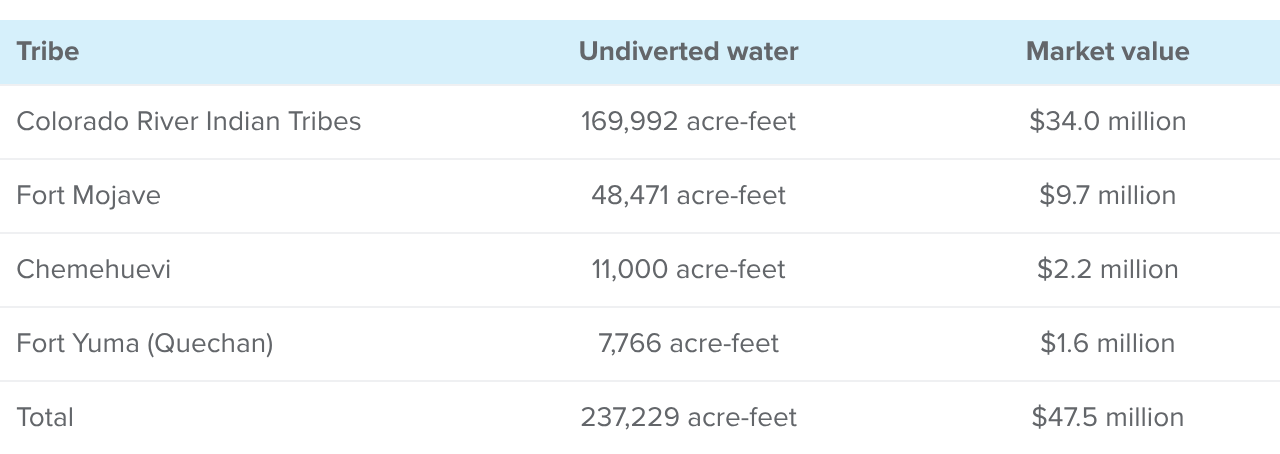
Broader authority to transfer water would provide significant benefits to California’s Tribes. For example, the Lower Colorado River Tribes currently are unable to use all of the water within their water rights because they lack the necessary infrastructure. If these Tribes could transfer this water (which now simply flows to other Colorado River users for free), they would be able to capture the economic value of that water (Table 2). In turn, the Tribes could use the revenues produced by such transfers to modernize their water supply, distribution, and irrigation systems.
Estimated annual economic value of undiverted Tribal water
SOURCE: US Bureau of Reclamation, Lower Colorado River Water Accounting annual reports.
NOTES: (1) “Undiverted Water” is the difference between each Tribe’s maximum annual diversion rights under the 2006 Consolidated Decree in Arizona v. California and the Tribe’s actual average annual diversions from 2014–24. (2) The estimate of the Quechan’s Tribe’s potential undiverted water is reduced from 27,766 acre-feet to 7,766 acre-feet to account for the 13,000 acre-feet of surplus water that it currently transfers to MWD or contributes to the System Conservation Program and the 7,000 acre-feet to which it does not have diversion rights until 2035. (3) The table assigns a $200 per acre-foot market value to the undiverted water. This imputed annual market value is based on the approximate current rate ($200/acre-feet) that MWD pays for water it receives under its forbearance agreement with the Quechan Tribe. The $200 per acre-foot imputed value is also in the middle range of the prices of conserved water that the Colorado River Indian Tribes transferred to the US Bureau of Reclamation and the Arizona Department of Water Resources from 2016 through 2022 (Colorado River Indian Tribes 2019; Arizona Department of Water Resources 2019; US Bureau of Reclamation 2021; Congressional Research Service 2025b).
Legal Settlements Can Help Quantify Tribal Water Rights
For Tribes that do not have quantified federal reserved water rights, filing lawsuits can kickstart the process to define and quantify these rights. But quantification alone will still leave the Tribe without capacity to develop the infrastructure to use the water. In addition, since most watersheds are fully appropriated, litigation can place a cloud of uncertainty over junior water rights and chill continued investment in water infrastructure. In contrast, if litigation is used to catalyze settlement, all parties may benefit, with the Tribe obtaining funding for infrastructure and the opportunity to address broader issues within the watershed.
Seven Southern California Tribes, which fall within the “Mission Indian” group, filed lawsuits that resulted in settlement agreements confirmed by Congress. These settlements quantified the Tribes’ water rights and authorized federal funding to implement the settlements. The San Luis Rey, Soboba, and Pechanga settlements demonstrate the benefits of negotiated resolutions of Tribal water rights disputes.
- The San Luis Rey Indian Reservations Water Rights Settlement Act (1988) included 16,000 acre-feet of “supplemental water” for five San Luis Rey Mission Bands, $30 million in federal funding to establish a San Luis Rey Tribal Development Fund, and the creation of the San Luis Rey River Indian Water Authority.
- The Soboba Band of Luiseño Indians Water Rights Settlement Act (2008) recognized the Tribe’s right to pump 9,000 acre-feet of native or recharged groundwater from the basin, and it authorized the Tribe to lease or exchange water with other users within the groundwater recharge management area. The legislation also provided $21 million in federal funding for Tribal water infrastructure. Additionally, local water districts paid $18 million to fund economic development within the reservation.
- The Pechanga Band of Luiseño Mission Indians Water Rights Settlement Act (2016) confirmed a Tribal reserved water right of 4,994 acre-feet. Imported water made the settlement possible, as the Tribal water portfolio includes local groundwater, recycled water, and imported water. The settlement also included $30 million in federal funding for water projects and to defray some of the costs of acquiring imported water.
Congressionally approved settlements offer a variety of benefits both for Tribes and other water users:
- Funding. The biggest advantage is funding for projects. Through the settlements, the Tribes have received significant funding for water infrastructure, water quality improvements, habitat restoration, housing, public utilities, and other economic development.
- Flexibility in water use. The settlement agreements authorize the Tribes to use their water as they choose, like all other water right holders. For the San Luis Rey and Soboba Bands, this includes the authority to transfer water to off-reservation uses and thereby earn income.
- Increased regional certainty. The water agencies that participate in the settlements gain greater certainty in managing their water supplies, because their water rights are now defined relative to the Tribes’ rights, and long-standing disputes over water are resolved. This in turn sets the stage for more collaborative management of the various sources of water that serve the parties within each watershed.
- Improved regional management. The integration of local surface water, local groundwater, imported surface water, treated wastewater, and groundwater recharge facilitates more efficient regional water management. The Tribes can store water for later use or transfer water that exceeds their own immediate needs to other users. Water that has served its initial purpose can be recycled for reuse. Integrated management of the various sources of water also can facilitate the development of regional water markets.
The availability of imported water supplies from the Colorado River was a key factor in making all three settlements successful. By augmenting native supplies, the imported water made the negotiations less of a zero-sum game. Thus, while these settlement agreements and enabling legislation set important precedents, they serve as limited models for future Tribal water rights negotiations in places where the parties do not have access to imported or other supplemental supplies.
Settlements can be difficult to achieve without imported water
Since 2007, the Cahuilla and Ramona Tribes have been engaged in efforts to quantify all water rights in the Santa Margarita River basin. Their reservations do not lie within the service area of any water utility, and water currently cannot be imported for direct service or to augment native groundwater supplies. The Tribal governments have been in negotiations with the Metropolitan Water District and the Eastern Municipal Water District to bring imported water to their reservations. Without federal funding for the construction of a pipeline, however, a negotiated settlement has been difficult to achieve (see Appendix, Part 4, Coda).
Settlements can get stuck in limbo awaiting congressional approval
Settlements have proven to be an effective way for Tribes to attain water rights and federal funding, but one hurdle must be overcome: congressional authorization. For example, the Tule River Indian Reservation Water Rights Settlement (2007) quantifies the Tribe’s surface water rights to the Tule River and defines their priority vis-à-vis other users in the watershed. Full implementation of the settlement is contingent on congressional approval and authorization of federal funding for a new dam and water distribution system. Although settlement legislation has been introduced biennially since 2007, Congress has not yet acted (see Appendix, Part 6).
A much more recent settlement agreement for the Agua Caliente Band of Cahuilla Indians (2025) quantifies Tribal groundwater rights of 20,000 acre-feet annually. The Tribe may extract this amount free of charge for use within the reservation or, with the consent of the two local agencies that also extract groundwater from the basin, transfer water for off-reservation uses. This grants the Tribe a greater role in regional groundwater management. The settlement agreement also calls for $500 million in federal funding to pay for water supply and water quality infrastructure, including groundwater recharge facilities and a water treatment plant that would provide tertiary-treated water for non-potable uses within the reservation. This funding is contingent on congressional authorization (see Appendix, Part 6).
Tribal Water Rights Under California Law
Tribes can hold the same three types of water rights under state law as other water users: riparian, appropriative, and groundwater. These water rights exist independent of their federal reserved water rights, and Tribes can use both at the same time (see Appendix, Part 8 for more details).
Tribes Have Relatively Small State Water Rights
According to State Water Board records, more than 30 Tribes have state water rights or water rights claims to surface water and groundwater. The quantities are generally small, ranging from a few acre-feet to more than 5,000 acre-feet per year (SWRCB 2026a).
In 2022 and 2023, the California Legislature appropriated $100 million to fund the Tribal Nature-Based Solutions Program (California Natural Resources Agency 2025). To date, this and other state programs have supported the return of approximately 103,000 acres of ancestral lands to California Native American tribes (California Natural Resources Agency 2026). It is likely that most of these restored lands have surface water and groundwater rights under state law. If these lands are incorporated into existing reservations, they also are likely to have federal reserved water rights.
Most Tribes Have Chosen Not to Participate in the Implementation of SGMA
Although many Tribes in California hold groundwater rights, few have chosen to participate in the Sustainable Groundwater Management Act (SGMA) process.
The reasons for this lack of engagement vary. A principal reason is that SGMA does not authorize Tribal governments to serve as groundwater sustainability agencies (GSAs). Other reasons include inadequate Tribal information about their groundwater resources and potential groundwater rights, a reluctance to transfer or share decision-making authority with non-Tribal entities, concern that Tribal interests and water rights would not be well-represented or adequately protected in the groundwater sustainability planning and implementation processes, and skepticism about SGMA’s assurances regarding the protection of Tribal water rights (see Appendix, Part 8).
Except for the Tribes with quantified federal reserved rights to groundwater described above, Tribal groundwater rights in California are ill-defined and uncertain. They are also largely undeveloped. These facts have two consequences:
- First, as small or inactive groundwater users, it is unlikely that Tribes would be well-represented within any individual groundwater sustainability agency.
- Second, regardless of GSA membership, Tribes that participate in SGMA could be subject to pumping limitations, extraction charges, higher fees for new pumping, and other restrictions on new groundwater that are a common feature of groundwater sustainability plans and local agency policies.
Moreover, because Tribal nations have sovereign governmental immunity, nothing in SGMA or its implementation can diminish or alter Tribal groundwater rights. For these and other reasons, most Tribes have decided not to participate in the SGMA process.
California Has Added Nascent Protection for Tribal Beneficial Uses of Water
The State Water Board and the nine regional water boards set water quality objectives to protect beneficial uses of all of California’s rivers, lakes, and estuaries. Beneficial uses include water supply, hydropower, recreation, navigation, and support of fish and wildlife. These water quality objectives protect Tribal and non-Tribal uses of the state’s waters.
In 2016, the State Water Board established three new beneficial use definitions: Tribal Tradition and Culture, Tribal Subsistence Fishing, and Subsistence Fishing (SWRCB 2016). The new beneficial use categories recognize Tribal practices and water quality interests that state and federal law did not previously specifically protect.
All nine regional boards report that they are engaging with the Tribes and the public and are prioritizing Tribal beneficial uses in their triennial reviews of their basin plans. Six regional boards have incorporated Tribal beneficial use definitions into their water quality plans. None has yet made final designations of Tribal beneficial uses for specific lakes, estuaries, and river segments within their respective jurisdictions, however (SWRCB 2026b).
Some Tribes Can Implement and Enforce Federal Water Quality Standards
The US Environmental Protection Agency has authorized 18 federally recognized Tribes in California to administer federal water quality standards within their respective reservations (US EPA 2026). This allows the Tribes to designate beneficial uses, set water quality criteria to protect those uses, issue pollutant discharge permits, and integrate Tribal and federal requirements. Participating Tribes have the same authority to implement and enforce these federal standards as California and other states have under federal law to protect their own waters (US EPA 2025).
This authority represents a significant confirmation of Tribal sovereignty. It also recognizes the capacity of Tribes to manage their water resources, fisheries, lands, and aquatic ecosystems in the interest of public health and welfare.
Yet the Tribes’ authority is limited by the boundaries of their reservations, and they remain vulnerable to upstream activities that may deplete flows, degrade water quality, or contribute pollutants that jeopardize Tribal beneficial uses and water quality standards. For these protections, the Tribes must rely on broader state and federal water quality regulations.
Conclusion
In this report and the accompanying appendix, we have examined the spectrum of Tribal water rights in California, including federal reserved water rights and water rights held under California law. These rights—including their origins and uses—are as diverse as the Tribes.
What emerges is the clear benefit of establishing quantified Tribal water rights through negotiated agreements.
- This creates certainty for the Tribes and other water users and can potentially integrate Tribal water rights and uses into overall watershed management and planning, as is being done on the Colorado River and among several of the Mission Indian Bands in Southern California.
- Negotiated agreements can also bring important economic benefits to Tribes from water transfers and government funding for water infrastructure and other programs.
- Reaching such agreements for more Tribes and gaining congressional approval will require sustained effort from Tribes, the Bureau of Indian Affairs, and Congress, with help from California.
The California Natural Resources Agency and the State Water Board are working to help Tribes protect their water resources, but these efforts are in early stages. Still, the state could seize the opportunity to integrate Tribal beneficial uses and the Tribes’ deep historical knowledge into many facets of water and watershed management. These agencies also should continue to support Tribal efforts to secure and quantify their federal reserved water rights.
All in all, momentum seems to be building for better defining Tribal water rights and integrating Indigenous knowledge into water and watershed management to benefit both the Tribes and the overall management of California’s water resources.
Topics
Economic Growth Economic Mobility Economy Freshwater Ecosystems Paying for Water Safe Drinking Water Water Supply Water, Land & AirLearn More
The Essential Role of Tribes in Regional Water Management
Agriculture and Water Use on California’s Tribal Lands
Tribal Water Rights and Water Use in California
The Water Remembers: A Story of the Klamath River
A Promising New Effort to Save California’s Salmon

The Chumash Tribe’s Long Struggle to Protect California’s Coastal Waters
Exploring the Yurok Tribe’s Management of the Klamath River

Ensuring Safe Drinking Water for California’s Native American Communities
Using Fire for Good on Tribal Land