
There’s a lot in the news about changes underway at federal agencies, including agencies California relies on for water and weather forecasts. The reductions in funding and workforce will have implications for the state. As these changes continue to unfold, it’s worth taking a step back to examine exactly how the state partners with the federal government on forecasts. We asked climate scientist Daniel Swain to explain.
 How is the National Oceanic and Atmospheric Administration (NOAA) involved in weather forecasting in California?
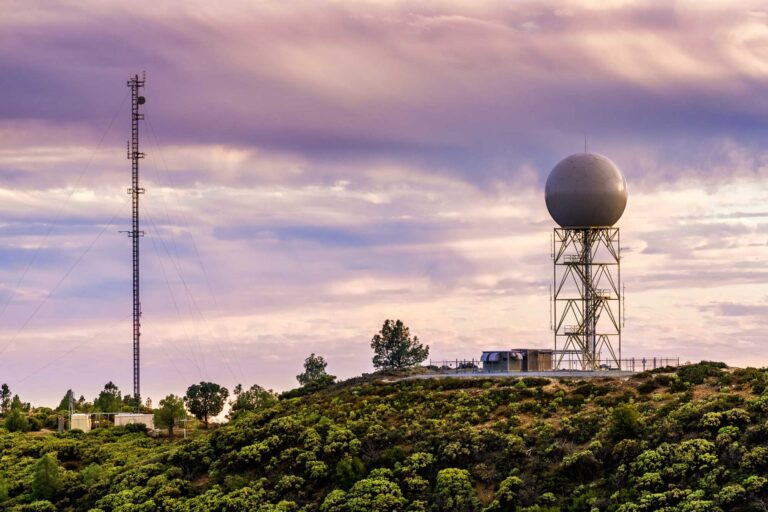
NOAA operates a vast array of instruments that measure weather, including satellites, radar, wind sensors, weather balloons, and thermometers. NOAA also brings the data together and makes it available for free to the public, including easy-to-use visualizations, such as the NOAA Climate at a Glance portal. It’s a fundamental public service used by researchers, businesses, local governments, and others.
Researchers from NOAA and the National Weather Service (NWS, which is housed within NOAA) also provide the backbone of all runoff predictions in California, which is very important for the state’s water management, including water supply and flooding. They do this with help from federal partners including the US Department of Agriculture, US Army Corps of Engineers, US Geological Survey, and the National Science Foundation’s National Center for Atmospheric Research. Together, these agencies provide highly reliable, real-time measures of flow and water quality on many rivers.
What role does local knowledge play in weather forecasts?
Local knowledge is still critically important. NWS operates field offices around the country—including 10 serving California—and the folks who work there have detailed local geographic and meteorological knowledge, relevant not only to weather but also to fire and water-related hazards, that predictive models often can’t fully replicate. Human forecasters know a model’s weak spots and biases, and they’re good at adjusting predictions accordingly—as well as closely coordinating with local and state government agencies during emergencies. Human knowledge makes for better, more accurate, more timely, and better communicated predictions and warnings.
How does the private sector fit in with weather forecasting?
The private weather and water sector, including the companies behind websites and apps many of us consult regularly, all use freely available data from NOAA and the NWS as the basis for most of the informational products they offer. There’s wide agreement that greater collaboration between public and private sectors on weather and climate would be desirable. Ironically, the federal government was on the cusp of taking a big step in this direction this year before staff reductions began.
It would be essentially impossible for the private sector to completely replace what NOAA and the National Weather Service provide, because it would be difficult to make a profit while still meeting the NWS’s mission of providing critical and life-saving services to the entire American public on a 24/7/365 basis. Folks in the private weather sector understand that their industry relies, in large part, on critical services that NOAA makes freely available.
How does longer-term research relate to weather forecasting?
We know with certainty that the climate is warming, but a lot of important details remain fuzzy. The point of ongoing climate research is to bring those details into focus, including what the future may hold for droughts, wildfires, and floods. Having those answers sooner and with more clarity allows us to prepare with appropriate infrastructure, like levees and floodplain restoration, and management, like prescribed fire and sustainable vegetation treatments. The federal government is the primary funder of research to answer these questions, through internal studies at research labs and external research at universities.
Final thoughts?
Weather forecasting relies on information collected throughout the country and the world, including oceans, land surfaces, and the atmosphere. The federal government’s size enables efficiencies of scale that are hard to replicate on state-by-state basis. It’s not easy to launch and maintain a fleet of Earth-orbiting satellites and ground-based radars, and there’s no way any entity could spin this up in a matter of weeks or months.
Forecast data from federal agencies benefit California and the rest of the US. For instance, this past January, we saw shockingly destructive wildfires in Los Angeles. As terrible as the outcome was, it could have been even worse. The National Weather Service’s excellent advance predictions allowed LA and the state to stage firefighting resources in advance and take other preemptive measures. Had we not known that extreme winds following record-dry conditions were coming, the fires likely would have been even more numerous and destructive.
This is just one illustration of how California relies on robust federal involvement in weather forecasting and climate data collection and management. Given the recent and proposed reductions in NOAA’s budget and workforce, it may be prudent for the state to consider how weather and water forecasting could work in California with a greatly reduced federal partner.
Topics
agriculture atmospheric rivers climate change extreme weather Forests and Fires natural disaster state-federal water partnerships Water Supply Water, Land & Air wildfiresLearn More
Federal Satellites Gather Critical Data for Managing California’s Water
How California Partners with the Federal Government on Water Infrastructure

Priorities for California’s Water
Extreme Heat Takes a Toll on Californians’ Health
The Weird Weather of 2023: Better Get Used to It