


The 2014 Sustainable Groundwater Management Act (SGMA) is driving major changes for California’s vibrant agricultural industry. The state’s growers will need to pump less groundwater to comply with the law, which seeks to limit groundwater use in the face of depleted aquifers and the problems they cause. And while that shift will make agriculture more sustainable in the long-term, it will cause short-term challenges.
One tool that can help lessen the economic pain and boost groundwater sustainability is groundwater recharge—putting water into underground aquifers. Groundwater recharge is key to implementing SGMA, because it can reduce the need to curtail groundwater pumping. Local agencies are working to scale up recharge by incentivizing it on private land. Our research has found that recharge on private land is growing fast, but it still accounts for less than 10% of total recharge volumes in the valley.
What are landowners’ concerns about participating in recharge? In many cases, they worry they won’t be compensated for costly recharge efforts. In this two-part series, we examine the policies of seven leading agencies working to ensure landowners benefit from recharge. In this post, we detail how several agencies have set up the conditions needed for recharge incentives. In a second post, we’ll explain how these agencies are incentivizing landowners to conduct recharge.
How have agencies established accounting, allocations, and other groundwater management tools?
Local agencies use a variety of methods to track and reduce groundwater use, including establishing groundwater accounting and allocation systems, monitoring practices, use fees, penalties for excess pumping, and carryover between years (allowing the unused part of an allocation one year to be used in future years).
Some agencies also grant landowners flexibility in how they use the groundwater they’re allocated, allowing them to either shift their allocation between parcels or trade groundwater with each other.
Groundwater accounting. Strong accounting is fundamental to successful groundwater management. Without accurate numbers for inflows and outflows, pumping reductions and recharge incentives are not possible. Most of the agencies we examined track groundwater use with landowner accounts—a groundwater bank account for each landowner. These accounts track:
- groundwater allocations, or the slice of the total groundwater pie in an area that the landowner can use;
- applied groundwater, or the amount of groundwater a landowner puts on crops;
- recharge credits, which increase the amount of groundwater landowners can pump in the future in proportion to how much groundwater they have recharged; and
- groundwater transfers between landowners.
Landowner accounts can be useful even for agencies that don’t intend to directly limit pumping. For example, Pajaro Valley Water uses its accounts to track pumped quantities, fees, and fee rebates—a reduction of pumping fees in proportion to recharged amounts.
Groundwater allocations. When imposing pumping limits, one of the first hurdles agencies face is determining which lands are eligible for a groundwater allocation. Among the agencies we analyzed, those that issue pumping limits determine eligibility based on which lands are currently (or were historically) irrigated.
Some agencies may not know where all local irrigated lands are, especially if the area contains a high proportion of lands irrigated solely with groundwater. Agencies typically have fewer preexisting relationships with landowners who irrigate with only groundwater. To get around this problem, agencies use a combination of landowner enrollments in the allocation program and remotely-sensed evapotranspiration (ET) data—satellite imagery that tracks water moving from the land or plants to the atmosphere.
Among the agencies we examined, those with pumping limits use two broad accounting categories: “sustainable yield” and “transition water.” “Sustainable yield” refers to the amount growers can pump while keeping a balanced groundwater budget. “Transition water” is the amount landowners can pump (above the sustainable yield) as they transition to sustainability. Some agencies ramp down transition water over time, and some charge fees for transition water but not for sustainable yield.
Monitoring use. Most agencies use remotely sensed ET data to measure groundwater use on land irrigated solely with groundwater or with a mix of surface and groundwater. Precipitation and applied surface water are deducted from ET to estimate applied groundwater.
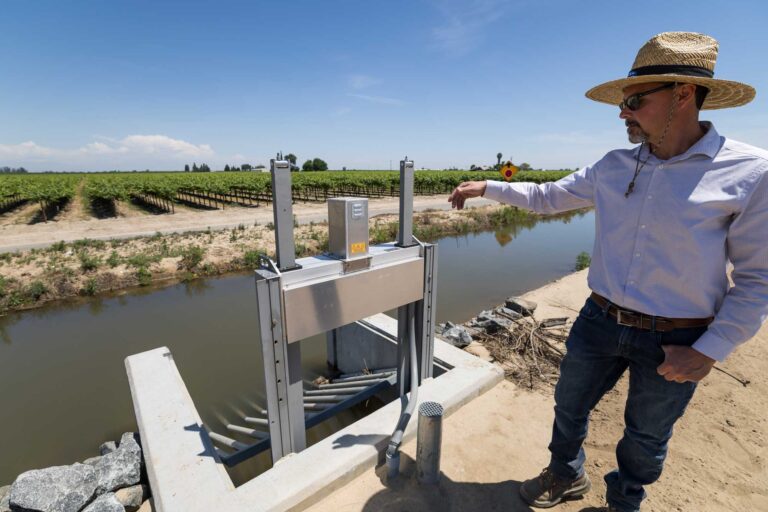
Metering individual pumps—an alternative to the ET approach—can be more precise, though it has bigger up-front costs and meters must be carefully calibrated. For example, Westlands Water District owns the meters on wells in its service area, which automatically transmit pumping data back to the district. PV Water requires landowners to install meters on their wells, and agency staff read the meters quarterly.
Fees. Agencies use two types of fees: pumping fees and acreage fees (a fee based on how many acres a farmer irrigates with groundwater). These fees fund groundwater sustainability agencies and pay for the replacement of transition water with surface water, among other purposes. The use of transition water can lead to negative effects, such as subsidence and dry wells, that the GSA would need to offset.
While these fees vary across agencies, they include $10–25 per acre-foot pumping fees, as well as a $2 per-acre fee. The fees used to cover transition water costs range from $90–210 per acre-foot, depending on the amount of transition water used (tiered pricing raises costs as quantities rise) and whether the landowner also irrigates with surface water.
Penalties. Penalties are charges levied on top of fees if landowners pump more than their allocated amounts. SGMA limits these penalties to $500 per acre-foot, as well as $1,000 plus $100 per day if the violation persists for more than 30 days. Agencies with pumping limits plan to (or already) assess the maximum $500 per acre-foot penalty for landowners who exceed their allocation. They may charge the additional penalty for persistent violations. One of the agencies also deducts the amount pumped above a user’s allocation from their allocation in the next water year.
Carryover. The agencies we looked at with pumping limits allow landowners to carry over some unused groundwater allocations between years. Restrictions differ across agencies, and they include requiring sustainable yield to be the first quantity used in any given year, limiting carryover to one year, reducing the amount of carryover eligible for pumping by a fixed rate each year, and limiting the use of transition water to a fixed amount each year.
Establishing groundwater accounting and allocation systems is an important step not only for managing demand, but also for incentivizing landowner recharge. In the next post, we take a detailed look at how agencies are using these systems to set up incentives.
This blog post is based on a review of publicly available documents and/or correspondence with managers of seven local water management agencies: Arvin-Edison Water Storage District, Lower Tule River Irrigation District Groundwater Sustainability Agency (GSA), Pixley Irrigation District GSA, the Madera County GSAs, Mid-Kaweah GSA, Westlands Water District GSA, and Pajaro Valley Water Management Agency (PV Water).