

While California’s housing market has undergone tremendous changes over the years, with some aspects worsening in the last decade, the central problem—high housing costs—remains the same. On PPIC’s 30th anniversary, we take stock of California’s housing market over the last three decades, tracking changes in housing costs and homeownership rates as well as some of the consequences of the housing crisis, including financial stress, homelessness, and people leaving the state.
As California’s population has increased, more housing units have been built—yet housing costs and rent increases have outpaced building. Since 1990, the state has added 3.6 million housing units and 9.4 million residents (increases of 33% and 31% respectively from April 1990 to January 2024). Adjusted for inflation, California’s median values for owner-occupied housing have increased 56% since 1990 (from $456,000 to $753,000) and rents have increased 39% (from $1,300 to $1,800). California’s housing values remain more than twice as high as the national median, and the state’s rents remain about 50% higher.
Because housing costs are so high, California has among the lowest homeownership rates in the country. In 1990, only three states (New York, Hawaii, and Nevada) had lower homeownership rates than California. In 2023, only New York had a lower homeownership rate. Homeownership rates are especially low for young adults in California, reflecting the difficulty of affording a first home. Homeownership rates have declined among young adults over the past 30 years, but overall rates remain unchanged because the population has aged and older adults are more likely to own homes.
There are stark disparities in homeownership across racial/ethnic lines. Homeownership is far more common among whites and Asian Americans and Pacific Islanders (AAPI) in California than among African Americans or Latinos. The bursting of the housing bubble that led to the Great Recession in 2008 hurt homeownership for Californians of all races and ethnicities, but African Americans and Latinos were more affected.
High housing costs have left many Californians financially burdened. The share of renters who are “stressed”—paying over half their income in rental costs—is considerably higher here than in other states. Not surprisingly, housing stress most affects lower-income Californians, who are generally already in the cheapest rental units and cannot move to escape the burden.
But the gap in housing stress between California and the rest of the country has been growing most among the middle class. It is a sign of the severity of the housing crisis that one in six middle-class renters in California are now spending over half their income on housing. The gap in stress between California and the rest of country is actually larger among homeowners, but it has not increased over time to the same extent.
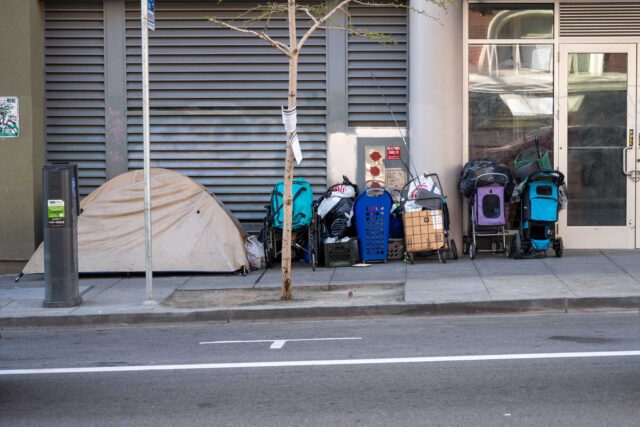
High costs and financial stress have had two immediate consequences. First, homelessness affects a growing number of Californians, including those with mental health or substance abuse problems. Measuring the scale of this problem is difficult, but there is no debate that it has gotten worse. Point-in-time estimates developed by the US Housing and Urban Development agency suggest that the homeless population in California grew from 123,000 in 2007 to 181,000 in 2023, a 47% increase over a period when the state's population increased just 7% (note that not all jurisdictions reported both sheltered and unsheltered counts in 2023). The vast majority of Californians experiencing homelessness are unsheltered; the state accounts for almost half of the nation’s unsheltered homeless population.
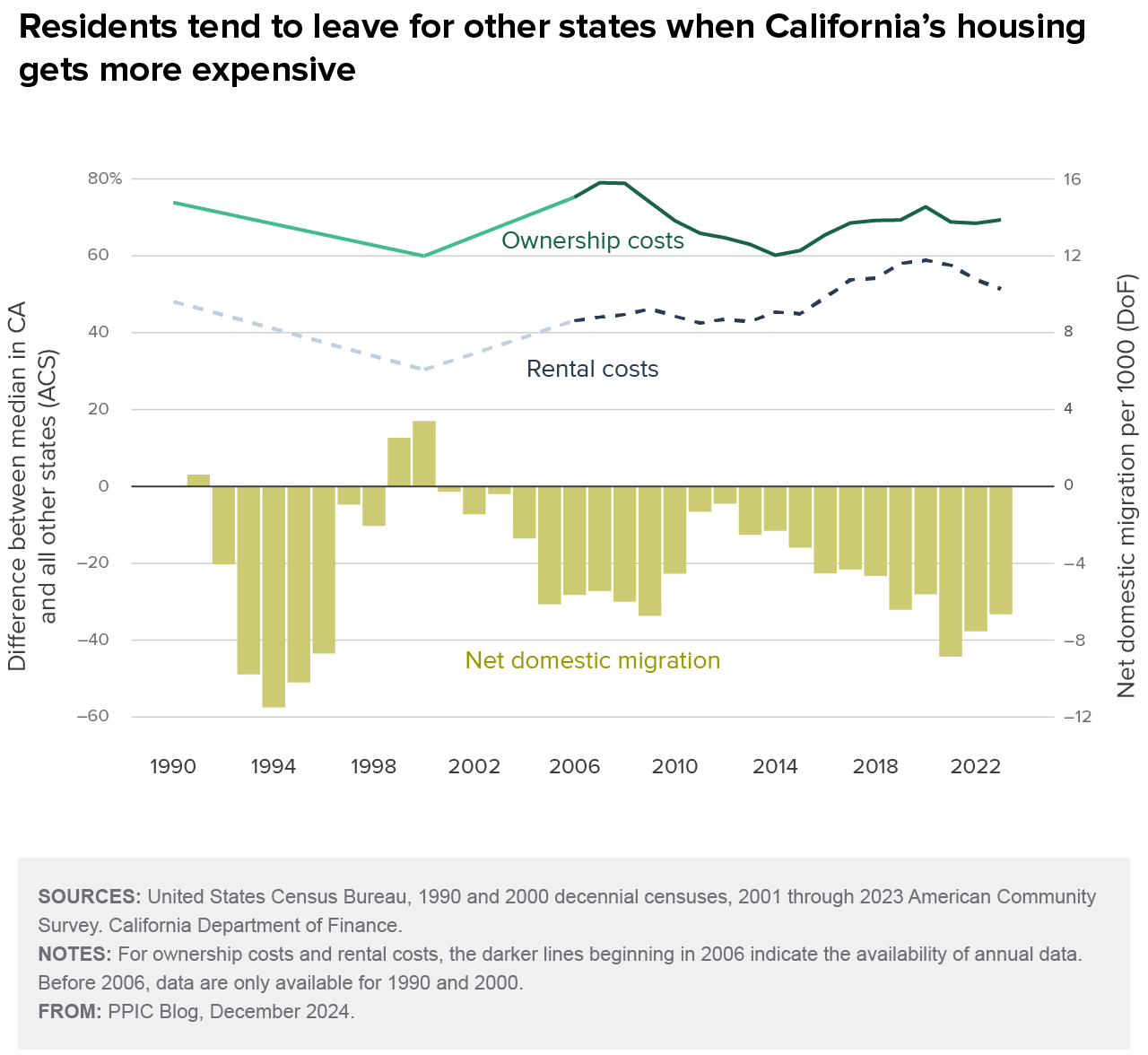
Second, high housing costs have driven more Californians to move elsewhere. Those leaving the state have become more likely to cite housing costs as the reason. Likewise, periods when California’s housing has become more expensive relative to the rest of the country have generally corresponded with higher flows of Californians leaving for other states. And this net outflow has been highest among precisely the lower- and middle-income Californians who have been hit hardest by the cost crisis.
Of course, there is a flip side. Those who bought houses decades ago, when prices were more manageable, have reaped a substantial equity windfall. Current market values have made over a million Californians into millionaires. These millionaires reflect the state’s past more than its future; they are far older and more likely to be white than the typical Californian. For many of them, this equity may be a key piece of their retirement plans. But these higher values do make it more challenging for younger Californians of modest means to buy into their first home.
In 1990, California’s housing was among the most expensive in the country, and it remains so today. The underlying problem is that California is a relatively wealthy state that has underbuilt housing for decades. As a result, high-income Californians bid up the available housing—both purchase prices and rents—while other Californians must pay the premium or move somewhere cheaper.
The best long-term solution is to build more housing of all kinds. California did build a lot of housing in the years leading up to the Great Recession, but construction slowed considerably after that. Partly due to recent state reforms, construction has recovered somewhat in recent years, especially for multi-unit housing. Indeed, housing growth slightly exceeds population growth over the total period from 1994 to the present. But demand to live in California remains strong, and the undersupply of housing was decades in the making. As California’s population is projected to remain low for several decades to come, it is possible that robust housing growth will put a dent in the state’s housing shortage. PPIC will continue to follow these trends.
Topics
Economy homelessness homeowners Housing Population Poverty & Inequality PPIC 30th anniversary racial disparities rentersLearn More
Has Adding More Homes Than People Eased California’s Housing Crisis?
Who’s Leaving California—and Who’s Moving In?

Five Fast Facts on the Cost of Living in California
A Deeper Look at California’s Homeowner Insurance Challenges
Homelessness Hits Record High in California, Jumps Dramatically in Rest of US
As People Leave California, How Are Rental Prices Affected?
California’s Housing Divide

California Homeowners Are Concerned about Climate-related Insurance Price Hikes

California’s Renters