



The next governor will need to contend with rising health care costs and the specter of major federal funding cuts, while ensuring that the state’s health providers and facilities have the resources to deliver quality care. While federal and state policies substantially increased the share of Californians with health coverage over the past decade, access to care remains uneven across the state. Health care costs have grown faster than inflation in recent years, driving up spending for households, businesses, and government alike—and well over half of Californians expect health care to be less affordable in the future.
Fundamentals
The federal government covers the largest share of overall health expenditures (about 30%) through programs like Medicare and Medicaid (Medi-Cal in California). Households cover about 28% through payroll taxes, premiums, and other out-of-pocket costs. Private businesses sponsor about 18%, primarily through contributions to employee coverage, and local and state governments contribute about 16%, mostly due to cost-sharing requirements of the Medi-Cal program.
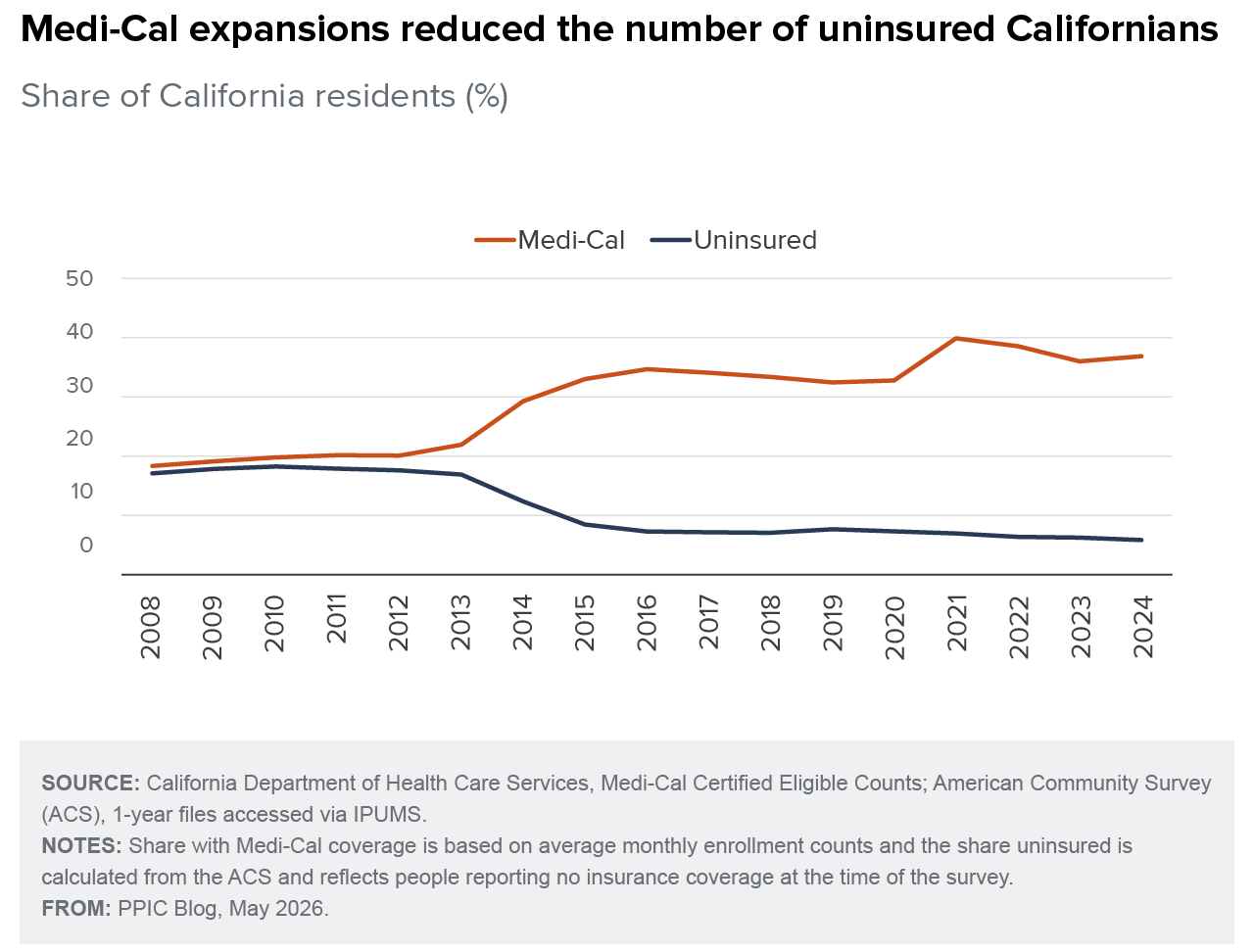
Under the Affordable Care Act, California expanded Medi-Cal to most low-income individuals and established Covered California. The state has also funded a series of smaller expansions, making California the first state in the nation to offer Medi-Cal to all low-income residents. As a result, most Californians (94%) now have health insurance coverage. About half have employer-provided coverage, another 6% purchase private insurance on the individual market and the rest are covered through public insurance programs.
As the state population ages, demand for long-term care is rising. Medi-Cal pays for long-term services, but private insurance plans and Medicare do not.
Key Issues
Federal and state policy changes could increase the number of uninsured. The federal government pays about 60% of total Medi-Cal costs; state funding, local government expenditures and transfers, and provider taxes cover the remaining 40%. Medi-Cal enrolls about 35% of state residents; in many counties, more than half of residents are covered by Medi-Cal.
Major federal changes to Medicaid under HR1—including the introduction of work requirements, more frequent eligibility determinations, and restrictions for some immigrant groups—is likely to reduce Medi-Cal enrollment. State policy changes enacted in the 2025–26 budget—including an enrollment freeze and monthly premiums for undocumented immigrants—will also reduce enrollment.
These state and federal changes are projected to double the current uninsured rate and result in more than 1 million immigrants losing comprehensive Medi-Cal coverage by 2030. While there is uncertainty in these projections, the changes will likely result in additional costs for local governments and safety net providers.
Cost growth is a major concern. The state created the Office of Health Care Affordability (OHCA) in 2022 to address cost growth and established the CalRx initiative to provide access to low-cost prescription drugs. OHCA has set an annual per capita health spending growth target of 3.5%; however, expenditures in recent years have risen more sharply. For example, employer plan premium increases in 2025 were more than twice the overall inflation rate (6% vs. 2.7%). These increases are partly attributable to changes to care, but also to other factors such as increased administrative costs and consolidation among providers.
Total Medi-Cal costs have also grown, reaching about $200 billion in 2025, exceeding estimates; the state borrowed $3.4 billion and implemented cost-saving measures. For many of those with private insurance purchased through Covered California, the end of enhanced federal subsidies has increased premiums.
Access to providers and services is uneven. While California has made significant progress in expanding health coverage, ensuring access to care remains a complex issue. There are longstanding concerns about the adequacy of provider networks for Medi-Cal enrollees, longer travel times and provider shortages in rural areas, and the challenge of finding behavioral health providers who accept insurance. Workforce shortages remain key drivers of these access gaps.
The state has made targeted investments to expand and strengthen the healthcare workforce and increase Medi-Cal rates for some providers, but more work is needed. Telehealth offers some promise, especially for rural communities and mental health services.
Ensuring high-quality care can be challenging. The ultimate objective of health care is to keep people healthy and improve outcomes. Most California health plans have expanded value-based payment models that tie a portion of payments to measurable outcomes, such as chronic disease management and preventive care, rather than volume of services. Medi-Cal is also making efforts to better coordinate health services for high-need, high-cost enrollees—who account for about 20% of Medi-Cal enrollment but more than 70% of total program costs.
Takeaways
Balancing costs with support for health care providers so they can deliver high quality services is a perennial challenge. At the same time, California’s aging population is increasing health care needs while reducing the workforce that provides care and the population that helps pay for it through taxes. Any major reform at the state level would face obstacles, given the large role of federal funding and potential opposition from key stakeholders.
For all of these reasons, health care is likely to exacerbate financial uncertainty and stress for households and government programs alike. The new governor should seek to ease this stress while finding ways to invest in the health of California’s population.
Topics
Affordable Care Act federal funding Health & Safety Net health care health insurance major issues for next governor Medi-Cal Medicaid Medicare mental health Political Landscape Poverty & Inequality rural communities undocumented immigrantsLearn More

Public Health Insurance in California

Concern over Health Care Affordability Is Widespread

California’s Aging Population

California’s Care Workforce

Medi-Cal Has Expanded Health Coverage in California