
Correction (7/7/2026): This brief has been updated to correct data errors identified after publication. The revisions affect some of the statistics presented but do not alter the brief’s overall findings or conclusions.
In recent years, some high-profile companies, like Tesla and Chevron, have moved their headquarters out of California, making headlines and raising concerns about the state’s economic future. But companies, headquarters, and branches are always entering and leaving states, as well as opening, closing, growing, or shrinking. Do a handful of prominent relocations actually reflect a change in the state’s ability to attract and sustain headquarter operations?
In this report, we go beyond the anecdotes to study trends in headquarter relocations and the implications for employment using comprehensive data on all business establishments.
Do headlines indicate a broader trend?
We find that the number of firms whose headquarters have left the state is small. Between 2011 and 2021, 2.3 percent (1,250) of the state’s more than 53,000 headquarters left California on net. Roughly half of the headquarters that left were in manufacturing, wholesale trade, or business services. Most headquarters that left were relatively small companies (fewer than 100 employees), but medium and large companies were more likely to relocate their headquarters.
While the number of headquarter moves is not large, the annual number of relocations has trended upwards. About 240 headquarters left California in 2011, compared to over 400 in 2021. Moreover, the number of relocations from other states to California dropped over the same time frame, from almost 230 to just under 200. Headquarters that left tended to go to other large states like Texas, New York, and Florida, or to nearby states like Nevada and Arizona.
Companies headquartered in California are increasingly moving out of state, and fewer are relocating to California
Number of headquarters relocating
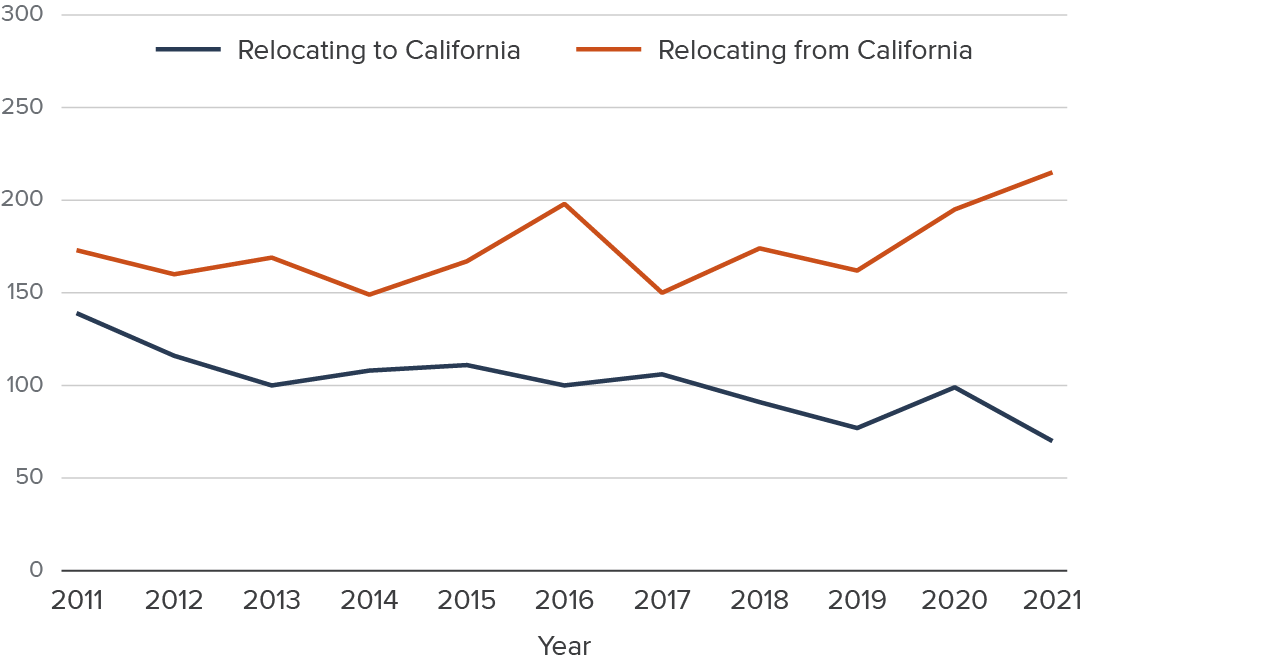
SOURCE: Authors’ analysis from Mergent data, 2010–2021.
NOTES: For each year, we measure moves between the given year (shown in chart) and the prior year in our data; for example, the 2011 data point represents headquarters that moved sometime between 2010 and 2011.
How are jobs affected when headquarters leave?
When headquarters leave the state, the high-paying jobs that tend to be housed at headquarters are most directly affected; this could have implications for state tax revenue, which relies heavily on high-income earners. In addition, headquarter relocations may influence broader business decisions about employment at branches both in and out of California, thereby affecting job growth more generally.
In our assessment, the impact on jobs due to headquarter exits is not negligible, but it also does not reflect a major change in the state’s employment picture. From 2011 to 2021, the decrease in jobs from headquarter relocations represented 3.6 percent (about 83,200) of all headquarter jobs. Further, job loss was mostly limited to headquarter jobs. Headquarters that moved out of state kept other branches and jobs in California, and these companies did not appear to shrink non-headquarter employment in the state relative to firms whose headquarters stay in California.
Do relocations reveal anything about California’s business climate?
Our analysis shows that when headquarters exit California, they tend to go to states with lower taxes and less regulation. The same pattern is evident among headquarters relocating nationally. Over the period studied, California’s tax and regulatory burden was largely unchanged based on widely used measures, while most other states reduced tax and regulatory burdens more, and in some cases substantially—a potential reason behind the uptick in headquarters leaving the state.
However, it is important to keep in mind that relocations are a small fraction of overall headquarter activity. Between 2011 and 2021, far more headquarters launched (23,800, 45% of all headquarters at the start of the period) and closed (16,500, 31%) than moved out of state, with no clear upward or downward trends. Launches and closures have asymmetrical effects on employment: new headquarters are always small, so the initial job gains are relatively low, while closing headquarters tend to be quite large, with considerable job losses.
Looking forward
The worsening trend in headquarter relocations deserves attention. But, in our view, focusing solely on relocations overlooks the range of positive and negative forces driving business activity and can misrepresent businesses’ desire and ability to operate headquarters in California and the broader impact on jobs. Tax and regulatory burdens are key factors for businesses when deciding where to locate their headquarters, and may explain some of the recent trends in headquarter moves. However, these relocations are a relatively small fraction of overall headquarter activity, and there are other signs of California’s appeal for headquarters, such as the number of launches. California also boasts several traits that can both attract and retain businesses, including a highly educated and innovative workforce, a good climate, and quality-of-life amenities.
It is too early in our research agenda to make firm policy recommendations. But a broad and simple lesson is that the state should continue to examine ways to maintain or strengthen the features that make it attractive to headquarters (and businesses more generally) while critically evaluating the costs and benefits associated with policies that may be causing headquarters to leave. Such efforts will require digging beyond the headlines to ultimately identify effective policy options for creating an environment that is conducive to growth and retention of businesses and jobs.
Topics
Economic Trends Economy Jobs and EmploymentLearn More

California’s Businesses

Business Regulation and Business Starts in California

Priorities for California’s Economy

Business Climate Rankings and the California Economy

Are Businesses Fleeing the State? Interstate Business Relocation and Employment Change in California