
In 2021, California launched the Universal Prekindergarten (UPK) program (AB 130), requiring public schools with kindergarten to provide free, high-quality, inclusive pre-kindergarten to all four-year-olds regardless of birth date. Starting in 2022, it increased the original age-eligibility for Transitional Kindergarten (TK)—students turning five in the fall—to include younger four-year-olds incrementally. This mandate comes to completion in the 2025–26 school year, which is fast approaching. To ascertain how well expansion is working, we examined enrollment data and interviewed ten districts. Below are just a few of our key findings.
Enrollment is growing, but participation rates have declined
TK has grown dramatically since expansion started in 2022. In 2023–24, it served over 150,000 students statewide out of an estimated 215,000 eligible—more students than ever before, but about 70% take-up, lower than the 83% pre-expansion peak.
TK take-up rates have fallen with expanding eligibility
State TK take-up rate (%)
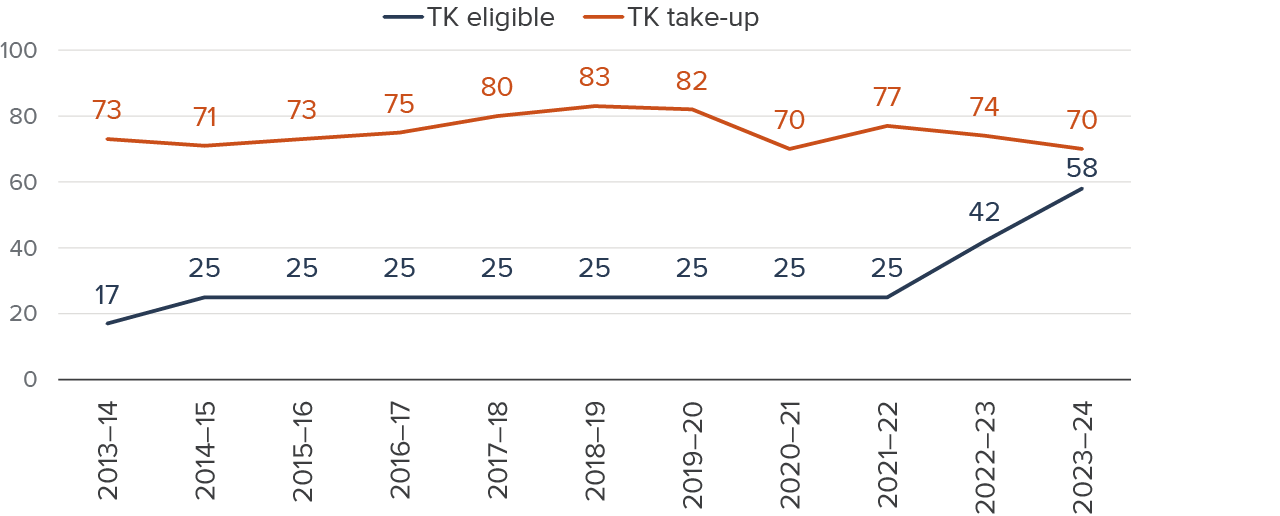
SOURCE: California Department of Education (CDE) TK Census Day enrollment.
Although participation among Dual Language Learner (DLL) students is 71%—similar to all students overall and those from lower income households—their rates have fallen 18 percentage points since 2019–20. Moreover, the age expansion does not seem to be increasing participation among children from underrepresented communities. At 18 percentage points, Latino children show the largest decline among these populations with current take-up rates of 70%. Take-up among Black children has fallen 12 percentage points to 66%.
Families consider a variety of factors when deciding on early childhood education—including programmatic learning environment, availability and duration of childcare, location, and curriculum. Enrolling in TK is optional, so these declines may reflect family preferences for the care of their younger four-year-olds.
Latino students show largest decline in take-up rates since pre-expansion peak
Take-up rates (%)

SOURCE: California DataQuest, Annual enrollment with ethnicity, 2019-20 and 2023-24.
NOTE: We use 2019-20 as our pre-expansion benchmark because most districts experienced pandemic-related declines in TK after 2019-20.
As TK expansion unfolds, the program is evolving
Most elementary and unified school districts with kindergarten are offering TK now—in 2023–24, 91% of elementary and unified districts and 85% of schools. A growing number have a full-day option. School districts reported increasingly moving away from the academic kindergarten-like curricula of original TK to more structured play-based learning. Indeed, staffing requirements emphasize the importance of expertise in early childhood and acknowledge the need for more child-teacher interaction.
Increasingly younger four-year-olds pose challenges
Children about to turn five have very different developmental needs than those who just turned four. What might suffice for a nearly five-year-old is inadequate for an early four-year-old who may need help with toileting, opportunities for rest, and lots of play-based, behavioral learning. Of the districts we interviewed, the top challenges included upgrading facilities to be age-appropriate, developing TK curriculum, and building staff and leadership capacity to accommodate early childhood education in K–12.
Looking forward
- Providing TK at all districts (including Basic Aid) and schools would likely increase participation. Gaining more clarification about family preferences would help districts make targeted program improvements.
- Younger four-year-olds and those about to turn five have vastly different developmental needs. To accommodate these differences effectively, school districts need ongoing support with facilities, staffing, professional development, and curriculum.
- For UPK to be successful, families must have clear, accessible information about local TK programs, including where it is offered and the availability of after-care.
- The evolution of a more fully structured and high-quality play-based curriculum—with teaching staff prepared and committed to administering it—may draw in more families over time.
- A lack of integrated data complicates districts’ understanding of local demand—and limits state policymakers and researchers seeking to understand need and evaluate impact.
Topics
Immigrants in California K–12 EducationLearn More

Enrollment Growth in Transitional Kindergarten Partially Offset Broader Declines

Transitional Kindergarten in California, Explained

California’s Changing Child Care Landscape

Experts Discuss California’s Transitional Kindergarten Expansion

Californians Support Universal Preschool, but Take-up of Transitional Kindergarten Is Uneven

Setting the Stage for Universal Preschool