High college costs loom large for families. A recent PPIC survey found that while 71 percent of California parents with school-age children want their children to complete at least a bachelor’s degree, a similar share of parents are concerned about their ability to pay for their children’s college education.
In hopes of increasing access to financial aid, the state implemented a universal financial aid application policy in 2022–23, which requires school districts to ensure that all high school seniors complete a financial aid application—either the Free Application for Federal Student Aid (FAFSA) or the California Dream Act Application (CADAA)—or formally opt out. Our research examines changes in college enrollment and access to financial aid in the first year of implementation.
How did college enrollment and access to aid change?
The policy contributed to an increase of almost 1,500 additional students enrolling in college, or a 0.3 percentage point uptick in the college-going rate. Compared to the year before the policy took effect, the share of high school seniors completing the FAFSA rose by 10 points. The shares of seniors eligible for grants given to low-income students went up as well (by 7 points for the federal Pell Grant; by 4 points for the Cal Grant).
The share of high school seniors who completed a FAFSA and enrolled in college grew by 6 percentage points. This reflects not only an overall increase in college enrollment but also more students gaining access to financial aid upon enrollment. These gains were broadly distributed across counties in the state.
The share of high school seniors enrolling in college with a completed FAFSA increased
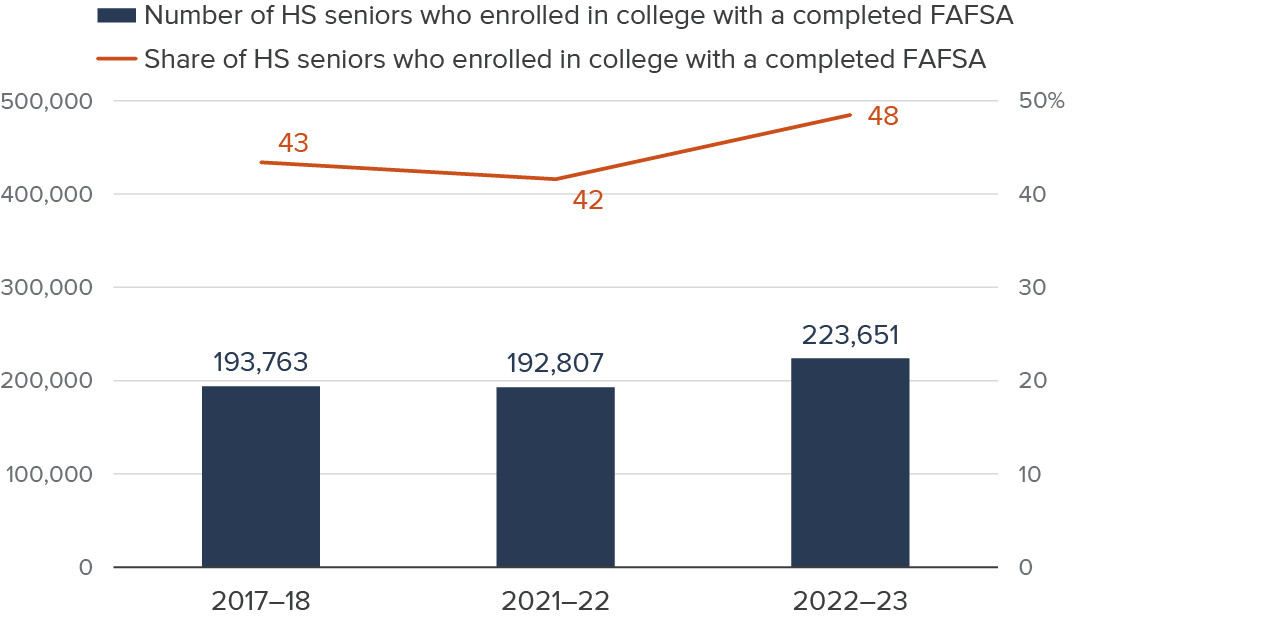
SOURCE: Authors’ calculations using California Student Aid Commission (CSAC) data.
NOTES: Sample is restricted to high school seniors in graduating cohorts of 2017–18, 2021–22, and 2022–23 in the CSAC data. Students are matched to National Student Clearinghouse records, and those with college enrollment between July 1 of the high school graduation year and June 30 of the following year are counted as enrolled. FAFSA completion is measured by June 30 of the student’s high school graduation year.
Which students were most affected?
Historically underserved students experienced a greater increase in college enrollment with a completed FAFSA. After the policy, first-generation students, low-income students, and those attending high schools with high shares of underrepresented racial/ethnic groups, including African Americans and Latinos, saw greater gains in both FAFSA completion and college enrollment compared to their peers.
However, about 30 percent of students still lack key information for making decisions about the cost of college and the aid they qualify for because they do not complete a FAFSA or a CADAA. In particular, the FAFSA completion rate for community college enrollees, who are often low-income or from other underserved student groups, remains below that of the University of California and California State University.
What are the implications for future policy?
Our findings suggest that California’s universal financial aid application policy is a promising strategy for increasing college enrollment and financial aid uptake among college enrollees and potentially narrowing gaps across student groups. Informed by our research, we offer the following recommendations:
Strengthen and expand policies to encourage completion of financial aid applications for all students. Targeted strategies to understand and address the specific barriers faced by different student groups will be essential to make sure that every student can access the financial resources needed to make informed decisions about postsecondary education.
Formalize a linked data system to inform policy. The state’s Cradle to Career (C2C) data system presents a critical opportunity to connect high school, college, and financial aid information with other key aspects of students’ educational trajectories. A coordinated system would lower administrative and research costs and improve the state’s ability to track long-term trends and evaluate the impact of policies like the universal financial aid application requirement.
Complement financial aid efforts by addressing non-financial barriers to college enrollment. Strengthening academic advising, expanding college and career counseling, and providing guidance throughout the college application and enrollment process can help more students navigate the path to college and take full advantage of the financial aid available to them.
California’s universal financial aid application policy has been an important step to ensure that more students have access to financial aid that can reduce the cost of college. Looking ahead, future research examining the role of aid in helping students achieve their higher education goals—as well as other barriers students might face accessing aid—will be essential to help more students succeed in college.
Topics
Access Affordability Equity Higher Education K–12 Education Poverty & InequalityLearn More

College Affordability in California

New Policy Improves Student Access to College and Financial Aid

California Increases Financial Aid Application Rate

Implementing California’s Universal Financial Aid Application Policy