As part of its recent efforts to address stark racial disparities in its criminal justice system, California enacted the Racial and Identity Profiling Act (RIPA) in 2015; RIPA requires detailed reporting on all pedestrian and traffic stops. We used recent RIPA data to examine changes in racial/ethnic disparities in law enforcement encounters from 2019 to 2023; this analysis is particularly important in light of dramatic pandemic-era changes to California’s criminal justice system.
The Number of Stops Remained below Pre-Pandemic Levels in 2023
Our analysis focused on California’s 15 largest law enforcement agencies: the California Highway Patrol, 8 police departments (Los Angeles, San Diego, San Francisco, Sacramento, Fresno, San Jose, Long Beach, and Oakland) and 6 county sheriff’s departments (Los Angeles, San Bernardino, Sacramento, San Diego, Riverside, and Orange).
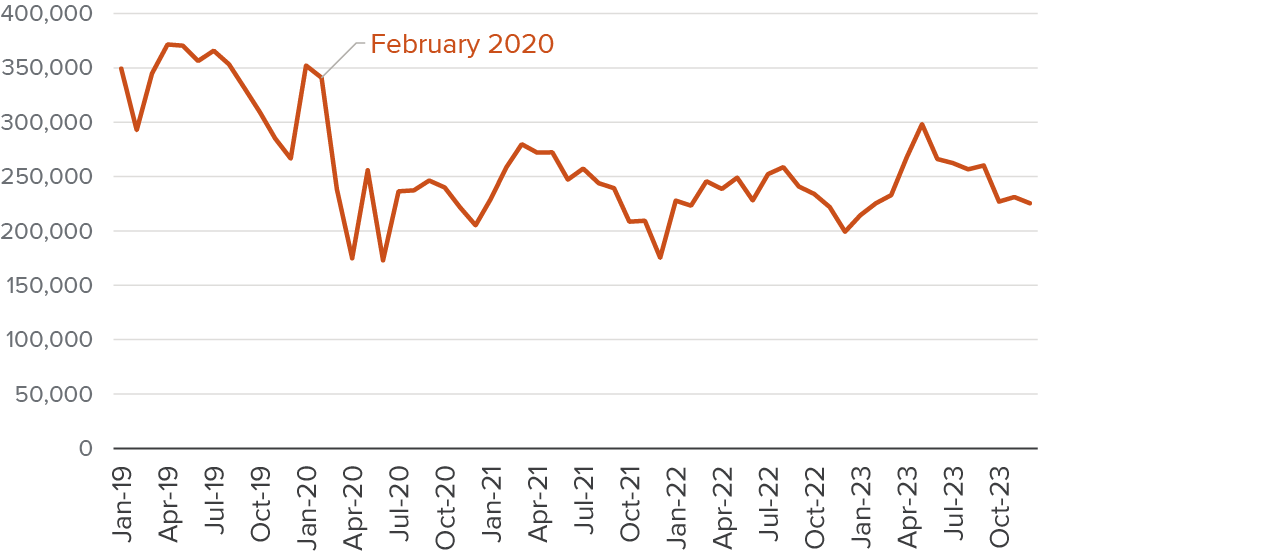
The RIPA data show that law enforcement stops—which plunged at the onset of the pandemic—were one million per year (or 26%) below 2019 levels in 2023. The eight largest police departments accounted for more than 60% of the overall decrease. In addition to the pandemic, key drivers could include the aftermath of the George Floyd murder, limits to pretext stops, and decreased police staffing.
The number of stops fell during the pandemic and remained below 2019 levels in 2023
Monthly number of stops
SOURCE: Author calculations using California Department of Justice, Racial and Identity Profiling Act (RIPA) data for the 15 largest law enforcement agencies, 2019–2023.
A million fewer stops overall means fewer intrusive encounters—including searches, detention, use of restraints such as handcuffs, and incidents involving weapons—and less risk for both officers and community members.
We find that among those stopped, searches became more likely, especially in stops made by police officers; in addition, the search discovery rate increased. At the same time, stops with no enforcement dropped markedly across agencies. These findings suggest that stops became more selective and productive, as well as more likely to lead to intrusive outcomes.
Have Racial/Ethnic Disparities in Stops and Outcomes Narrowed?
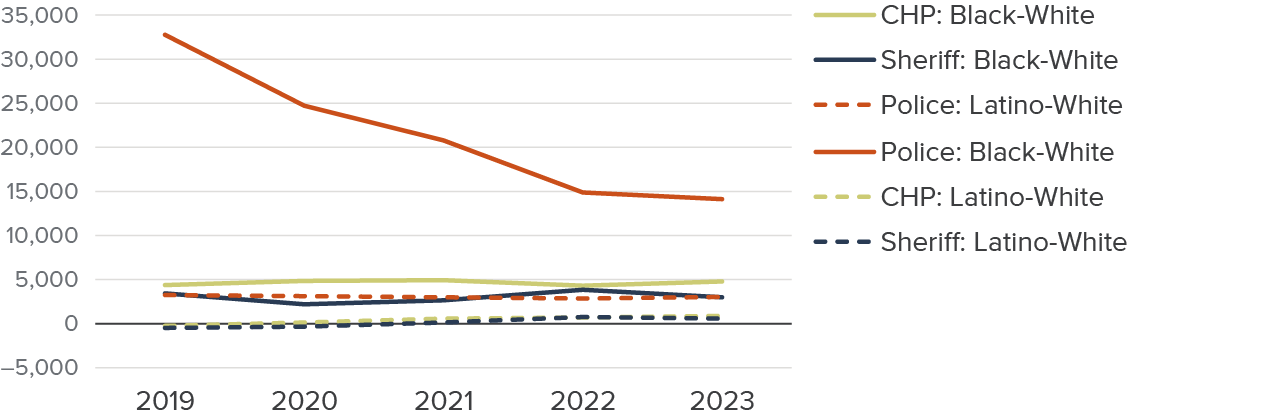
The data show significant decreases in racial disparities in the likelihood of being stopped, driven by police departments, but notable gaps remain. The Black-white gap in police stops decreased by 57%, while the Latino-white stop rate gap decreased by 7%. Asian Californians continue to experience fewer stops than white Californians.
Racial/ethnic gaps in police department stops have narrowed
Stop rate gaps (per 100,000 residents)
SOURCE: Author calculations using RIPA data for the 15 largest agencies and population data from the CA Dept. of Finance and US Census.
Our analysis of racial/ethnic disparities in experiences during stops—which accounts for key stop factors—reveals limited evidence of decreases. We do find that one racial/ethnic gap closed in 2023: police and California Highway Patrol stops of Black and Latino Californians were no more likely than stops of white individuals to result in no enforcement (including warnings). But Black and Latino individuals continue to be more likely to be searched than white individuals across agency types, and disparities have widened somewhat, with the exception of police department stops of Latinos.
At the same time, searches of Black, Latino, and Asian individuals continue to be less likely to yield contraband, with one notable exception: in 2023, the search discovery rate during police stops of Black individuals was higher than the rate for white individuals.
We find that Black and Latino individuals are increasingly more likely to have intrusive experiences during a stop, including being detained curbside or handcuffed, compared to white individuals. While stops involving officer weapons remain relatively rare, Black and Latino Californians continue to be more likely to experience this level of intrusiveness than whites.
Key Considerations
Our analysis points to a reduction in the overall number of stops, especially by police departments, and indicates that officers may be making stops more selectively, leading to decreases in racial disparities in the likelihood of being stopped. However, we do not see a substantial narrowing of disparities in the experiences during stops of Black and Latino Californians relative to whites. Also, an evaluation of the impact of fewer stops on public and traffic safety could reveal unintended consequences.
We looked at completion of RIPA-required training in racial and cultural understanding as well as use-of-force/de-escalation course-taking by officers in the 15 largest agencies. Trends vary from year to year, but thousands of courses have been completed in these areas. A better understanding of this training’s impact on racial/ethnic inequities would be helpful, and efforts to identify effective approaches are needed.
Lastly, but importantly, we observed some patterns that point to the possibility that, at least temporarily, agencies may not have reported all stops. Efforts by the RIPA Board and individual law enforcement agencies to ensure the completeness of reported data are crucial in preserving its value.
Topics
Criminal Justice Population