SGMA is reshaping farming in the San Joaquin Valley
California’s San Joaquin Valley, one of the most productive agricultural regions in the world, accounts for about 60 percent of the state’s farm economy and produces a large share of the nation’s fruits, nuts, and vegetables. The valley’s abundant sunshine and rich soils support a wide range of crops, but farming depends on irrigation water that has become increasingly unreliable.
The Sustainable Groundwater Management Act (SGMA), enacted in 2014, requires overdrafted groundwater basins to reach long‑term balance by the early 2040s. Consequently, less land is likely to be irrigated across the valley, with 10 to 20 percent of farmland, or 500,000 to 900,000 acres, potentially coming out of production. But the scale, location, and consequences of land retirement for the valley’s economy and communities depend on how farmers adapt.
Left unmanaged, these idle lands often generate weeds that spread to nearby planted fields and dust that poses health risks for rural communities. Fallowed farmland can support solar development, groundwater recharge, and habitat restoration, but these options will not suit every landowner or community. Farmers in areas where significant cuts to water use are required may adapt by growing a SGMA-ready crop—one that uses minimal irrigation water and other inputs, offers positive returns in wet years and limited losses in dry years, and provides benefits such as improved soil health, dust suppression, and the potential for groundwater recharge. This policy brief examines where growing such a crop makes economic sense and how government programs can support its adoption.
Growing winter forage offers an alternative to fallowing
As groundwater cutbacks take effect under SGMA, the acreage of summer forage crops (which are used to feed livestock) is likely to decline in areas that rely heavily on groundwater. Currently, forage crops like alfalfa and corn are second only to perennials by acreage—up to 700,000 acres, about 15 percent of the valley’s irrigated land. Many dairies source feed from nearby forage growers, and beef producers add to this demand at a smaller scale. These crops are thirsty: alfalfa requires 3.5 to 5 acre-feet a year and corn needs 3 to 4.5 acre-feet.
Valley farmers have a long history of growing small grain winter crops that require less water—including wheat, barley, rye, and triticale—for both forage and grain. While acreage can vary significantly, in recent years growers have planted a little over 100,000 acres of wheat annually—well below historic levels, which often exceeded 300,000 acres. Winter forages offer a low-water alternative to summer crops:
- Winter forages can be grown with as little as 4 inches of supplemental irrigation, according to PPIC and University of California research.
- Winter forages are grown in cooler, wetter months when evaporation is low and rainfall can help meet their water needs. Flexible harvest timing can help farmers adjust to uncertain water supplies.
- Winter forage, when managed appropriately, uses little more water than fallow land, which loses significant amounts to evaporation.
Many farmers adapting to SGMA may need to choose between growing a managed winter crop on fields that are fallow in the summer or no crop at all. Even modest positive returns may be an improvement over leaving lands idle. How much farmers can earn depends on the amount and timing of rainfall, water available for irrigation, and forage prices, among other factors.
Winter forages could be a viable SGMA-ready crop . . .
A number of factors suggest that winter forages could make economic sense in the valley.
- The valley’s roughly 1.5 million cattle—about 90 percent of them living on dairies—depend heavily on locally grown forage.
- As summer forage acreage declines, dairies may face higher costs from purchasing forage that is shipped into the region. Supplies from elsewhere in the West face their own water constraints, potentially driving up prices and contributing to herd reductions.
- Winter forage stored as dry hay can be fed to livestock through the summer, partly reducing the need for locally grown summer forage.
- Growers may tap additional markets among producers of beef cattle and dry (non-lactating) dairy cows that have more flexible diets and can incorporate more small grain forage.
. . . where conditions are right
Water-limited winter forage cultivation is not viable everywhere in the valley. While it is often economical for dairies to buy grains and alfalfa from out of state, wet forages like corn and small grain silage are too low in value (relative to their weight) to ship far. Dairy farmers predominantly feed cattle with alfalfa and corn silage, which are highly nutritious and precisely calibrated to current feed rations; using higher proportions of small grain forages for milking cows may require technical support. Dairies currently have high demand for feed, especially in spring and early summer before corn silage is available. Winter forage growers located near dairies will find a readily accessible market for their crops.
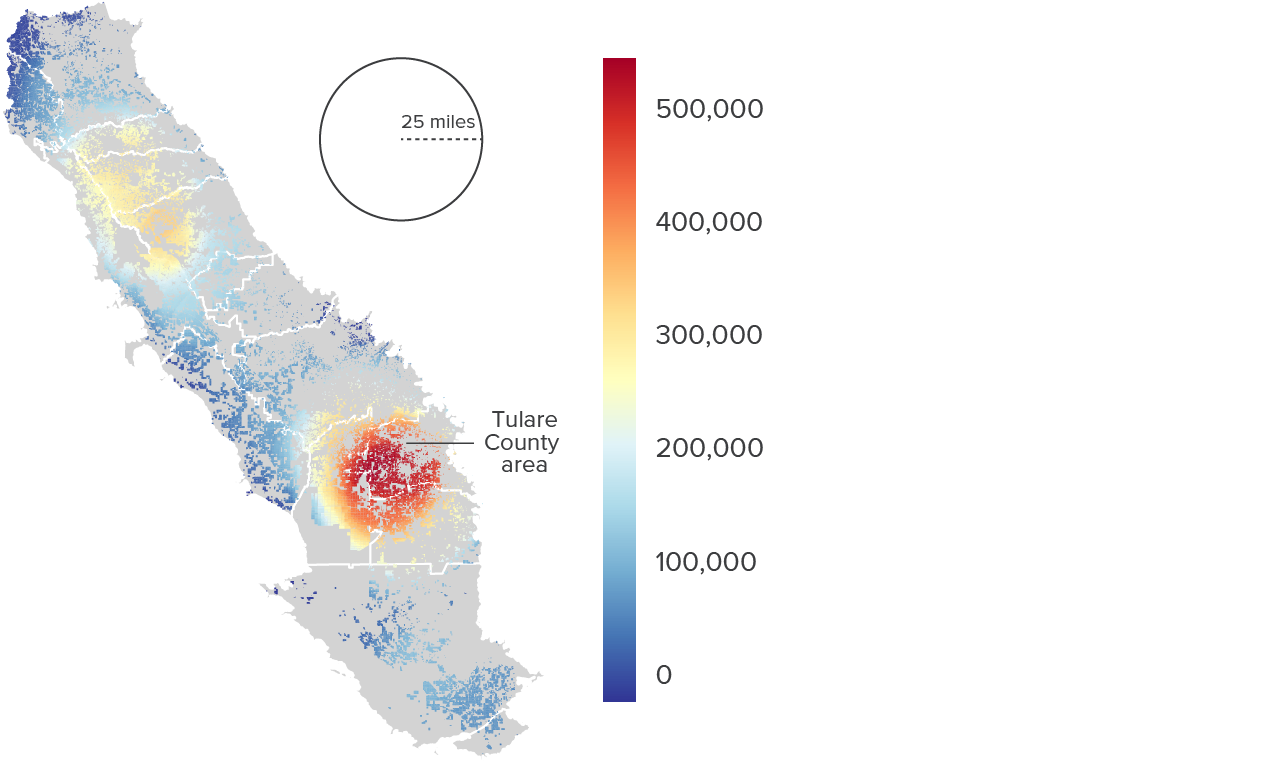
Cropland within 25 miles of dairies—excluding lands planted with valuable, long-lived perennial crops such as almonds, pistachios, and grapes—is the strongest potential location for winter forage production. The figure below shows the population of dairy cows within 25 miles of annual cropland. Tulare and Kings Counties, where dairies are large and concentrated, have the greatest potential demand.
Dairy demand for forage in the San Joaquin Valley
Population density of dairy cows within a 25-mile radius
SOURCE: State Water Board’s California Integrated Water Quality System and DWR crop mapping data.
NOTES: The color of each pixel represents the number of dairy cows within a 25-mile radius. Only pixels representing acres planted in annual crops are shown, including areas currently growing forage, vegetables, and other crops.
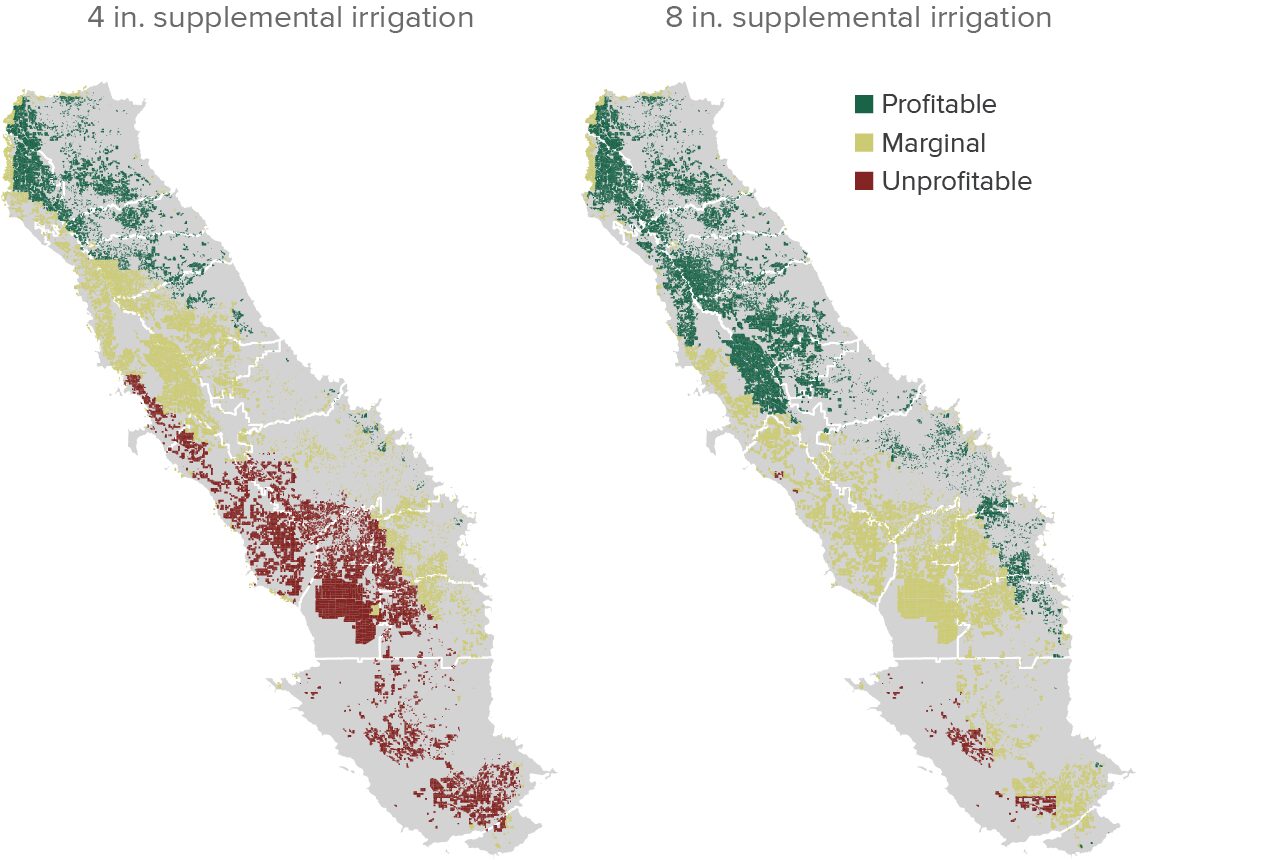
The second figure shows estimated net returns from wheat forage on approximately 1.74 million acres across the valley, based on projected yields from field trials and modeling, assuming an average water year using annual rainfall from 2010–20. Returns per acre are categorized as profitable if they exceed $100, marginal if they fall between a loss of $50 and a gain of $100, and unprofitable if losses exceed $50.
Estimated net returns per acre under different irrigation scenarios
SOURCES: PRISM rainfall data from 2010–20. Yields from Peterson et al. (2023). Net returns based on UCANR crop budgets, ASFMRA Land Trends reports (2022–25), forage price from USDA Agricultural Marketing Service hay price data, and author calculations.
NOTES: Net returns per acre are categorized as profitable if they exceed $100, marginal if they fall between a loss of $50 and a gain of $100, and unprofitable if losses exceed $50. Net returns are calculated as revenue, given yields that correspond to applied water and average annual rainfall from 2010–20, less costs, including irrigation costs and land rent.
Returns vary widely across the valley, driven largely by local rainfall. At 4 inches of supplemental irrigation, net returns are profitable or marginal across much of the northern valley but are marginal to unprofitable farther south, where lower rainfall makes break-even yields harder to reach. The areas with the strongest forage demand—Tulare and Kings Counties—have marginal or unprofitable returns at 4 inches, though they improve markedly with 8 inches.
An accompanying PPIC report on winter forage water productivity suggests that most areas of the valley require supplemental irrigation to avoid crop failure and attain viable yields. Thus, economic returns depend heavily on how much water is applied. As little as 4 inches of supplemental irrigation are enough to establish a wheat forage crop, but at that irrigation level around half of the acreage is unprofitable. Still, growers who own or rent land that would otherwise be idled may find it worth planting: even modest returns help defray unavoidable costs such as land rent, property taxes, and water district assessments. At 8 inches of irrigation, 92 percent of locations are marginal or profitable.
Returns also vary considerably by water year type, based on a classification of water years from 2011–25. In normal water years, roughly half of locations are marginal or profitable with 4 inches of irrigation—rising to nearly 90 percent with 8 inches. In dry years, most locations are unprofitable even at 8 inches. In wet years, most locations are profitable with only 4 inches.
Public programs can help farmers adopt crops that provide community benefits
Winter forage crops may deliver public benefits that are difficult to capture through private markets, including reducing the spread of weeds to neighboring lands and lower greenhouse gas emissions than fallow land (see technical appendices).
Communities in the San Joaquin Valley have some of the worst air quality in the nation. Windblown dust from disturbed or idle land significantly contributes to this problem, which individual landowners and existing air pollution controls are unlikely to fully address. Prior PPIC research found that annual crops are associated with lower local dust levels than fallowed land, and that even as little as 4 inches of supplemental irrigation can support enough vegetation to reliably suppress dust.
New analysis suggests that winter forage crops reduce dust risk relative to fallowing by maintaining vegetative cover from crop establishment through harvest—roughly November to April (see technical appendices). Because harvest may be complete before or at the start of the windiest months of the year (April through June), dust suppression benefits depend in part on post-harvest management of crop residue. Tilling in residues and leaving fields bare would likely offer no meaningful advantage over fallowing, while retaining standing stubble or surface mulch could substantially reduce wind erosion through the summer.
Across nearly 1 million acres identified in Figure 2, applying 4 inches of irrigation to winter forage crops in an average water year from 2010–20 offers profitable or marginal returns—though not all of these acres are near enough to dairies to access ready markets. The scale is comparable to projections of fallowed land under SGMA and suggests winter forage could be adopted across the valley in areas where land is more plentiful than water. However, this estimate does not imply that all these acres will be planted in winter forage. Large increases in winter forage acreage could also drive down forage prices.
Recent experience with the Multibenefit Land Repurposing Program and LandFlex enrollments shows that landowners respond to incentives that encourage alternative, less water-intensive land uses. A $50 per-acre incentive—sufficient to offset losses at the lower end of the marginal range, and lower than recent cover cropping incentive payments administered by state and federal programs—could help marginal lands break even in normal water years. Farmers would likely lose money in dry years even with this incentive, which means this strategy may not be viable in the southern valley, where average rainfall is lower.
California can update state rules and build on existing work by local bodies (such as the San Joaquin Valley Air Pollution Control District) to launch pilots that incentivize emerging cropping practices with multiple public benefits. Doing so could shift land that would otherwise be fallowed into SGMA-ready crops, reducing public health costs associated with air quality.
Improved groundwater accounting could support SGMA-ready crop adoption
Local water agencies—primarily groundwater sustainability agencies (GSAs) and irrigation districts—set the rules that govern local water use. Water accounting rules that treat winter crops the same as summer crops can discourage growers from adopting winter forage crops.
GSAs can support SGMA-ready crops through two key mechanisms:
- Flexible allocation accounting. Groundwater consumed by winter crops is typically a small fraction of summer irrigation, and accounting systems should reflect this distinction. GSA accounting rules should only charge growers for water use that exceeds the amount of water that would be lost from a fallow field.
- Low- or no-cost winter irrigation water in wet years. Where surface water supplies are available, GSAs can offer water at reduced rates during the winter growing season. In exceptionally wet years, when recharge potential is greatest, the small grain forage crop could be forgone to repurpose land as recharge basins—though in most wet years growing forage is likely more profitable.
State agencies with SGMA oversight can support this process by providing technical guidance to GSAs—particularly smaller, under-resourced districts—on accounting policies and fallowing program rules.
Conservation and risk management programs can help
Current federal programs create barriers to adopting water-limited winter forages. US Department of Agriculture (USDA) programs generally prohibit harvesting cover crops, while crop insurance programs require growers to declare a single intended use (e.g., grain or forage) before seasonal rainfall is known. This creates real financial risk even where average returns are positive. These rules prevent growers from accessing both conservation payments and limited crop insurance options simultaneously, discouraging adoption in areas where it is most needed.
While federal programs lack flexibility, state agencies are better positioned to act quickly through changes to incentive programs and pilot projects. Several changes would help:
- Allow flexible harvest within state conservation programs. California’s Healthy Soils Initiative is more flexible about the use of cover crops relative to federal programs. Expanding this flexibility across state conservation funding would reduce the conflict between winter management strategies with similar soil protection benefits.
- Support pilots in high-priority basins. Targeted pilots in SGMA-affected regions could test how water-limited forage crops perform under revised program rules, generating evidence to inform broader reforms and demonstrating viability to federal partners.
- Pilot multi-purpose crop insurance. The California Department of Food and Agriculture could work with USDA to pilot insurance products for small grains grown as forage in water-limited settings. Continued development of yield baselines and risk profiles would inform both state policy and federal insurance product development.
Winter forage crops bring many benefits as a SGMA adaptation option
Winter forage alone cannot solve the valley’s land transition challenges, but it could play a meaningful role if supported by public programs. The economic returns are profitable or marginal in normal and wet years across much of the valley, particularly in northern areas where winter rainfall is reliable and farms are close to livestock.
Public programs could expand adoption by reducing planting risk, providing land use incentives, and updating SGMA accounting rules to reflect the low water use of winter forage. Potential benefits extend beyond returns to growers: local livestock producers would have a more stable feed supply at a lower cost; rural communities would experience improved air quality; and greenhouse gas emissions would be reduced relative to fallowed land. As more land comes out of summer irrigation under SGMA, state agencies, federal agencies, and groundwater sustainability agencies have an opportunity to align existing programs—including conservation programs, water accounting, and land repurposing—to help keep farmland productive.
Topics
Drought San Joaquin Valley Water Supply Water, Land & AirLearn More
SGMA-Ready Crops as a Low-Water Alternative to Fallowing

Land Transitions and Dust in the San Joaquin Valley
Commentary: Drought Requires New Strategies for Managing Cropland

Exploring the Potential for Water-Limited Agriculture in the San Joaquin Valley
Dangers Lurk in the San Joaquin Valley’s Dust

Water Use in California’s Agriculture