
Law enforcement agencies at the state, county, and local levels employ over 77,000 individuals with arrest powers across California, spending about $28 billion on policing. Research shows that hiring additional law enforcement officers reduces crime, especially violent crime. Yet agencies have experienced challenges around officer recruitment and retention in recent years amid the COVID-19 pandemic, economic uncertainty, and societal changes.
Bringing together several new and underused data sources, we provide key trends and context for understanding officer staffing in California, highlighting several obstacles for agencies moving forward.
Officer staffing is below pre-pandemic levels
Despite small growth over the last two years, the statewide officer count (77,200) in 2024 is 3 percent less than it was in 2019 (79,600). California has 196 officers per 100,000 residents, down from a peak of 221 in 2008.
Officer staffing reached a peak in 2008, then declined during the Great Recession and pandemic
Officers per 1,000 residents
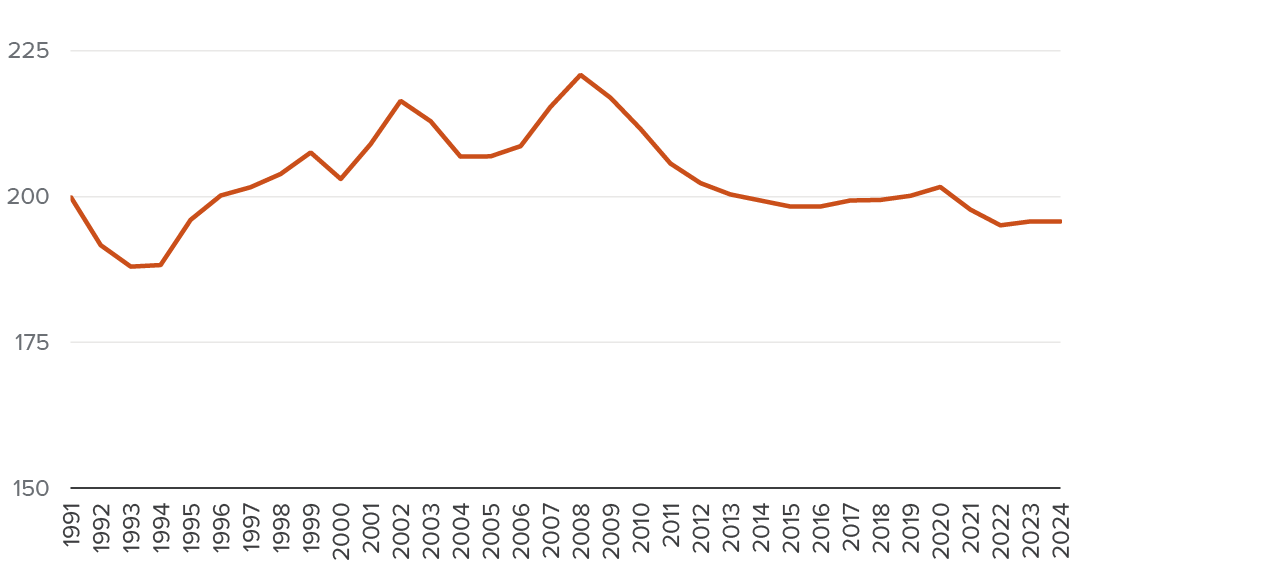
SOURCES: Authors’ calculation based on California Department of Justice’s Law Enforcement Personnel Survey and California Department of Finance Population Data, 1991–2024.
NOTE: The California Department of Justice collects the Law Enforcement Personnel data through a one-day survey taken on October 31st of each reporting year.
Trends in staffing vary based on agency size and type. The post-pandemic drop in staffing has been driven by large agencies with over 100 officers. Over the last two decades, staffing levels have risen at sheriff’s departments—possibly due to public safety realignment in 2011, which shifted some correctional responsibilities from the state to the counties—while declining slightly at police departments. And in recent years, rural agencies have experienced more volatile changes in staffing than non-rural agencies.
Officer demographics have shifted
Although officers are predominantly male, the share of female officers is rising. Women now make up 15.3 percent of sworn officers, compared to 12.6 percent in 2008. Looking at race/ethnicity, representation of Latino officers has increased significantly over the last two decades, while representation of white and Black officers has declined and representation of Asian officers has remained largely unchanged after accounting for shifts in the underlying California population. Meanwhile, average officer age and tenure have stayed relatively stable. Recent research shows having more female, Latino, Black, older, and experienced officers leads to benefits, such as reductions in use of force.
Retention has declined, and overtime has increased
From 2016 to 2020, total separations—including resignations, retirements, and terminations—rose steadily at California law enforcement agencies, by about 11 percent. Separations then went up more than 30 percent between 2020 and 2022, potentially influenced by factors like the pandemic and protests following the murder of George Floyd.
Since 2011, after adjusting for inflation, officer salaries have declined slightly, and overtime pay has increased considerably, especially for non-rural agencies. The average base salary for officers decreased from $116,000 to $110,000 between 2011 and 2023, possibly due to more experienced officers leaving. Over this time, average overtime pay grew from $10,000 to over $25,000. Though rural and non-rural agencies had similar overtime pay in 2011, there was a large difference by 2023 ($16,000 rural; $28,000 non-rural). Agencies are most likely relying on overtime to fill staffing gaps. While overtime pay boosts officers’ total compensation, department policies mandating overtime for officers could lead to low morale and eventual exits. In addition, research has shown that fatigued officers may not be able to perform as effectively as those who are well rested.
Agencies face several challenges
To learn more about agencies’ perspectives on recruitment and retention, we conducted an original survey of police and sheriff’s departments. Our findings identify agency competition, pay, and location issues (such as remoteness of the agency or housing costs and availability) as key staffing challenges. When it comes to hiring, respondents shared that finding high-quality candidates has become more difficult. About 30 percent of respondents indicated that limited staff capacity has led to shifts in services or response priorities, such as deprioritizing non-criminal medical calls. It is important to note that these survey findings are more representative of smaller agencies and sheriff’s departments because a lower percentage of police departments, and few of the largest police departments, responded to the survey.
With the substantial number of officers employed across the state and significant funds going toward law enforcement, monitoring and understanding trends in officer staffing is crucial. Looking forward, policymakers may need to consider variation across agency types when thinking about possible policy changes to address staffing challenges. Different kinds of agencies have experienced varying trends in staffing, and a single reform may not work effectively across the board. In addition, policymakers and criminal justice leaders will need to find successful ways to hire and retain officers even amid uncertain fiscal times in the coming years. A first step could be improving cross-agency communication and collaboration to better share strategies that are currently working, such as those highlighted in our survey of law enforcement agencies.
Topics
Criminal JusticeLearn More

Police Agencies Face Obstacles with Hiring and Retention
Understanding Trends in Law Enforcement Staffing

Law Enforcement Staffing in California

California’s Notable Declines in Law Enforcement Staffing