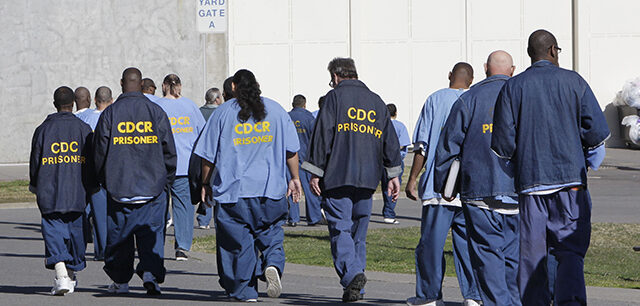

California’s prison population differs dramatically from those elsewhere in the country, a contrast resulting from major criminal justice reforms and the pandemic. Moreso than other states, California has prioritized keeping people convicted of drug and property crimes out of prison through policies that have reduced the number of state prisoners and shifted the demography of the imprisoned population. With the recent passage of Proposition 36, voters have started to change that approach—and California’s prison population may change along with it.
Only Texas sends more people to prison than California. In 2022 (the most recent year of national data), Texas imprisoned nearly 139,000 people, compared to 97,600 in California. Yet California imprisons a lesser share of its residents than most other states. California’s imprisonment rate of 319 per 100,000 adults is 20% lower than the national average of 397—and nearly half the rate in Texas, which is 601.
Though prison overcrowding is a national issue, only California has a mandate to decrease the size of its prison population. Of 32 states that reported prison populations and capacities in 2022, California and 13 others were at or above capacity. Prisons in Montana, Nebraska, and Alabama exceeded the 137.5% capacity limit imposed on California.
Just three states spent more than California per prison inmate per year in 2021: Massachusetts ($307K), Vermont ($134K), and New Jersey ($132K). Median annual spending of $65,000 nationally was about half the $128,000 California paid in 2021. Georgia, Louisiana, Mississippi, and Arkansas each spent $30,000 or less.
Policy choices—such as pandemic-era releases, realignment, and Proposition 47—play a large part in explaining why California prison’s population now stands at a 35-year low. Under realignment, people convicted of certain felonies could serve jail time instead of prison time. Pandemic releases and realignment each reduced the prison population by more than 27,000 people. Proposition 47 reshaped the prison population because it reclassified some felony drug and property crimes to misdemeanors, which do not typically qualify for prison sentences.
As a result, California prisoners are less likely to have been imprisoned for drug and property crimes than their national counterparts. In 2022, 83% of California prisoners had been convicted of violent crimes, compared to 63% of prisoners in the country. Just 9% of people imprisoned in California had been convicted of drug or property crimes, compared to 26% nationally.
Realignment and Proposition 47 also help explain why the demographics of California’s prisoners differ from prisoners elsewhere in the United States. Most felony arrests in California are for violent crimes. Black people are more likely to be arrested for violent felonies and women are less likely than men to commit violent crimes.
Accordingly, women comprise a lesser share of the prison population in California. While the state’s male imprisonment rate is 30% lower than nationally (602 versus 857 per 100,000 adults), the female imprisonment rate is 60% lower (24 versus 62). Just 4% of California prisoners are women, compared to 7% nationally.
Further, California imprisons Black people at a higher rate than the national average (1,496 versus 1,196 per 100,000 adults). Conversely, imprisonment rates for white (165 versus 229) and Latino (378 versus 603 per 100,000 adults) people are lower statewide than nationwide. As a result, the state’s Black-white disparity in imprisonment rates is nearly double the rest of the nation (9:1 versus 5:1).
In the wake of the 2024 election, California’s prison population may be poised for more change. Voters passed Proposition 36 by a strong majority, which deepens the pool of repeat drug and property crimes that can lead to felony convictions. Akin to Proposition 47, which reduced the prison population by shrinking that pool, Proposition 36 could cause it to expand. Over time, people imprisoned for nonviolent crimes could begin to comprise a larger share of the prison population and, thereby shift its demographic composition.
Topics
arrests Criminal Justice gender gap Political Landscape prisons Proposition 36 Proposition 47 racial disparitiesLearn More
Employment Before, During, and After Prison in California

California’s Prison Population

Crime after Proposition 47 and the Pandemic

California’s Prison Population Drops Sharply, but Overcrowding Still Threatens Prisoner Health

Felony Arrests in California

California’s Historic Corrections Reforms