
The Golden State is a major energy producer and consumer; it has also been a leader in the shift toward renewable energy sources. Federal policy and other factors make the trajectory of this transition uncertain, but the workforce in the energy sector is already undergoing changes. To better understand current and future energy workforce needs, we examined required skills in the sector; these are the key to upward mobility for workers and to energy sector innovation and productivity.
The energy workforce differs from the state’s overall workforce
Since 2016, the energy workforce in California has grown about 29%, more than twice the rate of all jobs (12%). Energy workers comprise 5.9% of California’s workforce; about a million jobs directly support energy creation, storage, distribution, and consumption. Most energy sector jobs are in construction (52%), followed by professional, scientific, and technical services (30%) and manufacturing (11%). Fossil fuel is a key but relatively small segment of the energy workforce (10%).
Energy sector jobs are distributed throughout the state, but some are tied to geographic areas where, for example, there are oil refineries or locations that facilitate the production of wind or solar energy. Fossil fuel work, in particular, is concentrated in southern inland California (Kern County and the Inland Empire) and the eastern part of the Bay Area (Contra Costa County).
There are significant differences between California’s energy workforce and its overall workforce: energy-related jobs are predominantly held by men; fewer workers have college degrees; and on-the-job training is more common. In general, energy sector workers have strong technical skills, face more workplace hazards and harsher environmental conditions, and assume high levels of responsibility for others. Correspondingly, the median hourly wage for energy workers is higher than that of all workers.
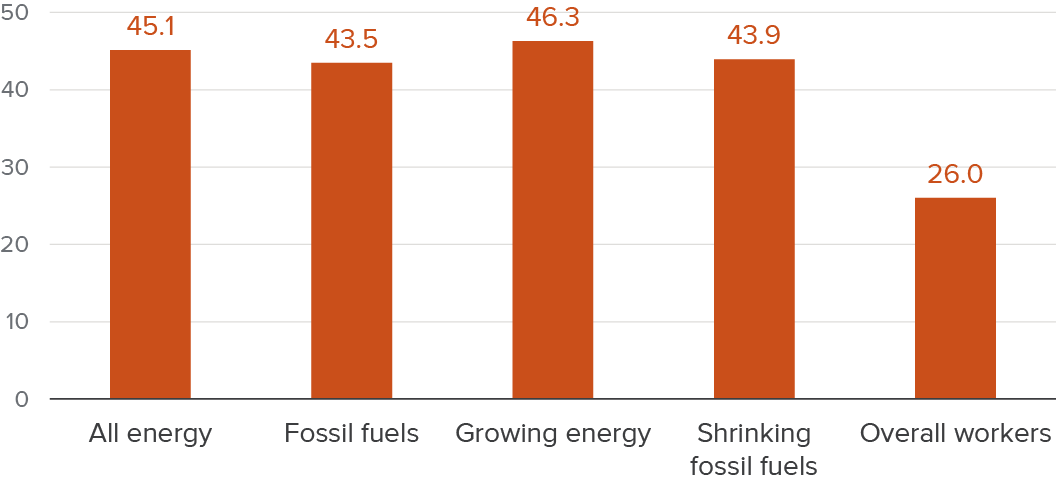
Close to half of the energy sector workforce has at most a high school diploma
% of workers

SOURCE: PPIC calculations based on IPUMS-ACS for California, 2018–2023.
California’s changing energy needs may involve occupational shifts
The state has enacted major policies and programs to move toward carbon neutrality and is investing billions in a range of projects, including clean energy generation, zero-emission vehicles, and battery storage technology. In this context, the energy workforce is also expected to undergo a long-term transition.
A large percentage of future energy jobs are projected to require at most a high school diploma (42%). However, occupations that drive new energy sources and technology are likely to need more college-educated workers than today’s energy workforce (44%). As a result, the occupations projected to grow will to skew toward higher wages than the energy sector overall.
Growing energy occupations tend to offer higher wages
$ per hour
SOURCES: PPIC calculations from OEWS data for California, 2023; and on Employment Projections program, US Bureau of Labor Statistics.
On the other hand, some of the greatest decreases are projected among occupations directly related to fossil fuels; in today’s economy, these jobs are more highly compensated than similar jobs that require comparable skills and education levels. Fossil fuel workers affected by job shrinkage have skills that are valued in other parts of the state’s energy sector or in other key sectors. However, most comparable jobs offer lower wages. And in smaller regions—especially the Bakersfield metro area—there are fewer of these comparable jobs than in larger metros, such as Los Angeles.
How can California—and its energy workers—navigate change?
The future of California’s energy transition is uncertain, since it depends in part on state and federal policy choices. But in the long term, the state may need to wrestle with growing workforce needs in some areas and shrinking opportunities in others to meet demand for energy and energy services.
Occupational shifts in the energy sector will require investments across the state’s education spectrum, as well as broader connections among educational institutions, employers, unions, and other stakeholders.
Given the aging of California’s workforce, the energy sector will face the challenge of attracting workers from a shrinking pool of younger adults. The higher median wages offered by growing energy jobs—especially those that require college degrees—may help the sector recruit workers in what is likely to be a competitive hiring environment.
To ease the negative effects of an energy transition on the workforce, the state should focus on targeted assistance for job training, job search, and income and relocation support for affected workers, as well as tailored approaches to regional economic development. Assessments of current efforts and initiatives, such as the Contra Costa Refinery Transition Partnership, can help guide future efforts.
Topics
Economy Jobs and Employment Water, Land & Air Workforce and Training