
Table of Contents
- Introduction
- California’s job growth has stagnated
- Recent job growth has been limited to a few sectors
- Job growth is stronger in some inland areas but has slowed everywhere
- Unemployment remains relatively low—but job searches have become more challenging
- Wages are barely keeping up with recent inflation
- The biggest long-term gains have gone to high earners
- A shrinking labor force could limit California’s economic growth
- Transformation is a key feature of California’s labor market
- Widening pathways to prosperity through work
- Additional figure notes
We take a look at labor market trends and challenges in California.
California boasts a large, innovative economy built on wide-ranging business activity, highly productive firms, and a large workforce. In many respects, it is a global exemplar. However, many Californians feel pessimistic about the economy and their place in it: 69 percent expect bad economic times in 2026 and only 29 percent believe in the American Dream—the idea that if they work hard they can get ahead. This pessimism may be linked to job cuts during the pandemic and the current slowdown in job growth. It may also be fueled by price increases that have eaten into earnings and exacerbated long-term affordability challenges.
A better understanding of the labor market and its role in creating economic opportunity for Californians can help policymakers navigate the current economic landscape and build future prosperity.

California’s job growth has stagnated
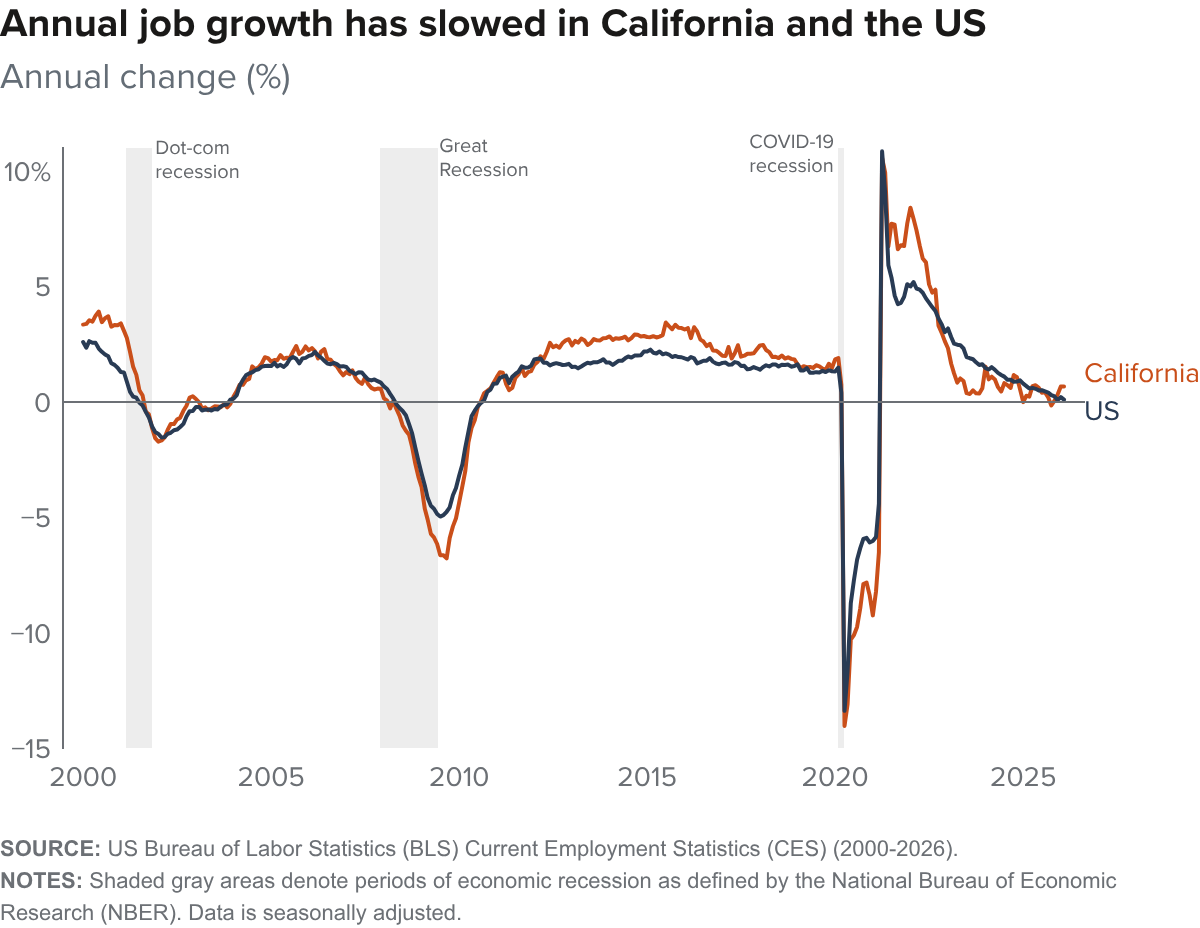
Over the past 25 years, California’s labor market has swung more widely than the national market during downturns, such as the Great Recession, and periods of job growth such as the 2010s. After recovering quickly from the impact of the pandemic, statewide job growth plummeted in 2022 and has since come to a standstill. The US job decline was more gradual, but the national labor market now mirrors the stagnancy in California.
Recent job growth has been limited to a few sectors
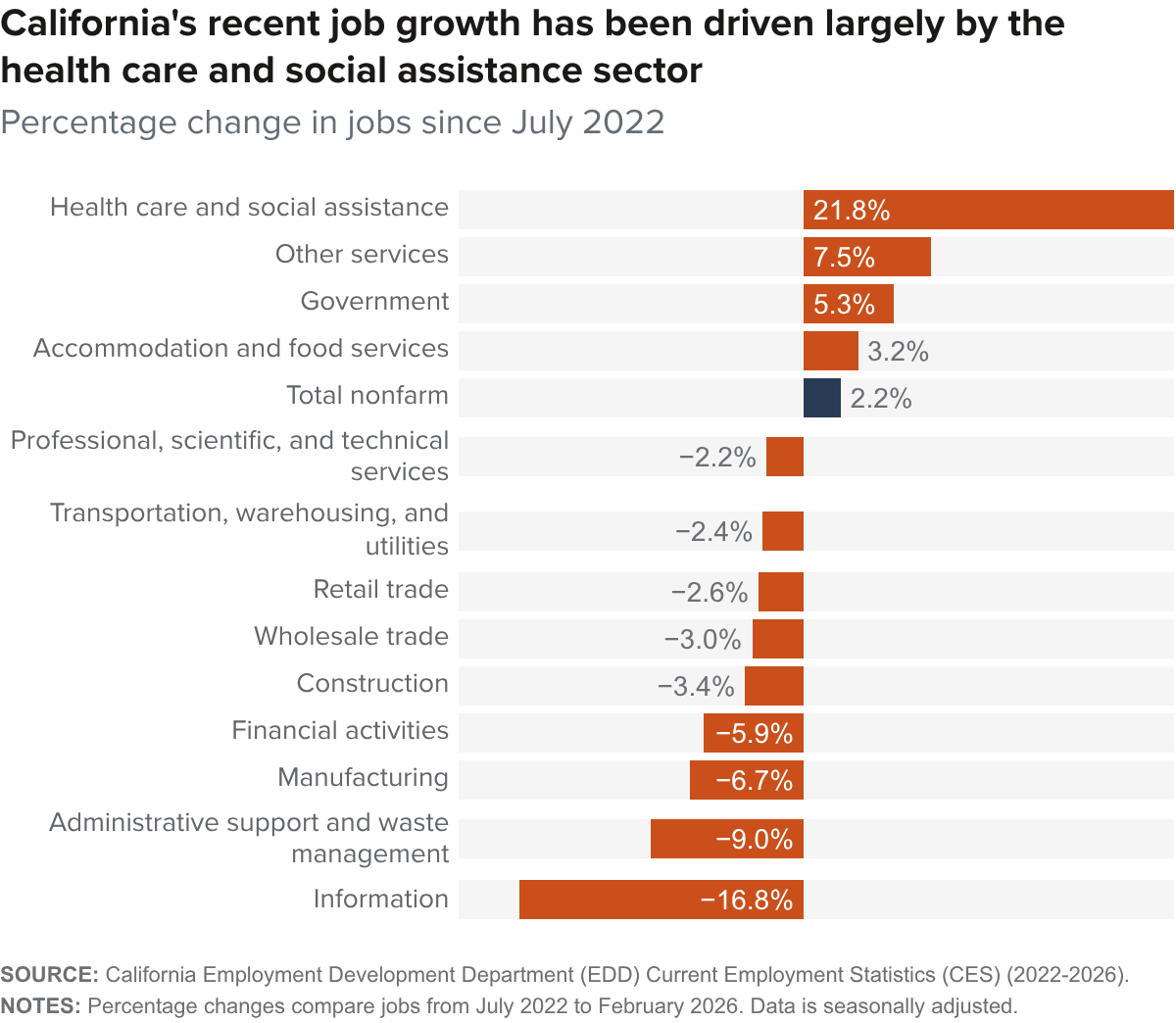
Since mid-2022, job gains have been concentrated in the health care and social assistance sector. Government jobs and jobs in “other services”—a sector that includes businesses like auto repair and dry cleaning as well as some civic organizations—have grown at rates that are similar to pre-pandemic trends.
All other key sectors have shed jobs; declines have been largest in information (driven by slowdowns in tech and Hollywood), administrative support, manufacturing, and finance. While concern about AI’s impact on the labor market abounds, there is no strong evidence that it is driving California’s recent job slowdown, which predates the launch of ChatGPT; the slowdown is more clearly tied to inflation, business uncertainty, and shifts in consumer demand.
Job growth is stronger in some inland areas but has slowed everywhere
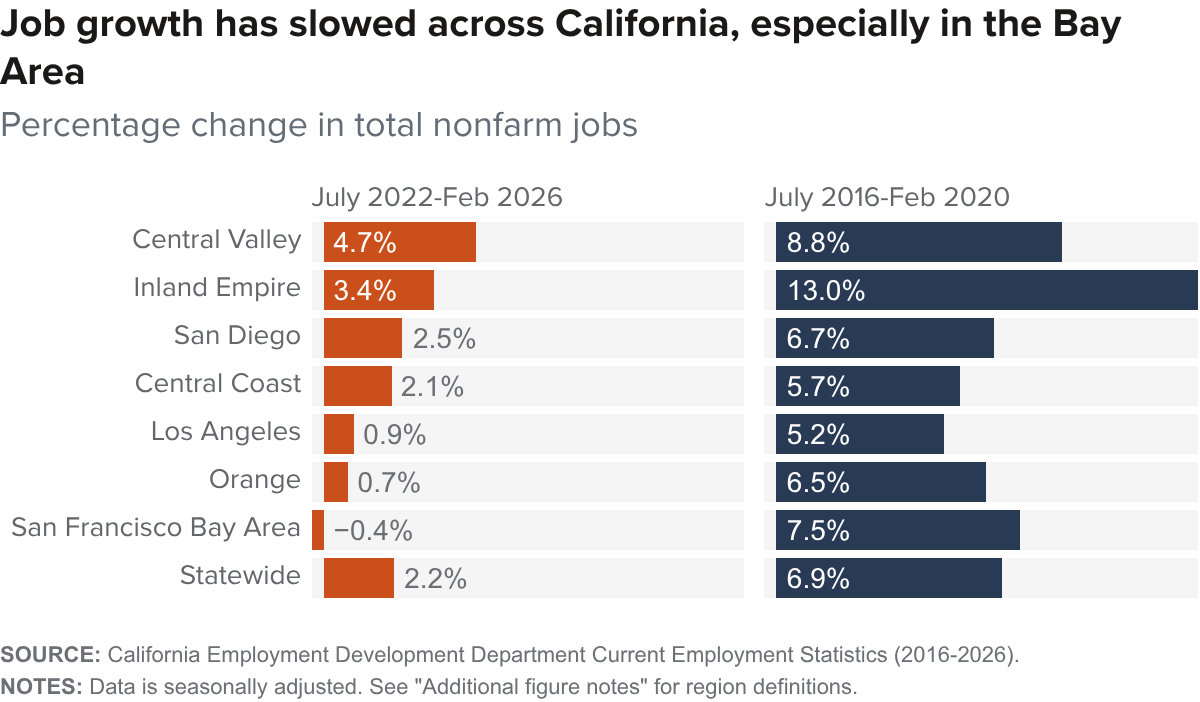
While the slowdown in the labor market is affecting all of California’s regions, it has been especially dramatic in the San Francisco Bay Area—the only region to experience net job loss since 2022 (-0.4%). Job growth has been strongest in the Central Valley (4.7%) and Inland Empire (3.4%) since mid-2022. However, inland growth has been dominated by middle- and low-wage jobs. Stagnating job growth statewide diverges from patterns in the years leading up to the pandemic: from mid-2016 to February 2020, California’s job growth averaged 6.9%, with stronger growth in the Inland Empire (13%), Central Valley (8.8%), and the Bay Area (7.5%).
Unemployment remains relatively low—but job searches have become more challenging
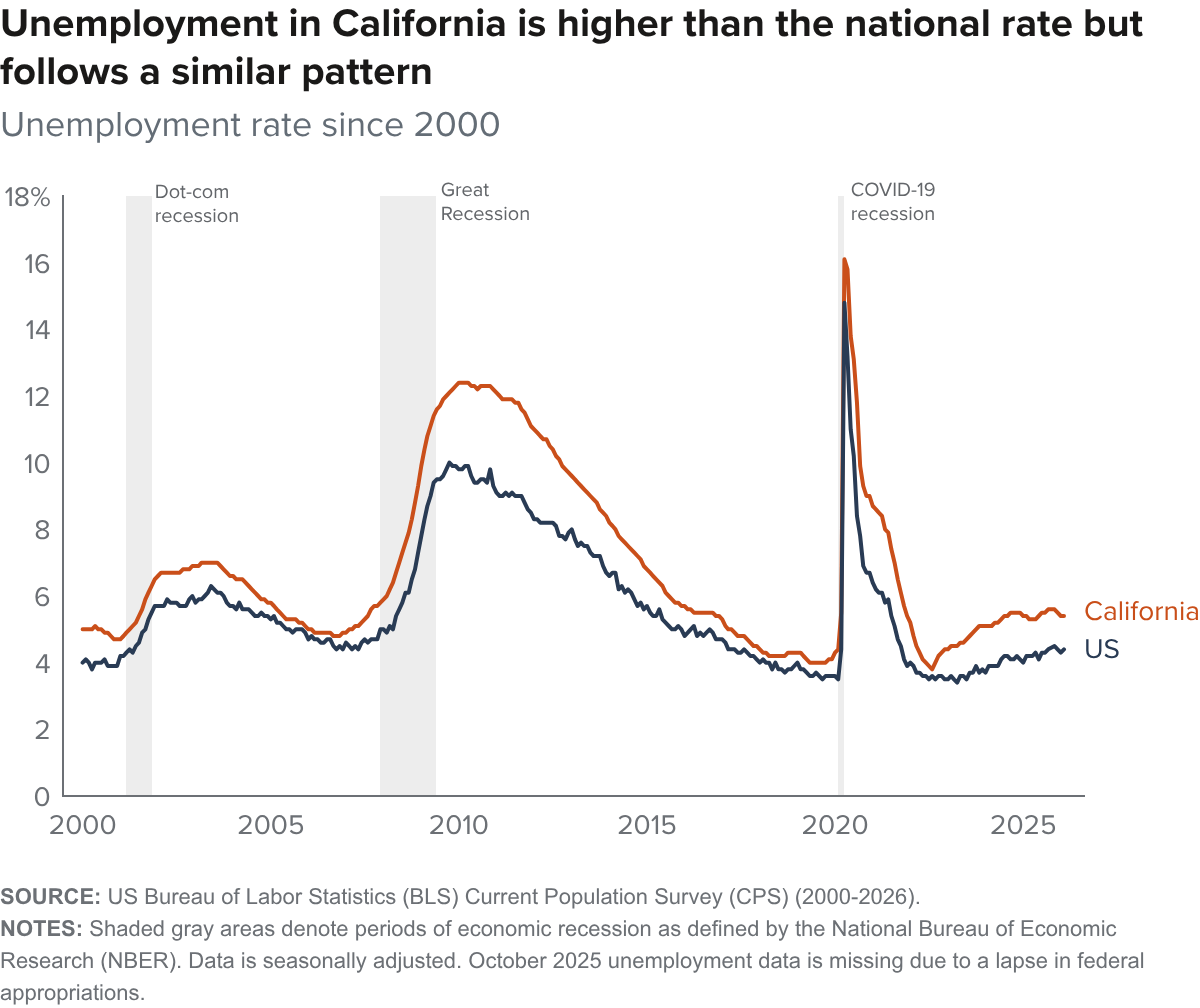
California’s unemployment rate increased steadily to 5.4 percent by February 2026, up from a low of 3.8 percent in the summer of 2022. The rate remains below the state’s 25-year average of 6.9 percent. However, California’s unemployment rate is higher than in the rest of the country, and increases in unemployment have been particularly stark for Black women and Latino men, as well as for younger workers. Moreover, slow job growth has added to the challenges of those looking for work. There are 1.9 unemployed workers per job opening in California, compared to 1.1 for the US as a whole, and about 30 percent of unemployed Californians have been looking for work for at least half a year.
Wages are barely keeping up with recent inflation
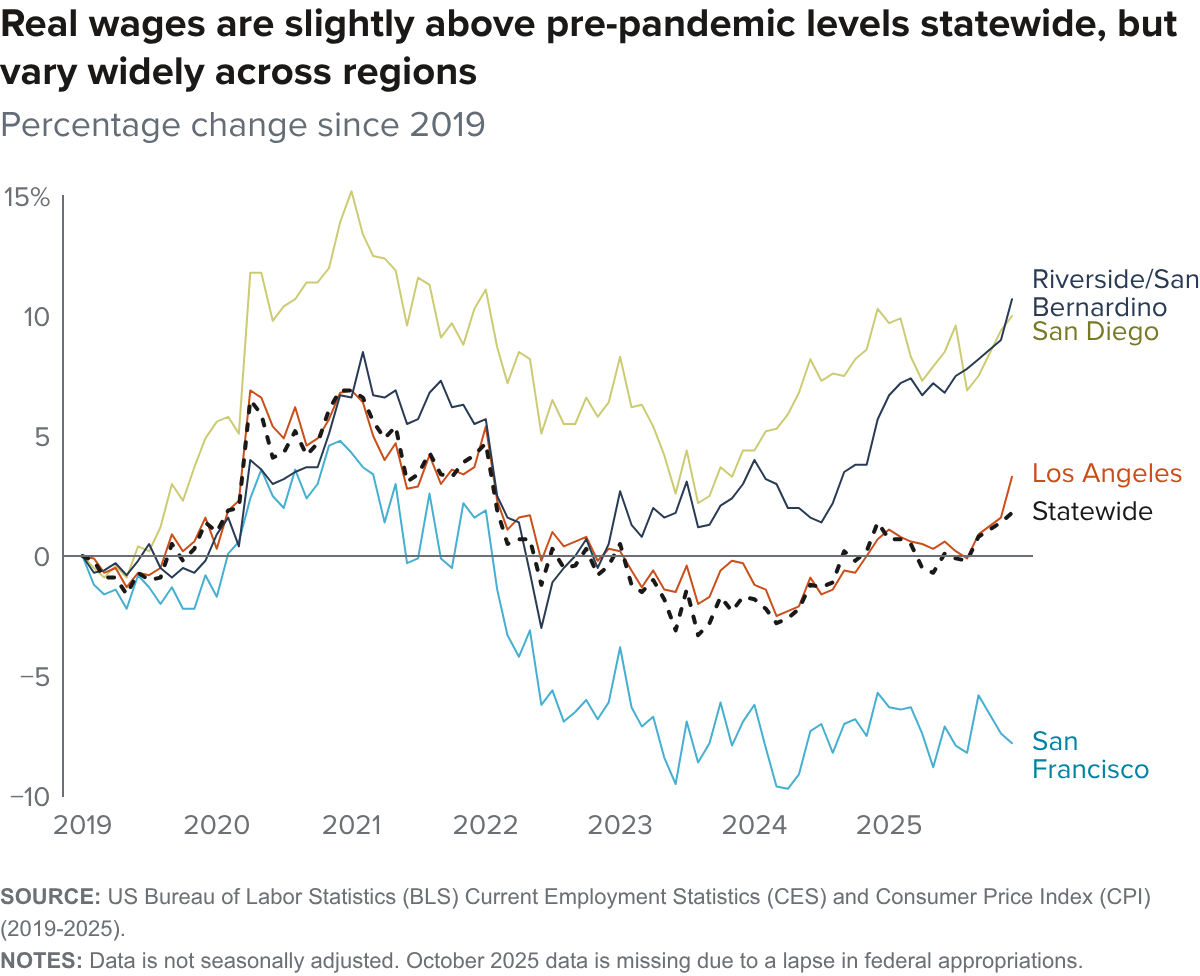
While wage increases help Californians cope with rising costs, inflation-adjusted (or “real”) hourly wages have barely increased for many. After adjusting for inflation, statewide average wages in the private sector are only 1.8 percent higher than in January 2019. Real wages did rise notably from 2020 to 2021, but they decreased amid the inflation spike that started in 2021 and did not begin to creep back up until late 2024.
In some regions, real wage growth has been stronger than the statewide average: real wages in Riverside/San Bernardino and San Diego metro areas have grown 10 percent since before the pandemic. Meanwhile, in the San Francisco metro area, average real wages are down 7.8 percent. Wage levels remain lower in inland California—workers in the San Joaquin Valley and Sierras have the state’s lowest median wages per hour ($22), while median hourly wages in the Bay Area are still the highest ($37).
The biggest long-term gains have gone to high earners
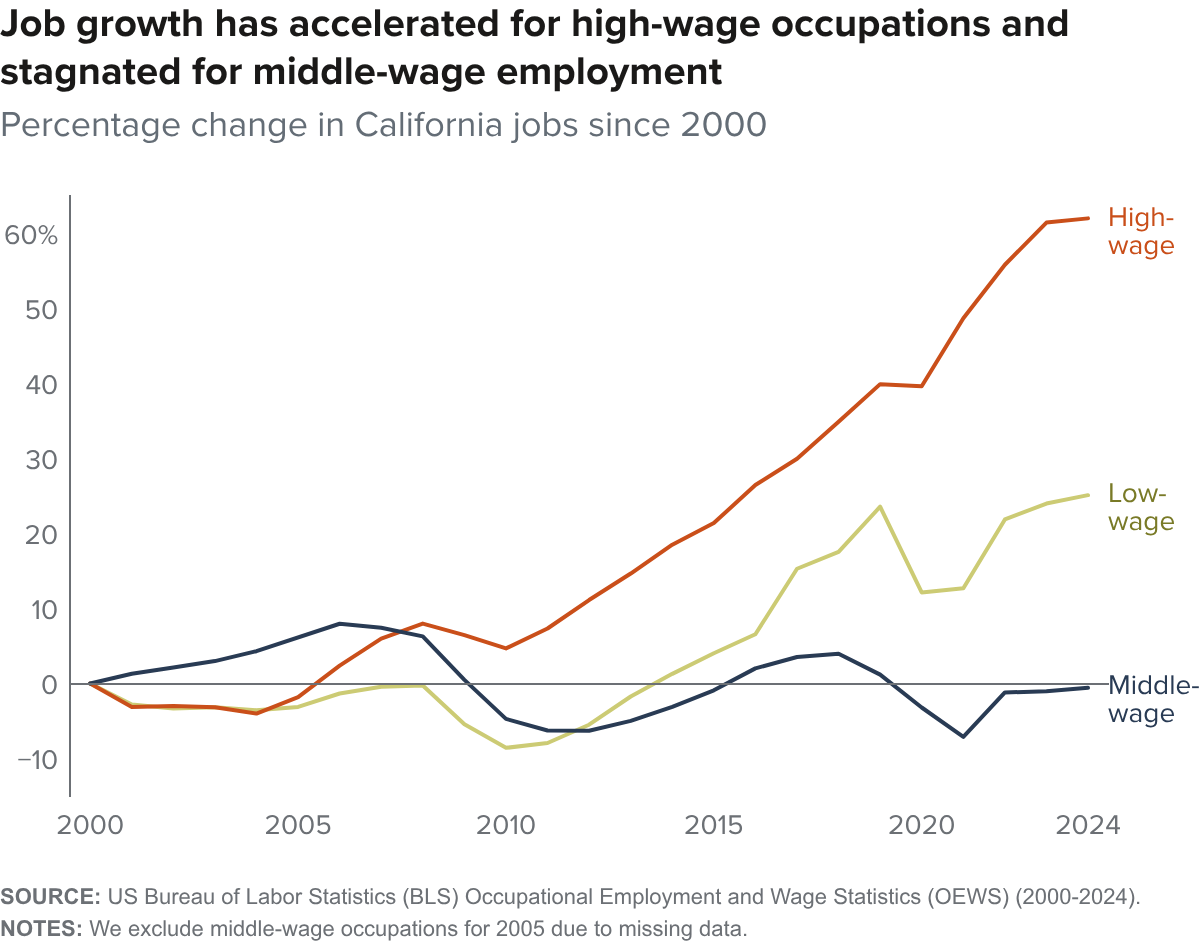
Driven by technological advances and global trade that have favored more-educated workers, high-wage jobs have grown 60 percent since 2000; annual incomes at the top of California’s distribution (with the 90th percentile earning $356,000 in 2024) are up 72 percent since 1980. Low-wage jobs have also grown, but to a lesser extent (up 25%), and there has been no growth in middle-wage jobs. Incomes at the bottom (10th percentile) have fallen sharply during economic downturns and rebounded slowly during recoveries; these incomes have risen only about 19 percent—to $33,000—since 1980.
In a labor market with a growing gap between high- and low-wage positions, it takes a substantial investment of time and money to gain the skills and experiences needed to move up the economic ladder. Many Californians lack these resources, and many workers are concerned about pursuing additional training or taking other career risks that could worsen the economic insecurity they are already experiencing.
A shrinking labor force could limit California’s economic growth
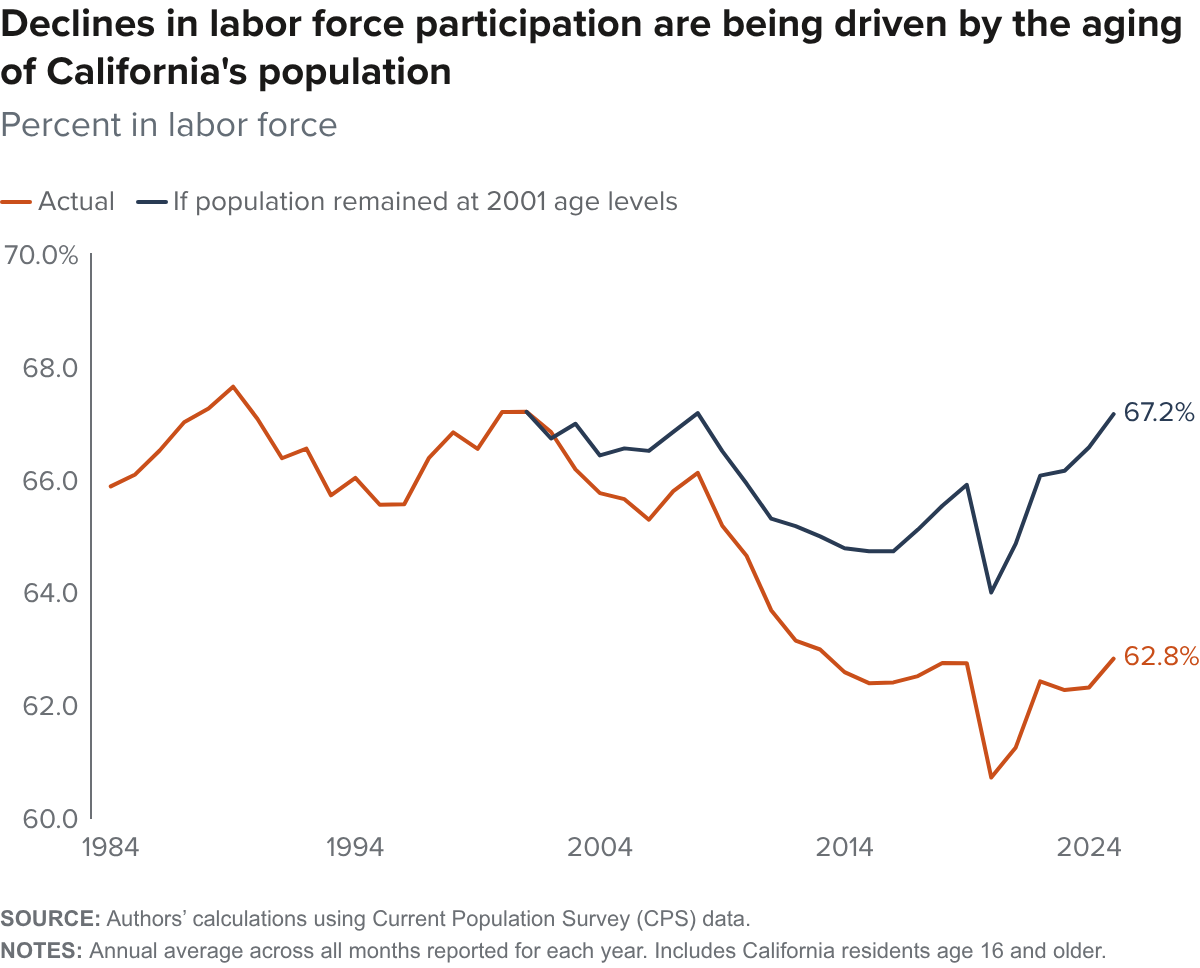
Workforce participation has been ebbing for decades; the decline from 67 percent in 2001 to 62.8 percent in 2025 was almost entirely due to the aging of California’s population. In recent years, growth in the state’s US-born working-age population has been weak, and nearly all labor force growth has been attributable to immigration; current federal immigration policies may have an impact on future growth. By 2050, the state is projected to have 72 dependents—Californians who are either young or old—for every 100 working-age adults (18–64), the highest rate since the 1970s. This could heighten the challenge of meeting the workforce needs of a growing economy and an aging population.
Some Californians face barriers to joining the labor force. For instance, labor force participation rates are lower for women than men, and notably lower among Latina women, Black men, and those without college degrees. Helping Californians attain the skills needed for jobs that offer good wages and career prospects—and addressing barriers like child care, stable housing, disability, immigration status, and criminal history—could help more Californians participate fully in the workforce.
Transformation is a key feature of California’s labor market
Long-term shifts such as the aging of the population, the changing climate, and artificial intelligence technology have broad economic consequences, requiring new investments and workforce shifts. Several recent transformations also have lasting effects. The pandemic normalized hybrid and remote work for some Californians; this trend has benefited many workers but continues to pose challenges for many of the state’s business districts. And new federal policies are changing immigration and trade patterns, with implications for key economic sectors.
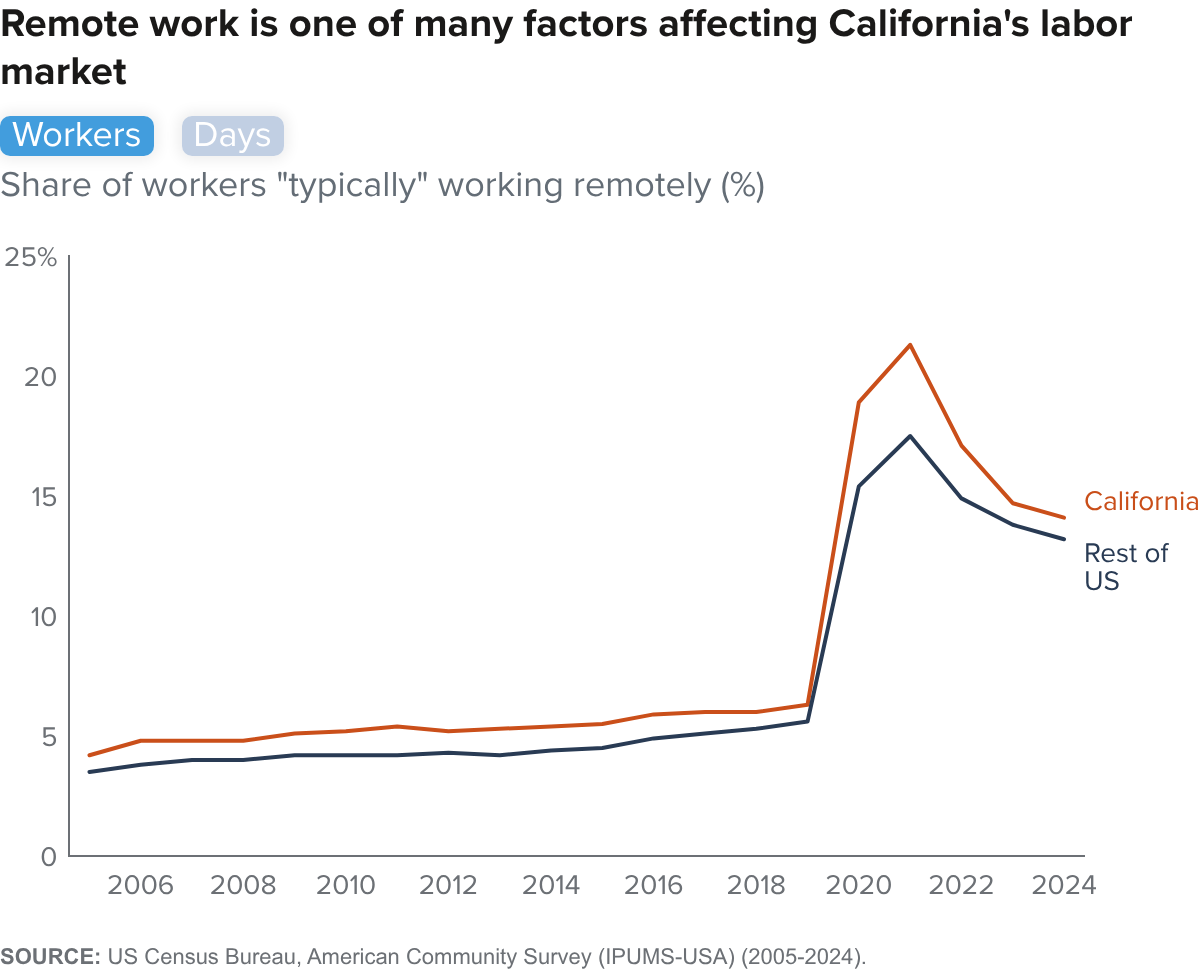
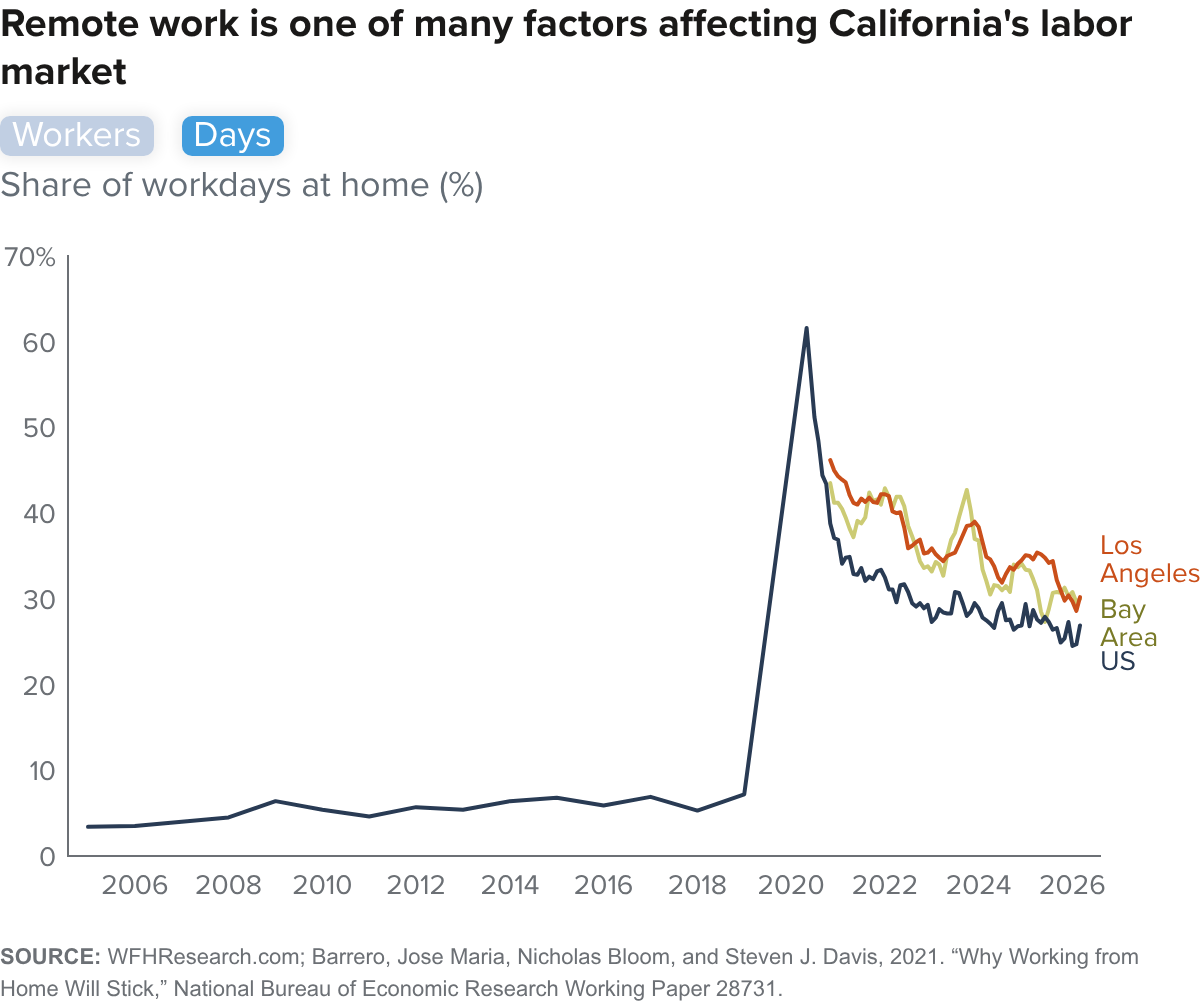
While California has weathered many labor market transformations in the past, the state currently faces the challenge of responding to ongoing changes on multiple fronts. Leveraging state systems to help workers gain new skills in the context of major shifts such as the transition to clean energy and engaging with business leaders who are adapting to an economy in flux are key to navigating a rapidly evolving labor market.
Widening pathways to prosperity through work
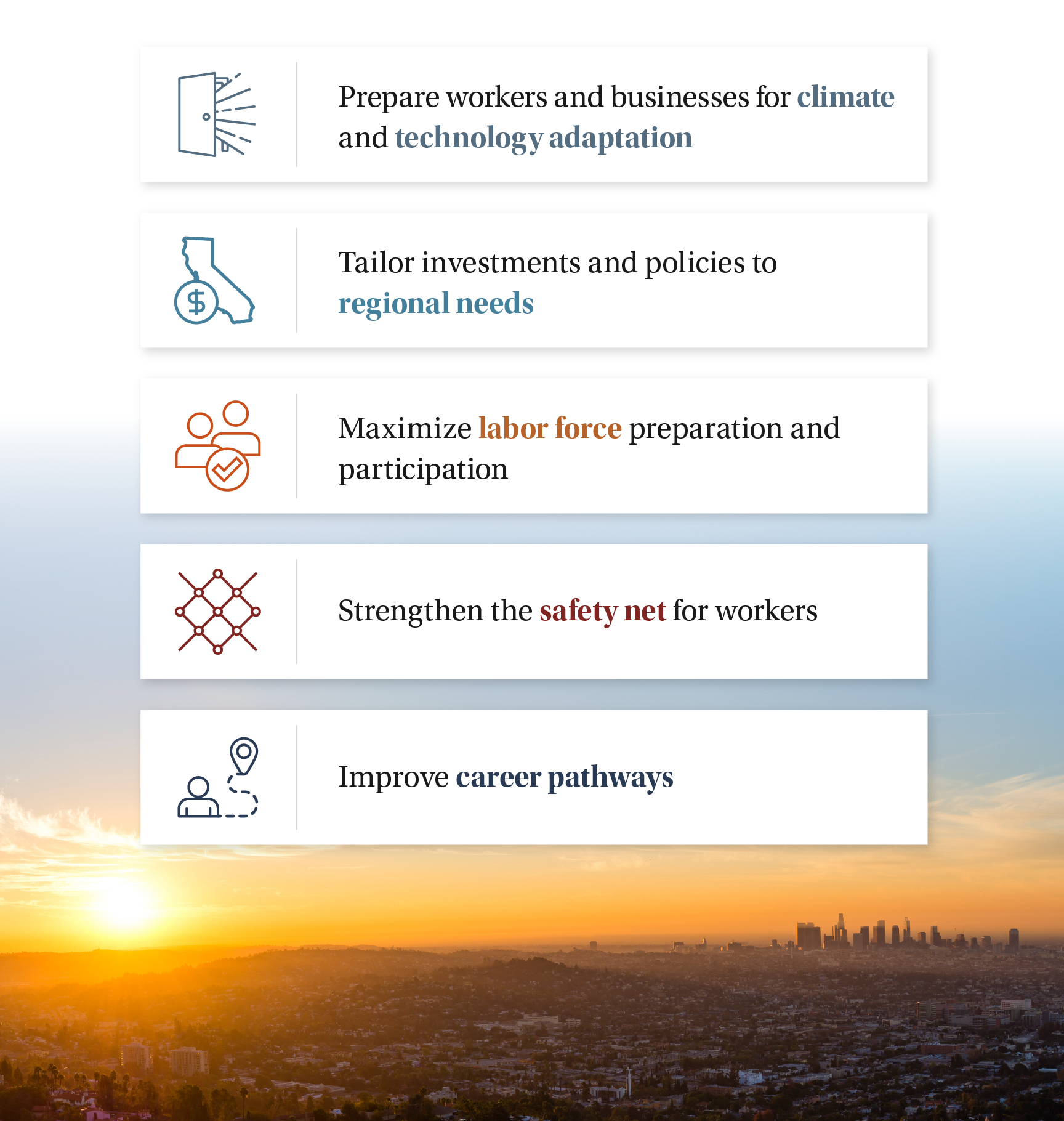
Policymakers seeking to strengthen California’s economy need to confront long-term challenges—including the high cost of living, the connection between income inequality and economic mobility, and a shrinking labor force. Meanwhile, the state will need to respond to economic changes driven by climate adaptation and advances in automation and AI. California can meet these challenges by strengthening the ecosystem that enables businesses to create good jobs and helps prepare workers for those opportunities.

Key features of this ecosystem include worker and business supports that are tailored to diverse regional needs, policies that enable more people to work and assist businesses in hiring as the workforce shrinks; a safety net that better supports workers and smooths transitions in a changing economy, and career pathways that allow Californians of all ages to move toward a brighter future.
Focusing on these priorities would help bolster the state’s economic foundations and ensure that more people can participate in and benefit from California’s economic prosperity.
Navigating an uncertain future
Topics
Economic Growth Economic Trends Economy Jobs and Employment Poverty & Inequality Workforce and Training