

Key Takeaways
The Golden State is a major energy producer and consumer; it is also a leader in the shift toward renewable energy sources. Federal policy and other factors make the trajectory of this shift uncertain, but the skilled workforce in the energy sector is already undergoing changes—with some jobs growing and others shrinking. This report outlines key features of the current energy workforce and explores how shifting energy demands may create and narrow worker opportunities. We find:
- Energy workers comprise 5.9 percent of California’s workforce; about a million jobs directly support energy creation, storage, distribution, and consumption. Fossil fuel is a key but relatively small component of the energy workforce: 94,000 jobs or about 10 percent of all energy jobs.
- While the energy sector is distributed throughout the state, fossil fuel work is concentrated in southern inland California (Kern County and the Inland Empire) and the eastern part of the Bay Area (Contra Costa County).
- California’s energy workforce differs significantly from its overall workforce: jobs are predominantly held by men; fewer workers have college degrees; and on-the-job training is more common. In general, energy sector workers face more workplace hazards and exposure to harsher environmental conditions, assume high levels of responsibility for others, and have strong technical skills. Correspondingly, the median hourly wage for energy workers is higher than that of all workers.
- Occupations that drive new energy sources and technology will require more highly educated workers than today’s energy workforce, but a large percentage of new jobs needed to develop and deploy future renewable energy projects will still require at most a high school diploma. Overall, occupations projected to grow skew toward higher wages than the energy sector overall, driven largely by those requiring a college degree.
- Jobs that are most likely to be affected if the fossil fuels sector continues to shrink are more highly compensated than similar jobs in today’s economy that require comparable skills and education levels. While this segment of California’s energy workforce is smaller than the portion expected to grow as the energy transition proceeds, it comprises a large percentage of the fossil fuels workforce in some regions, such as the Bakersfield metro area.
- Many of the occupations that fossil fuel workers could theoretically qualify for (perhaps with additional training) are in other parts of the energy sector (about 39%). Most of these jobs offer lower wages, though. And in smaller regions, again especially in Bakersfield metro, the availability of these related jobs is much more limited than in larger places.
Rigorous studies of previous industrial transitions suggest that while near-term gains in employment, earnings, and job growth may be small, targeted assistance to affected workers and communities can yield long-term payoffs and avoid dislocation and decline. The occupational shifts due to changes in the energy sources California relies on require investments across the state’s education spectrum, as well as broader connections among educational institutions, employers, unions, and other stakeholders.
Introduction
Energy powers efficient access to essential goods and services and facilitates improvements in modern daily life; it powers industry and contributes to a competitive business environment and economic growth (IEA 2025). At the same time, the energy sector has environmental and climate change implications and consequences for air, water, and soil quality. For this reason, ensuring access to energy that is not just affordable and reliable but also environmentally sustainable are important state goals, with 60% of Californians in support of renewable energy goals but a similar share concerned about affordability of renewable energy sources (Baldassare et al 2025). Shifts in energy supply and demand will have long-term effects on the workforce that supports California’s energy sector—both creating opportunities and narrowing them.
California is a major player in the energy sector, both as a producer and a consumer. In 2024, it was the eighth-largest producer of crude oil among the 50 states and ranked third in crude oil refining capacity. Most of the energy produced and consumed in California is oil and natural gas (50% of total energy produced and 80% of energy consumed, as of 2023). The production and consumption of fossil fuels have declined, as a share, over the past few decades as the production and distribution of renewable energy has increased. Recent closures of major refineries in Martinez and Rodeo are part of a long-term trend away from fossil fuel in California.
California is now second across states in renewable energy production (including solar, wind, biomass, geothermal, and hydro; EIA 2025). The share of renewable production has more than doubled since 2010 and now makes up the second-largest segment of energy production within California (39% vs. 41% for oil). Notably, while California is the largest state based on population and economic output and the second-largest total energy consumer, its per capita energy consumption is the third lowest in the nation, thanks in part to its energy efficiency efforts (EIA 2025).
The state has enacted major policies and programs to reduce emissions and move toward carbon neutrality and is investing billions of dollars in a range of projects, including clean energy generation, zero-emission vehicles, and battery storage technology. In the past, federal policy has supported these investments, most recently via major legislation in 2021 and 2022. However, the current administration has frozen funds appropriated by Congress to clean energy projects, slowed permitting for offshore wind projects, issued executive orders that aim to boost the extraction and use of fossil fuels, and curtailed incentives for households and businesses in the solar, wind, and electric vehicle arenas. Also, the federal government has sought to limit the ability of states to implement their own climate policies; the US Senate passed Congressional Review Act resolutions that block California’s landmark mandate to phase out gas-powered cars. These actions may affect the pace of change toward renewable energy in California, especially in a period of state budget constraints. However, investments already made in renewable energy capacity suggest that source of energy will continue to be important and costs of further development—both in fossil fuel and renewable energy—could drive the sector regardless of federal support.
While conflicting state and federal policy goals and investments raise questions about the pace of change in the energy sector, some realities in California energy are clear: reliable, affordable energy is essential for households and the economy, traditional fossil fuel still predominates, and renewable energy is key to meeting growing demand.
As a result, the state’s energy workforce is in the midst of a long-term transition. To better understand current and future energy workforce needs, we focus on the skills needed in the sector; these are key to upward mobility for workers as well as energy sector innovation and productivity. We begin with an analysis of the current energy workforce, seeking to shed light on its demographics as well as levels of education, experience, skills, and wages in this important sector. We then identify types of work that are likely to grow or shrink if the energy transition continues to unfold, to understand which workers will be most affected and what opportunities there might be in recruiting new workers and transitioning existing workers. We also look into the regional distribution of energy jobs, paying special attention to the fossil fuels subsector. With these facts in hand, and an assessment of relevant research literature, we aim to identify key areas of focus for policymakers and stakeholders.
Key Features of the Energy Sector Workforce
California’s energy workforce supports a broad range of activities related to energy creation, storage, distribution, and use. These activities include energy generation and distribution, the manufacturing of goods for energy efficiency improvements as well as services to construct or install them, managing environmental needs related to energy use (e.g., waste management), and the scientific and technical design and implementation of energy systems. Businesses as distinct as large energy corporations like Chevron, PG&E, and other small, independently-owned electrical contractors contribute to these efforts and, as we will show, require a wide range of skilled worker inputs.
We estimate that as of 2023, there were just over a million jobs in California’s energy sector (1,065,000, or 5.9% of all jobs in the state). The energy workforce is similar in size to California’s care workforce (970,000 jobs; McConville et al. 2024) and to the federal, state, and local government workforce, excluding teachers (1.1 million jobs). This is our best estimate of the number of workers directly supporting California’s energy needs; note that there are additional jobs that support the sector indirectly, such as manufacturing of products used by the energy sector, and jobs generated in communities where major energy sector activities take place such as retail and service sector businesses. While these indirect and induced jobs are not included in this analysis, they are relevant to broader questions about California’s energy transition.
To delve further into the fossil fuels workforce, which faces unique challenges in California, we separate out the industries and occupations relevant to that subsector from the overall energy workforce. This shows that it is a critical but a relatively small component of the energy workforce; we estimate about 94,000 jobs in the fossil fuels subsector in 2023 (0.5% of total jobs in the state).
The Energy Workforce Is Predominantly Male and Latino
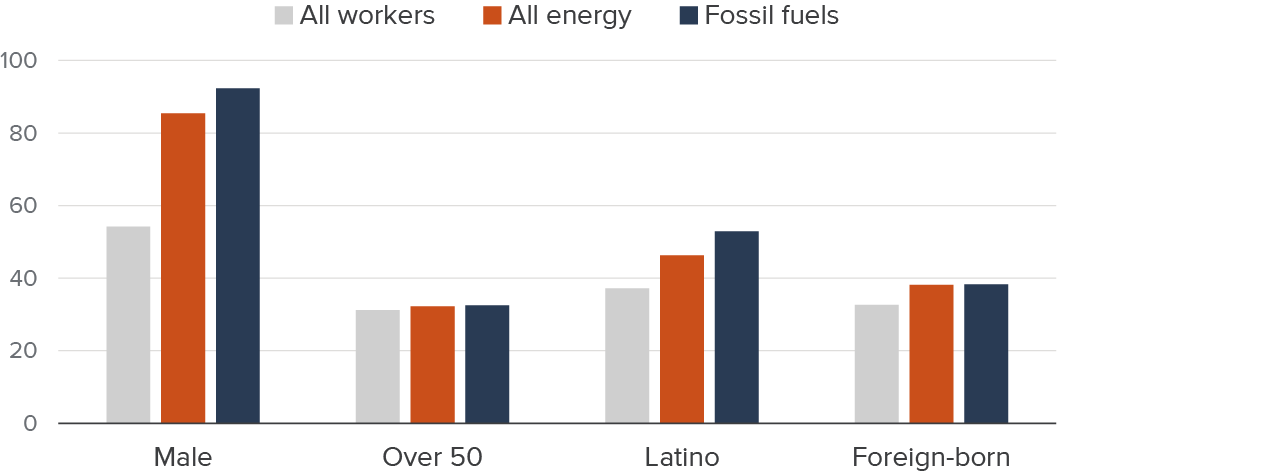
Men make up 85 percent of today’s energy sector workforce (Figure 1) and 92 percent of the fossil fuel workforce, compared to 54 percent of the workforce overall. This is not surprising given the predominance of construction work in energy—as we will see in the next section. But even outside construction jobs in the sector, men make up 70 percent of the energy workforce (see Technical Appendix Table A6).
Almost a third of workers in the energy sector are age 50 or older; so is the California workforce overall. Energy workers are less likely to be between 18 and 39 (44% vs. 48%). Given the aging of the workforce, the energy sector is one of many facing the challenge of attracting workers from the shrinking pool of younger adults (Lafortune et al. 2024).
In terms of race/ethnicity, Latinos make up 46 percent of energy workers, compared to 37 percent of the workforce overall (outside of construction jobs, the Latino share drops to 24%). White Californians are the next largest group, comprising 38 percent of the energy workforce. Asian and Black workers are the smallest racial/ethnic group in this sector and are less likely employed in energy than other sectors.
Energy workers are predominantly male and Latino
% of workers
SOURCES: PPIC calculations based on IPUMS-ACS for California, 2018-2023.
NOTES: Not all industries in the energy sector can be identified specifically in the ACS, see Technical Appendix A for more information.
Most energy workers are US born or naturalized citizens (62%), but the sector is more reliant on immigrant workers than the economy overall (38% vs. 33%). The US citizen share of the energy workforce is larger in non-construction jobs (68% for energy overall and 74% for the fossil fuels subsector).
Energy Sector Jobs Are Especially Prevalent in a Few Parts of the State
Some energy sector activities are tied to geographic areas where there are energy resources, including refineries that convert oil into petroleum products or locations areas where wind or solar energy can be harnessed. Other energy sector activities, especially general operations and management, construction, and energy efficiency services, are located across most of the state, especially in densely populated areas. Because these subsectors are labor-intensive, the energy workforce comprises a sizeable share of the workforce in many major metro areas. Unfortunately, the best available data covers only metro areas, so our regional analysis omits some rural parts of the state.
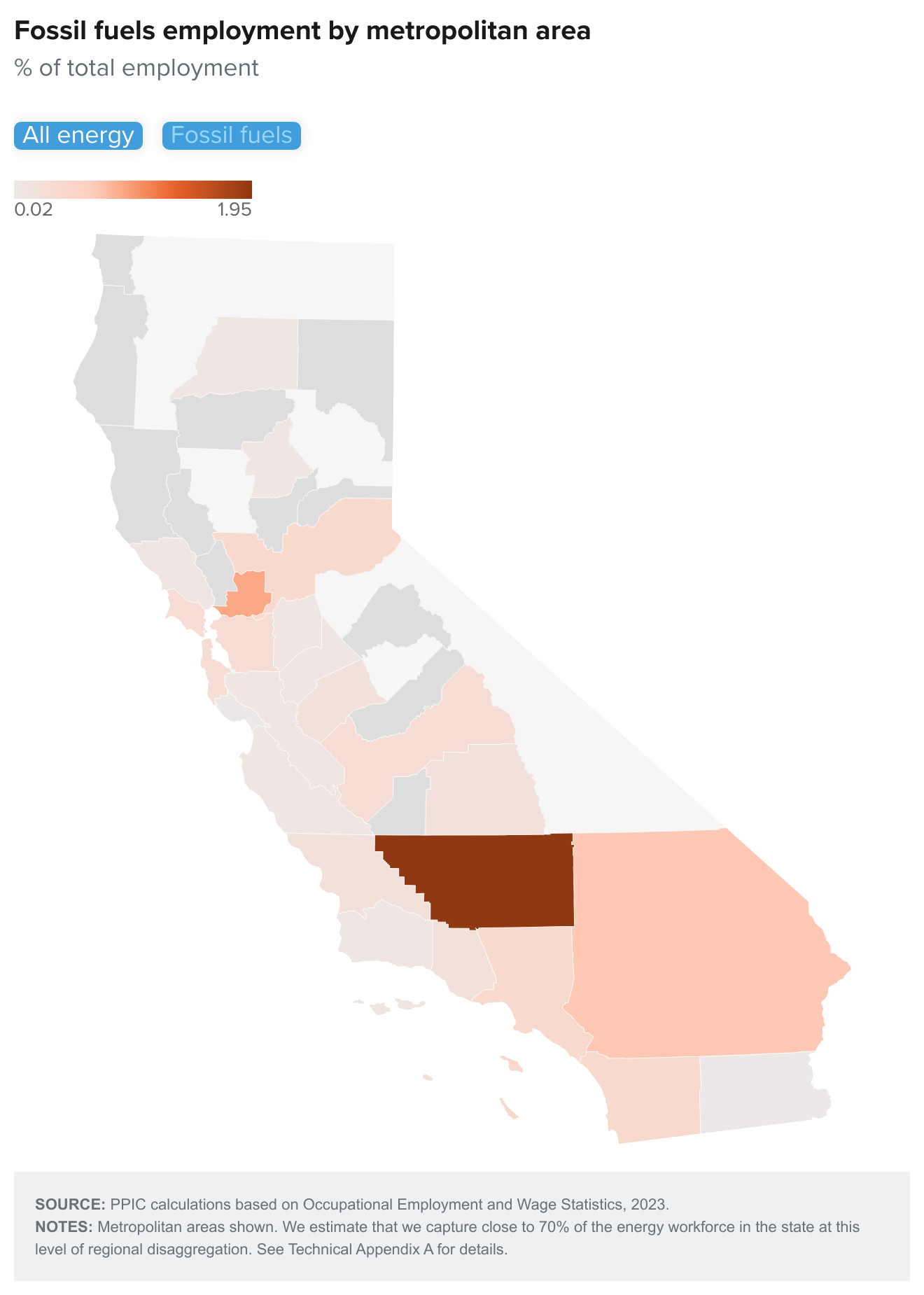
Energy jobs are most prevalent in the San Jose-Sunnyvale-Santa Clara metropolitan area (8.1% of total jobs), followed by San Diego-Carlsbad (6.9%) and San Francisco-Oakland-Hayward (6.6%) (Figure 2). Energy jobs comprise a larger share of employment in these areas relative to the share of energy jobs statewide (5.9%). The highest number of energy jobs, not surprisingly, are in the most populous metro areas: Close to half of the state’s energy jobs are in Los Angeles-Long Beach-Anaheim (228,000), San Francisco-Oakland-Hayward (158,00), and San Diego-Carlsbad (102,000). (See Technical Appendix Table A7.)
The fossil fuel workforce is most concentrated in the Bakersfield, Vallejo-Fairfield, and Riverside-San Bernardino-Ontario metro areas; these jobs make up 2 percent, 0.9 percent, and 0.7 percent, respectively, of the jobs in each area, compared to only .5 percent of jobs statewide (Figure 2). The number of fossil fuel jobs is highest in Los Angeles-Long Beach-Anaheim (24,000), Riverside-San Bernardino-Ontario (11,000), San Francisco-Oakland-Hayward (6,200), and Bakersfield (6,100) (See Technical Appendix Table A8).

The workforce needs, opportunities, and challenges in California’s energy sector are thus both a statewide and a regional issue. In certain locations, energy sector jobs are more prevalent and/or offer greater opportunities to workers because of the characteristics of those jobs, which we explore next.
Construction Workers Make Up a Large Share of the Energy Workforce
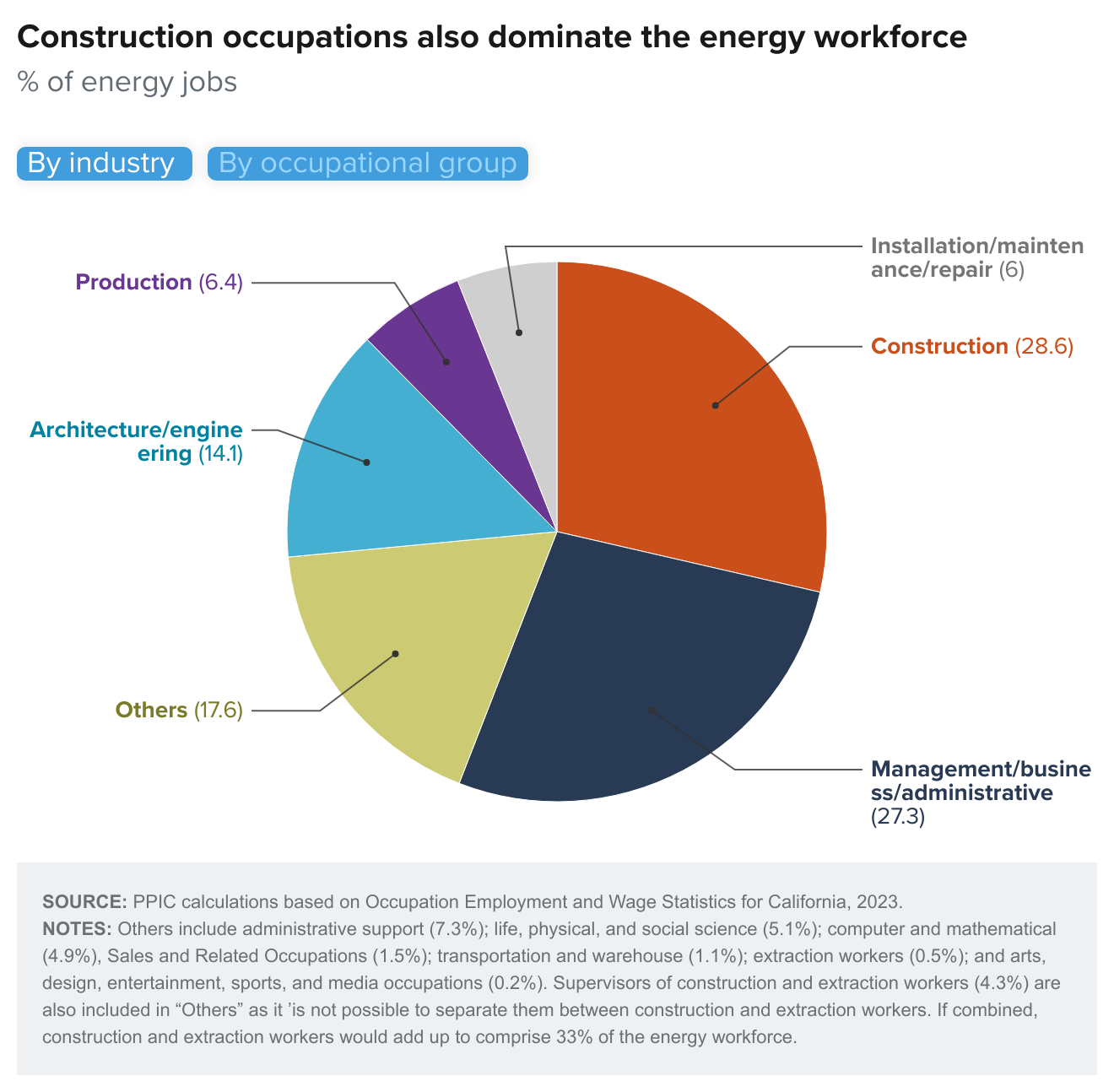
Most energy sector work is in construction (52%, Figure 3), followed by professional, scientific, and technical services (30%), and manufacturing (11%). Utilities and extraction sectors are key to the generation and distribution of energy but comprise a relatively small percentage of the energy workforce (6%, combined). The dominance of construction businesses in the sector is related to the work needed to build and upgrade facilities, transmission lines, and distribution systems, among other energy infrastructure needs (Department of Energy 2024).
Overall, we identify 188 unique energy sector occupations. Close to 30 percent of the energy workforce is in occupations related to construction; 27 percent is in occupations associated with management, business and financial operations, and administrative support; and 14 percent is in architecture and engineering (Figure 3).

Some energy sector work is very common across other sectors, while other work is highly specialized. For instance, construction supervisors or carpenters do work for a range of sectors across the construction or manufacturing industries. But petroleum system operators, solar installers, and pipelayers almost always work in the energy sector; their specialized skills are important to the functioning of the energy sector and may determine how easily these workers can advance or transition to a new job.
Higher-than-Typical Wages Prevail in the Energy Sector
In 2023, the median hourly wage for energy workers was $45 per hour, well above the state median for all occupations ($26/hour). Wages in the fossil fuel subsector are $43 per hour. Even the lower range of energy sector wages (the 25th percentile) is above the median wage in the workforce overall; this indicates that even lower-paid or entry-level positions in energy sector businesses tend to offer financial return to workers (Figure 4).

Out of the 188 energy occupations we identify, about 80 percent earn hourly wages above the statewide median. The highest-paid occupations tend to be professional and managerial, including computer and information systems managers ($104/hour), natural science managers ($101/hour), and architectural and engineering managers ($97/hour).
In the fossil fuels subsector, a similar share of occupations (82%) earn more than the statewide median, and some make substantially more: 36 percent of fossil fuel occupations earn more than double the statewide median (see Technical Appendix Figures A3 and A4 for the wage distribution by sector). As in the energy sector overall, wages in the fossil fuel subsector are highest for engineering and managerial workers—for example, architectural and engineering managers ($93/hour), database architects ($85/hour), and health and safety engineers ($80/hour).
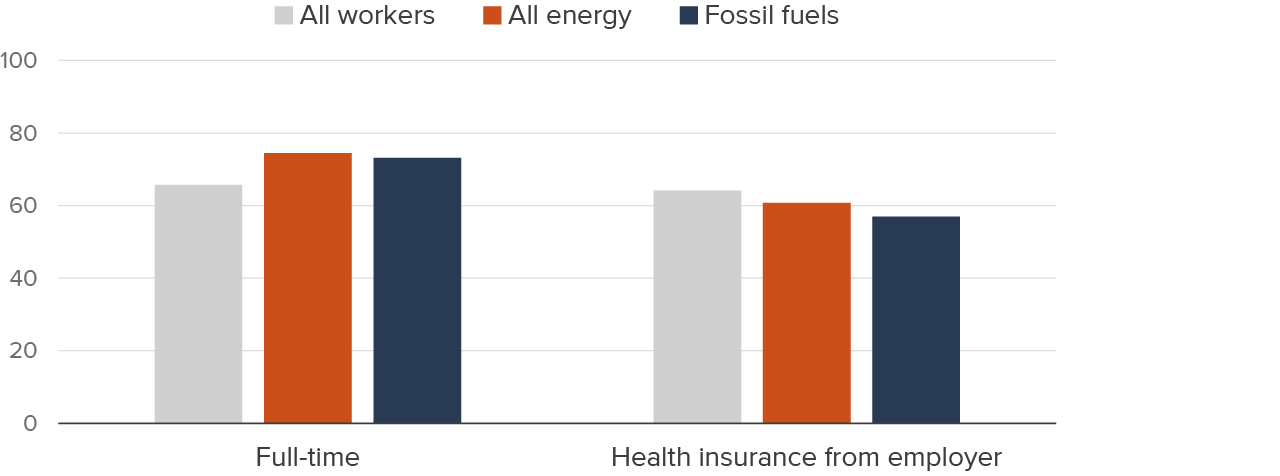
Energy sector workers are more likely to be working full time than the average state worker (74% vs. 66%). Full-time work is similarly common in the fossil fuel subsector (Figure 5). On the other hand, the share of energy workers reporting access to health insurance provided by their employers is lower than the state average (61% vs. 64%). Lower coverage rates in construction work drive this finding to some extent; outside of construction work in the energy sector, the share working full time is 83 percent and the share with access to employer-based health insurance is 82 percent (86% and 84% for workers in the fossil fuel subsector, respectively; see Technical Appendix Table A6).
While union membership is not measured in the data used for this analysis, it factors into the availability of full-time schedules and benefits. Pollin et al. (2021) and GEPI (2023) find that relatively high shares of fossil fuel workers in California are union members—20 to 23 percent, compared to 15 percent of wage and salary workers (Bureau of Labor Statistics 2024) or to 13 percent of construction workers (Hirsch, Macpherson, and Even 2025). We explore other job characteristics—including required levels of experience and environmental risk factors—in a later section.
The energy workforce is more likely to be employed full time
% of workers
SOURCE: PPIC calculations based on IPUMS-ACS for California, 2018–2023.
NOTE: Full-time employment = at least 35 hours of work per week for at least 50 weeks per year.
Energy Jobs Require Less Formal Education but More Experience, Training, and Skills
Almost half of the energy sector workforce has a high school education or less: 47 percent overall and 57 percent in the fossil fuels subsector have at most a high school diploma (Figure 6). That is notably different than the workforce overall, where only one third have no formal education beyond high school.
However, educational requirements vary substantially across types of occupations. Bachelor’s degrees in programs associated with architecture and engineering as well as business and management make up the largest share of educational credentials in those energy sector occupations. By contrast, credentials for construction, production, and installation occupations tend to be shorter-term vocational certificates, associate degrees, or apprenticeships.


Apprenticeship programs in construction trades are particularly salient to training for the energy workforce; about half of training and education programs for energy jobs in construction occupations are completed through registered apprenticeships with local union trust funds. Several of the largest occupations in the energy sector are in construction trades, which tend to have craft-based unions that train electricians, carpenters, plumbers, and the like. Other jobs, particularly in the fossil fuel subsector, are covered by industry-based unions such as the United Steelworkers, which represents all workers in oil refineries (among other industries).
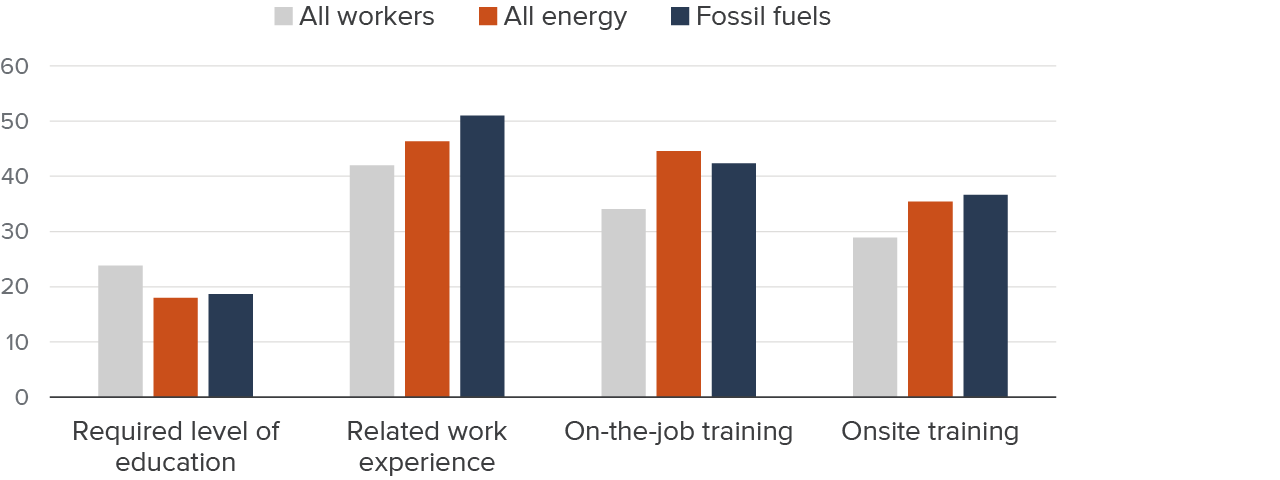
On the whole, occupations in the energy sector require less formal education upon entry but more work-related experience and training requirements relative to non-energy occupations (Figure 7). One to two years of related work experience is commonly required, compared to 6 months to a year for the workforce overall. Energy workers also require more on-the-job training than the typical California worker and/or more on-site or plant-specific training (up to 1 year). These requirements could factor into higher wage levels for energy jobs, especially those with lower formal education requirements.
Energy jobs require less formal education but more experience and on-the-job training than jobs in other sectors
Median score
SOURCE: O*NET 29.2 Database.
NOTES: Required level of education is measured on a scale from 1 (less than a high school diploma) to 12 (post-doctoral training). Related work experience is measured on a scale from 1 (none) to 11 (over 10 years). On-the-Job training and on-site/in-plant training are measured on a scale from 1 (none) to 9 (over 10 years). All scores are standardized to a 0–100 scale; for example, a score of 50 is equivalent to a bachelor’s degree for education, 1 to 2 years for related work experience, and 6 months to 1 year for on-the-job and on-site training.
The education, experience, and training required for certain occupations is intended to ensure workers have the skills necessary to perform and succeed in the job. Required skills include everything from listening and critical thinking, to complex problem-solving and decision-making, to technical skills like equipment maintenance and repair.
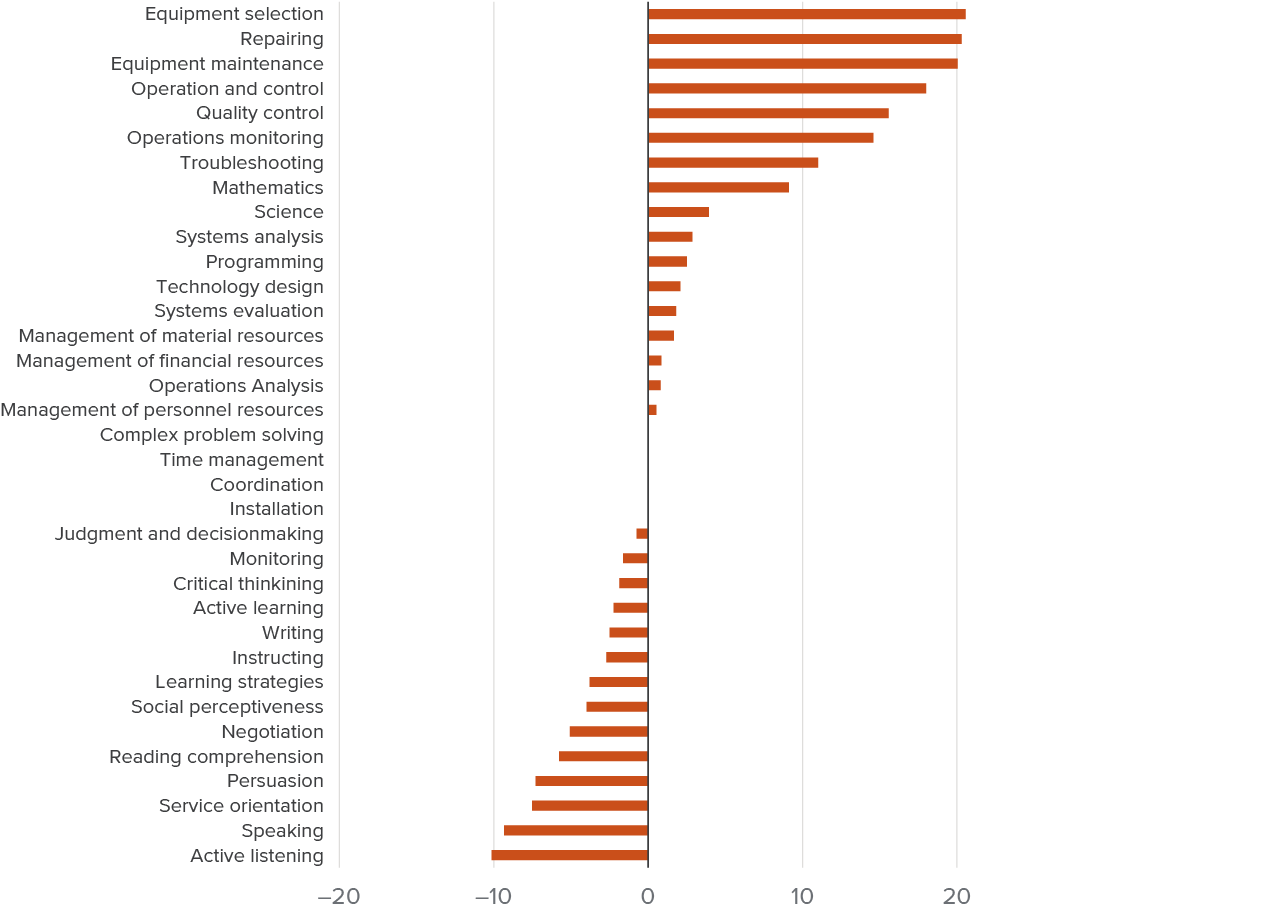
We find that jobs across the energy sector typically require foundational skills that are common to many jobs in today’s economy—including critical thinking, reading comprehension, active listening, and speaking (Technical Appendix Table A10). However, the energy sector relies much more heavily on technical skills such as equipment operation, monitoring, and repair, along with troubleshooting and quality control, compared to other parts of California’s workforce (Figure 8).
Equipment operation, maintenance, and troubleshooting skills are important for energy jobs
Score difference (energy occupations to non-energy occupations)
SOURCE: O*NET 29.2 Database
NOTES: Skill importance index difference: energy occupations versus non-energy occupations (>0 indicates more important for energy). Median scores are calculated across all occupations in the group.
Work Environment
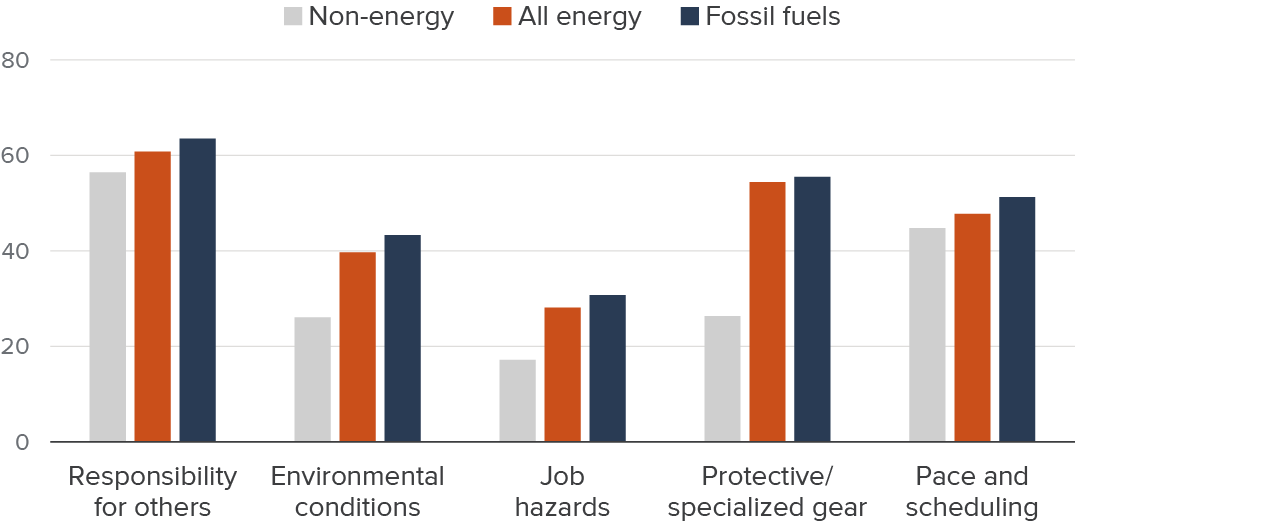
The interpersonal, physical, and structural conditions of jobs in the energy sector suggest a high level of responsibility; this may be a driver of higher earnings and shape the pool of workers willing or able to succeed in the sector.
While the interpersonal aspects of energy sector work are similar to those in rest of the workforce, energy work tends to take place in more demanding physical environments (Figure 9). Hazards, extreme environmental conditions, and the use of protective gear are more prevalent in these types of jobs, especially if we narrow in on jobs concentrated in the fossil fuel subsector. Some of the factors in these indices include loud noises and/or high temperatures. In addition to high levels of responsibility for others, energy sector jobs require fast-paced work and adherence to strict schedules.
Workers in energy jobs, especially in the fossil fuel subsector, face more job hazards and extreme work conditions
Median score
SOURCE: O*NET 29.2 Database.
NOTE: Median scores are calculated across all occupations in the group.
The Future of the Energy Sector Workforce
Since 2016, the energy workforce in California has grown about 29 percent, over twice the rate of all jobs (12%) (Figure 10). Growth in the fossil fuels subsector (22%) has also exceeded overall growth (see Technical Appendix Table A4). We estimate that the largest job gains have been for logisticians (21,000), electricians (14,000), and first-line supervisors of construction trades and extraction workers (14,000). In the fossil fuels sector, jobs for construction laborers (4,300), service unit operators, oil, gas, and mining (1,800), and first-line supervisors of construction trades and extraction workers (1,300) have increased most sharply in recent years.
Energy jobs in California have increased substantially since 2016
Number of jobs

SOURCE: PPIC calculations based on OEWS for California, 2016–2023.
NOTE: See Technical Appendix A for detailed estimates.
In the Near-Term, Energy Job Growth Is Likely to Vary Substantially across Occupations
If recent trends continue, growth in energy sector jobs could be slow and steady. Models that predict job growth through 2032 based on official Bureau of Labor Statistics data expect energy occupations to grow 7.6 percent and the occupations we’ve identified as key to the fossil fuels subsector to grow 6.5 percent. These rates are below projections for overall job growth in California (8.9%).
Among the energy-related occupations that are expected to see the greatest growth, we find technical jobs such as solar photovoltaic installers (42%) and electrical power-line installers and repairers (18%), as well as professional occupations that include architects (17%) and civil engineers (12%). Some of the greatest decreases are projected for some occupations directly related to fossil fuels, including petroleum pump system operators, refinery operators, and gaugers (-19%) and service unit operators, oil and gas (-15%). We discuss the decline in fossil fuel occupations in the section below.
However, many factors could impact the trajectory of the energy sector and its workforce. At the most basic level, these projections assume continued economic growth, but a recession could affect demand and/or investment in the energy sector. The energy sector is also sensitive to global trade and production patterns. Finally, federal and state priorities could also impact plans and future investments in the sector, as we discuss next.
Policy and Technology Will Affect Future Workforce Needs
The sector’s future is tied to policy decisions that affect prices, investments in infrastructure and technology, and incentives or impediments related to specific types of energy. While consumers, businesses, and private investment have effects on the energy sector, the government is a major player. For example, the federal Infrastructure Investment and Jobs Act prioritized building resilience in the energy grid, networks for electric vehicle charging, and moving toward zero-emission buses among other infrastructure, all of which would require a ready workforce. Initial funding of $41 billion was directed toward California and included about $4 billion for energy-related projects (White House 2024). In the current presidential administration, however, those funds and incentives have mostly been halted, and restrictions on some new energy projects and state climate policy are being pursued. California will not be able to fill gaps in federal funding. In addition, there are many state-level challenges to building new infrastructure quickly, including slow and costly permitting.
While California remains committed to its climate policy goals, state and federal policymaking may affect how or how quickly they can be met. Policy may mute or shift energy-related initiatives—and future workforce needs. Additionally, concerns about energy affordability for households and businesses, as well as the need for reliable energy production during a transition to more renewable sources, could have an impact. Private sector investments and private/state partnerships are expected to continue to increase the share of energy generation and consumption from renewable sources. All of this will have implications for the workforce, but it is difficult to predict exactly what these implications will be.
Research has modeled the long-run impact of the energy transition on workforce needs, accounting in a variety of ways for the scenarios noted above (and others). Estimates range from very little growth in the energy sector workforce to dramatic increases of three times the size today. This reflects differing horizons, modeling approaches, and assumptions about the evolution of energy technology and policy (Ram et al. 2022; Jacobson et al. 2015; Mayfield et al. 2023; Roland-Holst 2015; California Air Resources Board 2022).
The California Air Resources Board estimates that the state’s energy workforce will comprise a relatively stable share of the workforce overall through 2045. Other estimates suggest that even if national job growth in the energy sector is relatively small (400,000 to 600,000 by 2040), California could see more new jobs than other states given its scale and potential for growth in wind and solar energy generation (Xie et al. 2023). However, impediments to building new facilities could affect the evolution of California-based manufacturing connected to the energy sector, thus affecting workforce needs (Mayfield et al. 2023).
Some new job opportunities related to the development of new energy sources are short term and may or may not grow the sector overall in the longer term. For instance, a single energy infrastructure project requires a construction workforce for a certain amount of time without increasing jobs in the long term, but a continuous or growing stream of such projects could require a consistently larger construction workforce over that period. The transition to manufacturing batteries for energy storage rather than extracting and processing oil, for example, could shift the type of jobs needed in the sector from operations to manufacturing (Bucker et al. 2025)—and might create jobs in manufacturing firms that are not solely related to energy. Finally, some high-level job numbers count only jobs created due to new investments and not those lost due to what is being replaced, phased out, or repurposed. Some “new” jobs in growing areas of the energy sector will be existing jobs repurposed for new activities.
While the workforce needs of the energy sector grow and shift along with energy technology, policy decisions, and the like, the workforce will also be in transition due to broader demographic factors. As noted above, 32 percent of the workforce is over age 50. As the pace of retirement in the energy sector accelerates, energy companies will need to focus on recruitment and retention as well as training.
Which Energy Jobs Will Be Most Affected by the Energy Transition?
Given these expectations about the future of the energy workforce, we focus on understanding entry into the workforce for those seeking good job opportunities as well as transitions for workers—especially those in the fossil fuel subsector—who could face long-term declines in their job prospects.
Drawing on Greenspon and Raimi (2025), Popp et al. (2024), and Vona et al. (2018), we identify two sets of occupations most likely to change as a result of the energy transition: those most likely to shrink or disappear due to the phasing out of fossil fuel and those most likely to be generated by the emergence of new fuel sources. This discussion zeroes in on the jobs most likely to change as a result of the energy transition. Other types of workers that are currently critical to the energy sector—for instance, electricians—may acquire new skills and tasks, but they remain prevalent.
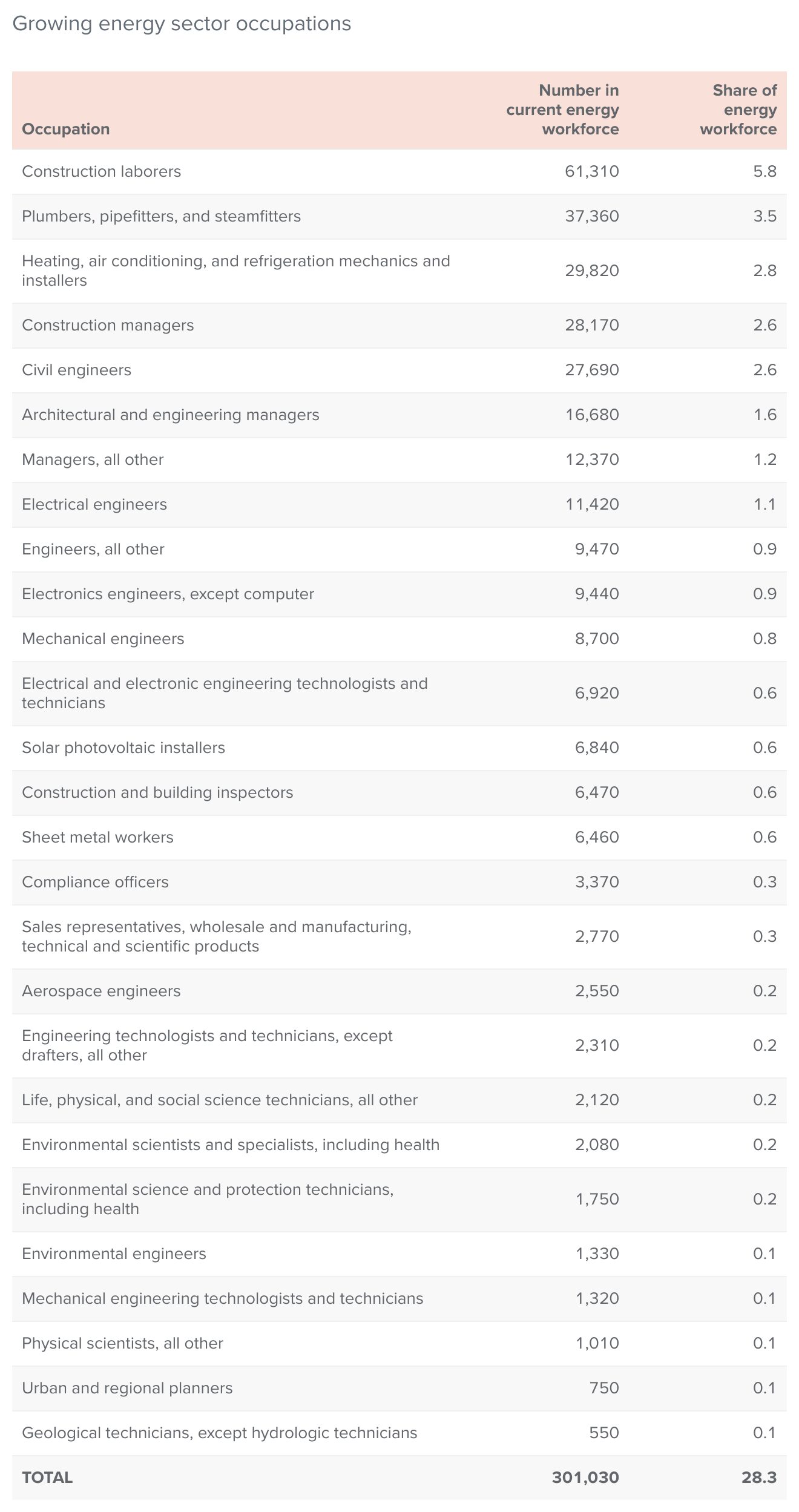
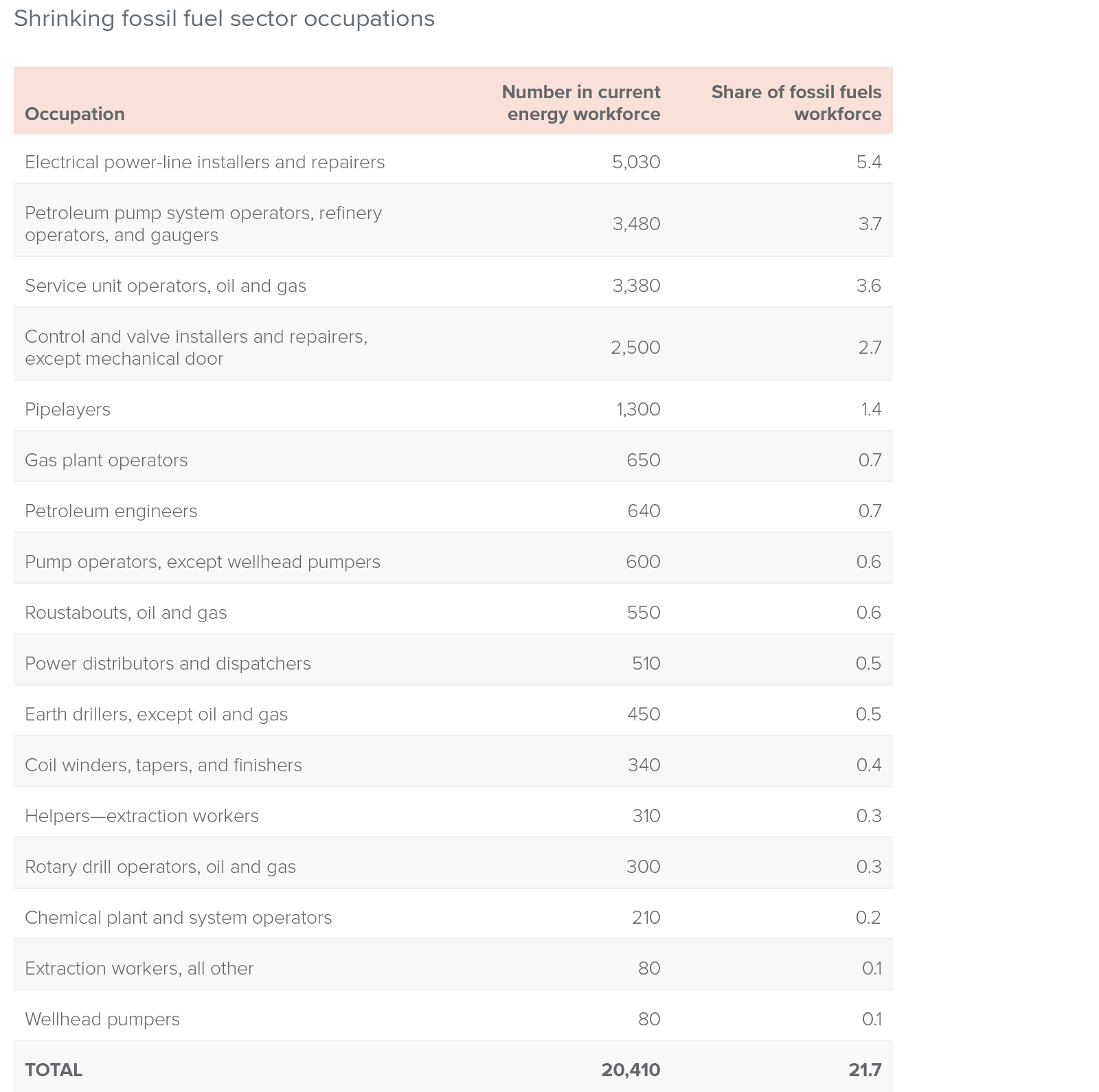
We identified 27 occupations that are likely to grow if the transition to renewable energy sources continues and 17 likely to shrink or disappear if the state shifts further away from fossil fuel (Table 1).
Energy sector occupations most likely to shift along with the energy transition
SOURCE: PPIC calculations from OEWS for California, 2023.
NOTES: Counts employment in given occupations within industrial sectors defined as part of the energy or fossil fuel sector, based on our definition. Occupations selected based on approach described in text.
Occupations associated with the transition toward renewable energy already comprise about one-quarter of energy sector jobs (about 300,000). As noted in related national studies, a large share of these jobs are in construction, professional/technical services, and electrical equipment-related firms (Xie et al. 2023). However, some emerging occupations within these categories can be difficult to identify in official jobs data. Like software developers or social media specialists—occupations that did not exist a few decades ago but are now commonplace—new energy technologies may be creating new occupations or increase their visibility in the data. For instance, transportation, fuel cell, or energy engineers are so few in number that they are currently counted as civil, mechanical, or “all other” engineers; our best estimate of total jobs in these occupations is 46,000, or 4.3 percent of the energy workforce. However, if renewable energy technology moves in that direction, these jobs may become separately measurable.
Occupations that are most likely to phase out due to a further shift away from fossil fuel sources comprise 2 percent of the energy sector today but 22 percent of the fossil fuel subsector. While the timeline is uncertain and depends on both government and private sector choices, we have already seen some job losses in California. For example, in 2020, the Marathon Martinez oil refinery in Contra Costa County idled, and the company laid off over 700 workers who had limited options to move into jobs with comparable pay and benefits (Hammerling et al. 2025; Parks and Baran 2023). As other closures are announced, policy action is needed to support workers.
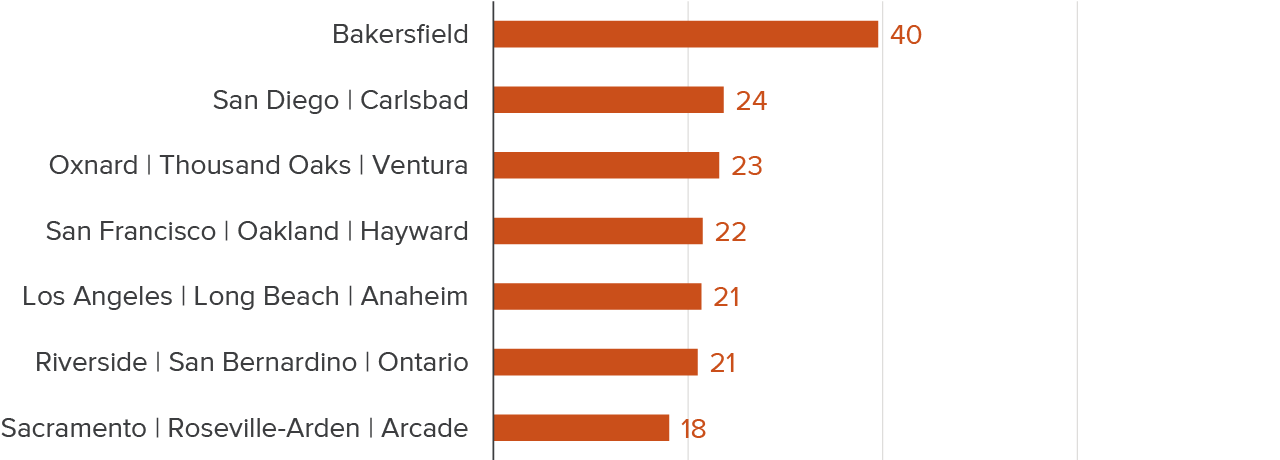
In addition to skill and experience requirements, geographic factors may affect how emerging or shrinking workforce opportunities in energy will be met. Specifically, the fossil fuel jobs most likely to decline represent almost 40 percent of all fossil fuel jobs in Bakersfield, 24 percent of those in San Diego, and 22 percent of those in the Bay Area (Figure 11). In absolute terms, twice as many of these jobs are located in the Los Angeles metro (5,200) compared to Bakersfield (2,400) or Riverside-San Bernardino (2,300).
Fossil fuel jobs likely to shrink are more prevalent in Bakersfield
Phasing out fossil fuel jobs as share of regional fossil fuel workforce (%)
SOURCE: PPIC calculations from OEWS data for California, 2023.
NOTES: Number of fossil fuel jobs in occupations likely to phase out as share of total fossil fuel jobs in metro area, as of 2023. Six largest Metropolitan Statistical Areas shown.
Preparing for Emerging and Shrinking Energy Jobs
We now turn to a more in-depth examination of the occupations likely to grow and shrink due to changes in the energy sector—as well as the skills, education levels, and earnings potential that can contribute to or constrain individual opportunities.
Growing Jobs in Energy Require Higher Levels of Education
Energy occupations that are likely to grow require relatively higher educational attainment at entry level: 44 percent of these jobs require a bachelor’s degree, compared to 39 percent of energy jobs overall and 24 percent of fossil fuel jobs (Table 2). About four in ten (42%) of these occupations require at most a high school diploma—a lower share than in the energy sector overall.
Emerging energy occupations require higher levels of educational attainment at the entry level
Distribution of education requirement, based on 2023 employment (%)

SOURCES: PPIC calculations from OEWS data for California, 2023, and on Employment Projections program, US Bureau of Labor Statistics.
NOTE: The distribution of education is weighted across the occupations based on employment in 2023.
Growing energy occupations require a little bit less work experience than jobs in fossil fuel or energy overall—8 percent of the jobs projected to grow require 5+ years of experience compared to 10 and 12 percent in the fossil fuel or energy sector overall (Technical Appendix Table A12). Growing occupations require more on-the-job training than the energy sector workforce overall—48 percent compared to 39 percent—but less of this kind of training than fossil fuel jobs (61%); our findings are consistent with similar research at the national level (Popp et al. 2024).
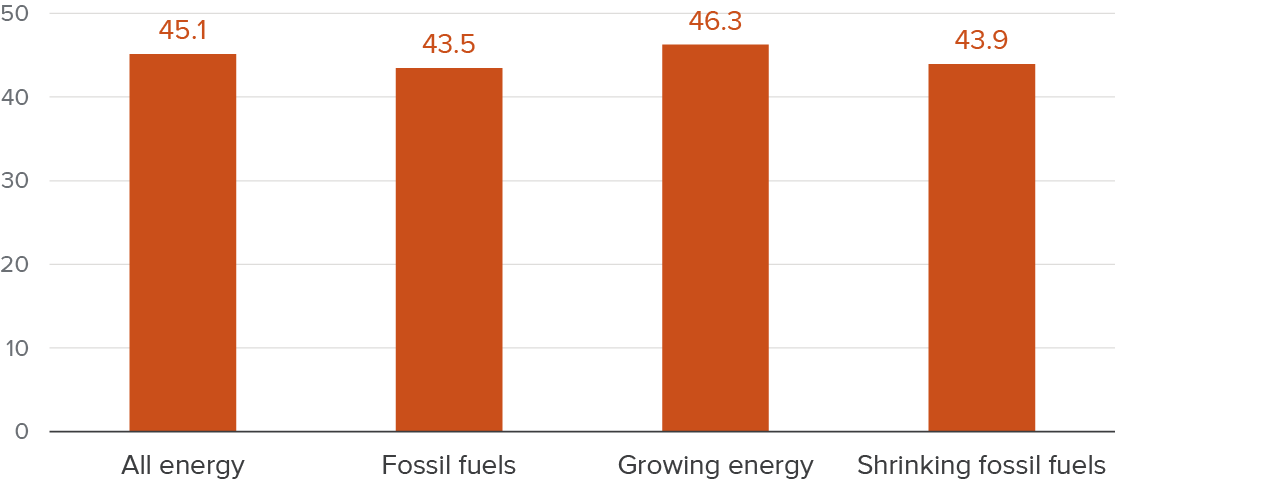
Driven by higher education and training requirements, the occupations likely to grow currently pay slightly higher wages than those in the energy sector overall: $46/hour at the median, compared to $45 for energy jobs overall (Figure 12). However, among growing occupations that require less than a bachelor’s degree, typical wages are currently $31/hour; this hourly median is lower than the growing energy jobs overall but greater than typical earnings for workers in occupations that require less than a bachelor’s degree in the workforce overall ($23/hour).
Growing energy occupations offer higher wages, in general
$ per hour
SOURCES: PPIC calculations from OEWS data for California, 2023, and on Employment Projections program, US Bureau of Labor Statistics.
Higher earnings may help the energy sector recruit workers. But the sector will also rely on post-secondary institutions, employers, and unions, among others, to provide workers with the education, skills, and experience necessary to perform in those jobs.
Firms can also recruit existing workers from other sectors. The occupations estimated to grow to support the energy transition currently employ workers across many of California’s sectors. In fact, only 43 percent of employment in the 27 occupations projected to grow to support the energy sector are in the energy sector today; the other 57 percent are in other sectors, including manufacturing, construction, or professional services. That means that skills that might translate to support future energy sector needs are already present in California’s workforce. Though not all skills can be transferred seamlessly across sectors, supporting workers in this transition may give them access to favorable wages, benefits, and/or work environments.
Workers in Shrinking Fossil Fuel Jobs Could Qualify for Jobs in other Industries—but Most Pay Less
About 20,000 Californians have fossil fuel jobs that are likely to be phased out during the energy transition. Most of these jobs do not require education beyond high school and typically offer relatively high wages: $44/hour as of 2023. It is impossible to predict exactly how many of these jobs will ultimately be lost or when that might happen. But many have already been affected by, for example, the closures of oil refineries, and their transition potential is of great concern.
Because many of these jobs are specific to fossil fuels, many workers are highly affected by changes in that subsector. For example, operators of petroleum pump systems, refineries, and gas plants are unlikely to find the same job opportunities in other sectors. However, workers in other less-specialized occupations may find opportunities in other sectors. The occupations identified in Table 1 are mostly found in the fossil fuel sector (20,000); an additional 10,000 jobs in those occupations are found in other sectors of the economy. For example, one year after the Marathon Martinez oil refinery layoffs, one-quarter of workers (excluding retirees) were unemployed, and those who had found new jobs went from earning a median wage of $50 per hour to $38 per hour (Hammerling, Toaspern, and Schmahmann 2025). National evidence suggests that workers leaving the fossil fuel sector mostly do not move into jobs in renewable energy-related sectors, despite recent growth in EV-related jobs that provides some opportunity (Curtis et al. 2023). Furthermore, older workers in the fossil fuel sector and those without a bachelor’s degree are even less likely to transition to jobs in other parts of the energy sector, validating concerns about supporting the transition of workers affected by the decline in fossil fuel work.
To better understand the potential for workers to transfer from fossil fuel occupations that may shrink over time, we identified occupations with the most similar skill, training, and education requirements as well as work environments. Our analysis draws on the O*NET occupational data. We identified the ten closest occupations to each of the “shrinking” occupations, based on a “relatedness” index that compares multiple dimensions of each job and finds the closest match. Extra weight is given to matching jobs based on educational requirements, training, and skills, though the day-to-day tasks and overall conditions of each job are also factored in (e.g., job characteristics described in Figures 7–9). Similarity does not necessarily translate into seamless transitions: moving into occupations that are very similar may require additional training that is specific to the sub-field of work or to individual employers.
We find that 52 percent of closely related occupations are in the broader energy sector in California (or 82% of total employment, based on 2023 data; see Technical Appendix Table A13). For example, based on skills and job characteristics, a service unit operator position in the oil and gas sector is similar to four positions—operating engineers and other construction equipment operators, industrial machinery mechanic, septic tank servicers and sewer pipe cleaners, and engine and other machine assemblers—in other parts of the energy sector. Other examples include pipelayers, who may be able to use their skills as plumbers, pipefitters, steamfitters, or construction workers in other parts of the energy sector; and electrical powerline installers and repairers, who could use their skills as telecommunications line installers and repairers or electrician helpers (see Technical Appendix Table A14 for more examples).
We also find a broad distribution of similar jobs across the economy, from manufacturing to construction. For example, rotary drill operators in oil and gas may have skills and training required for jobs in machinery maintenance. The firms that employ such workers are typically in manufacturing and transportation and warehousing industries.
To the extent that skill-building or training is needed before an individual can start in a new job in a similar occupation, employers, unions, apprenticeship providers, and workforce development partners may facilitate worker transitions. And “earn and learn” models may help transitioning workers support themselves and/or their families.
Notwithstanding overlapping educational levels, skills, and job characteristics, mismatches in earnings potential matter a lot for fossil fuel workers who need to shift careers. Figure 13 plots the median wage of each job projected to phase out (horizontal axis) versus the median wage of jobs identified as similar (vertical axis). Seventy-four percent of the related occupations (or 67% of employment, based on 2023 levels) offer lower wages; or only one-quarter of the proximate occupations would pay workers more than they earn today.
Proximate jobs for workers in shrinking fossil fuel occupations often pay lower wages

SOURCES: PPIC calculations based on OEWS data for California, 2023, and Employment Projections for California, 2022–2032.
NOTES: The dotted line represents a 1-1 match between the shrinking fossil fuel occupation wages and the wages of closely related occupations based on O*NET, excluding those that are part of the shrinking fossil fuel list. Bubbles above the dotted line indicate wages in related occupations are higher than current wages in shrinking fossil fuels occupations; bubbles below mean that wages are lower. The size of the bubbles indicates the change in number of jobs for each occupation according to the BLS projections for 2022–2032 based on quintiles of the distribution of job change in absolute value. Occupations with no information on projected jobs were assumed as having no changes in employment. Occupation 53-7073—Wellhead Pumpers was excluded from the analysis because OEWS data is lacking on current wages for California. For detailed information see Technical Appendix Table A14.
It is also important to note that some closely related jobs are projected to grow (blue circles in Figure 13) while others are expected to decline (orange circles) or have zero growth (grey dots) by 2032. Projected job growth is greatest among laborers and freight, stock, and material movers (38,000 projected additional jobs); construction workers (20,000); and electricians (10,000). None of these jobs offer higher typical wages than fossil fuel occupations. In aggregate, the five most closely related occupations for shrinking fossil fuel occupations are projected to grow 5 percent (6,000 jobs per year) by 2032 (see Technical Appendix Table A14). If we take the extreme case and assume that all of our selected fossil fuel sector jobs phase out over that period (20,000 total jobs lost) and that all of the affected workers transition to one of these related jobs, we estimate that the transition will constitute 15 percent of the projected change in related occupations.
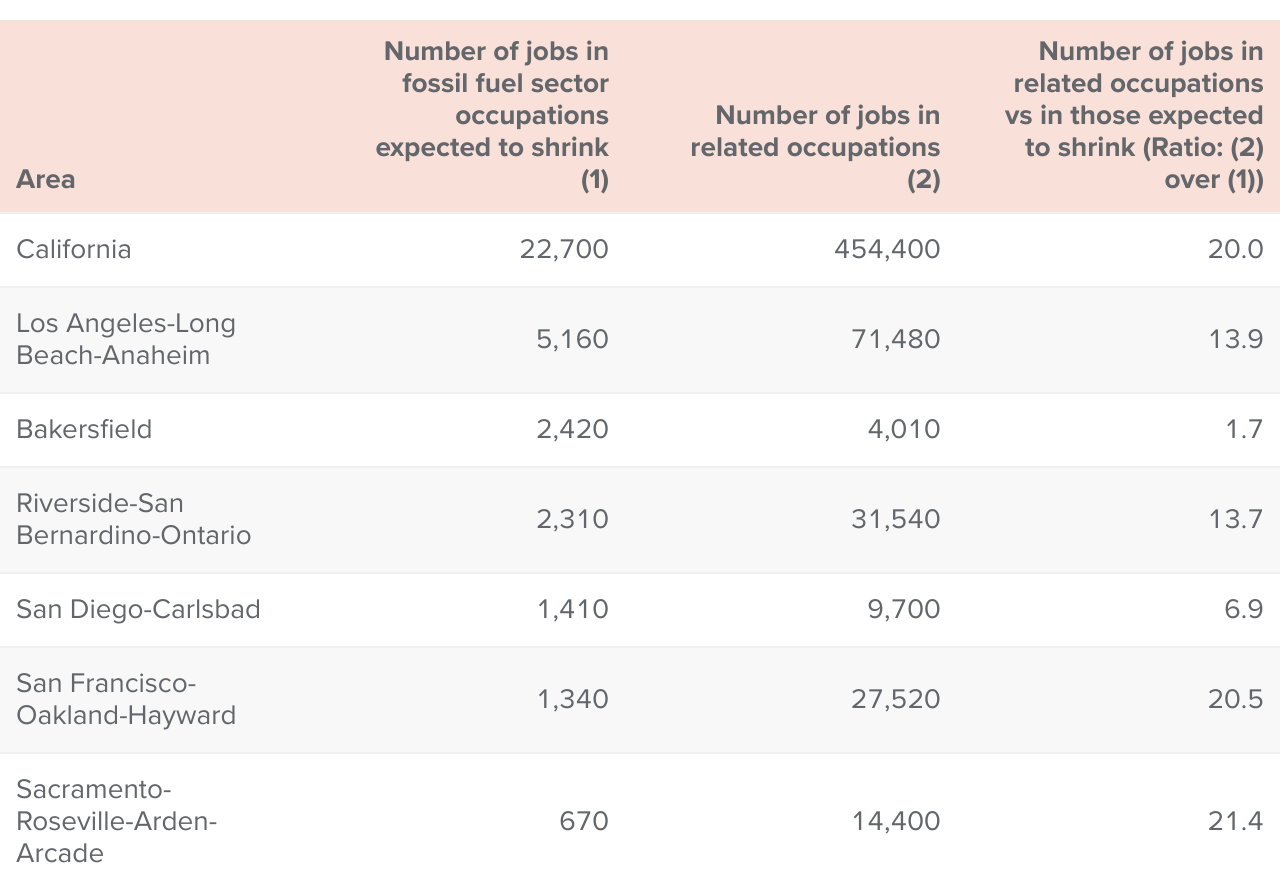
As noted, the fossil fuel jobs that would be affected by a continuing transition are more concentrated in Bakersfield metro than in other areas, though they are also numerous in Los Angeles, Riverside–San Bernardino, San Diego, and San Francisco metro areas. Whether those workers can find related work in their region is a critical question. To shed more light on this issue, we examine the six metro areas with the largest level of employment in our target fossil fuel occupations, for which we have relatively detailed employment data. We find that opportunities in closely related occupations vary dramatically across these six metros (Table 3). In particular, the relatively small size of Bakersfield’s labor market means that there are fewer local jobs in related occupations. The largest occupations in the metro area that are expected to shrink are service unit operators in oil and gas (1,700 jobs in 2023) and petroleum engineers (300 jobs). There are currently only 1,500 jobs in the five occupations closest to service unit operators—that is, around 0.9 jobs per 1 job in the affected fossil fuel subsector. For petroleum engineers, the number of closely related jobs is 800, or around 2.5 times the current number of jobs for petroleum engineers.
By contrast, in the Los Angeles metro area, electrical power-line installers and repairers (1,800 jobs) and petroleum pump system operators, refinery operators, and gaugers (1,700 jobs) are among the largest shrinking fossil fuels occupations. Closely related occupations currently employ 3,900 and 22,000 workers, respectively—equivalent to 2 and 13 times the number of jobs in the two fossil fuels occupations phasing out. In aggregate, Bakersfield has 1.7 jobs in closely related occupations per one job in phasing fossil fuels ones. For Los Angeles, Riverside–San Bernardino, San Diego, and San Francisco metro areas, the ratios range from 6.9 to 20.5—much better odds for fossil fuel workers who would be affected by the energy transition.
Proximate jobs for workers in shrinking fossil fuel occupations are more prevalent in some regions
SOURCE: PPIC calculations based on OEWS data for California, 2023.
NOTES: Top six metro areas in terms of column 1 shown. See text for explanation of related occupations; only the top five most closely related occupations are used in column 2.
Policy and Research on Workforce Transitions
Education and training will play key roles in addressing the shifting workforce needs for the energy sector—but other supports for workers and businesses may also be needed. It is instructive to look at research on the impact of previous industrial transformations on workers, regional economies, and the economy at large. Prominent examples include the decline of coal-fired energy generation in Ohio, the end of the steel industry in Pennsylvania, the dwindling of the coal industry in West Virginia, and major manufacturing sector shifts due to trade and import competition (Peluso, Kearney, and Lester 2020; Autor, Dorn, and Hanson 2016; Autor et al. 2014). A variety of local, state, and federal policies were put in place to deal with the economic and labor market consequences generated by these and other transitions. While a complete review of these policies is beyond the scope of the present report, we offer insights from existing research on some policy approaches that might be relevant to California’s current energy transition.
The long-term effects of the cessation of energy-related activities have been quite dire for the communities and workers directly impacted (Krause 2023; Black, McKinnish, and Sanders 2005). For instance, workers who were most affected by the decline of the coal industry have had lower earnings and propensity of work over the long term; especially those who stayed in the local area, though relocating did not mitigate earnings losses much (Colmer 2024). Even for workers who transitioned to high-wage industries, the transition was costly in terms of long-term earnings potential.
Targeted economic development
Economic development efforts aim to support communities, businesses, and workers by attracting new industries, private investment, and jobs to regions affected by industrial decline. The Contra Costa Refinery Transition Project aims to do just that in the Bay Area (Hammerling, Toaspern, and Schmahmann 2025), while prioritizing job quality and environmental health. A substantial body of research has evaluated policy approaches to generating local economic development; syntheses of this research generally find limited effects. Policies that solely target locations (e.g., place-based policies like empowerment or opportunity zones or tax credits for operating in certain markets; see Neumark and Simpson 2014; Bartik 2020; Mukherjee and Raimi 2023) have been largely ineffective at generating job or business growth beyond what would have happened in their absence.
However, research does find promising approaches to incentivizing local economic development through investments in infrastructure (e.g., the Tennessee Valley Authority, see Kline and Moretti 2014) and well-designed tax credits for employers (e.g., the Employment Training Panel or California Competes Tax Credit, see Neumark et al. 2023; Neumark and Wohl 2023).
Education and training for impacted workers
A vast number of programs provide education and training, with state, federal, and local agencies playing key roles. Federal funding is particularly important for education, training, and job search assistance for workers affected by industrial transformation—for example, the Dislocated Worker program, part of the Workforce Innovation and Opportunity Act, and the Trade Adjustment Assistance (TAA) program, which operated between 1974 and 2022. Hundreds of studies in both US and non-US settings estimate consistent gains for dislocated workers who participate in programs that improve their skills. While they may forgo earnings and employment in the short term, workers see increased employment two to three years after completion of training programs (Card, Kluve, and Weber, 2017; Hyman 2022).
A California-specific evaluation finds an 11 percentage-point gain in employment and 20 percent higher earnings up to three years after workers completed training through the TAA program. However, most evaluations find that improvements are not equivalent across demographic groups: women and workers who experience longer spells of unemployment generally see larger gains, while gains for younger and older workers are typically smaller. The services found to be most effective are generally related to training, though positive returns to training may take time to realize or entail fully shifting careers (Marcal 2001; Schochet et al. 2012). Some positive results may be due to workers who are willing to fully shift careers.
Programs that target job training to dislocated workers with dedicated outreach and services may be more effective than hoping that workers will seek training independently. A study focused on communities affected by the decline in the coal industry finds essentially no increase in educational achievement—or even enrollment—at public and private colleges, including those that grant certificates, such as community colleges (Krause 2025). Even financial support (via government transfers) to coal workers in these communities did not correlate to increasing educational attainment.
Earnings support
Policies have also sought to address earnings and employment directly. The TAA program addressed earnings by providing extended unemployment insurance benefits (contingent on enrollment in training), a wage insurance program, and/or a tax credit for health coverage. A rigorous study of the TAA wage insurance program, which provided a temporary subsidy to offset the difference between the worker’s previous and current wage to help them get into new jobs more quickly, found improvement in employment and long-term earnings (Hyman, Kovac, and Leive 2024). Notably, the program was designed to reach workers over age 50, who may face other barriers to investing in new skills and starting new careers.
An employment guarantee can also sustain dislocated workers’ earnings. The US has utilized large-scale, temporary jobs programs in critical periods, like the Works Progress Administration (WPA) and Civilian Conservation Corps during the Great Depression, or in critical places like the US Department of Commerce’s POWER initiative providing temporary employment in communities affected by the decline of the coal industry in Appalachia. A study of the long-term impact of the Civilian Conservation Corps found that among young adults who participated, employment and earnings did not change much in the short term but lifetime earnings—along with health, mobility, and longevity—were significantly improved (Aizer et al. 2024). However, these improvements must be balanced against the cost of the program and the extent to which public investment displaces private sector investments.
Relocation support
Historically, migration within the US has been closely tied to emerging job opportunities. Today, however, large-scale relocation in response to economic declines or opportunities is much less common. Most Americans pursue careers in the metro area where they grew up (Bartik 2020). Even communities that have weathered shocks to manufacturing earnings due to increased global trade have seen relatively small out-migration (Autor et al. 2014; Bartik 2020). Attachment to place may be stronger now, and/or relocation costs may be higher, due in part to the housing market. But assistance with relocation can support long-term economic well-being for workers who would like to pursue job opportunities in new places (Lim, Aklin, and Frank 2023). The TAA program included a stipend for relocation for dislocated workers who find employment outside of their previous commuting area; to our knowledge there are no evaluations of this stipend.
However, large-scale experiments such as Move to Opportunity have sought to understand how overcoming cost and information barriers to migration can impact economic outcomes. Studies find small or no effects on the employment or earnings of adults in households that relocated but sizeable positive impacts on college attendance and earnings of children who have grown up in those households (Chetty et al. 2016; Ludwig et al. 2013). The Move to Opportunity experiment was focused on households in poor communities, which may not be fully comparable to communities affected by industrial decline.
In sum, the evidence suggests that policy interventions may not guarantee successful workforce transitions during economic transformations. Efforts to support workers may need to take a multifaceted approach that combines targeted training programs, strategic economic development plans, and tailored support services. In addition, decision makers must consider the costs of the interventions relative to potential benefits, to achieve both fiscal sustainability and provide solutions that are responsive to affected workers and communities.
Policy Implications
California’s move toward renewable energy generation and consumption has had some effects on the state’s energy sector workforce. Growth in jobs related to solar technology, for example, are occurring alongside the loss of oil and gas refinery jobs. The future course of the transition from fossil fuels to renewable energy sources is highly dependent on state and federal policy choices; however, California will need to be mindful of workforce needs in the energy sector in order to support the state’s critical activities and to plan for transitions that affect workers and communities.
We have found that work needed to drive new energy sources and technology would require skills at either end of the education distribution. We estimate that 44 percent of new energy jobs will require at least a bachelor’s degree compared to 39 percent of today’s energy workforce and only 24 percent of the fossil fuel workforce. At the same time, a similarly large percentage of new energy jobs (42%) will require at most a high school diploma.
The jobs projected to grow to support new energy activities tend to offer higher median wages than the energy sector overall today, though that is driven by the high share of new jobs that would require a college degree. Given the aging of California’s workforce, the energy sector will face the challenge of attracting workers from the shrinking pool of younger adults; sustained earnings potential is likely to help the sector recruit workers in a competitive environment.
Another key concern is that the jobs that are most likely to shrink due to further shifts away from fossil fuel pay higher wages than the occupations fossil fuel workers could qualify for based on their skills, education, and job characteristics. While the segment of California’s energy workforce that would shrink is smaller than the portion expected to grow, it comprises a large percentage of the overall fossil fuel workforce in some regions, such as the Bakersfield metro area.
Fossil fuel workers who would be affected by the energy transition have skills that are valued for jobs in other parts of the state’s energy sector or in other key sectors. However, most of these jobs offer lower wages. And in smaller regions—again, especially in the Bakersfield metro area—the there are fewer of these related jobs than in larger metros.
These estimates—along with rigorous studies of previous industrial transitions—indicate that to ease the negative workforce ramifications of shifts in the energy sector, the state should focus on targeted assistance for job training, job search, and income support for affected workers, as well targeted approaches to addressing regional economic development. A large body of research on previous transitions has found that while near-term gains to workers in terms of employment and earnings and to communities in terms of job growth may be small, targeted approaches can prevent the worst outcomes of dislocation and decline. In addition, state leaders can learn from current efforts and initiatives, such as the Contra Costa Refinery Transition Partnership.
Ongoing shifts in occupational needs will require a range of workforce preparation, from postsecondary education to on-the-job training for high school graduates. State investments across the educational and workforce development spectrum will be critical, and broader connections between industry needs and state investments can be strengthened by partnerships with employers, unions, and other workforce stakeholders.
Topics
Economy Jobs and Employment Water, Land & Air Workforce and Training