
California has long been a top destination for immigrants coming to the United States. In turn, immigrants have played a pivotal role in shaping the state’s strong economic growth and cultural vitality. Today, executive actions have transformed the federal policy landscape in ways that will reverberate through the lives of immigrants and alter immigration trends. In light of these actions and their consequences, we offer insights into immigration patterns for California as well as past and present views of immigration and immigrants.
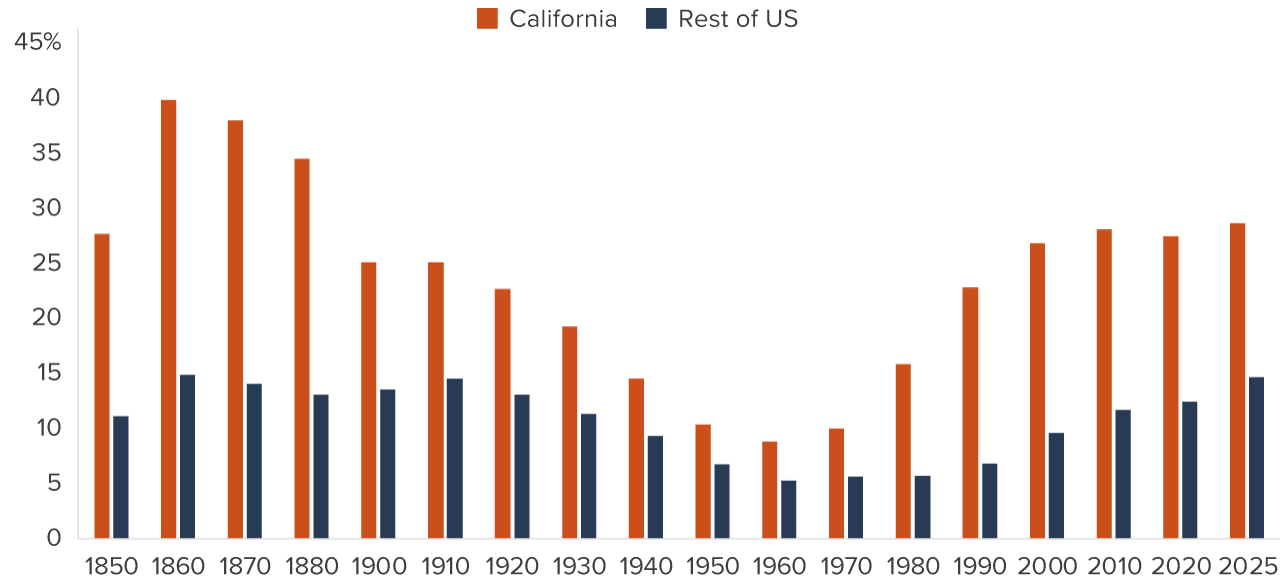
California has more immigrants—almost 11 million—and a higher share of immigrants (28%) than any other state. That population share is also twice that of the rest of the country (14%). Flows of immigrants to California have slowed in recent decades, but immigration remains an important source of population and economic growth.
California has attracted a substantial share of immigrants for more than a century
Percent of population foreign-born
Source: Decennial censuses through 2020, Current Population Survey 2025. Accessed via IPUMS.
California’s immigrant population is diverse, with sizable populations of at least 10,000 from over 60 different countries. Most are from Latin America (49%) or Asia (40%), with Mexico, the Philippines, and China as the leading countries of origin. But in recent decades the flow from Asia has surged, while the flow from Latin America has subsided. Since 2000, the number of immigrants from Asia has gone up by 1.4 million—numbers from Latin America went up by only 322,000.
Where do California’s immigrants live and work?
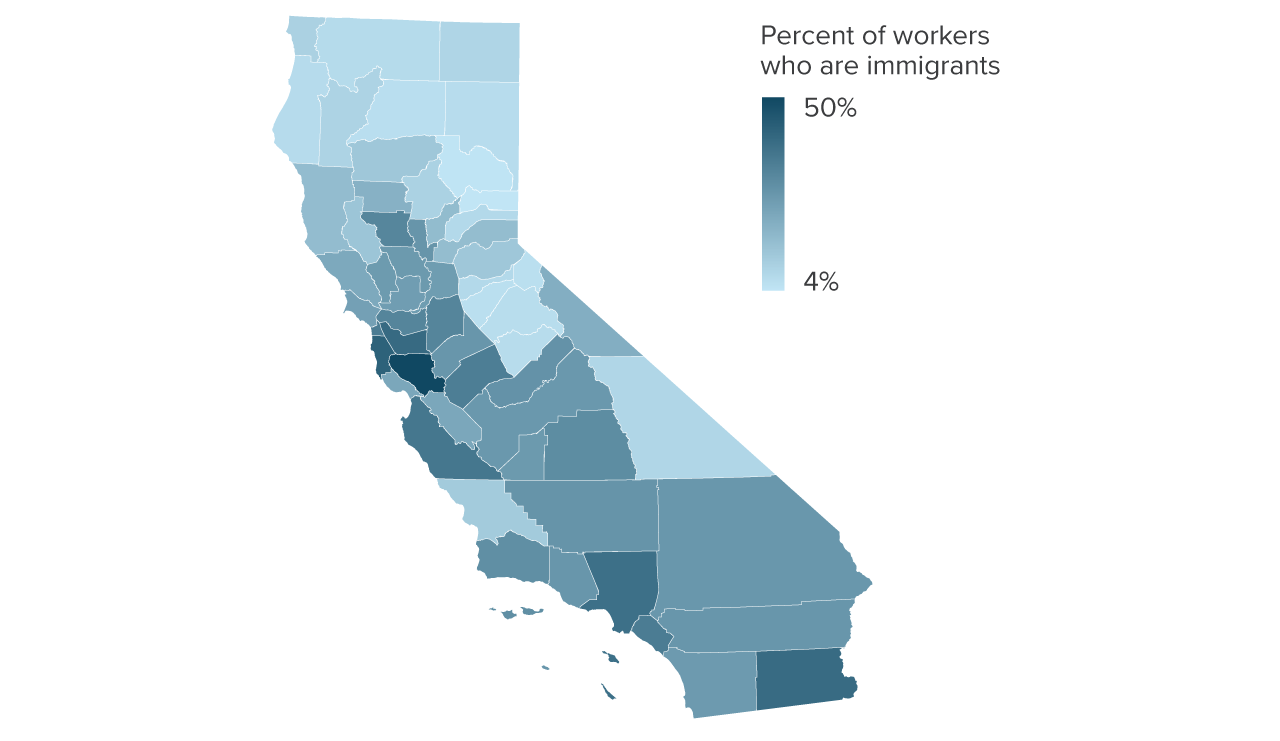
California also distinguishes itself from other states by the regions where immigrants live and work. Substantial immigrant populations live in all large metropolitan areas as well as in the many rural areas that make up the state’s agricultural corridors, such as the Central Coast and the San Joaquin Valley. In Santa Clara County, home to Silicon Valley, 42 percent of the population and 51 percent of workers are immigrants, the highest share in the state. By contrast, in New York—the state with the second-highest share of foreign-born residents—immigrants are concentrated in New York City, with small populations in other metropolitan areas and in rural areas.
Immigrants are a large share of California’s workforce
Source: American Community Surveys 2019–23 accessed via IPUMS; counties with total populations less than 100,000 use adjusted estimates based on 5-year 2021 American Community Survey tables accessed at the US Census Bureau.
California’s labor force relies on immigrants: one of every three workers is an immigrant. From agriculture to high tech, immigrants constitute a large share of most industries. Highly educated immigrants have come to dominate the flow of recent arrivals, both reflecting and driving the changing nature of the state’s economy. While growth in the agricultural workforce, where most workers do not have degrees, has stalled somewhat, growth has picked up speed in the health and tech sectors—both with large shares of foreign-born workers with advanced degrees.
One dramatic change to California’s immigrant population has been a spike in naturalization. In 2000, only 38 percent of the state’s immigrants had become citizens; by 2025, 53 percent had done so. Meanwhile, the latest estimates for 2023 suggest that undocumented immigrants are about 20 percent of the foreign-born population, an increase from 2021 but substantially lower than in 2007.
How have views around immigrants and immigration policies changed?
California residents have not always embraced immigration and immigrants. In 1994, voters passed Proposition 187 (59% yes), which banned government services to undocumented immigrants, including education. Proposition 187 was judged unconstitutional and never enacted.
In the 21st century, Californians’ views have turned positive toward immigration and immigrants and have remained so through economic booms and slumps.
- Sixty-five percent of Californians think that immigration is a “good thing” for the country, according to the October PPIC Survey. Majorities across age, education, gender, income groups, and state regions hold this view while partisans are divided (85% Democrats, 33% Republicans, 64% independents).
- Half of Californians want immigration to the US to be kept at its current level while 20 percent want it increased and just 27 percent want it decreased. Pluralities across demographic groups and state regions want to maintain immigration levels although partisans vary on this approach (56% Democrats, 33% Republicans, 51% independents).
- Overwhelming majorities (73%) believe that “immigrants today are a benefit to California because of their hard work and job skills.” Majorities across demographic groups and regions agree, while partisans are divided (93% Democrats, 29% Republicans, 71% independents).
- Overwhelming majorities (71%) also think that when immigrants come legally to the United States they are a major benefit in contributing to economic growth, a sentiment that even includes majorities across partisan groups (83% Democrats, 56% Republicans, 67% independents).
Californians’ views on federal policies towards undocumented immigrants are not aligned with recent executive actions.
- Overwhelming majorities (74%) today think there should be a way for undocumented immigrants who live in the US to stay in the country legally if certain requirements are met. This preference has been widely held since PPIC first asked this question in 2016.
- Seventy-nine percent supported the protections given by “DACA” (Deferred Action for Childhood Arrivals) to undocumented immigrants brought to the US as children—which includes protection from deportation and a work permit, if they meet certain requirements, according to our February PPIC Survey. This share includes majorities across demographic and partisan groups and state regions. In the same survey, 67 percent opposed ending the automatic granting of citizenship for children born in the US to undocumented immigrants.
- Sixty percent of Californians favor the state and local government making their own policies and taking actions separate from the federal government, to protect the legal rights of undocumented immigrants in California. Majorities have expressed this preference since PPIC first asked this question in 2014.
In the context of increased federal immigration enforcement, almost half of Californians today worry “a lot” (22%) or “some” (27%) that someone they know could be deported—including 65 percent of Democrats, 65 percent of Latinos, and 60 percent of Los Angeles residents. Seventy-one percent disapprove of the job the US Immigration and Customs Enforcement Agency (ICE) is doing. Majorities hold these negative views of ICE across demographic groups and regions while partisans are divided (93% Democrats, 21% Republicans, 76% independents).
Whether California’s immigrant population continues to grow may depend on federal policy, although there are also larger global economic, social, and political forces at play. The general population of the state is aging and birth rates are falling, two factors that make continued immigration vital for bolstering the state’s labor force. Policies related to California’s immigrant population, such as providing access to health care and expanding educational opportunities, will help to boost the contributions of this diverse population. Regardless of whether federal policy changes immigration flows in the immediate moment and in the future, immigrants will continue to play a key role in shaping our state’s dynamic cultural, political, and economic landscape.
Topics
Economic Growth Economy Health & Safety Net Immigrants in California Jobs and Employment Political Landscape Population Statewide Survey Workforce and Training