

Key Findings
The governor and legislature called a November 4 statewide special election to ask voters to authorize temporary changes in the state’s congressional district maps in response to partisan redistricting in Texas. At the federal level, executive actions on immigration policy, tariffs, and spending are affecting life in the Golden State. There are uncertainties about US economic trends, with slowing jobs gains, the Federal Reserve lowering interest rates, and the federal government shutdown. The state legislature ended its 2025 session with a flurry of bills that the governor has recently signed into law on a wide range of policies such as energy, immigration, insurance, and artificial intelligence. The California economy has its own worrisome signals, including the highest unemployment rate in the 50 states.
These are the key findings of the Californians and Their Government survey that was conducted October 7 to October 14, 2025:
 Fifty-six percent of likely voters say they would vote yes on Proposition 50 on the November statewide election ballot, with partisans divided. About seven in ten think that the outcome on Proposition 50 is very important to them; majorities across parties say this. About seven in ten believe that Proposition 20, which was passed by voters in 2010 to give the citizens’ redistricting commission rather than the state legislature and the governor the task of making congressional redistricting decisions, has turned out to be mostly a good thing for California, with majorities of partisans holding this view.
- Twenty-six percent of adults and 33 percent of likely voters approve of the way Donald Trump is handling his job as president. Partisans are deeply divided on the president’s job performance. Fourteen percent of adults and 17 percent of likely voters approve of the way the US Congress is handling its job, and approval ratings are low across partisan groups. About three in ten adults approve of the way the US Immigration and Customs Enforcement (ICE) agency is doing its job, and about one in four approve of the “One Big Beautiful Bill Act” passed by Congress and favor the US placing new tariffs on imported goods. Partisans differ in their support for these federal policies.
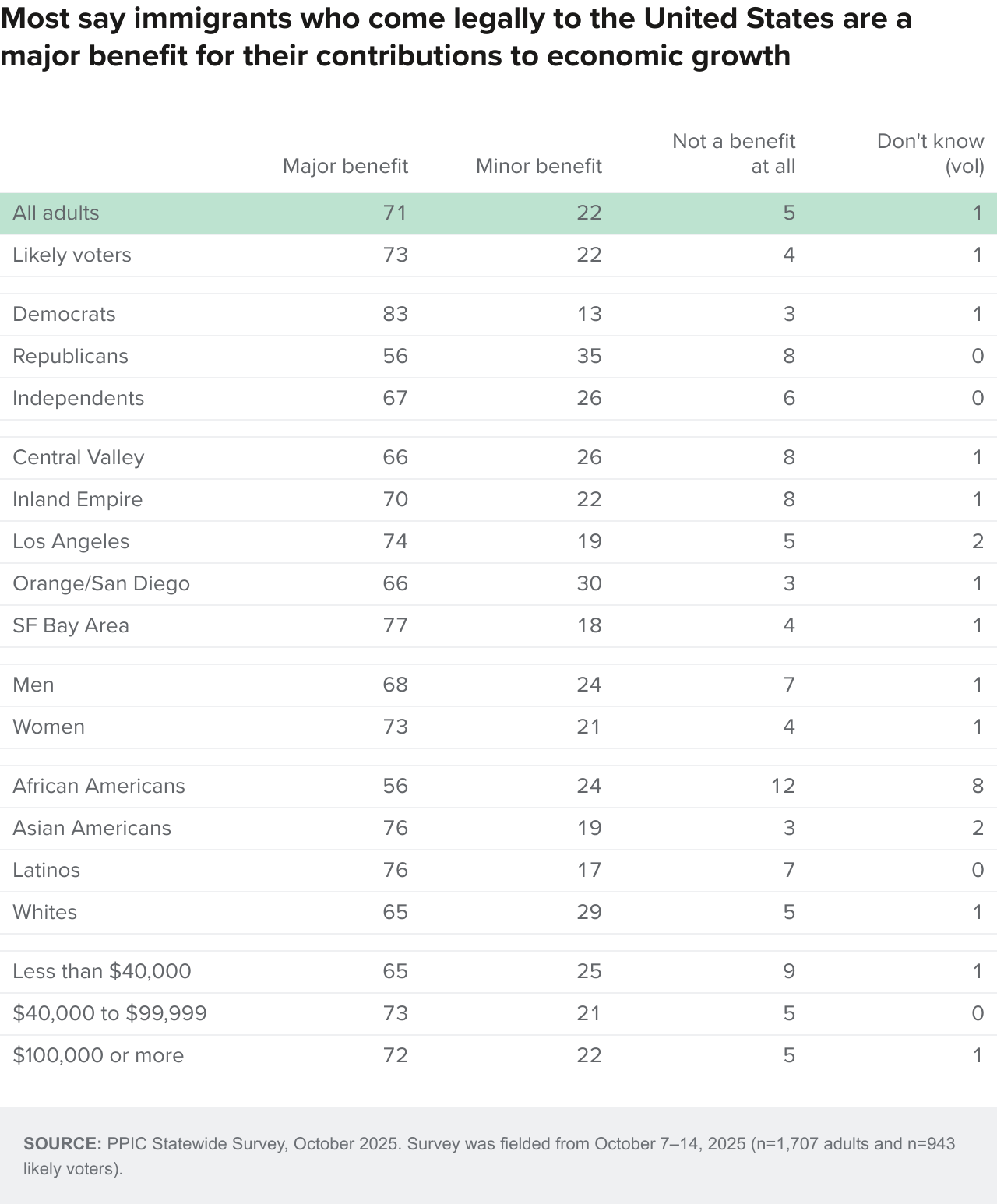
 Californians choose political extremism or threats to democracy, followed by economic conditions and immigration, as the most important problem facing the US today. Only about two in ten adults think things in the US are generally going in the right direction, that the US will have good times financially over the next 12 months, and that the nation’s economy is excellent or good these days. Majorities think that immigration is a good thing for the country today and that immigrants who come to the US legally are a major benefit to economic growth. Partisans differ in their views about the nation’s direction, US economic conditions, and immigration’s impacts.
- Californians choose the cost of living, the economy, or inflation, and housing costs and availability as the most important issues facing the state. Fifty-four percent of adults and 55 percent of likely voters approve of the way Governor Gavin Newsom is handling his job. About half say that things in California are going in the right direction, and one in four think the California economy will have good times financially during the next 12 months. Overwhelming majorities believe that immigrants today are a benefit to California because of their hard work and job skills.
- Most Californians are satisfied with their household financial situation, but about four in ten are concerned about not having enough money to pay for their rent or mortgage. About half say they see someone experiencing homelessness on a daily basis and that the presence of homeless people in their community has increased in the last 12 months. Fewer than two in ten say that local property crimes or local violent crimes are a big problem. Nearly half say they worry that someone they know could be deported due to increased federal immigration enforcement.
 Californians choose political extremism or threats to democracy, followed by economic conditions and immigration, as the most important problem facing the US today. Only about two in ten adults think things in the US are generally going in the right direction, that the US will have good times financially over the next 12 months, and that the nation’s economy is excellent or good these days. Majorities think that immigration is a good thing for the country today and that immigrants who come to the US legally are a major benefit to economic growth. Partisans differ in their views about the nation’s direction, US economic conditions, and immigration’s impacts.
Proposition 50 and the Federal Policy Landscape
As the major parties jockey for political advantage in the 2026 midterm, California voters will weigh in on congressional redistricting with Proposition 50 on the November special statewide election. The executive actions on tariffs for imported goods continue to raise uncertainties for consumer prices, while increased federal immigration enforcement is affecting state residents. The federal budget bill and federal downsizing are raising concerns about future funding for Medi-Cal and other major programs that are administered by state and local governments in California.
Proposition 50. Fifty-six percent of likely voters say they would vote “yes” on the legislative constitutional amendment, called Authorizes Temporary Changes to Congressional District Maps in Response to Texas’ Partisan Redistricting. Republicans and Democrats have different views; independents lean toward voting yes on Proposition 50. Majorities across age, gender, and income groups say they would vote yes, while support is higher in the coastal regions than in the inland regions. Majorities living in Republican House districts say they would vote no. Of those who say they would vote yes, 95 percent disapprove of the way Donald Trump is handling his job as president and 86 percent approve of the way Gavin Newsom is handling his job as governor.
Sixty-eight percent of likely voters say the outcome of Proposition 50 is “very important” to them. Majorities across partisan, demographic, and regional groups feel this way about Proposition 50. Majorities of yes (73%) and no (64%) voters on Proposition 50 say the outcome is very important. Notably, 66 percent are closely (30% very, 36% somewhat) following news about Proposition 50.
Seventy-two percent think that it has been “mostly a good thing” for California that Proposition 20 was passed by voters in 2010 to give the citizens’ redistricting commission rather than the state legislature and governor the task of redrawing the voting districts for Congress. Majorities across partisan, demographic, and regional groups hold this view. Majorities of yes (77%) and no (67%) voters on Proposition 50 think the citizens’ redistricting commission has been mostly a good thing.
President. Donald Trump’s approval rating stands at 26 percent among California adults and 33 percent among likely voters today. Approval of the president was similar at the start of his second term. Today, 80 percent of Republicans, 4 percent of Democrats, and 19 percent of independent voters approve of the president. Approval varies across racial/ethnic groups (11% African Americans, 16% Asian Americans, 21% Latinos, 37% whites). Fewer than four in ten across regions and age, education, gender, education, and income groups approve of the president’s job performance. The president’s approval rating is much higher in national polls.

US Congress. Fourteen percent of California adults and 17 percent of likely voters approve of the way the US Congress is handling its job. The approval ratings for Congress were similar in our February survey (20% adults, 18% likely voters) and June survey (20% adults, 20% likely voters). Fewer than 30 percent of adults have approved of Congress since 2023. Today, 36 percent of Republicans, 5 percent of Democrats, and 11 percent of independents approve of the way Congress is handling its job. Fewer than one in four approve of Congress in Republican House districts (22%) and in Democratic House districts (13%). Fewer than two in ten adults across regions and age, education, gender, income, and racial/ethnic groups approve of the way Congress is handling its job. Americans’ approval rating of Congress is similar in national polls.

US Immigration Policies. Twenty-eight percent of adults and 34 percent of likely voters approve of the job the US Immigration and Customs Enforcement agency (ICE) is doing. Across demographic groups and regions, four in ten or fewer approve of the job that ICE is doing. However, approval varies sharply across partisans (6% Democrats, 78% Republicans, 24% independents).
Majorities of Californians (74% adults, 69% likely voters) think there should be a way for undocumented immigrants who are living in the US to stay in the country legally if certain requirements are met, similar to results in our February survey. More than six in ten across demographic groups and regions hold this view of undocumented immigrants. Half of Californians want immigration to the US to be kept at its present level (50% adults, 48% likely voters). Pluralities across demographic groups and regions think that immigration should be kept at its present level. Partisans differ in their views about policies toward undocumented immigrants and immigration levels.
Majorities (60% adults, 58% likely voters) are in favor of California state and local governments making their own policies and taking actions separate from the federal government to protect the legal rights of undocumented immigrants in California, similar to findings in our February survey.
Federal Budget Bill. Twenty-six percent of adults and 32 percent of likely voters approve of the “One Big Beautiful Bill Act” passed by Congress. About one in three or fewer are in favor of the federal budget bill across demographic groups and regions (21% San Francisco Bay Area, 22% Los Angeles, 28% Central Valley, 30% Inland Empire, 31% Orange/San Diego). Partisans are divided in their support for the federal budget bill (8% Democrats, 74% Republicans, 18% independents).
New Tariffs. Twenty-five percent of adults and 32 percent of likely voters say they are in favor of the US placing new tariffs on goods imported from other countries. About one in three or fewer are in favor of new tariffs across age, education, gender, and income groups. Three in ten or fewer across regions are in favor of new tariffs (20% San Francisco Bay Area, 22% Los Angeles, 26% Central Valley, 29% Orange/San Diego, 30% Inland Empire). Partisans are deeply divided in their support for new tariffs on imported goods (7% Democrats, 74% Republicans, 21% independents).

National Issues
Californians continue to choose political extremism or threats to democracy (40%) as the most important problem facing the United States today, while far fewer choose economic conditions (19%) and immigration (12%) as the top issue. Political extremism is the top issue among Democrats (61%) and independents (36%), while one in five Republicans (21%) choose political extremism as the top problem. Among Republicans, the top issue is immigration (27%); far fewer Democrats (5%) or independents (6%) choose immigration as the most important problem. Notably, the share choosing political extremism or threats to democracy has more than doubled since we first asked this question last October (18%).
We asked about California’s two US Senators in the context of the ongoing federal government shutdown. Californians are divided on how Padilla is handling his job as senator (47% approve, 47% disapprove), while likely voters are slightly more approving (54% approve, 42% disapprove). Approval among adults is up slightly since June and has been similar since we first asked this question in March 2021. Today, Senator Padilla has the approval of seven in ten Democrats (71%), four in ten independents (39%), and just over two in ten Republicans (23%). When asked about Senator Schiff, adults are more likely to disapprove (56%) than approve (38%), while likely voters are divided (47% approve, 50% disapprove). Approval was nearly identical in June—the only other time we have asked about approval of Senator Schiff. Today, Senator Schiff has the support of six in ten Democrats, three in ten independents, and two in ten Republicans.
When asked if the United States is heading in the right direction or the wrong direction, three in four Californians (77%) say it is heading in the wrong direction; just one in five (21%) say it is heading in the right direction. The share saying the country is heading in the wrong direction is similar to earlier this year (73% June, 76% February) and is at its highest point since we began asking this question in 2003. Today, overwhelming shares of Democrats (94%) and independents (83%) say the country is heading in the wrong direction, while most Republicans (64%) are optimistic. More than seven in ten across regions and demographic groups think the country is heading in the wrong direction.

Californians hold similar views regarding the economic outlook of the country, with three in four (76%) expecting bad economic times over the next year, while about one in five expect good economic times. This pessimistic view is similar to earlier this year (73% June, 72% February) and matches its highest point, which was previously reached in June 2023 and March 2008. Democrats (92%) and independents (80%) are far more likely than Republicans (39%) to be pessimistic about the US economy. About seven in ten or more across regions and demographic groups think the country will have bad economic times over the next year and this perception declines with rising income and age.
When asked about the state of the nation’s economy today, one in five say it is excellent or good, while three in four would describe it as not so good or poor. Democrats (91%) and independents (79%) are far more likely than Republicans (47%) to describe the economy as not so good or poor. More than seven in ten across regions and demographic groups hold this negative view.

California is home to 10.6 million immigrants, who make up 22 percent of the foreign-born population nationwide. When Californians are asked whether immigration is a good thing or a bad thing for the US, two in three adults say it is a good thing, while one in three say it is a bad thing. Views are relatively unchanged from the only other time we asked this question in September 2023 (69% good thing, 29% bad thing). Today, partisans are widely divided, with most Democrats (85%) and independents (64%) saying it is a good thing, while most Republicans (65%) view it as a bad thing. Residents in the San Francisco Bay Area (73%) and Los Angeles (71%) are the most likely to say immigration is a good thing, followed by those in Orange/San Diego (64%), the Central Valley (56%), and the Inland Empire (52%). Majorities across demographic groups hold a positive view of immigration, and the shares holding this positive view increase with rising income and education. Majorities of Asian Americans (79%), Latinos (65%), and whites (61%) view immigration positively, while African Americans are divided (46% good thing, 43% bad thing). A July Gallup poll found adults nationwide (79%) are more likely than Californians to say immigration is a good thing for the country.
Nearly all Californians think that when immigrants come legally to the United States they are a benefit given what they contribute to economic growth, including 71 percent who say they are a major benefit. Majorities across parties say they are a major benefit, although Democrats and independents are more likely than Republicans to hold this view. About two in three or more across regions and most demographic groups think immigrants who come legally to the US are a major benefit for their contributions to economic growth. Asian Americans and Latinos are more likely than whites and African Americans to hold this view. Immigrants in California (78%) are more likely than those born in the United States (68%) to say that when immigrants come legally to the United States, they are a benefit given what they contribute to economic growth.
State Issues
When asked about the most important issue facing the state, about one in three California adults say it is the cost of living, economy, or inflation (32%), followed by one in ten or more who say it is housing costs and availability (14%), threats to democracy or political extremism (11%), or government in general (11%).
Views are mixed regarding the direction of the state, with nearly half of adults (47%) and likely voters (49%) saying it is headed in the right direction (wrong direction: 51% adults, 50% likely voters). Still, the share of adults saying the state is headed in the right direction has increased since June, when 39 percent said this. A majority has said wrong direction since June 2023.
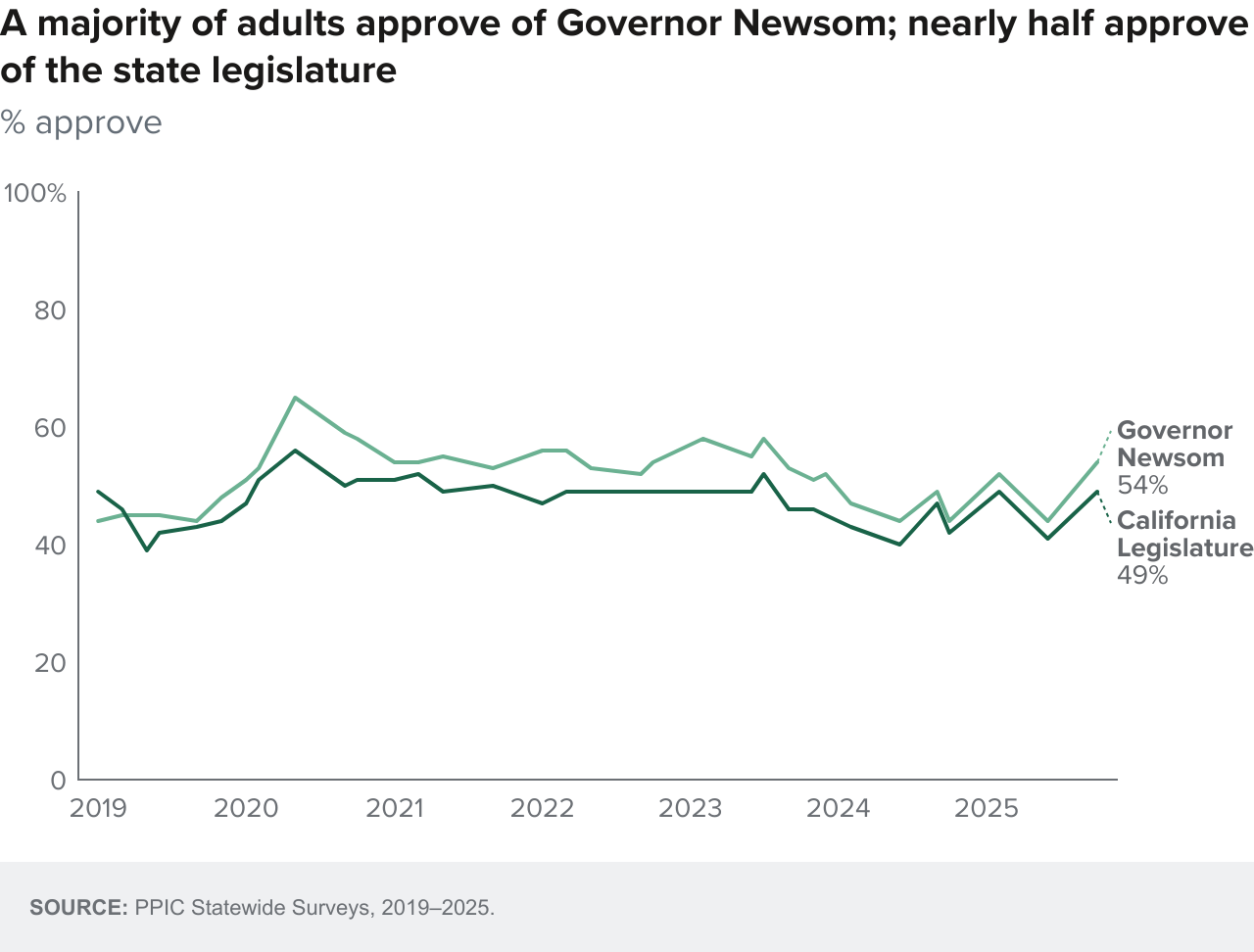
A majority of adults and likely voters (55%) approve of the way Gavin Newsom is handling his job as governor; this share among adults has fluctuated over the course of this year, rising again after falling to 44 percent in June. Today, over eight in ten Democrats approve, compared to a majority of independents and nine in ten Republicans who disapprove. Half or more across demographic and regional groups approve, with exceptions among Californians who are white (44%) or reside in the Central Valley (45%).
When it comes to the state legislature, 49 percent of adults and 52 percent of likely voters approve. The share of adults who approve has stayed below half since September 2023. Today, an overwhelming majority of Democrats (77%) approve, while most independents (54%) and Republicans (91%) disapprove. The share who approves varies across demographic and regional groups.
Three in four adults (75%) and likely voters (76%) expect that over the next 12 months, California will have bad times financially. This share has increased from a year ago (62% October 2024). Today, about two in three or more across partisan, demographic, and regional groups hold this pessimistic view.
Nearly half of California adults say the state is in an economic recession, including one in six who say it is a serious recession. The overall share saying the state is in a recession has decreased from the last time we asked this question (59% June 2023). Republicans today are more likely than Democrats and independents to say this, and Republicans are also much more likely than other partisans to say it is a serious recession. Majorities of lower-income residents say that California is in a serious or moderate recession.

Asked about how much they can trust the government in Sacramento to do what is right, a majority of adults (54%) and likely voters (52%) say they can trust it only some of the time; fewer than half of adults and likely voters feel they can trust the state government just about always or most of the time. A majority of adults have expressed distrust since the first time PPIC asked this question in 1999. Today, nine in ten Republicans and six in ten independents say only some of the time, while most Democrats express trust in the state government. Views across demographic and regional groups are mixed, and trust in the state government increases with rising education and income.
Solid majorities of adults (65%) and likely voters (64%) say the state government is pretty much run by a few big interests looking out for themselves; roughly a third or fewer say it is run for the benefit of all the people (32% adults, 34% likely voters). Most have said the state government is run by a few big interests since PPIC began asking this question in 1998. About nine in ten Californians say the state government wastes a lot (47% adults, 48% likely voters) or some (44% adults, 45% likely votes) of the money they pay in taxes.
When it comes to immigrants in the state, strong majorities of adults and likely voters say they are a benefit to California because of their hard work and job skills; three in ten or fewer say they are a burden because they use public services. The share of adults who say immigrants are a benefit is similar to findings from February. Today, partisans are divided on this issue, with overwhelming shares of Democrats and independents saying immigrants are a benefit to the state, while just three in ten Republicans say this. Six in ten or more across regions and demographic groups say this; these shares decline with increasing income and age.

Local Issues
Despite dreary views of both the state and US economy, most Californians are very (20%) or somewhat (54%) satisfied with their household financial situation, while about a quarter are not satisfied (26%). Satisfaction levels were similar about a year ago in September 2024 (18% very, 50% somewhat). Views today vary greatly by income. Nearly nine in ten (87%) of those earning over $100,000 express satisfaction, compared to a smaller share of those earning $40,000 to $100,000 (66%) and fewer than half of residents earning less than $40,000 (44%). Two in three or more across regions are satisfied with their household’s finances, with San Francisco Bay Area residents reporting the highest satisfaction. Asian Americans (80%) and whites (79%) are more likely to be satisfied than Latinos (69%) and African Americans (61%). Overwhelming shares across partisan groups are satisfied.
Still, about a third of Californians are worried that they or someone in their family will lose their job in the next year (18% very concerned, 17% somewhat concerned). This concern is more common in Los Angeles (43%) and the Inland Empire (41%) than in other regions of the state. The share worried about job security decreases as income increases (52% less than $40,000; 39% $40,000 to $99,999; 28% more than $100,000).
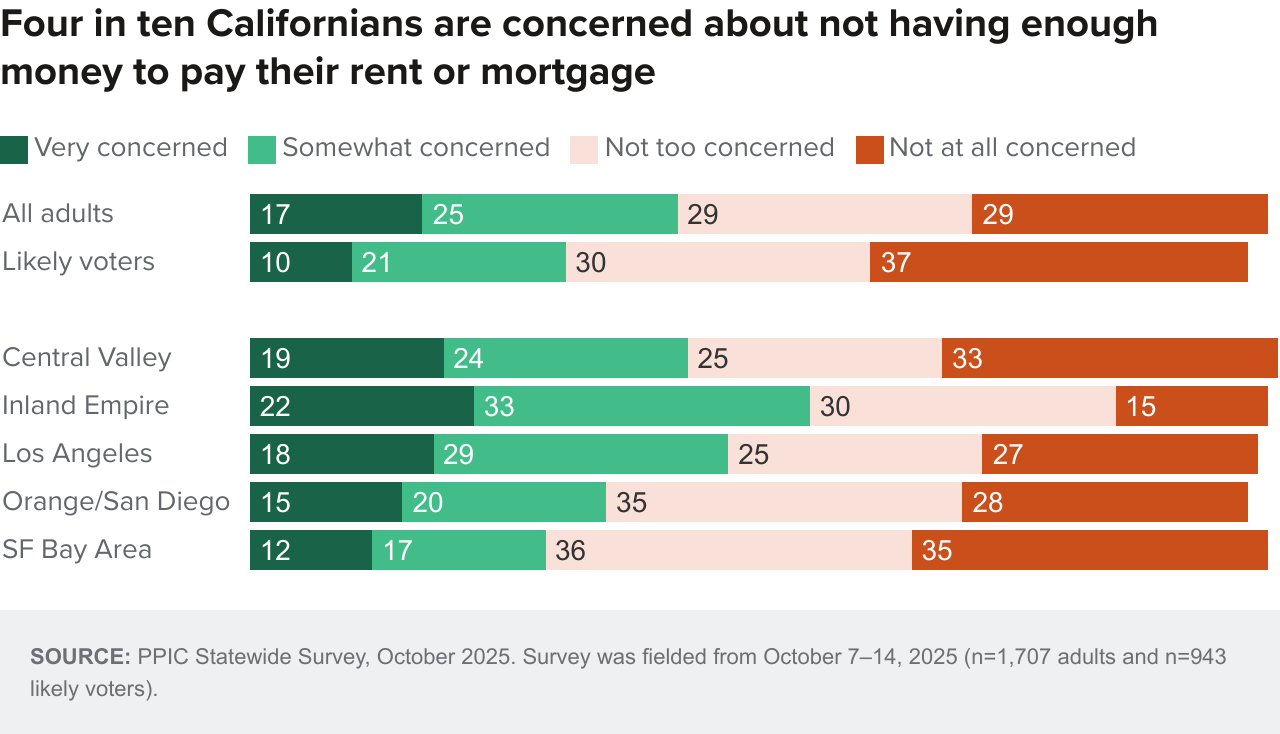
Moreover, about four in ten Californias are very (17%) or somewhat (25%) concerned about not having enough money to pay for their rent or mortgage. Renters (61%) are twice as likely to express this concern than homeowners (29%). A majority of Inland Empire residents and nearly half of Los Angeles residents are worried about paying for their housing, while this share is lowest among San Francisco Bay Area residents. Most residents earning less than $100,000 are concerned about this (78% less than $40,0000; 54% $40,000 to $99,999), compared to a much smaller share of those earning more than $100,000 (24%).
Turning to local issues, more than seven in ten Californians say they see someone experiencing homelessness daily (53%) or every few days (20%), while relatively few say they see a homeless person weekly (14%) or seldom (12%; 1% never). About half or more across parties and most demographic groups say they see a person experiencing homelessness daily. More than six in ten residing in the Central Valley (63%) and Los Angeles (62%) report this, compared to half in the Inland Empire and smaller shares in other regions (45% Orange County/San Deigo, 41% San Francisco Bay Area).
Californians are split on whether the presence of homeless people in their local community has increased (47%) or stayed the same (45%) in the last year. Few say it has decreased (7%). The share of Californians who perceived an increase was much higher in February 2023 (70%). Today, majorities in the Central Valley (56%), the Inland Empire (54%), and Los Angeles (52%) perceive an increase, while majorities in the San Francisco Bay Area (56%) and Orange County/San Diego (51%) say it is the same. Six in ten Republicans and about half of independents see an increase, while most Democrats see no change.
Seventy-eight percent of California adults say that they are very (37%) or somewhat (41%) concerned about the presence of homeless people in their local communities. The share of Californians who are very concerned has declined steadily and significantly since November 2019 (58% very concerned). Overwhelming shares across regions are concerned about homelessness in their local community, with four in ten in Los Angeles, the Central Valley, and the Inland Empire very concerned. Seven in ten or more across partisan and demographic groups are concerned.

About six in ten Californians say that violence/street crime and property crime in their local community is a problem, with about one in five saying each is a big problem. The share identifying both these types of crime has decreased significantly since February 2023 (violence/street crime: 76%, property crime: 74%). Today, perceptions of these crimes being a problem are higher among Republicans than other partisan groups. Central Valley residents are the most likely to view violence/street crime as a problem in their local community, while residents in Los Angeles are the most likely to view property crime as such. Orange/San Diego residents are the least likely to perceive both types of crime as problems.
About three in ten Californians think that both violence/street crime and property crime have increased in their local community in the last year, while about six in ten think crime rates have stayed the same and less than one in ten say there has been a decrease. Los Angeles residents are the most likely to say both types of crimes have increased (38% violence/street crime, 38% property crime). However, majorities across regions say both have stayed the same.
Regarding increased federal immigration enforcement, about half of Californians are worried a lot (22%) or some (27%) that someone they know could be deported, a slight increase since this February (20% a lot, 23% some). Today, six in ten Los Angeles residents (60%) have this worry, as do a majority in the Inland Empire (56%), compared to fewer than half in other major regions. About two in three Latinos (65%) are worried about deportation, including 37 percent who worry a lot. A majority of African Americans share this worry (54%), compared to about four in ten or fewer Asian Americans (40%) and whites (36%). An overwhelming share of noncitizens worry about this (55% a lot, 22% some).

Topics
2026 Election Political Landscape Population Statewide SurveyLearn More
Californians’ Concern about Homelessness Has Softened

Key Takeaways from the Proposition 50 Election

A Majority of Californians Distrust the State Government

Prop 50 Draws Record High Voter Interest, Approval of Congress Hits Record Low

Five Fast Facts on California Voters