Highlights
- Birth rates have shifted—dropping notably among younger women and rising only slightly among older women.
- All states have experienced declines in birth rates; California’s decline has been slightly larger than the national average.
- Lower birth rates could be positive, negative, or neutral for the state, depending on values and goals.
Birth rates in California today are at a historic low, marking a significant departure from the state’s history. Births have been an important source of population growth, especially as migration from California to other states has increased and international migration has slowed. To keep the population steady without adding residents through migration, California would need a fertility rate of 2.1 children per woman; the current rate is 1.48 (the US average is 1.6) down from 2.2 in 2008. Because the state is also aging, the California Department of Finance projects that deaths will exceed births by 2038.
How have California’s birth rates shifted with recent generations?
Like the rest of the country, California experienced a post-war baby boom, with the typical young family having three or more children. Families then shrank to fewer than two children in the 1970s, only to bump back up in the 1980s and 1990s due largely to immigration from Latin America.
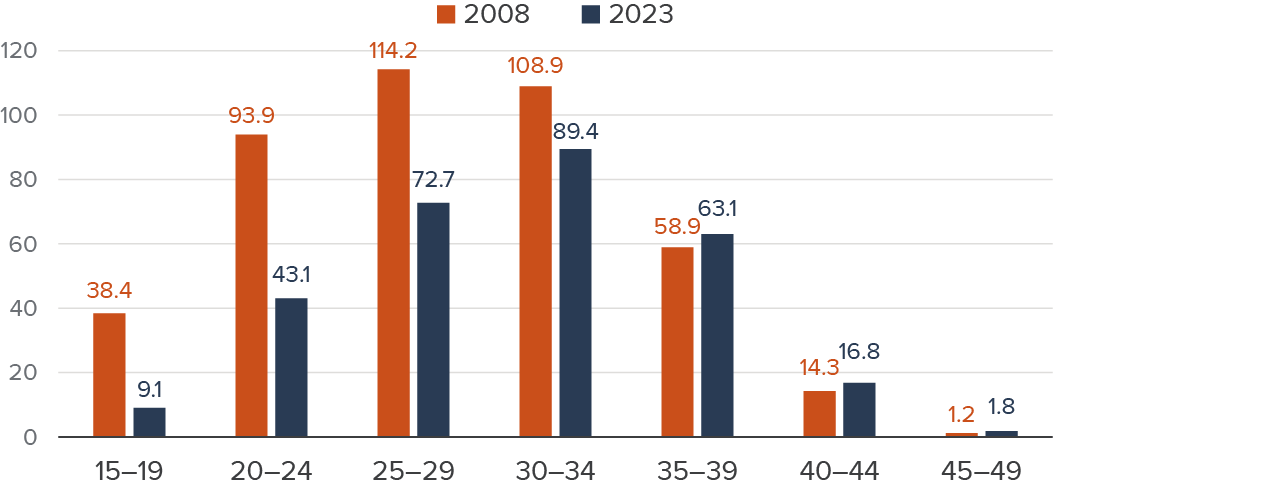
Between 2008 to 2022, birth rates fell about 50 percent among women in their early 20s, from 94 births per 1,000 women to 44. The teen birth rate plummeted by 74 percent, from 38 births per 1,000 women to 9, a major win for public health because early births disrupted schooling and led to financial stress.
In this same period, birth rates fell less dramatically among women in their early 30s—this group is now more likely than women in their late 20s to give birth, a reversal from 14 years ago. And among women 35 and older, birth rates rose about 7 percent. This increase is not enough to offset the decrease among younger groups. To reach the previous level of 2.1 children per woman, birth rates for women in their late 30s and 40s would have to increase over 50 percent in the next five years, an unlikely occurrence. Over the longer run, wider availability of fertility treatments like in-vitro fertilization could help women start families later in life, but that option still faces many obstacles.
Birth rates have dropped notably among younger women and increased slightly among older women
Age-specific birth rates
SOURCE: Author’s calculations based on National Center for Health Statistics data.
NOTE: Chart shows births per 1,000 women in each age group.
Research points to household economics and social norms as factors that may be influencing the trends: cost of living keeps inching up, people stay in school to boost their earning potential, and they marry later. By pursuing a degree, California women can often bolster their household incomes, which may mean delaying a family. Today, the high cost of childcare is a growing concern for families with children.
What are the advantages and disadvantages of lower birth rates?
On the one hand, a smaller population could reduce demand on the state’s housing market, allowing a higher share of people to buy a home or find affordable rent; the state may be able to direct more dollars to each public school student, and even reach its climate goals. On the other hand, a smaller population means PK–12 enrollment declines that could close some schools, and fewer workers to pay into programs that support aging Californians. Further, if California’s population growth continues to lag behind other states, California would lose congressional representation.
Family-friendly and public health policies may help families thrive. The social welfare policies available in many developed countries provide extended time off with pay for families to care for newborns and school-age children, and policies include state-funded, quality childcare. Scandinavian countries have been at the forefront of such policies, but while their fertility rates are higher than in most of Europe, they are still below the rate to maintain the same population size. The primary goal of these policies is to improve family well-being rather than increase the population.
California policymakers need to plan for a future with slow population growth. To help manage the challenges of a smaller workforce supporting an aging population, the state could consider adopting policies that increase immigration, delay retirement, and improve the productivity of young workers—such as through education and training.
By embracing a nuanced understanding of demographic change, California can chart a course toward a future that honors individual choices, supports family well-being, and ensures the continued vitality and innovation that have long been the state’s hallmarks.
Topics
Health & Safety Net Immigrants in California K–12 Education Population